
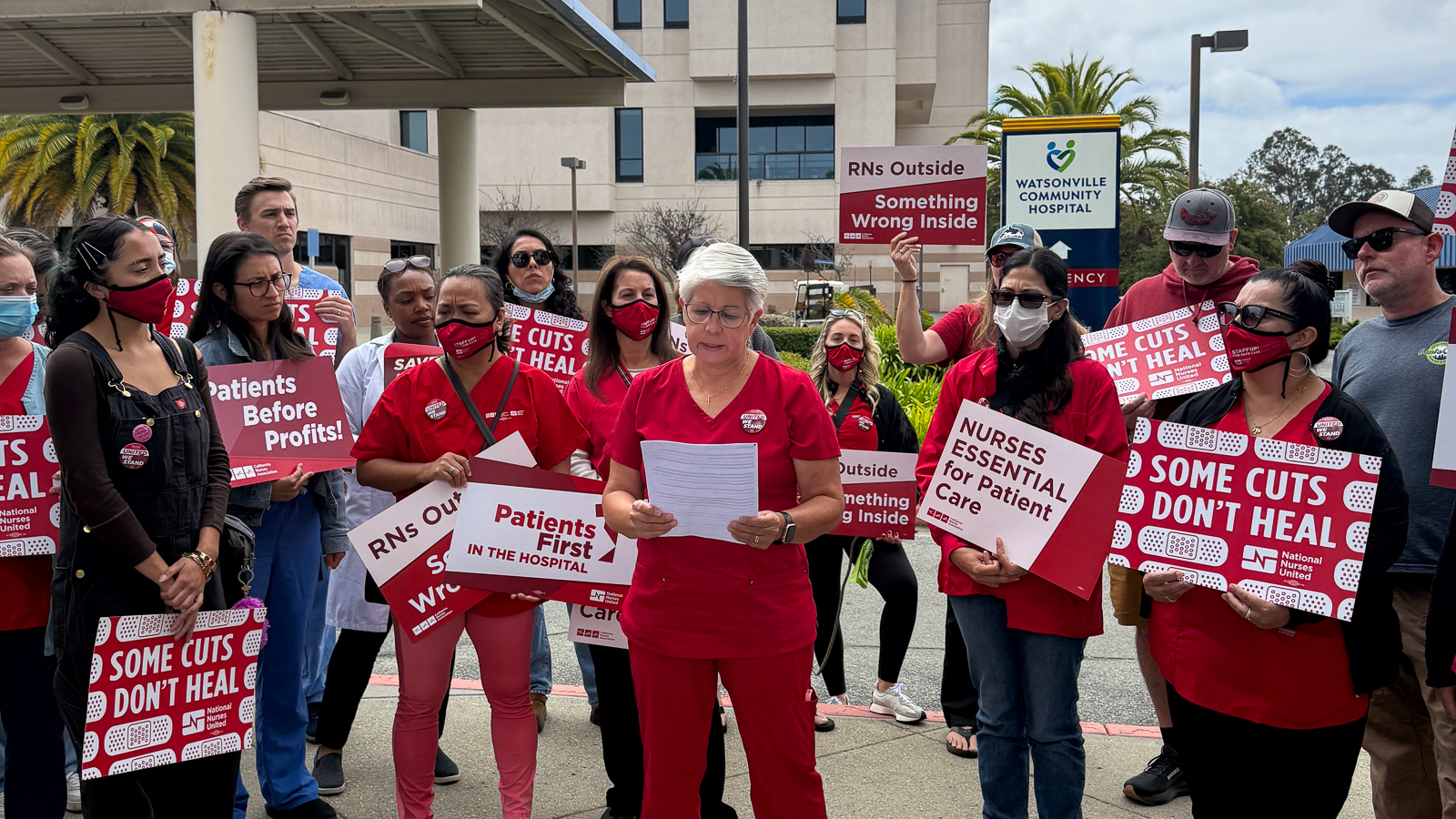
Sandra Morioka speaks at an informational picket organized by the nurses union at Watsonville Community Hospital on Aug. 31. (Erika Zaro — Santa Cruz Local)
WATSONVILLE >> Dozens of nurses rallied outside Watsonville Community Hospital on Monday afternoon demanding hospital administrators reopen the hospital’s intensive care nursery.
The closure, which hospital leaders said would be temporary, began on July 10 amid a shortage of nurses to staff the nursery, also known as the neonatal intensive care unit, or NICU. The closure caught hospital staff by surprise, and no public notice was issued by hospital higher-ups.
Since the closure, babies that need intensive care are stabilized and then transferred to a nearby hospital, sometimes separating a newborn from a recovering mother, potentially adding barriers for parents who lack reliable transportation to visit the child or who don’t speak English and can’t advocate for their family’s needs.
As of now, the nursery has no expected reopening date, but Tim Moran, the hospital’s interim CEO, shared that they’re onboarding four or five new neonatal nurses.
“The staffing problem is not something the hospital planned for,” said Moran. “I will not reopen the unit until I know we can do it safely.”
The hospital’s adult ICU nearly closed amid a shortage of night shift nurses in January.
According to Moran, staffing shortages in the NICU were due to many nurses being called in to meet staffing needs in the labor and delivery department, taking them away from their jobs in the nursery.
When asked by Santa Cruz Local why there wasn’t a press release about the closure to notify the Watsonville community, Moran stated that all doctors and “players involved” were notified and would then share that information with their patients.
“If you’re not pregnant, or a man, it’s probably not something you’d worry about in terms of a press release,” said Moran. “What we wanted to be sure we did was connect with the physicians that were involved in the patient’s care. That’s why we did it the way we did.”
The NICU’s staffing problems impact more than delivering mothers and their babies, said one nurse at Monday’s rally.
“When the neonatal intensive care unit is short-staffed, those of us in the intensive care unit have had to step in that role,” said Hope Ogaga, a nurse at Watsonville Hospital who has worked at the hospital’s ICU for the past five years. “You should have your NICU staff be the ones who are there to help take care of these babies.”
Teresa Mack, California Nurses Association labor representative, suggested the NICU’s closure had to do with its profitability.
“They wanted to close the labor [ward] or they wanted to close the NICU, because they said it wasn’t profitable, ” said Mack. “You ask any mother how profitable is their newborn child to them.”
Moran, the CEO, called the allegation “nonsense.”
Watsonville’s intensive care nursery operated as a Level II NICU, meaning it typically took care of babies born after 32 weeks, who were moderately ill, or who needed oxygen therapy or feeding support. Without Watsonville’s intensive care nursery operating, other local NICUs are absorbing the additional newborns.
The nursery at Watsonville has admitted about two babies per day for the past year, according to Tony Nuñez, board president of the Pajaro Valley Health Care District, the agency that operates the hospital.
Watsonville Hospital currently leads the county in births, at 30%, followed by Dominican Hospital at 29%, according to a Santa Cruz County Public Health birth report from 2024. Despite NICU admissions seeing a decrease in Santa Cruz County since 2019, the need for them is still there.
“The importance of our NICU extends beyond the walls of our hospital,” said Sandra Morioka during Monday’s rally, a nurse who has been at Watsonville Hospital for the past 35 years. “It provides a critical safety net for the surrounding community.”

The Pajaro Valley Health Care District board of directors meets on March 25. The hospital faces ongoing financial troubles. (Amaya Edwards — Santa Cruz Local/CatchLight Local file)
A mother and baby stay together
One local doula who has been working for a non-profit doula service for about two years described a best-case scenario for a baby that needed intensive care.
The doula, who is undocumented and requested anonymity over fear of immigration enforcement, has accompanied clients for about a dozen births at Watsonville Hospital. A doula provides physical, emotional and logistical support, but does not have formal obstetric training.
In early July, just before the NICU closed, the doula supported a first-time mother giving birth at Watsonville Hospital. The mother was in labor for three days and at one point during the delivery, the baby stopped breathing. The infant had to be taken for monitoring and separated from its mother — in this case, it needed a more advanced level of care than Watsonville’s NICU was equipped for.
Luckily, the mother was transferred to the same nearby hospital as the baby — though the doula said that was rare.
“It was like a miraculous case where it had a good ending, but not all moms will get this,” she said.
In most cases, when a patient — adult or infant — needs care not available at Watsonville Hospital, the patient will be stabilized and transferred to a neighboring hospital, such as Dominican Hospital in Santa Cruz or Natividad Medical Center in Salinas. These “treat and transfer” agreements are set in place and not changed by the NICU’s temporary closure, said Nuñez.
Changes at one hospital affect the entire health care ecosystem, said Nora Yerena, founder of Central Coast Doula Services, a Watsonville-based program offering Santa Cruz County mothers labor support.
“It’s a ripple effect,” Yerena said. “It doesn’t matter your demographic.”
Watsonville Hospital has struggled with staff retention and mounting facility maintenance costs, in part a legacy of underinvestment by its prior for-profit owners. Financial challenges for the hospital were exacerbated last year by federal cuts to Medicaid and Medicare, and state cuts to Medi-Cal.
Watsonville Hospital and many rural hospitals across the country are being hit hardest by the cuts as they have a greater share of patients with Medicaid or Medicare.
“This is just the beginning of how things are going to be; it’s not just us, it’s going to be everywhere,” said Morioka, one of the nurses in the rally. “But if Watsonville can fight for this, then maybe other communities could do the same.”
¿Tienes alguna pregunta o comentario? Envía un correo electrónico a [email protected]. Santa Cruz Local cuenta con el apoyo de sus miembros, principales donantes, patrocinadores y subvenciones para el funcionamiento general de nuestra redacción. Nuestras decisiones editoriales se toman de forma independiente y no se basan en el apoyo de los donantes. Obtenga más información sobre Santa Cruz Local y cómo nos financiamos.

Born and raised in San Mateo, Erika spent many summers driving over Highway 17 to visit Santa Cruz with her grandfather, parents, and older brother. Over the years, she developed a deep appreciation for the town and its community, and knew that one day, she wanted to write about it.
As Santa Cruz Local’s government accountability reporter, Erika brings detailed, accountability-driven reporting to the people of Santa Cruz County. Her work focuses on dissecting major government decisions, tracking the promises of elected officials, housing and more.
Erika earned her bachelor’s degree in journalism from Loyola Marymount University in Los Angeles and her master’s degree in journalism from the University of California, Berkeley Graduate School of Journalism in 2025.Before joining Santa Cruz Local, she spent two years reporting at UC Berkeley’s Investigative Reporting Program. Her capstone project was on a child welfare facility that involved 100+ public records and 50+ interviews.
In her free time, Erika enjoys finding the perfect matcha latte, spending time with her family and hanging at the beach.