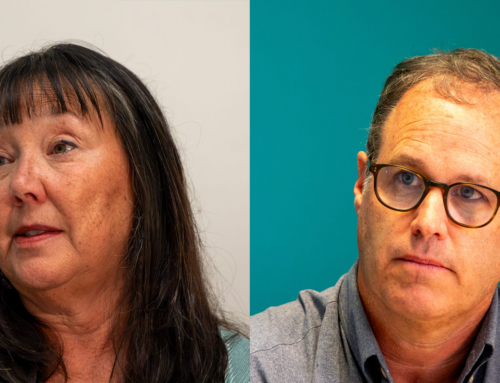
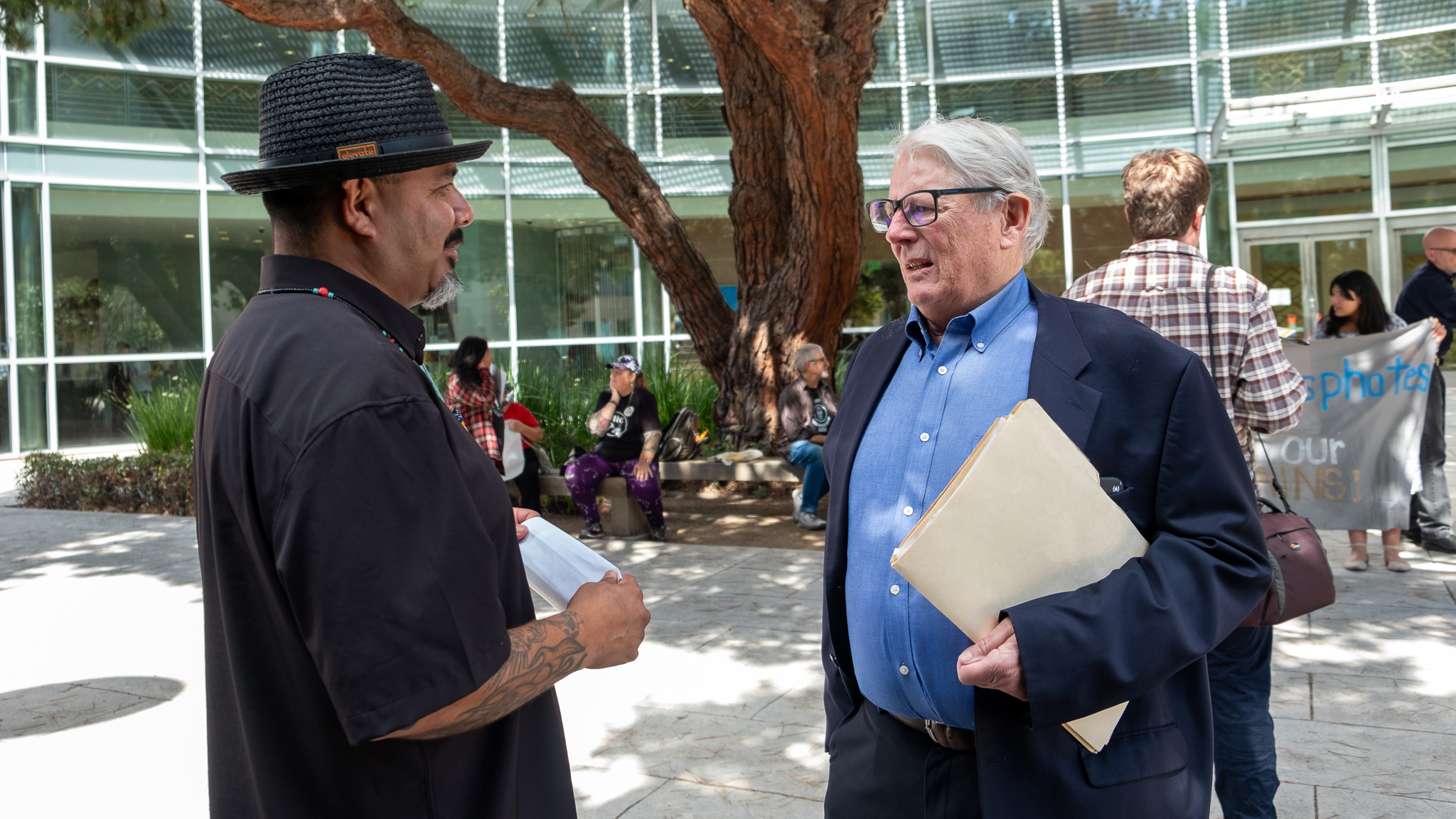
Former California Senator Bill Monning, who represented parts of Santa Cruz and Monterey counties in the 17th District from 2012 to 2020, considers Prop 50 a “pragmatic” response to “unique and troubled times.” Monning at a pesticides rally, Sept. 2025. (Nik Altenberg — Santa Cruz Local file)
SANTA CRUZ >> Political leaders and representatives in Santa Cruz County are overwhelmingly in support of Proposition 50, a redistricting measure on the Nov. 4 ballot that will determine how Californians will be represented in Congress.
The proposition, which triggered a statewide special election, is aimed at countering Republican efforts in other states to redraw maps and secure more Republican seats ahead of the 2026 midterm elections.
California voters will decide whether to let lawmakers temporarily take over the process of drawing the state’s congressional districts — a responsibility currently held by an independent, nonpartisan commission — with the intention of redistricting to secure five more Democratic seats in the U.S. House of Representatives.
Local leaders said democracy is at stake with Prop 50 and failing to pass the measure could harm county residents by maintaining a Republican-led Congress that would further pursue cuts to health care, food assistance programs and the broader social safety net.
A “yes” vote would give the power to redistrict to the California legislature through 2030. A “no” vote would keep the power to redistrict with an independent, nonpartisan commission.
What is Proposition 50?
In August, California Gov. Gavin Newsom introduced the legislation in response to Texas’s Republican-controlled legislature redrawing its congressional districts earlier this year to add five GOP-leaning seats ahead of next year’s midterms.
President Donald Trump encouraged the partisan gerrymander to protect Republicans’ narrow majority in the House of Representatives. Normally, redistricting wouldn’t happen until after the next census in 2030.
https://platform.twitter.com/widgets.jsReporter: Are you calling for a complete redraw of the Texas congressional map?
— Acyn (@Acyn) July 15, 2025
Trump: No, just a very simple redraw—we pick up five seats. A couple of other states where we will pick up seats also. pic.twitter.com/H2vDiB0ndE
Newsom’s proposal could flip five of the nine California districts currently held by Republicans. The new lines would incorporate some urban voters into more rural districts, making the districts more favorable to Democrats and potentially flipping Republican-held seats in the northeast, east, Central Valley, Inland Empire and San Diego.
Democrats currently hold 43 of the state’s 52 seats in the House.
Voters in 2008 and 2010 transferred the redistricting powers from the legislature to the independent California Citizens Redistricting Commission. Proposition 50 would temporarily return that power to lawmakers until after the 2030 elections.
How would the new lines affect Santa Cruz County?
Santa Cruz County spans two congressional districts — 18 and 19.
Under Prop 50, District 19, which includes most of the county and is represented by Rep. Jimmy Panetta, D-Santa Cruz, would remain unchanged. District 18, represented by Rep. Zoe Lofgren, D-San José, would see minor adjustments and add a portion of the Central Valley to its district.
Both Panetta and Lofgren publicly support Proposition 50, as do all three state Assemblymembers who represent parts of Santa Cruz County: Gail Pellerin, D-Santa Cruz, Robert Rivas, D-Hollister, and Dawn Addis, D-Morro Bay.
A county spokesperson confirmed the measure will not affect the county budget, as the state is covering costs for the special election.
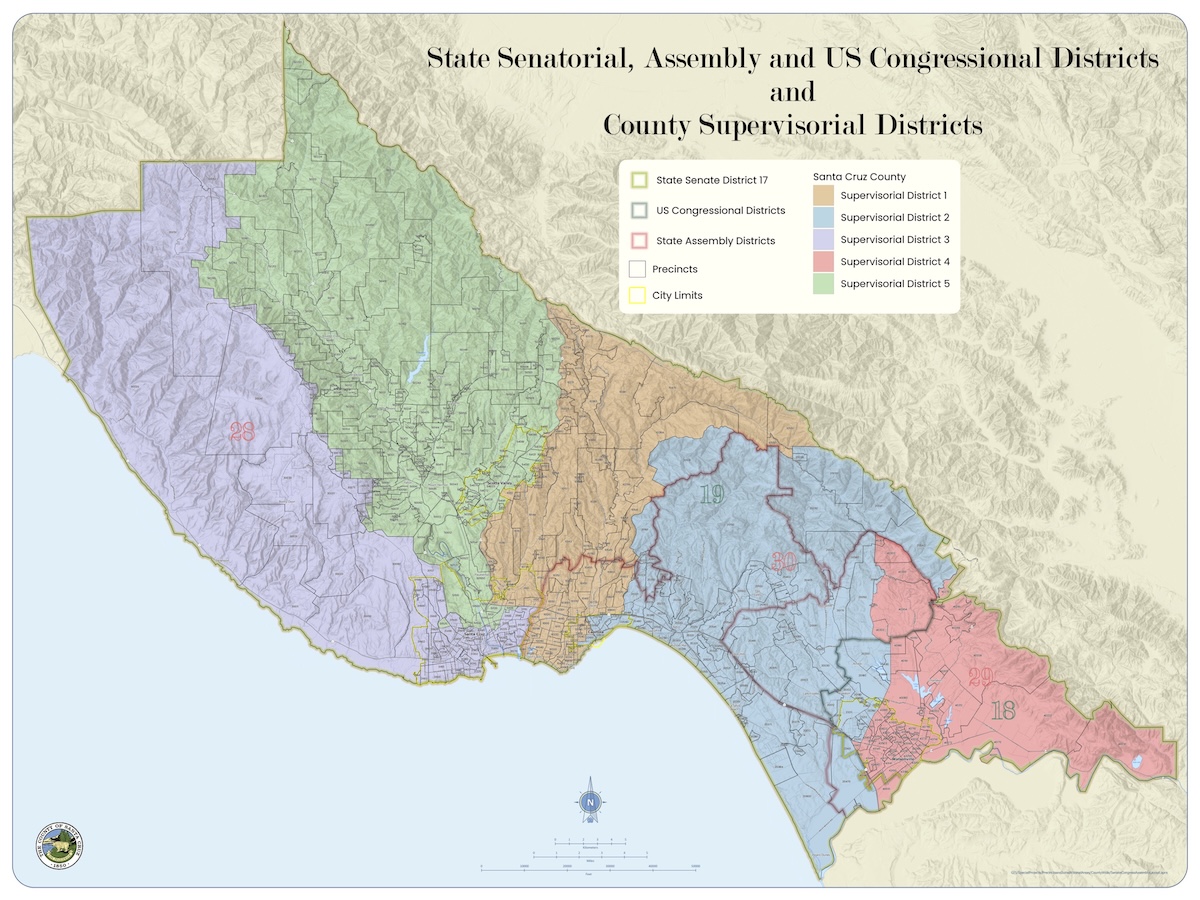
Santa Cruz County spans two congressional districts — 18 and 19. (Santa Cruz County Geographic Information Services)
What local leaders are saying
Santa Cruz Mayor Fred Keeley called Trump’s aggressive redistricting efforts “a serious threat to our democracy.”
“It perpetuates the terrible notion that elected officials should select their voters, rather than voters selecting their representatives,” Keeley said.
Keeley, despite helping establish California’s independent redistricting system, said he supports a temporary suspension of the commission’s authority to counteract redistricting in Texas.
Former State Senator and Assemblymember Bill Monning, who represented Santa Cruz County, said he supported California’s independent redistricting commission, but considers Prop 50 a “pragmatic” response to “unique and troubled times.”
“For those who stay allegiant to a notion of an independent redistricting commission, I think that’s a narrow vision,” Monning said. “What happens at the federal level has a direct impact on us — none of our counties are insulated from attacks on Social Security, Medicare, Medicaid and the health care exchange.”
Monning warned that as federal subsidies for health coverage expire in November, Republicans’ stance could cause rates to double or triple next year. The current federal government shutdown is largely over Democrats’ refusal to approve a budget until the health insurance subsidies are extended.
According to a recent county report, more than 21,000 Santa Cruz County residents could lose Medi-Cal coverage by 2028 because of cuts included in the July budget bill that passed on strictly partisan lines.
Assemblymember Addis, whose district includes Capitola, Live Oak, Aptos and La Selva Beach, also voiced support for the measure. She said it’s essential to preserving fair representation and minority voices as other states attempt to tilt the balance of power.
“California leads the nation in free and fair elections,” Addis said. “While states like Texas strip away the voices of everyday Americans, Prop 50 gives that power back.”
Assemblymember Pellerin said she supports Prop 50 to “protect democracy.”
“If Donald Trump and the MAGA machine are able to steal unchecked power for two more years, they’ll have free rein to keep up their harmful policies and authoritarian power grabs,” Pellerin said.
State Sen. John Laird, D-Santa Cruz, served on the Senate’s redistricting working group. He said California’s approach to redistricting differs sharply from Texas, as the process is being done publicly and includes a set timeline for returning redistricting power to the independent commission.
Laird noted that while the measure wouldn’t significantly change Santa Cruz County’s districts, national decisions — from Medicaid funding to climate policy — still have direct impacts on local communities.
“I believe in the commission system, but this is a crisis in our democracy where cities are being occupied, health care is being cut. The only thing that will get us back on track is the midterm elections next year, and with the President trying to steal seats in Texas and other states, California just needs to respond,” Laird said.
Keeley agreed, saying action from California is necessary.
“Larger anti-democratic forces are at work throughout the country, and Californians should push back,” Keeley said.
What local opposition is saying
Santa Cruz County Republican Party Chairman Mike Lelieur believes Proposition 50 undermines the independent redistricting process and unconstitutionally groups districts by race.
According to Lelieur, the measure would make the system less fair, noting that Texas should also establish an independent commission as California has. Lelieur said Republicans are already underrepresented in the state — despite earning nearly 40% of the vote in the 2024 presidential election, and that they hold relatively fewer seats in the state legislature.
“(Drawing district lines) needs to be in the hands of the people, not politicians. They’re saying that this is temporary, and it shouldn’t even be temporary. It should not happen,” Lelieur said.
He said local voters, including Democrats, have expressed concern that the measure is too extreme.
“A lot of Democrats are calling me asking for ‘No on 50’ signs because they think it goes too far,” Lelieur said. “You see the commercials on TV, and they’re making it all about Trump. It’s just propaganda.”
Lelieur said he expects a close vote but hopes Californians will “do things the right way” and preserve the current system.
Peter Verbica, a Republican candidate for Congress in District 19, called Prop 50 an “attempt to gerrymander past the will of California voters.”
He dismissed comparisons to Texas’s redistricting process, arguing that Texas operates under its existing legislative authority without temporary constitutional changes.
He also expressed skepticism that the measure would truly be temporary.
“Middle class Californians want a return to smaller government, personal accountability and safe neighborhoods,” Verbica said. “Are they interested in a Frankenstein gerrymandering act? Not in the least.”
A federal court is weighing whether the new Texas congressional map amounts to racial gerrymandering that discriminates against minority voters. Meanwhile, Missouri has followed Texas’s lead in drawing new districts, and several other states — both Republican- and Democrat-led — are considering gerrymandering their states before the midterms elections.
Read Santa Cruz Local’s Election Guide
Questions or comments? Email [email protected]. Santa Cruz Local is supported by members, major donors, sponsors and grants for the general support of our newsroom. Our news judgments are made independently and not on the basis of donor support. Learn more about Santa Cruz Local and how we are funded.

Evan Quarnstrom holds a degree in International Business from San Diego State University. He grew up in midtown Santa Cruz.