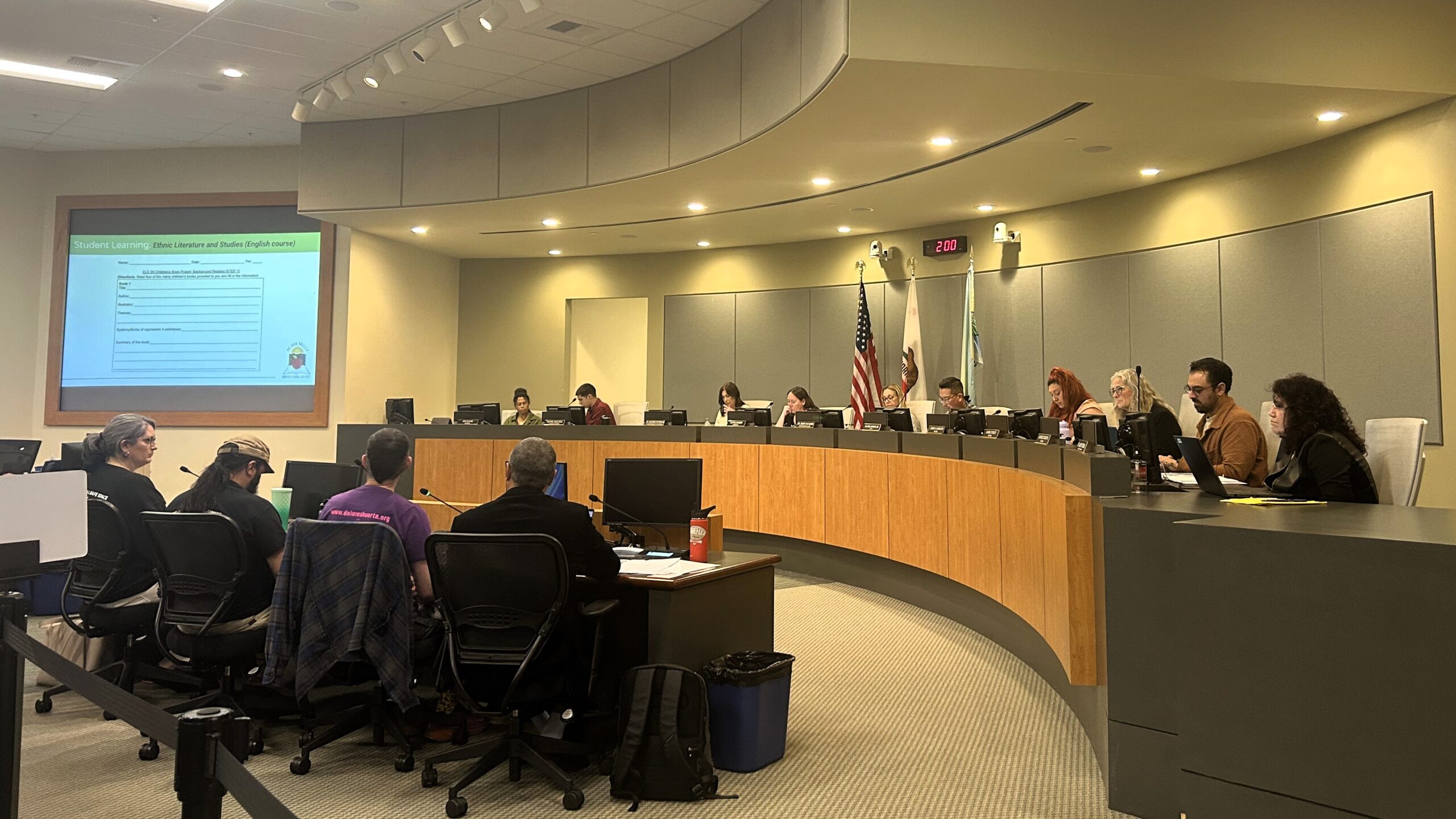
A Pajaro Valley Unified School District board meeting in March. (Shaanth Nanguneri — Santa Cruz Local file)
PAJARO VALLEY >> Pajaro Valley Unified School District has blown past deadlines to complete a required financial audit, and now has until Sept. 15 to submit the report to the state — or potentially face consequences.
The district blames staff shortages and turnover as reasons for the ongoing delays to submit the audit that was due Dec. 15. The state Controller’s Office — the entity responsible for accountability and disbursement of the state’s financial resources — granted the district an extension to June 30. After the district again failed to submit the report by that date, they re-extended the deadline to Sept. 15.
The staffing issues come amid a shrinking budget, declining enrollment and a state report that cited deficiencies in the district’s human resources. Pajaro Valley Unified is the largest school district in the county, and serves about 17,000 students across 35 schools.
There are 2,268 local education agencies in California and Pajaro Valley Unified was one of 50 with a “delinquent” audit as of Aug. 15.
Bismarck Obando, press secretary for the State Controller’s Office, said audit reports are essential for transparency and accountability in school districts, and vital to maintaining credibility and trust with constituents.
“These audits serve as an important tool for stakeholders to ensure there’s compliance with laws and regulations and taxpayer dollars are being used for its intended purpose,” said Obando.
District Superintendent Heather Contreras attributes the delayed report to staffing issues because “the district was without a director of fiscal services and the prior chief business officer was not able to have that task completed.”
The former chief business officer announced her resignation in March after public outcry over a proposal to cut 100 full-time equivalent positions to address a budget gap of about $20 million. The Pajaro Valley school board partially rejected that proposal, setting the district up for more deficit spending and potentially more severe cuts next school year, Contreras told Santa Cruz Local in February.
Contreras said she expects the audit to be completed before the extended deadline on Sept. 15. If it is delayed more than 14 days beyond the deadline, the County Office of Education could “withhold payments of any stipends, expenses, or salaries to the district superintendent, county superintendent or members of the governing boards,” according to the state Controller’s Office.
An April report from a state oversight agency found deficiencies in district leadership, frequent turnover in key positions, low staff morale, an inaccurate bookkeeping system and poor department communication.
The report, requested by the district in 2023, revealed that the bookkeeping system created inaccuracies in the budget for salaries and benefits. At the time of the report, it had still not been fixed.
The report also stated that staff are not properly trained on the financial system and that management has yelled at staff for not completing processes correctly.
“They don’t treat their employees with respect and dignity,” said Brandon Diniz, president of the district’s teachers’ union. “You have people who will come to this district, maybe last a year or two, then they get burned out and accept work elsewhere.”
Diniz said the district’s claim that a high cost of living has caused staff turnover is not entirely true. He said that the district’s last chief business officer did not leave for a more affordable region, but instead transferred to nearby Live Oak.
“We should have had a chief business officer and chief financial officer, but we haven’t had someone in that [financial officer] position for, I want to say, two years,” Diniz said. “The chief business officer was basically doing two jobs.”
Deficit spending
Beyond late audit and turnover, Pajaro Valley faces deficit spending that is expected to further drain reserves.
The Santa Cruz County Office of Education’s analysis showed that the district is projected to meet its financial obligations through the 2026-27 school year. However, they warn of the district’s current trend of deficit spending, which this year is projected to surpass the state standard of one-third of the district’s available unrestricted reserve.
The district’s projected unrestricted fund balance — flexible money the district can use for most purposes — is projected as follows:
- 2024-25: A $55.5 million unrestricted fund balance with $4.5 million in deficit spending is within state standards.
- 2025-26: A $45.1 million unrestricted fund balance with $10.4 million of deficit spending is expected to exceed state standards.
- 2026-27: A $35.4 million unrestricted fund balance with $9.7 million of deficit spending is expected to exceed state standards.
The report indicates a $60 million drop in revenue this year compared to last, mostly due to the exhaustion of one-time pandemic-era funding. Most of the decline, $21.4 million, came from federal revenues.
The district has not posted the adopted budgets on its website since 2022, which makes it more difficult for the public to stay informed about its finances.
Bond delays
Without the audit report, the district is unable to issue bonds passed in November’s election with Measure M.
Voters approved $315 million in bonds for Pajaro Valley’s school facilities, potential teacher housing and expanded technology programs. The money cannot be used on teacher or staff salaries.
The measure calls for the bonds to be repaid by a tax of $60 per $100,000 of assessed property value annually for roughly 30 years.
Contreras said issuing Measure M bonds has not yet been necessary because $8 million remains in the district’s building fund.
“Community members would needlessly be paying interest while the [Measure M bond] funds are waiting to be used for projects,” Contreras said.
Contreras expects the first set of Measure M bonds to be issued in November.
Questions or comments? Email [email protected]. Santa Cruz Local is supported by members, major donors, sponsors and grants for the general support of our newsroom. Our news judgments are made independently and not on the basis of donor support. Learn more about Santa Cruz Local and how we are funded.

Evan Quarnstrom holds a degree in International Business from San Diego State University. He grew up in midtown Santa Cruz.