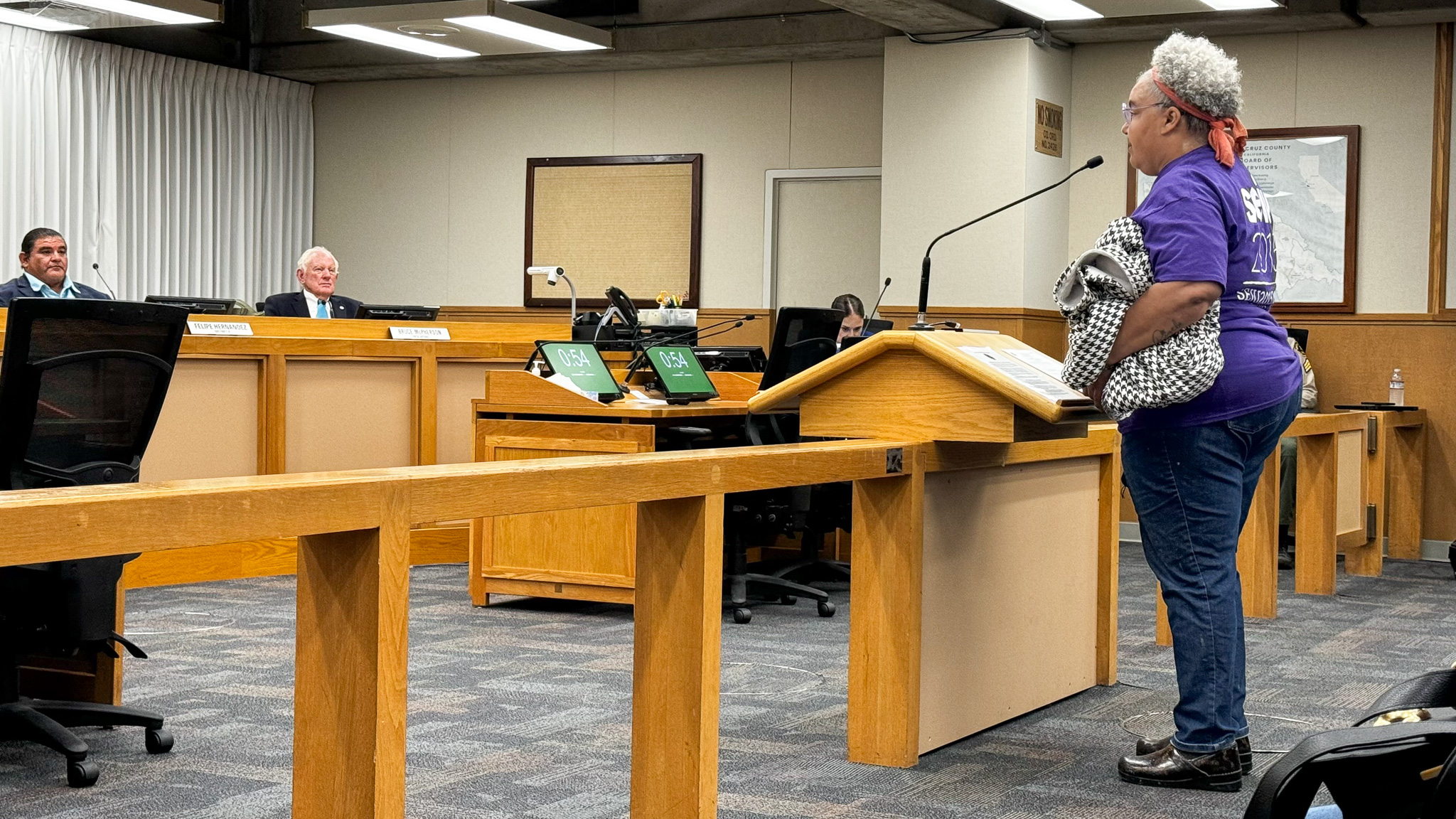
The financial fallout from President Donald Trump Administration’s July budget bill set to take effect over the next three years, and could cost Santa Cruz County $30 million annually by 2028. A speaker from IHSS Public Authority Advisory Commission at the Board of Supervisors meeting on Aug. 13, 2024. (Nik Altenberg — Santa Cruz Local)
SANTA CRUZ >> Widespread fallout from President Donald Trump Administration’s July budget bill and trimmed spending at the state level is expected to result in major disruptions to the social safety net in Santa Cruz County.
The looming cuts are like “a tsunami, where an earthquake has hit thousands of miles away, but the wave isn’t coming for another day and a half, so there are people still playing on the beach,” said Supervisor Monica Martinez at Tuesday’s Board of Supervisors meeting. “Our community doesn’t quite yet know the magnitude of what’s happening.”
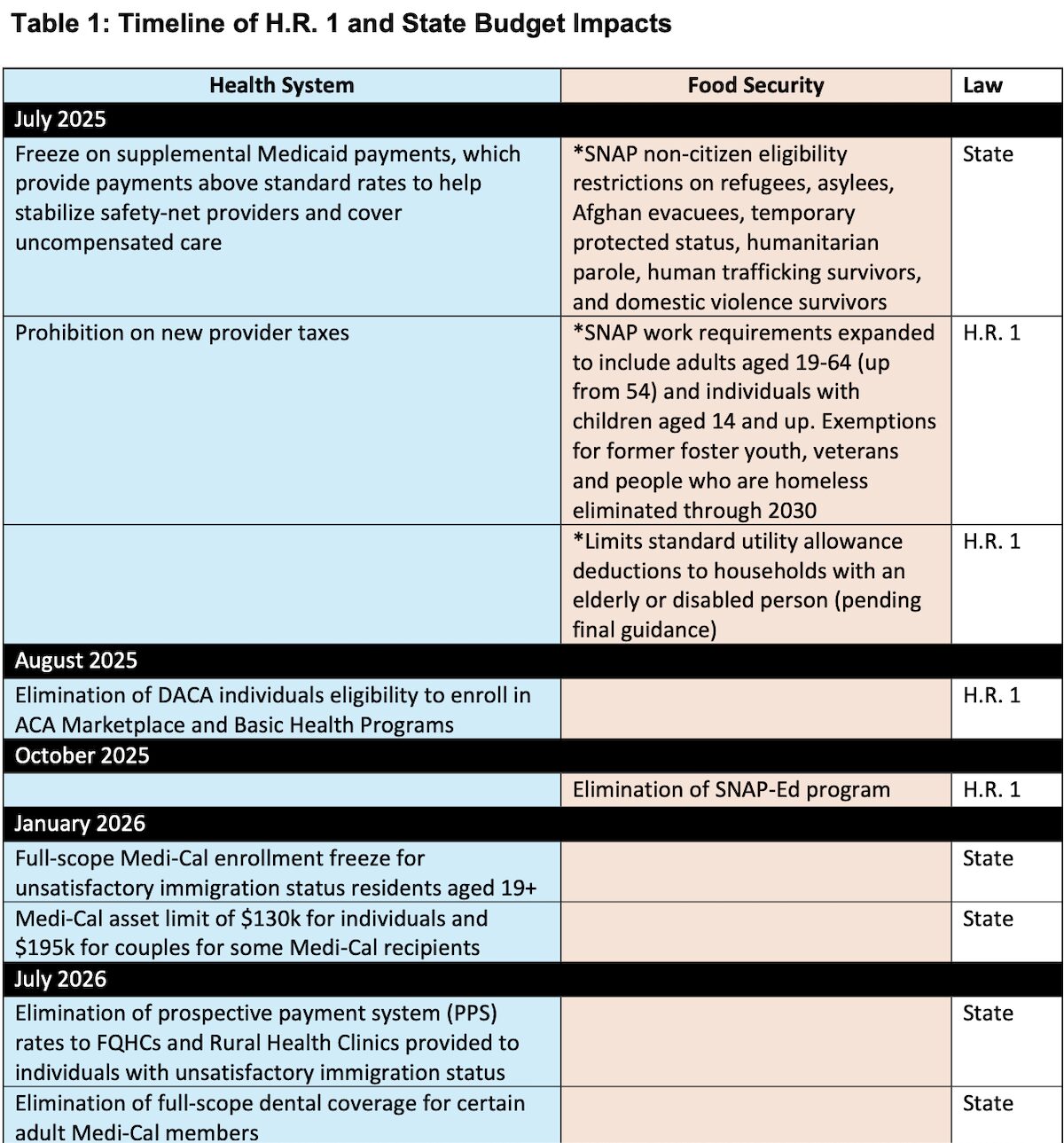
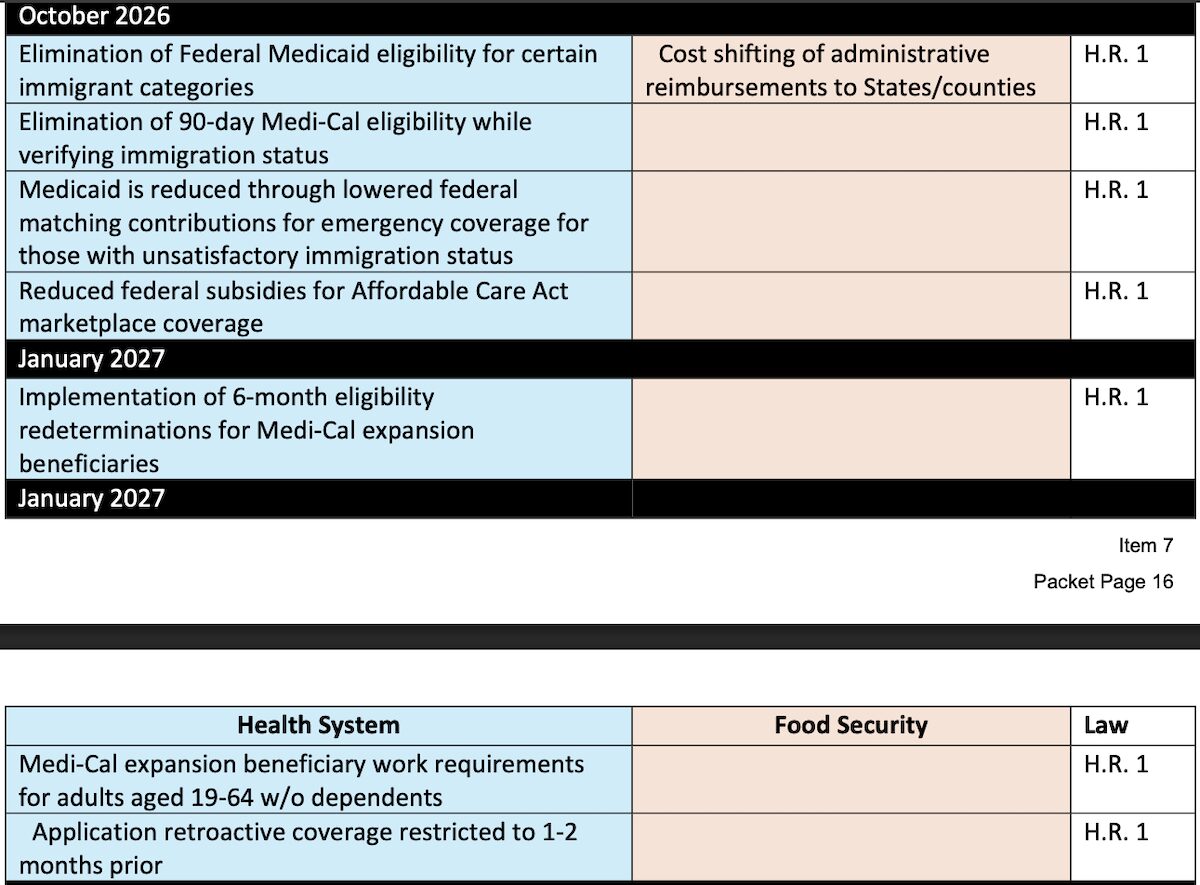
Between new work requirements in the federal budget bill and California budget cuts for unauthorized immigrants, more than 21,000 Santa Cruz County residents could lose Medi-Cal coverage by 2028, according to a report presented by county staff last week. Medi-Cal is a state version of Medicaid, the federal safety-net health insurance for people with the lowest incomes.
County residents that make too much to qualify for Medi-Cal, but receive a subsidy through Covered California, could see insurance premiums double. Households that make more than 400% of the federal poverty level — $60,240 for a single person in 2025 — are set to lose the subsidy altogether by October 2026, according to the report.
At least 7,000 county residents could also see monthly payments from SNAP, formerly called food stamps, either reduced or eliminated.
Federal and state cuts
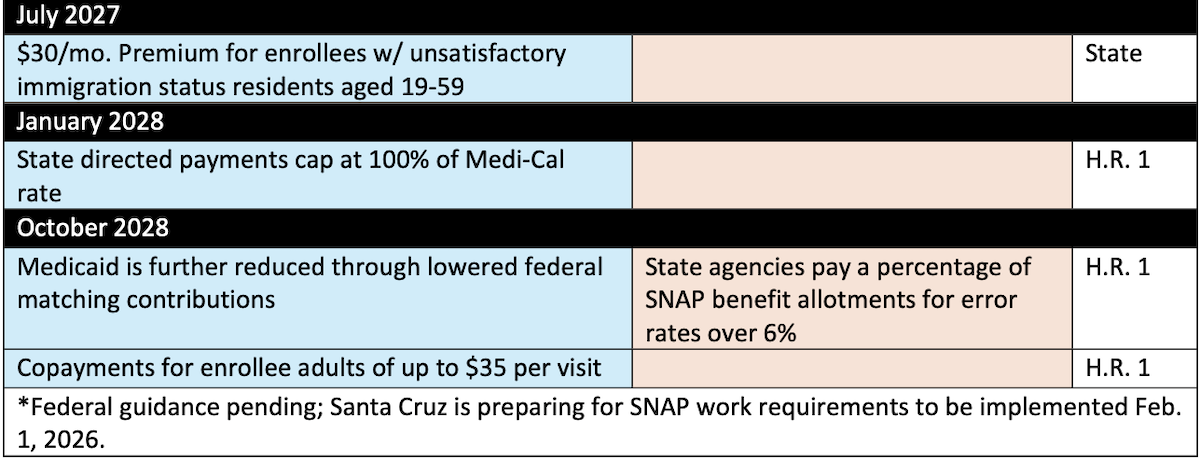
The federal and state budget cuts, set to take effect over the next three years, could cost the county $30 million annually by 2028. Work requirements and more frequent eligibility tests will increase administrative work for SNAP and Medi-Cal and the report estimated the county will need to hire 17 additional staff, a cost of about $4 million each year. As thousands of residents lose health insurance coverage, revenue in county clinics is expected to decrease.
County supervisors reviewed the report at a Sept. 30 meeting, and directed county departments to continue coordinating across departments and with community partners and advocating with state and federal representatives to preserve safety net programs. A followup report is expected in December.
The report outlined a phased implementation of the changes over a three-year period beginning in July 2025. “These cuts and changes are over multiple years, so that the pain keeps growing and deepening,” said Assistant County Executive Officer Elissa Benson, who delivered the report.
She said the multitude of programs facing cuts all involved “fundamental things human beings need to live — health care and food.” Leaders from multiple service providers testified about the cuts’ wide-ranging impacts on vulnerable populations.
Leeann Luna, CEO of Monarch Services, a domestic violence shelter operator and service provider, said the cuts to food benefits could lead to domestic abuse survivors “having to choose between buying food or paying rent.”
“People are not going to get the care that they need in order to be at work, at school and everywhere else,” said Tony Nunez, a spokesman for local nonprofit Community Bridges.
Danielle Solick, human services director of Santa Cruz Community Health, said chronic food insecurity can cause instability and cause people to not make it to appointments.
“You’re not showing up to preventative care appointments. You’re probably not even showing up to your regular health care appointments,” she said.
“This is really our first deep dive into understanding the immediate and upcoming, operational, fiscal and human impacts of HR1 and the state budget actions,” Benson said.
Impacts of the cuts
Fiscal impacts to the county could increase the deficit by $30 million due to an expected rise in coverage of indigent care and increased administrative burdens over the next three years if left unaddressed, according to the report. Federally required increased oversight of the program alone would require an additional $4 million in staffing costs, and county staff expect a $10 million shortfall in 2026 due to Medi-Cal immigrant restrictions by the state.
Federally Qualified Health Centers (FQHCs) such as county clinics in Santa Cruz and Watsonville, Santa Cruz Community Health Centers and Salud Para La Gente are required to provide health care regardless of ability to pay. Benson said the increase in likely uninsured individuals seeking care would lead to increased financial exposure of the county.
“I’m just wondering why we aren’t taking some steps now to rein in our budget – Is there a reason that we’re waiting?” asked county supervisor Kim De Serpa. She said she was expecting cost-saving recommendations in advance of the cuts.
“I don’t think there’s any answers at this point,” said Morris. “I think the board needs to look at all of our spending in the mid-year and start prioritizing” spending cuts and looking at options to raise revenue.
Additionally, Morris said recent layoffs at relevant federal departments increased uncertainty at the state level around implementing the new rules. This in turn adds uncertainty at the county level, challenging budgetary and medical services planning.
“When I go to my state meetings, we say, well, what’s the next step? ‘We are waiting for guidance from the federal government,’” he said.
Benson ended the staff report by underlining the “major institutional norms breaking” as a result of the federal budget bill, but offered some optimism about the increased collaboration happening locally.
“You have partners here – you have staff here that are ready for this challenge, and we will get through it together. So here we go,” she said.
Questions or comments? Email [email protected]. Santa Cruz Local is supported by members, major donors, sponsors and grants for the general support of our newsroom. Our news judgments are made independently and not on the basis of donor support. Learn more about Santa Cruz Local and how we are funded.

Tyler Maldonado holds a degree in English from the University of California, Berkeley. He writes about housing, homelessness and the environment. He lives in Santa Cruz County.