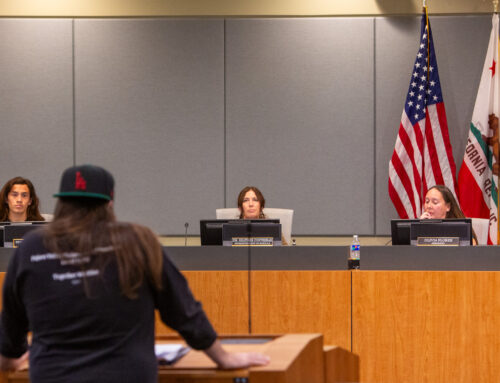

Felton Fire leaders have proposed a charge on property owners to maintain an independent district. (Amaya Edwards —Santa Cruz Local/CatchLight Local)
FELTON >> Property owners in Felton Fire Protection District are considering a new annual charge that could help the embattled district secure a future with paid fire staff. The district has faced years of mounting pension debt, decreasing volunteers and a rotation of chiefs, leaving residents uncertain about its future.
Supporters — including Felton Fire leaders — say the proposed property assessment would be the most cost-effective option, and would provide the best response to 911 calls. But detractors question whether the proposed $1.7 million income boost is truly needed.
If the assessment fails, Felton Fire could dissolve or try again to pass a different tax or assessment. Felton Fire leaders said that without a cash infusion, the district could run out of money to pay staff and volunteers by 2028.
Key Takeaways
- Property owners can turn in mail-in ballots until July 24. Owners who would pay more get a bigger say.
- If the tax isn’t approved, Felton Fire leaders could propose another way to raise money, or ask another agency to take over.
- It’s unclear if other agencies would be willing to absorb Felton Fire, or how much residents would pay.
- Volunteer-driven response is currently meeting the community’s need, but is unsustainable, Felton Fire leaders said.
- Regardless of the vote outcome, emergency service will continue.
What is the assessment, and how do I vote?
The property assessment is proposed under state Proposition 218, which differs from elections for parcel taxes and bonds. Only property owners can vote, and each vote is weighted according to the amount they would pay — essentially, those who would pay more get a bigger say. The assessment requires 50% approval of the weighted ballots.
Ballots were mailed out in late May and must be returned by July 24. They may be submitted:
- By mail, using a pre-paid envelope included with the ballot. Send to 131 Kirby St., Felton, CA 95018.
- In person by July 24 at the Felton Fire district office at 131 Kirby St. in Felton.
- In person at a public hearing for the assessment, 6 p.m. July 24.
Voters who want to change their vote or request a replacement ballot can call 831-335-4422.
Property owners who believe the assessment doesn’t comply with the California Constitution have until July 6 to submit a written objection. If the assessment is approved, it may only be challenged in court by those who have submitted a constitutional objection.
Who would pay, and how much?
The assessment must also be priced according to how much each property owner would benefit from the improved service. The assessments have been priced according to property use, property value, fire hazard and distance to the station.
Each ballot includes the amount of the property’s proposed assessment. A typical single-family home would be assessed $697.43 annually. The assessment can increase up to 3% a year to match inflation. A citizen panel would annually review Felton Fire’s finances and assessment spending.
All properties are legally required to pay the tax. But though homeowners could face a lien for non-payment, churches, nonprofits, or government buildings like schools would not.
What would the assessment pay for?
Felton Fire collects about $1.1 million annually through property taxes. The new tax would increase the district’s revenue to $2.8 million.
The district has long relied on volunteer firefighters. Until 2024, it also had a part-time administrator, a full-time chief and up to two full-time firefighters and two full-time captains. But the district can no longer afford the full-time employees, said Interim Chief Issac Blum, and is currently staffed entirely by volunteers.
Volunteers receive a $120 stipend for a 12-hour shift. Blum receives up to a $2,500 stipend each month, though some months he has opted not to take it, he said. Blum said he usually works at the station four days a week, in addition to a full-time paid position at NASA Ames research center near Mountain View.
Blum said he intends to vacate his volunteer position at the end of the summer. The board is interviewing six candidates for the role, one of whom is set to receive a job offer after the assessment vote. If the board offered him the role, “I would have to think very hard about it,” he said. “What we want to ensure the next fire chief is the best person for the job.”
About $1.6 million of the expanded $2.8 million budget would go to training and salaries, including health care and retirement:
- A full-time chief and for $166,000 to $193,000 base pay.
- Three fire captains.
- Six firefighters. The staffing plan also accounts for two on-call volunteer firefighters.
The Proposition 218 assessment must be linked to the cost of a specific benefit to property owners. In this case, Felton Fire leaders say, the money would allow the re-hiring of three full-time firefighters and a full-time chief, ensuring faster response times and more firefighters responding. It would also pay for training and equipment.
District leaders previously considered a $700 parcel tax before pursuing the assessment.
What happens if the tax doesn’t pass?
If property owners reject the proposed assessment, the station will not immediately close, and 911 calls will still be answered. The station’s reserves are expected to be mostly depleted by an agreement underway to exit California’s CalPERS pension system, a move to make future hires less costly.
The reserves have enough money to also cover a $400,000 shortfall in this year’s budget and staff the station for one year with a slightly larger paid staff — a chief, two fire captains and an administrative assistant.
Without an assessment, the station may not have enough money to continue to maintain that staffing after 2028, Blum said.
If the assessment fails, Felton Fire leaders could propose a lower assessment, or renew efforts for a parcel tax. Director Erica Schwanbeck said she is unsure if she would propose another revenue measure or move towards dissolving.
“I would hope that there’s a through road there” to continue without dissolution, “but I don’t know for how long.” she said.
Could another agency absorb Felton Fire?
If Felton Fire leaders are unable to find a sustainable way to provide emergency response, they could ask another fire agency to absorb the district. But no district would be obligated to take on Felton Fire’s coverage area.
A 2025 report from the Local Area Formation Commission of Santa Cruz County included a dozen possibilities for Felton Fire’s future. The report’s four top-ranked options are to be absorbed by another fire agency.
One of those agencies is County Service Area 48, also known as Santa Cruz County Fire. The agency is part of the county government, though leaders have discussed becoming an independent fire district. CSA 48 has two existing assessments, which total about $367 for a typical single-family home. But if CSA 48 takes over Felton Fire, it could decide that the existing assessments won’t be enough to provide service to Felton residents, and propose an increase.
CSA 48 is in the process of absorbing Pajaro Valley Fire Protection District, which opted to dissolve after years of unsuccessful tax proposals. Pajaro Valley Fire Chief Dave Martone said the move is a win for residents, who will now have more robust emergency service. Martone did not take a position on the Felton assessment.
Former interim Aptos/La Selva Fire Chief Don Jarvis, a Pajaro Valley Fire District resident and past consultant for LAFCO, presented the South County dissolution as a cautionary tale for Felton Fire residents. Single-family homeowners will pay more to CSA 48 than what Pajaro Valley Fire proposed as an assessment. It’s unclear how much CSA 48 would charge Felton property owners if it absorbed the area. A county spokesperson declined to comment on whether CSA 48 would be willing to absorb Felton Fire, or how much it would charge.
The neighboring Zayante Fire Protection District could also offer to absorb Felton Fire. Zayante Fire Chief Jeff Maxwell said that neither he nor Zayante Fire’s board of directors have taken a position on the tax or the possibility of taking on Felton Fire’s service area, and that said Felton Fire leaders have not reached out to discuss the issue.
Blum said Zayante’s staffing model wouldn’t work for Felton Fire long-term. Zayante, which takes on fewer calls than Felton Fire, employs two daytime fire fighters and relies on volunteers at night. Like CSA 48, Zayante Fire leaders could decide they need to raise taxes to take on the expanded service, he said.
“Maybe we could tread water for a few years, but the reality is that it still does not provide a long-term solution for the Felton community,” Blum said.
Ultimately, Felton Fire residents will not have a firm idea of how much a takeover would cost until the district signals an intent to dissolve.
LAFCO Executive Officer Joe Serrano had encouraged directors last year to start the dissolution process at the same time they pursued a new assessment, to create a “Plan B” in case it fails. That would have triggered a process for LAFCO to consult with neighboring fire agencies and create a report on the possible cost and viability of being absorbed by another agency. The directors opted not to start that process, leaving the other options unclear.
“It’s a little misleading to say that there’s other options out there,” Serrano said. “There are, but there’s no analysis, there’s no commitment, there’s nothing.”
Does Felton Fire need 24-hour paid staff?
Supporters of the assessment say that it assures an industry-standard three-person response to emergencies — and it makes a four-person response, with the assistance of a chief or volunteer, more likely.
Labor protection laws stipulate that with fewer than four people, fire fighters can enter a burning building only for search and rescue. With four people, two can enter to fight the fire from within while two stand outside.
Felton Fire has 25 volunteer fire fighters, including 21 with enough training to respond to calls, Blum said, but only three live in Felton. The rest may not be available on short notice.
Blum attributes the difficulty of recruiting local volunteers to the increasing gentrification of the San Lorenzo Valley with more commuters to Silicon Valley. Within a decade, “you’re going to see this transition all the way through the valley,” he said.
Maxwell, the Zayante Fire chief, said his agency has had success hiring daytime staff while relying on local volunteers for nighttime coverage. “I think it takes strong leadership to create an environment that is welcoming for those members of the community,” he said. “It’s absolutely not easy.”
Serrano said the fact that other agencies have survived on a smaller budget thus far doesn’t mean the model is sustainable long term.
“If you lose your legacy fire chief and you have to hire someone new, you know, they may not want to take a pay cut like the current fire chief is taking,” he said. “You can easily compare somebody, but at the end of the day, Felton Fire is struggling with its current model, and it’s looking for ways to address that.”
If voters approve the assessment but later push to reduce paid staffing, fees could be lowered with the vote of three board members.
Questions or comments? Email [email protected]. Santa Cruz Local is supported by members, major donors, sponsors and grants for the general support of our newsroom. Our news judgments are made independently and not on the basis of donor support. Learn more about Santa Cruz Local and how we are funded.

Jesse Kathan is a staff reporter for Santa Cruz Local. They hold a master's degree in science communications from UC Santa Cruz.