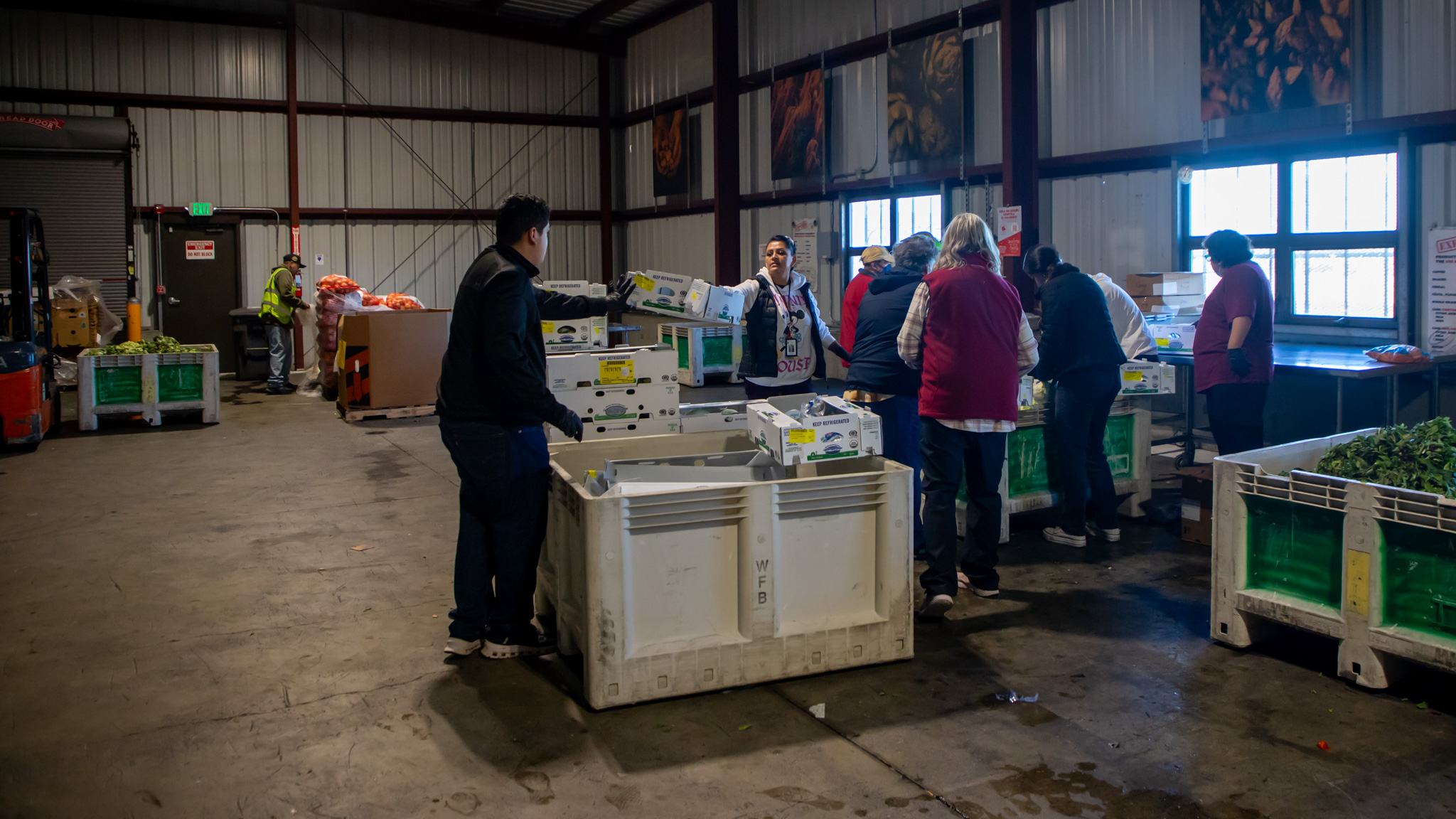
People volunteer at the Second Harvest Food Bank warehouse in Watsonville on Thursday, Oct. 30, 2025. (Amaya Edwards — Santa Cruz Local/CatchLight Local)
SANTA CRUZ >> As the federal government shutdown rages on with no apparent end date, and food assistance payments failed to go out on Nov. 1, millions across the country are left wondering when funds may be allocated.
On Thursday, a federal judge directed President Donald Trump and his administration to continue funding the food benefits program — called SNAP, or Supplemental Nutrition Assistance Program — by Friday so states can distribute $1.1 billion in benefits to the 42 million low-income Americans enrolled.
However, the Justice Department appealed the order, adding further uncertainty to the program’s fate, which became unfunded as a result of the shutdown that began on Oct. 1.
Some counties in California as of Friday reported that families are beginning to see their full SNAP benefits restored on their EBT cards, following two lawsuits filed by a coalition of states, according to a Nov. 6 press release by Gov. Gavin Newsom’s office. It remains unclear whether all Californians enrolled in the program will see funds from Nov. 1 – 7 restored to their cards.
At the local level, Santa Cruz County officials say they are still awaiting guidance from the state on when funds may arrive, how much might be allocated and whether any conditions to the distributions will be attached. More than 30,000 county residents, representing 20,000 households, receive $6 million in monthly CalFresh benefits, the California SNAP distributor.
“(We don’t) have direction from the state on what that means for beneficiaries, when those funds might be available, whether beneficiaries will eventually be made whole for the month, or what the plan is for December if the shutdown persists,” said Jason Hoppin, Public Information Officer of Santa Cruz County.
Before Thursday’s ruling, the Trump Administration had proposed partially restoring benefits — first suggesting a 50% cut, then revising that to 35% after outside analysis showed the proposal would have left nearly five million people with no payment. Two federal judges then ruled that the administration is legally bound to use all their contingency funds and disperse payments in full.
While awaiting direction from the state and federal government, Santa Cruz County announced Nov. 4 that local agencies and community organizations have committed more than $1 million to support food distribution efforts by the local non-profit Second Harvest Food Bank. Santa Cruz County, the County Office of Education, the cities of Watsonville and Santa Cruz and Community Foundation Santa Cruz County have all contributed. The county also declared a state of emergency, due to disruptions in CalFresh benefits.
Second Harvest is preparing to serve 100,000 people in November, up from 73,000 in September. CEO Erica Padilla-Chavez says demand during the first week without federal benefits has been as high as expected, with some distribution sites seeing increases of up to 100%.
“We are seeing a steady flow of traffic here at the food bank with people coming to our administrative offices/warehouse for food support,” Padilla-Chavez said. “We are providing all individuals with food and educating them on our partner distribution map so that they can continue to access Second Harvest food through our partner pantries.”
Questions or comments? Email [email protected]. Santa Cruz Local is supported by members, major donors, sponsors and grants for the general support of our newsroom. Our news judgments are made independently and not on the basis of donor support. Learn more about Santa Cruz Local and how we are funded.

Evan Quarnstrom holds a degree in International Business from San Diego State University. He grew up in midtown Santa Cruz.