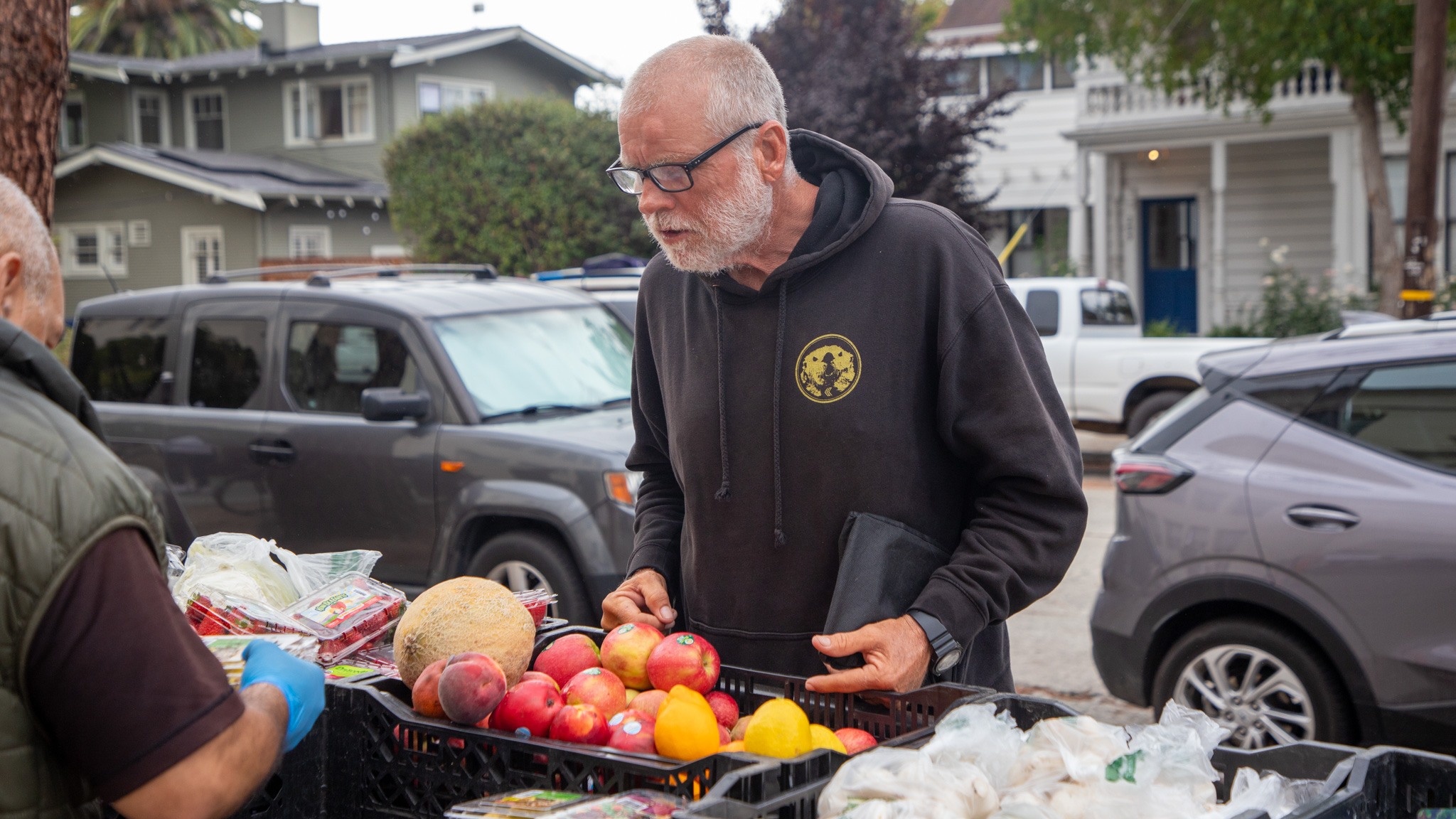
Ed Thorp picks his groceries during a weekly food pantry at Holy Cross Church in Santa Cruz on Wednesday. (Amaya Edwards — Santa Cruz Local/CatchLight Local)
SANTA CRUZ >> Home aid worker Tai Miller, 60, took on a new client this week. Miller, a City of Santa Cruz resident, normally works about 15 hours a week, cleaning and cooking for her disabled clients. By the end of the week, her arthritic hands and knees ache.
With those hours, Miller can cover her rent and basic needs. But her razor-thin budget hinges on about $290 per month from CalFresh, California’s version of the federal Supplemental Nutrition Assistance Program. Formerly called food stamps, SNAP helps low-income Americans buy groceries.
Starting next year, Miller’s normal workload won’t meet new eligibility requirements for the program.
To qualify, most CalFresh recipients must work, volunteer or be in training at least 80 hours a month. Currently, people 55 and older are exempt from that requirement. Next year, the exemption will be narrowed to those 65 and older.
When Miller learned of the change earlier this month, “I immediately started trying to find a way to squeeze in a few more hours,” she said. She now works 21 hours a week, enough to meet the coming requirements of 80 hours a month. But if she loses clients in the future, or if her arthritis worsens and she is forced to work less, she could lose her benefits. That, she said, would be “pretty dire.”
Following federal cuts to SNAP, Miller is one of thousands of Santa Cruz County residents who will face these new work requirements. While Miller said she expects to meet the requirements, not everyone will.
Earlier this year Santa Cruz County’s largest food bank lost about $1 million of food and money due to federal budget cuts. Now, Second Harvest Food Bank Santa Cruz County is bracing for a surge in demand.
New CalFresh requirements
Starting next year, some people now exempt from CalFresh work requirements will be required to document at least 80 hours of work, volunteering or training each month, or lose their benefits. They include:
- Adults 55-64.
- Parents whose youngest child is 14 to 17.
- Veterans.
- People experiencing homelessness.
- Former foster youth.
People with disabilities, adults with children under 14 in their household, and seniors 65 and older will remain exempt.
Certain non-citizens, including most people granted asylum, will no longer be eligible for food assistance. Most unauthorized immigrants are ineligible and will remain so.
Santa Cruz County likely won’t implement the new requirements until February, said Adam Spickler, senior analyst for the county’s Human Services Department.
About 36,000 people in Santa Cruz County receive CalFresh. It’s unclear how many will lose it. Around 5,400 residents face new work requirements, with many likely already meeting them, Spickler said.
Andy King, who lives in a tent near Highway 9 and receives about $260 from CalFresh each month, is skeptical that the new requirements will be enforced. But if they are, “it’s going to be rough,” he said. The only times he has found a job is when he hasn’t been upfront about his past felonies for burglary and destruction of property.
“It’s usually two months, six months for them to figure it out,” he said. His last offense was nine years ago, he said.
Both King and Miller lean on free food distributions to supplement their CalFresh money. If they lose their benefits, they’ll have to lean even harder.
Food pantries brace for surge in demand
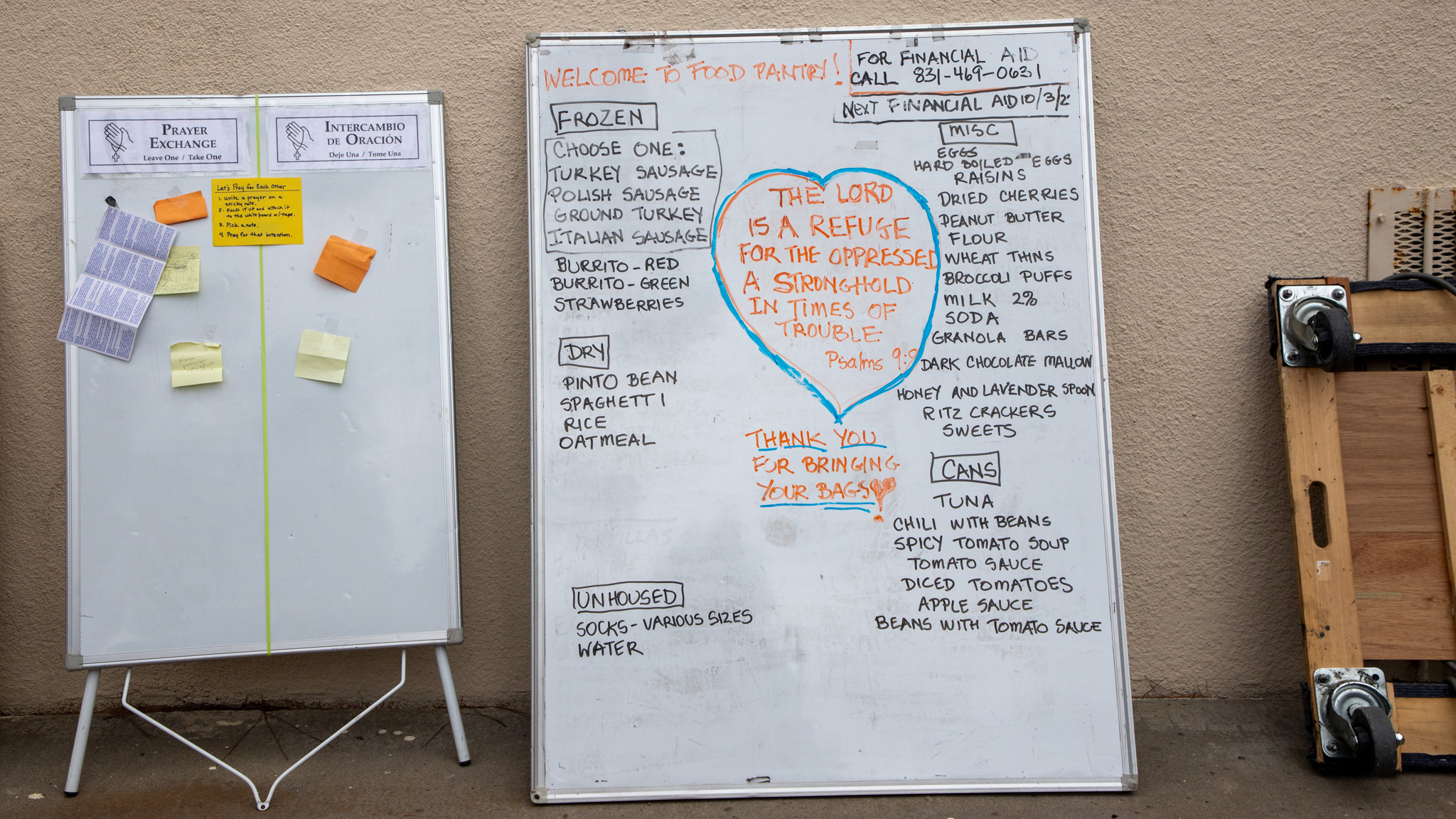
Holy Cross Catholic Church hosts a weekly food pantry. About 45 volunteers help distribute about 20,000 meals monthly, said Philip Hodsdon, co-managing director of the food pantry. (Amaya Edwards — Santa Cruz Local/CatchLight Local)
One in three Santa Cruz County residents are at risk of food insecurity, according to a UC Santa Cruz analysis of food assistance from July 2019 to June 2020.
Of the 30 million meals provided by food assistance programs in the county during that period, 42% were from CalFresh and 32% from Second Harvest Food Bank and its partners, the analysis found. The remainder were from other federally-funded programs and from schools.
Second Harvest locally supplies dozens of food distributions, soup kitchens and other programs.
In March, federal budget cuts axed Biden-era programs for food banks, withdrawing a promise to Second Harvest for truckloads of food from the U.S. Department of Agriculture, including meat and cheese that is otherwise hard to source. It also cut a program to buy from local farmers. Combined, the cuts total close to $1 million. Second Harvest spends about $20 million annually on food, according to recent audits.
The expected USDA food was mostly meat and eggs, and Second Harvest has for months been distributing far less protein than usual, said Adriana Mata, Second Harvest’s chief community impact officer.
G, a handyman who has lived in Santa Cruz for 27 years, relies on the pantry to feed his family. As an unauthorized immigrant, he asked that his full name not be used.
Because of his immigration status, G is ineligible for CalFresh. He has been visiting Holy Cross Food Pantry in the city of Santa Cruz since 2020. Parishioners of the Holy Cross Catholic Church run the pantry as volunteers under the nonprofit Catholic Charities Diocese of Monterey.
The help has been even more crucial the last few months, G said, as work has become harder to find. G used to go to the Home Depot parking lot to find jobs, but because of the increase in immigration enforcement he no longer feels safe doing so.
G is also seeing fewer options at the pantry. “They used to give a dozen of eggs,” he said. Now, “if it’s a good day, they give us six.” He buys meat and eggs with his own money when he can, but his family’s diet has grown increasingly vegan. “We need to adapt to what we get,” he said.
The pantry orders much of its food for free from Second Harvest. In previous years, “we could order a frozen chicken, sometimes we’d get hamburger, sometimes it’s sausage,” said Phil Hodsdon, co-managing director of the food bank. With dwindling options, the former meat freezer is filled with frozen strawberries.
Local donations have since temporarily filled Second Harvest’s funding gap, and staff hope to soon start buying more protein, Mata said.
Even as it faces a smaller budget, Second Harvest is bracing for a growing need.
Food stamps have “historically been the first line of defense” against food insecurity, said Second Harvest CEO Erica Padilla-Chavez. As those who don’t meet work requirements lose CalFresh, food banks could become that first line, she said.
Hodsdon said he doesn’t know how Holy Cross would meet the needs of more visitors. “We don’t have enough now.”
Read more
Questions or comments? Email [email protected]. Santa Cruz Local is supported by members, major donors, sponsors and grants for the general support of our newsroom. Our news judgments are made independently and not on the basis of donor support. Learn more about Santa Cruz Local and how we are funded.

Jesse Kathan is a staff reporter for Santa Cruz Local. They hold a master's degree in science communications from UC Santa Cruz.