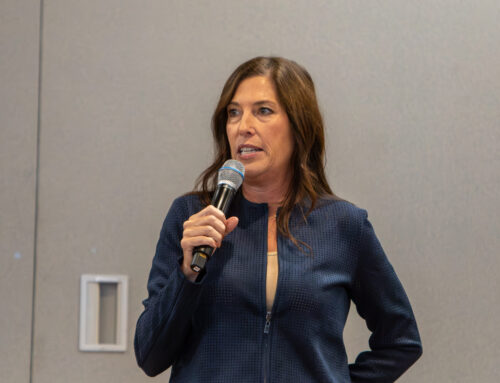
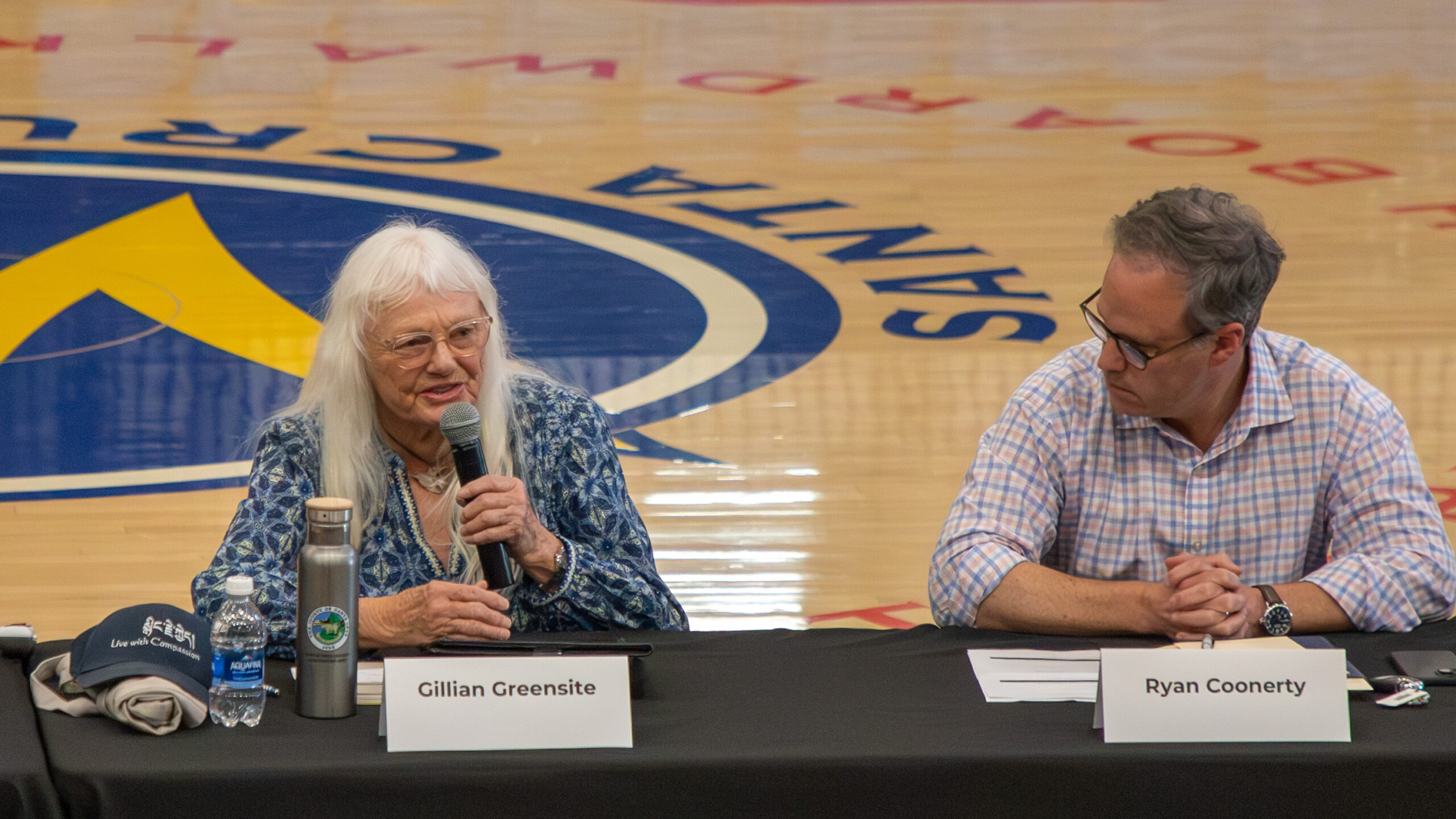
Mayoral candidates Gillian Greensite, left, and Ryan Coonerty speak at a candidate forum at the Kaiser Permanente Arena in Santa Cruz on May 14. (Amaya Edwards — Santa Cruz Local/CatchLight Local)
SANTA CRUZ >> As Santa Cruz contends with state housing mandates and the nation’s most expensive rental market, candidates running in the June 2 election have proposed major changes to the city’s housing policies.
Read on to hear how candidates described their views in interviews with Santa Cruz Local. For more on candidates’ positions on important local issues, read the full Election Guide.
Chen Mills and Noack call for more “missing middle” homes
Gabriella Noack, who is challenging Renee Golder for the District 6 City Council seat, said she wants more small-scale multifamily development in single-family neighborhoods.
“We can focus more on building duplexes, triplexes and fourplexes that prioritize access to public space, walkability, bikeability,” Noack said.
Such medium-density housing is known as the “missing middle” between single-family homes and large apartment buildings.
Confused about housing jargon?
Read Santa Cruz Local’s housing glossary to learn common words, phrases and laws.
State and local laws have already cleared a path towards some denser development in single-family neighborhoods. The 2021 state law SB 9 allows up to four units on single-family lots, including duplexes. In 2023, the city council approved a long-term development plan that calls for up to 10 units on some single-family parcels near public transit, and potentially more small-scale multi-family housing throughout single-family neighborhoods.
Noack and mayoral candidate Ami Chen Mills said more missing middle housing could be built instead of large buildings downtown and along major streets.

District 6 Santa Cruz City Councilmember Renee Golder, left, faces a challenger in Gabriella Noack. (Amaya Edwards — Santa Cruz Local/CatchLight Local)
Making the switch would require the go-ahead from state authorities.
The council could vote to allow more multifamily housing across single-family neighborhoods. But to downzone other areas, the city would have to convince state housing authorities not just that upzoned neighborhoods could expand enough to offset downzoning, but that the new development is economically likely to happen in the next six years.
Krohn and Greensite want to take on the state
Mayoral candidates Gillian Greensite and Chris Krohn say the city has been too welcoming to developers, and that leaders should take a more aggressive approach in fighting back against large market-rate projects and state laws that remove local control.
Krohn wants to join cities like Santa Monica and Huntington Beach in legally pushing back against state housing mandates, either by filing briefs in support of the cities’ suits against the state or joining as a litigant.
Even if they aren’t successful, Krohn said, “those kinds of lawsuits send signals to the developers themselves” that the city won’t easily bend to proposals residents oppose.

Former Santa Cruz City Councilmember Chris Krohn is making a bid for Santa Cruz Mayor in the June 2 primary election. (Amaya Edwards — Santa Cruz Local/CatchLight Local)
Cities have had some success challenging state law — in 2024, the Los Angeles Superior Court ruled that a group of charter cities were not obligated to abide by SB 9, although that ruling is now under reconsideration.
Krohn also said he wants to slow the production of market-rate “luxury apartments,” although he’s not sure whether he would risk a lawsuit, or the further loss of local control the state imposes on local governments that don’t meet their housing goals.
“I’d have to take a look at the situation and how far the council was willing to go, and the advice of the city attorney,” he said. Local governments that defy state laws to block development have mostly lost legal battles with the state, and have often faced heavy penalties.
Greensite said the city should take “a leadership role” in advocating for major change at the state level.
“I would be really working hard to have our state representatives come to town hall meetings and explain this to the people,” she said. “I think the state laws are outrageous, and I would be pushing back very strongly.”
The city has lobbied state lawmakers for “modest changes” to housing laws — to little effect, said Lee Butler, Santa Cruz director of planning and community development.

Ami Chen Mills is making a second attempt at Santa Cruz Mayor in the June 2 primary election. (Amaya Edwards — Santa Cruz Local/CatchLight Local)
Chen Mills and Krohn propose a rental registry
Chen Mills and Krohn both want to create a public rental registry more comprehensive than the city’s existing map of rentals. Krohn said the registry could include the identity of landlords and how many bedrooms each unit has. Chen Mills said it could include what rent is charged, to ensure compliance with state rent hike restrictions.
The city council discussed creating a mandatory or voluntary rental registry in 2019 and 2020, but it was never approved. In 2020, city staff estimated that a mandatory rental registry would cost $77,000 to create and $44,000 to maintain each year after.
Most candidates say city needs more tax revenue
Nearly all candidates mentioned the city’s Affordable Housing Trust Fund as a way to fund construction and preservation of affordable housing. Some want to add new taxes to bolster the fund — without raising sales or property taxes.

Hector Marin, right, is challenging incumbent District 4 City Councilmember Scott Newsome in the June 2 primary election. (Amaya Edwards — Santa Cruz Local/CatchLight Local)
The taxes proposed include:
- A higher real estate transfer tax. The city’s existing real estate transfer tax, established in 2025 with Measure C, goes toward the housing trust fund. “Next year, let’s make it a little stronger” by removing the $200,000 cap on the maximum tax paid, said mayoral candidate Joy Schendledecker.
- A gross receipts tax on businesses earning more than $1 million annually. The tax, proposed by District 4 Santa Cruz City Council candidate Hector Marin, could exempt locally owned businesses, he said. Some money could also be used to hire more police officers and mental health liaisons to enforce homeless camping restrictions, and to boost a small business incubator program, Marin said.
- An updated business registration tax. Chen Mills said the tax could be similar to one in Scotts Valley. Santa Cruz’s existing business registration fee charges $145.15 annually, plus up to $7.40 per employee.
Those taxes would need voter approval if placed on the ballot by the city council or a citizen initiative.
Mayoral candidate Ryan Coonerty said he doesn’t plan to propose new or raised taxes.
“People are feeling the pinch of affordability, and so we will not be able to go to the ballot and just raise people’s taxes,” he said. Instead, he said, he wants to drive economic growth to raise more money with the city’s existing sales tax and transient occupancy tax.
Questions or comments? Email [email protected]. Santa Cruz Local is supported by members, major donors, sponsors and grants for the general support of our newsroom. Our news judgments are made independently and not on the basis of donor support. Learn more about Santa Cruz Local and how we are funded.

Jesse Kathan is a staff reporter for Santa Cruz Local. They hold a master's degree in science communications from UC Santa Cruz.