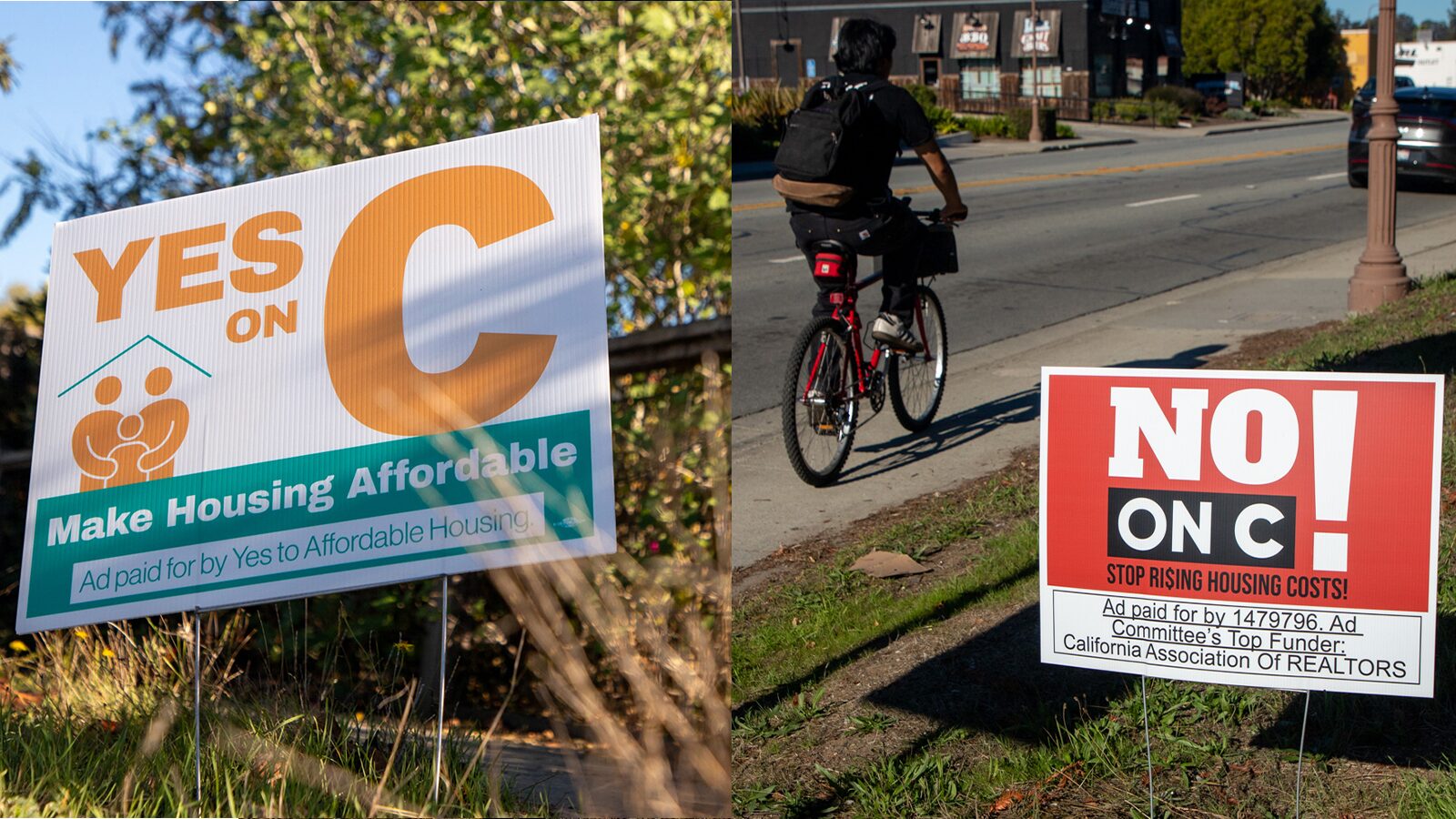
Signs for ‘Yes on C’ and ‘No on C’ in the city of Santa Cruz ahead of the Nov. 4 statewide special election. (Amaya Edwards — Santa Cruz Local/CatchLight Local)
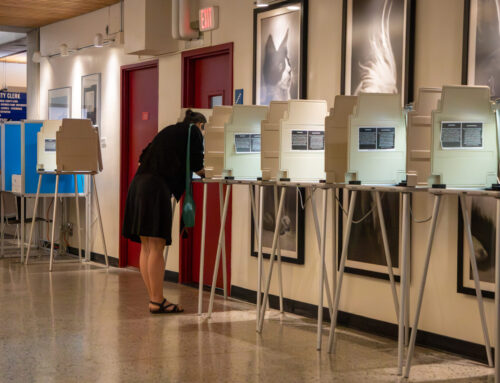
SANTA CRUZ >> Today is Election Day, Tuesday, Nov. 4. Voters in the City of Santa Cruz will consider two tax initiatives: Measure B and Measure C. Both would place new taxes on property owners to raise money for affordable housing and homelessness services in the city. Read our full election guide for both measures and for information on where to vote.
Read Santa Cruz Local’s Election Guide
Here are six things to know before filling out your ballot:
1. Both measures would place new taxes on property owners, not renters. Measure B has lower taxes and exempts more people.
Measure B and Measure C would each create two new taxes: a transfer tax when property is sold, and an annual parcel tax. But Measure B’s taxes are lower, exempt more people and raise less money.
For example, Measure B exempts all property owners 55 years or older from the parcel tax, while Measure C exempts homeowners 65 and older who qualify as low-income.
2. Measure C would raise more money than Measure B — but both would probably bring in less than it says on the ballot.
The ballot questions for Measure B and Measure C include estimates of how much money they would raise. But impartial analyses from city staff anticipate less revenue.
- The Measure C ballot question says it will raise $4.5 million annually, but the city analysis estimates $2.5 million annually, or about $50 million over the measure’s 20-year lifespan.
- The Measure B ballot question says it will raise $1.1 million annually, but the city analysis estimates $750,000 annually, or about $7.5 million over the measure’s 10-year lifespan.
The gap between the campaigns’ estimates and the city’s is because of differences in how the calculations accounted for people that would be exempt from the proposed taxes.
3. Measure C is focused on housing while Measure B could split funds with other projects.
Both measures dedicate up to 3% for oversight and administration, and 10% for supportive housing and shelter for unhoused people and rent help for people at risk of homelessness.
But the measures differ in how the other 87% of the money could be spent:
- Measure C would dedicate the remainder of the money to the city’s Affordable Housing Trust Fund, where it could be spent only on affordable housing development and preservation.
- Under Measure B, none of that chunk of money would be required to be spent on affordable housing — it could also go towards repairs to the Santa Cruz Wharf, roads damaged by extreme weather, or other environmental projects like tree planting.
Under both proposals, spending would be overseen by an oversight committee.
4. Authors of Measure B are focused on fighting Measure C, not their own proposal.
Measure B was written by the Santa Cruz County Realtors Association in response to Measure C. But the association has not actively campaigned for their measure — instead, they’ve focused on mailers and other campaign materials against Measure C.
5. Either measure could spark a legal fight.
The Santa Cruz County Realtors Association, authors of Measure B and leaders of the No on C campaign, have alleged that Measure C is illegally classified as a voter initiative. A coalition led by advocacy group Housing Santa Cruz County collected signatures to put the measure on the ballot. But because the city commissioned polling on support for a tax for affordable housing, and because Mayor Fred Keeley facilitated community conversations during Measure C’s development, opponents have argued that the initiative has been supported by the city council, and should require more than 66% voter approval.
Voter initiatives require more than 50% approval while measures placed on the ballot by a local government require more than 66% approval.
A representative of the realtor’s association told Santa Cruz Local that they may sue the city if Measure C wins. Santa Cruz City Attorney Tony Condotti has said the city followed election law, and would win any such lawsuit.
No group has signaled that they would sue if voters approve Measure B, but in an impartial analysis, Condotti wrote that the initiative may be vulnerable to a legal challenge.
Measure B requires more than 50% of the vote because it is a “special tax” for a specific purpose. But Measure B has two spending priorities — affordable housing and repairs to city infrastructure damaged by extreme weather. That could leave it open to a lawsuit arguing it should be classified as a “general tax” which would require more than 66% voter approval, Condotti said in an interview.
6. For major campaign donors, it’s realtors versus developers, nonprofits and the mayor.
As of Sept. 18, the No on C campaign has two donors: the National Association Of Realtors and the California Association of Realtors Issues Mobilization Political Action Committee. They’ve donated a combined $267,078.
The Yes on C campaign has dozens of individual and organizational donors. The largest contributions are a non-profit developer, a for-profit developer, a carpenter’s union and Santa Cruz Mayor Fred Keeley. As of Sept. 18, the campaign has raised $306,533.
Read Santa Cruz Local’s Election Guide
Questions or comments? Email [email protected]. Santa Cruz Local is supported by members, major donors, sponsors and grants for the general support of our newsroom. Our news judgments are made independently and not on the basis of donor support. Learn more about Santa Cruz Local and how we are funded.

Jesse Kathan is a staff reporter for Santa Cruz Local. They hold a master's degree in science communications from UC Santa Cruz.