

Santa Cruz Mayor
Santa Cruz County voters on Nov. 3 will have a packed ballot, depending on where you are registered to vote. Key races include: Santa Cruz Mayor, Scotts Valley City Council, Capitola City Council and Watsonville City Council. Voters will also decide on trustees in these school districts: Pajaro Valley, San Lorenzo Valley, Cabrillo College and Soquel Union Elementary School District. Additionally, eligible voters will get to weigh in on candidates running for director positions in the Felton Fire Protection District and the Scotts Valley Water District.
Our comprehensive election guide featuring in-depth profiles of each race will be published on Oct. 5.
In the meantime, get caught up on our election coverage from the June 2 primaries, where five candidates vied for the mayoral seat on the Santa Cruz City Council. On the Nov. 3 ballot, voters will decide between two remaining candidates — Ryan Coonerty and Ami Chen Mills — who received the most votes in the June primary election. No single candidate got enough votes to win the seat outright.
Jump to:
Quick comparison • On the issues • Campaign donations • On their records • About the mayor
Meet the candidates
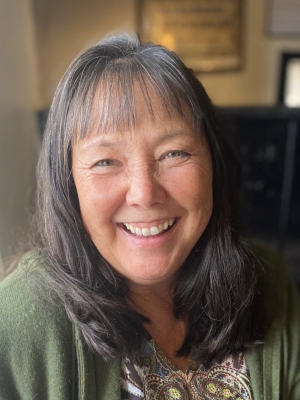
Ami Chen Mills
Age: 58.
Occupation: UC Santa Cruz educator and resilience coach.
Political background:
- Get The Flock Out anti-surveillance work.
- Ran for Santa Cruz County supervisor in 2022.
- Served on a city advisory committee on homelessness in 2019 and 2020.
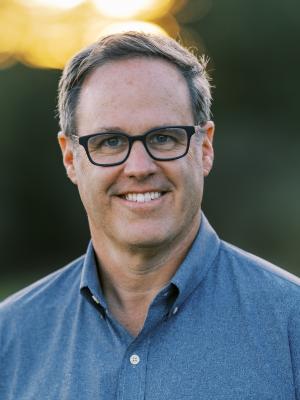
Ryan Coonerty
Age: 52.
Occupation: Educator at Leon Panetta Institute and UC Santa Cruz, CEO of nonprofit Leadership Santa Cruz County, advisor to San José Mayor.
Political background:
- Former Santa Cruz Mayor and Santa Cruz City Council member 2004-2012.
- Santa Cruz County Supervisor for two terms, 2015-2023.
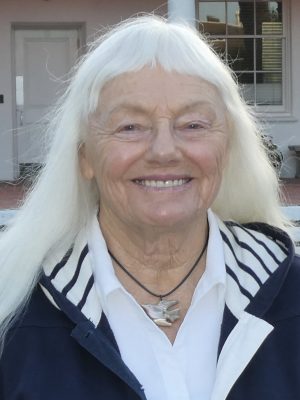
Gillian Greensite
Age: 81.
Occupation: Retired UC Santa Cruz educator.
Political background:
- Longtime activist for environmental and women’s issues.
- Repeat litigant against the city over environmental laws.
- Founding member of the city’s Commission for the Prevention of Violence Against Women.
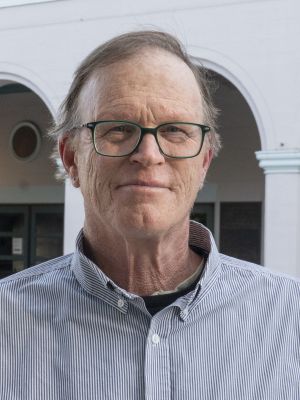
Chris Krohn
Age: 68.
Occupation: UC Santa Cruz internship manager.
Political background:
- Former Santa Cruz Mayor and Santa Cruz City Council member, 1998-2002 and 2016-2020.
- Recalled in 2020 over criticism of his homelessness policy and allegations of uncivil behavior.
Joy Schendledecker
Age: 51.
Occupation: Homeless shelter worker for nonprofit People First.
Political background:
- Homelessness advocacy with Santa Cruz Cares and a community organizer.
- Previously ran for Santa Cruz city council in 2024 and Santa Cruz mayor in 2022.
Quick comparison
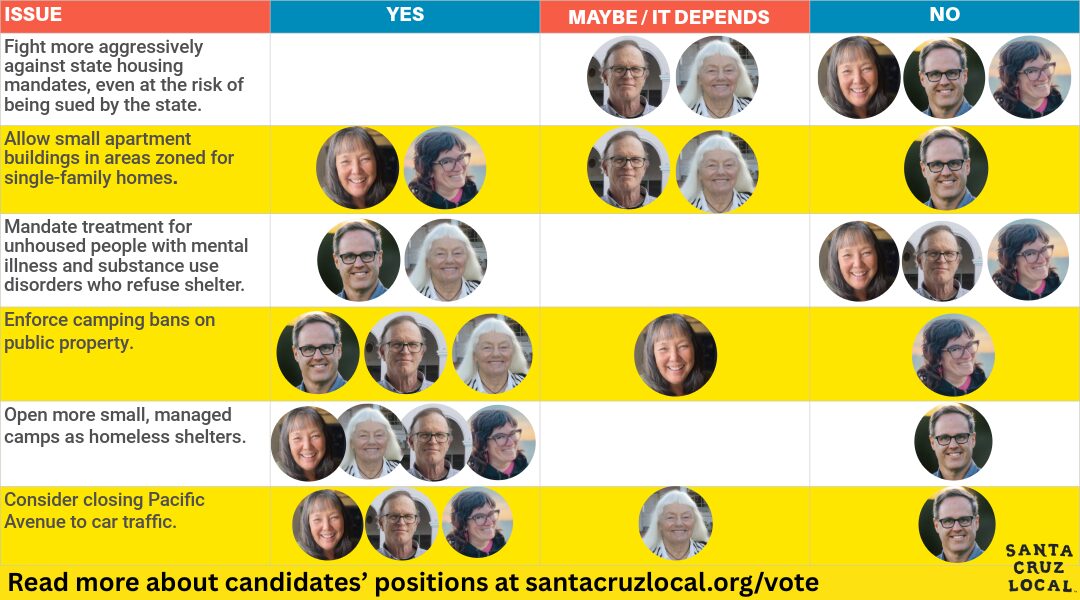
Candidates on the issues
Santa Cruz Local interviewed and surveyed residents in Santa Cruz about their priorities for mayoral candidates. The following questions are based on what we heard from voters.
Do you support policies like rent control, rental assistance or enhanced eviction protections? Do you have other plans for making existing housing stock more affordable?
Although Chen Mills supports rent control and more eviction protections, she said she’s “interested in working on things that we can advance, that won’t have too much chaos in the community happening.”
Chen Mills said she wants to:
- Give more money to tenants rights organizations like Tenant Sanctuary, and consider using city staff to educate renters.
- Create a public registry of landlords.
- Give incentives to landlords to rent to tenants with Housing Choice Vouchers, also known as Section 8.
- Raise money for tenant protection and other social services with a tiered business registration tax, similar to one in Scotts Valley. Consider slimming city staff, with fewer managerial roles
Chen Mills owns an accessory dwelling unit that she once offered as an Airbnb, but now is intermittently rented or used by her family.
“We should start by acknowledging that the rent is very high, and I hear about it all the time from working families, students trying to get through their education, seniors on fixed incomes,” Coonerty said. But with state restrictions on rent control and eviction protections, he doesn’t think local laws “would have a significant impact on renters in our community,” he said.
Coonerty said he wants to:
- Continue negotiations with the University of California to mandate UC Santa Cruz to house more of their students and faculty on campus, including 100% of any new expanded enrollment.
- Encourage developers to build more for-sale condos.
Coonerty partially owns a house for rent in Texas.
“I do support rent control and I support rental assistance and enhanced eviction protections,” Greensite said. “I don’t have a clear picture of what that would be.”
Greensite said she wants to:
- More stringently verify that locals are prioritized for below-market-rate housing.
- Investigate whether investors are buying vacant properties and driving up rents.
While Greensite believes the growth of UC Santa Cruz is a major factor behind increased rents, she said she doesn’t believe the city will have much power to stop it.
“I would start with a publicity campaign” about tenant protections, Krohn said. “A lot of people do not know what the laws are.” Krohn supports rent control, but said he wouldn’t want to revive Measure M, a ballot measure rejected by voters in 2018 that would have enacted local rent control and eviction protections.
Krohn said he wants to:
- Create a citizen-led housing committee where renters, landlords and others can bring forth their concerns.
- Create a public registry of landlords.
- Continue negotiations for UC Santa Cruz to house more incoming students. He opposed, however, a new housing complex in the undeveloped West Meadow.
- Center the city’s rental inspections on potential health and safety issues, and be more lenient on other code violations that could prevent people from renting their property.
- Buy properties with the Affordable Housing Trust Fund, and offer them at below-market rents.
Krohn rents three units to people with Housing Choice Vouchers.
Schendledecker said she wants to create a community land trust that owns public housing.
“It could be a public private partnership, if it needs to be, it could be managed by a nonprofit,” she said.
Schendledecker said she wants to:
- Buy older apartment buildings — including those that are aging out of their obligations to offer below-market rents — and maintain them as permanently affordable homes.
- Strengthen eviction protections.
- Put more city money towards the Community Action Board for their rental assistance program.
- Introduce a ballot measure to raise the real estate transfer tax established with Measure C, and remove the cap on taxes paid on the most expensive property sales, to raise more money for affordable housing.
- Allow some building code violations in rentable units to be “grandfathered in” if they don’t harm occupants’ health or safety.
How would you balance the pressures of state housing mandates with the desires of current residents?
“I think it’s important to preserve the human scale of our city,” Chen Mills said. “The reason we all live here, it’s because we’re not freaking Long Beach.”
Chen Mills said she wants to:
- Avoid legal fights with developers, and work within the confines of state housing laws.
- Streamline the permitting and approval process to incentivize smaller developments, while keeping public hearings.
- Allow small multi-family developments like triplexes and townhomes in single-family neighborhoods to avoid “the Manhattanization of our downtown,” and encourage people of different incomes living together.
“When the city has authority, we need to use it to protect neighborhoods from out-of-scale development,” Coonerty said. At the same time, “pretending like we can go back and just stop every project is lying to people, and it’s not how you should be running a government.”
Coonerty said he wants to:
- Work with developers early in the design process to advocate for design changes the community will support.
- Advocate for state legislators to allow student dormitories to count towards the city’s state-mandate housing goals.
- Continue the city’s advocacy for state lawmakers to give cities that have met housing production goals, such as Santa Cruz, more control over the size of new developments.
“I think people feel powerless, because, in a way, we are powerless unless we can challenge the state,” Greensite said. The problem is, not only are we not challenging the state, we’re facilitating the state mandate.”
Greensite said she wants to:
- Investigate whether the city is encouraging outside developers to propose projects in the city and, if so, stop doing that.
- Minimize the amount of new market-rate housing built in the city.
“The city council is now filled with people who are open arms to developers,” Krohn said. “You have to get four votes if you really want to slow it down.”
Krohn said he wants to:
- Join cities like Santa Monica and Huntington Beach in legally pushing back against state housing mandates — either by filing briefs in support of the cities’ suits against the state or joining as a litigant.
- Lobby state lawmakers to restore local control over development.
- More aggressively negotiate for developers to include public benefits, like new bike lanes.
- Secure project labor agreements to require local workers.
- Further streamline permitting for accessory dwelling units.
“I do think that we need to build more, and I do think that density is more efficient,” Schendledecker said. “I’d like to see slower and smaller development” downtown, she said, “but we need to choose our battles carefully” to avoid legal fights.
- Work with developers to seek residents’ feedback early in the design process.
- Encourage developers to produce below-market-rate units priced for renters with a range of incomes within the same building, and to use higher-priced units to subsidize the below-market-rate units.
- Open areas zoned for single-family homes to small multi-family housing.
What do you believe works or doesn’t work about the city’s homelessness policy? What changes would you propose?
“I think we need to give people places to be where they can be,” Chen Mills said. “It’s an issue for people [and] downtown businesses, they don’t want people just wandering around the streets. And I get it. But these are people in our community. They’re part of our community. So are there other spaces we can create?”
Chen Mills said she wants to:
- Institute day services for homeless people no longer provided by nonprofit Housing Matters.
- Establish transitional housing, possibly including tiny homes.
- Open small, low-barrier camps partially managed by the city.
- Establish more 24/7 safe parking sites with hygiene services and caseworkers.
- Conduct homeless sweeps only when necessary, without police presence.
Coonerty said the city has made progress in reducing homelessness, but those remaining “are the most sick, the most suffering from mental health and substance abuse, and will be the hardest to house.”
Coonerty said he wants to:
- Expand the county’s Homeward Bound program, which currently offers homeless people a bus ticket to a community where they have secured housing. The program could also become more flexible, for example to help pay for food or utilities for a family member who could provide housing.
- Use state laws to expand the ability to conserve or mandate treatment for people with serious mental illness or substance use disorders.
- Strengthen county court programs for repeat offenders of drug and property crimes.
- Enforce camping bans for people who refuse shelter and other support services.
“One camp says the homeless are bums who should be getting a job and pulling themselves up, and if they can’t, we shouldn’t be throwing money at it. The other extreme is people who feel that the homeless are all deserving of help and compassion, and they’re all unfortunate,” Greensite said. “And I don’t fall into either of those camps.”
Greensite said she wants to:
- Offer help to unhoused people who need it, and enforce rules against disruptive behavior and illegal camping.
- Add more police patrols downtown.
- Enforce the Oversized Vehicle Ordinance that prohibits overnight parking of RVs and other large vehicles.
- Hire park rangers and enforce camping bans in open spaces like Pogonip.
- Push for the use of expanded state laws around conservatorship and CARE Courts to force more people with severe mental illness or substance use disorder into treatment.
- Investigate current homelessness spending and shelter capacity.
Following the closure of day services at the Housing Matters campus, Krohn said “the city needs to replicate that situation for folks because they’re going to need a place to get their mail or to take a shower or to just have a little peace of mind during the day.” In the meantime, he suggested the city could provide mobile showers.
Krohn said he wants to:
- Give more funding to the county’s Mobile Crisis Response Team, which provides non-police response to people experiencing a mental health crisis.
- Establish new or expanded managed camping sites as homeless shelters. He said he doesn’t want a return of the unpermitted Ross Camp, which attracted drug dealers.
Schendledecker said focusing the homelessness conversation on mental health and substance use issues is too narrow. She said when residents form connections with those who are unhoused, “often they’re like, I don’t need to be scared of this person, and I don’t need to disappear them from my community.”
Schendledecker said she wants to:
- Establish more managed camp sites as homeless shelters. Ideally, she said, each city council member would have to choose a location in their district for a low-barrier managed camp site.
- Establish new day services for homeless people with showers and mail access, following the end of such services by Housing Matters.
- Increase city funding for the county’s Mobile Crisis Response Team.
- Give funding and other assistance to mutual aid groups and faith-based organizations helping homeless people.
- Redirect some police funding to expand homelessness services.
- Stop sweeps of homeless camps.
Schendledecker works for city-contracted nonprofit People First at the Armory Overlook Emergency Shelter. She said she would recuse herself on votes related to People First.
What policies would you propose to make roads safer and easier to navigate for all residents?
Chen Mills said she wants to:
- Build more bump-outs along city streets to slow car traffic.
- Plant more trees along roads.
- Conduct walking audits with neighbors to identify places for future crosswalks or other safety improvements.
- Invest in Metro for mass transit.
Coonerty said he wants to:
- Create “viable alternatives” to driving, including “protected bike lanes, so that people feel safe biking to and from work, or their kids to school.”
- Continue denser, more centralized development. “If we can have walkable, vibrant commercial cores so that people can live, work and shop within a short distance of where they live, that absolutely helps.”
Greensite said she wants to:
- Slow down the construction of new housing. “If you think [roads are] unsafe now, I don’t know how the town is going to handle when all these housing projects are filled with new people,” she said.
- Install more crosswalks with flashing beacons.
- Increase enforcement of traffic laws for cars and bikes.
- Seek more public input on “what the public feels they need to make it all safer” and “help facilitate those policies.
Krohn said he wants to:
- Narrow lanes on some streets to slow down cars, similar to a recent redesign on Bay Street from King Street to UC Santa Cruz.
- Respond to neighborhood requests for street safety measures.
- Experiment with closing Pacific Avenue or other downtown streets to vehicle traffic, and call for an advisory ballot to see if residents support permanently closing it to vehicles.
- Offer zero-interest or low-interest loans for residents to purchase bicycles or e-bikes.
- Establish a voting seat on the Metro board of directors reserved for a UC Santa Cruz student.
Schendledecker said she wants to:
- Continue progress on the city’s Vision Zero plans to redesign city streets for more safety.
- Grant permission and funding for neighborhood groups to design and implement new street safety measures. “I’m not opposed to people putting up their own bus stop benches and people making protected bike lanes,” she said.
- Build more traffic circles and change traffic light timing.
- Push the Santa Cruz County Regional Transportation Commission to move forward with plans for passenger rail.
How would you create spaces for residents to share their needs and desires? How would you incorporate residents’ voices in your policies and votes?
Chen Mills said she wants to:
- Hold a monthly town hall in each of the city’s districts to encourage community conversations and civic engagement.
- Invite residents to meet ahead of city council meetings to discuss the agenda.
- Hold city council meetings in the late afternoon or at night to allow more working people to attend.
- Use social media to inform constituents about public meetings and city politics.
- Raise salaries for council members to make holding public office more accessible for lower-income people.
Coonerty said he plans to hold a monthly public event like a town hall, workshop or neighborhood cleanup in an effort to hear from residents.
He said he also plans to create public dashboards with measures like police and fire response times, water usage and vacancy rates. “We can’t have an intelligent conversation about the future of this community if we don’t understand where we are,” he said.
A city council policy to ask questions of city staff prior to council meetings “has been a mistake in policy that has blunted good discussion and debate amongst council,” Greensite said, because the public doesn’t get to hear answers to the questions.
Greensite said she wants to:
- Undo a similar policy that requires council members to propose a motion before discussion, which has led to “rubber stamping” of motions written prior to the meeting, she said.
- Hold quarterly town halls.
Krohn said he wants to:
- Hold regular office hours.
- Allow advisory commissions to run their own meetings, with less participation from staff.
- Hold one city council meeting in each district annually.
- Minimize the number of closed sessions in city council meetings.
- Hold multiple town hall meetings for contentious issues.
- Hold city council meetings in the later afternoon or at night to allow more working people to attend.
Schendledecker said she wants to encourage more debate among council members. “I understand a little bit this sentiment that you can’t just have endless meetings, and that you don’t want complete chaos,” she said. “I think it’s [been] an over correction. And the messiness of city council politics — we need to do that because we’re messy people trying to figure things out together.”
Schendledecker said she wants to:
- Support a pilot program for quarterly “district assemblies” where neighbors in an electoral district gather to raise concerns and hear from elected officials.
- Lengthen the time allowed for city council meeting attendees to speak during public comment.
- Hold town halls ahead of council votes on contentious issues.
How do you plan to use your office to advance racial equity in Santa Cruz and make the city a more welcoming place for Black and Latino residents?
Chen Mills said she wants the city council to consider how policies can disproportionately impact marginalized groups.
She said sweeps of homeless encampments disproportionately affect people of color and LGBTQ+ people. Similarly, if federal officials access the license plate data for immigration enforcement or other surveillance, it’s going to largely affect immigrants and “any person of color.” Chen Mills also wants to appoint more people from diverse backgrounds on city advisory commissions, including disabled people.
As a Chinese American, she said she wants to recognize the 10% of Santa Cruz residents who are Asian American.“I am a part of that group, and I am showing up for that group,” she said.
Racial justice “starts with representation,” Coonerty said. “I’m proud that I’ve personally recruited dozens of leaders, minority leaders, onto city councils, advisory bodies and government generally,” many through his work with the nonprofit Leadership Santa Cruz County.
“Black and Latino families, when I am out talking to them, they want to be more than one-dimensional political groups,” Coonerty said. Like most Santa Cruzans, Coonerty said, “they want safe neighborhoods, and good jobs and adequate housing, good schools and after school programs.”
Greensite wants to focus on displacement, especially within Latino communities. To address the issue, she wants to push for below-market-rate housing to have more units sized for families, and ensure that housing is prioritized for local workers.
Greensite said she wants to:
- Examine the demographics of the city’s workforce. “Are we elevating a diverse group of people, or does it tend to be going to white males?” she said.
- Ensure that city outreach is offered in Spanish.
- Ensure that recorded responses from Latino residents are presented and considered in city decisions.
Krohn said he wants to engage with all groups to “abolish all forms of racism and prejudice.”
He said he wants to bring down the cost of housing and raise the minimum wage, to help keep locals in town. “Providing housing and job opportunities is one of the best ways to equal the playing field,” he said.
The city also needs to “fully celebrate and acknowledge Black History Month” and “resolve any internal issues that might discriminate against black and brown applicants to city jobs,” he said.
Schendledecker said she wants to have public conversations about how racism has shown up in the community.
She said city leadership should consider how economic inequality “may not be specifically racist, but the impacts of it are disproportionately felt by poor, BIPOC [Black Indigenous and People of Color] people,” she said.
She wants to form stronger relationships with the Amah Mutsun Tribal Band, and consider giving them city land.
Campaign donations
Ryan Coonerty — $55,115 total reported contributions for 2026, as of April 24.
- Total Expenditures: $21,116.
- Cash on hand: $33,999.
- Loans: $5,000 from himself.
Chris Krohn — $10,652 total reported contributions for 2026, as of April 24.
- Total Expenditures: $3,404.
- Cash on hand: $7,248.
- Loans: $5,000 from himself.
Ami Chen Mills — $8,382 total reported contributions for 2026, as of April 24.
- Total Expenditures: $2,449.
- Cash on hand: $5,933.
- Loans: $1,718 from herself.
Gillian Greensite — $8,189 total reported contributions for 2026, as of April 24.
- Total Expenditures: $3,820.
- Cash on hand: $4,369.
- Loans: $3,500 from herself.
Joy Schendledecker — $2,650 total reported contributions for 2026, as of April 24.
- Total Expenditures: $804.
- Cash on hand: $1,846.
- Loans: none as of April 24.
More information about campaign finances in the June 2, 2026 election.
On their records
Coonerty on his time in office
Coonerty has spent a cumulative 16 years as a local elected leader. He sat on Santa Cruz City Council from 2004 to 2012, serving as an appointed mayor in 2008 and 2011. He was then a county supervisor from 2014 to 2022.
Coonerty said that during his time in office, he:
- Helped establish the office of Response Recovery and Resilience, which leads county preparation for and response to disasters.
- In his capacity as supervisor, worked to expand the Community Partnership for Accountability, Connection and Treatment (PACT), a collaborative anti-crime project between the county and nonprofits that focuses on improving outcomes for repeat offenders.
- Helped secure ongoing county funding for the Downtown Streets Team, an organization that enlists unhoused people to clear litter and provides job training, starting in 2018. The organization shut down in 2025, and Coonerty said he wants to revive a replicated version.
Coonerty on his connections to developers
Coonerty has worked as a consultant for developers on multiple projects in the city, including the Cruz Hotel, 201 Front St. and an apartment complex on Delaware Avenue leased to UC Santa Cruz to house students and staff. As a consultant, he also helped developer Danco choose the location of a proposed affordable housing project for veterans on a Pacific Avenue parcel owned by his wife and mother-in-law.
Coonerty sees the consulting as part of his work to support the city’s economic development.
“I was trying to help projects that I agreed with get the community and city support necessary to get across the finish line,” he said. He said he turned down other consulting opportunities for projects he didn’t think would benefit the city.
Krohn on his time in office
Krohn served on the Santa Cruz City Council from 1998 to 2002, including one year as an appointed mayor in 2022. He served a second partial term from 2016 to 2020.
Krohn said that during his tenure, he:
- Successfully advocated two-way bike lanes on Beach Street and High Street.
- Approved an agreement with UC Santa Cruz leaders to forestall consideration of an eastern entrance to the campus through Pogonip.
- Allocated money to buy the Del Mar Theater and prevent the building’s redevelopment.
- Helped secure an agreement for 44 units to be offered below market rent in a 112-unit building at 1010 Pacific Ave.
Krohn on his recall
In 2019 as a councilmember, Krohn faced allegations of sexism and uncivil behavior from then-Mayor Martine Watkins and two city employees. In a July 2019 report, an outside investigator found that Watkin’s and the employee’s allegations of sexism were not substantiated. Krohn had similarly adversarial exchanges with male staff and elected officials, and had emailed Watkins twice to apologize and request mediation.
The investigator did substantiate a claim that Krohn had laughed disrespectfully at a city employee during a February 12 city council meeting, which three witnesses corroborated. The moment was not caught on camera, Krohn said he has no memory of laughing.
Fellow Councilmember Drew Glover also faced allegations of sexism and bullying. The report found one substantiated complaint of disrespectful behavior.
The two faced recall elections that focused on the allegations of incivility and their handling of the unsanctioned Ross Camp, a homeless encampment behind Ross Dress for Less.
Krohn maintained that he did not bully or act uncivilly to staff or members of council. He said he does not recall laughing at the staffer, though he said he apologized to her following the complaint.
“I’m an enthusiastic person and have a very energetic style of communication,” he said, adding that he has “mellowed a bit.” He said he has learned “to nip friction in the bud before it happens,” and wishes he and Watkins had pursued mediation sooner.
Regarding his homelessness policy, “I don’t know how the Ross Camp could have been handled differently, because it was an organic kind of thing in motion, and decisions were made in every moment,” he said. “I empathize with the businesses that were there, for sure.”
The recalls, he said, were really about political differences. “We were certainly attacked from day one because we were giving time to hearing from homeless people and from renters and from students,” he wrote in a May 4 text.
People posting on the social media site NextDoor had mentioned recalling progressive council members far before the civility complaints against him, Krohn said. And the recall received major funding from Santa Cruz Together, a group formed to oppose 2018’s Measure M initiative for rent control, which Krohn supported.
Greensite on her lawsuits against the city
Greensite has been involved in multiple lawsuits against the city over alleged violations of state environmental law:
- In 2013, as part of the organization Save Our Big Trees, she challenged changes to the city’s Heritage Tree Ordinance, which would have softened city rules meant to protect large trees. After the Santa Cruz Superior Court ruled in the city’s favor, an appellate judge reversed the decision and ordered the city to roll back the changes.
- In 2019, Greensite with Save Our Big Trees challenged the design of the Santa Cruz Rail Trail next to the Neary Lagoon. As part of a settlement, the city resolved to advance the restoration of the Jessie Street Marsh.
- In 2020, as part of Don’t Morph the Wharf, Greensite challenged the proposed redevelopment of the Santa Cruz Wharf. A judge ordered the city to undertake a more thorough environmental review. In 2024, the group agreed not to sue again after the city council dropped a walkway and large building from the redesign.
Greensite said the suits were part of an ongoing struggle to hold the city accountable to its legal obligations. They “were avoidable,” she said, if the city council had heeded community advocates. “But the city left no other choice,” she said.
One reason she’s running is to ensure that if the city undertakes more environmental reviews, “it’s done properly, and it’s defensible, and it doesn’t open the city up to legal challenge,” she said. Following the partial collapse of the wharf in 2020, city officials said Don’t Morph the Wharf’s suit had impeded the city’s ability to win grants that could have funded structural repairs. Greensite strongly disputes that accounting. She cited years of deferred maintenance on the wharf prior to the lawsuit, and a 2021 grant the city received for some repairs. “We did not want the lawsuit to hold up any maintenance on the wharf,” she said. “Still, we got blamed for what happened.”
About the mayor
The Santa Cruz Mayor represents the city for four years. The mayor has a vote equal to city council members. Together, the council decides how the city spends its money and what policies guide the city’s response to homeless encampments, storefront vacancies and other issues. State laws often limit the policies local officials can enact — especially ones that block housing development.
The mayor, along with city staff, drafts meeting agendas and helps determine if and when the council addresses certain issues. The seat can also serve as a “bully pulpit” for leaders to advocate for policies to county or state officials.
Some neighborhoods in Santa Cruz will also vote for their next city council member in the June election.
If no candidate wins more than 50% of the vote in the June election, the top two will face off in the November general election.