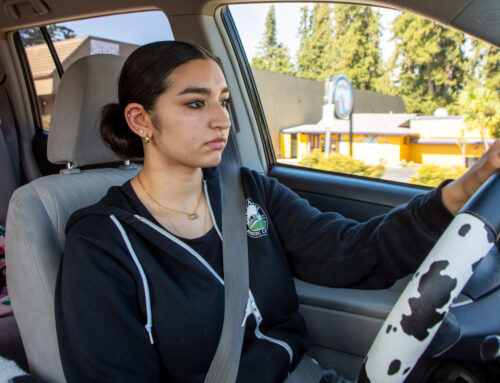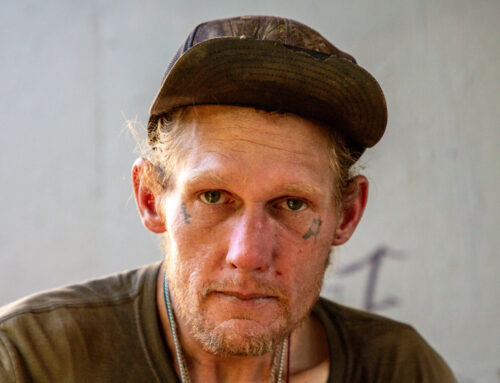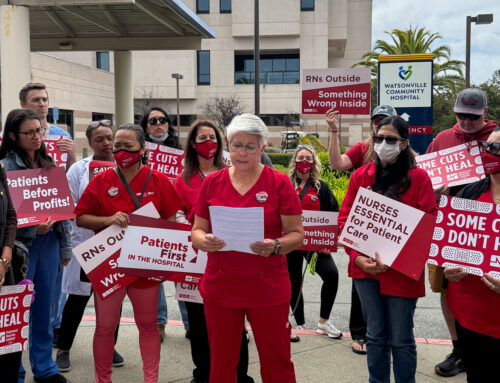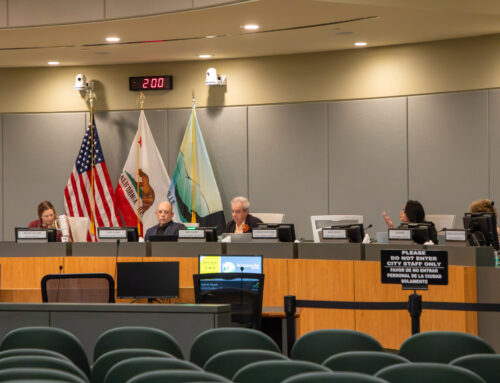

The No on Z campaign mailed fliers to Santa Cruz voters, sent people door to door and blanketed social media and TV with advertisements ahead of the Nov. 5, 2024 election. (Photo collage by Jesse Kathan)
This story is Part 2 of a series on soda taxes in Santa Cruz County. Read Part 1 here. This series is part of Big Food vs. The People, a reporting project with Lighthouse Reports and an international collaboration of newsrooms. Read the rest of the stories here.
SANTA CRUZ >> Hector Marin’s voice — low, impassioned, unfailingly rapid — is familiar to any Santa Cruzan attuned to local politics in the last five years. He has thrice launched unsuccessful bids for Santa Cruz City Council, most recently in June, and frequently decries what he sees as a local government too friendly to landlords and big business.
In 2024, his political targets included Measure Z, a proposed tax on distributors of sugar-sweetened drinks. Measure Z would disproportionately impact low-income residents, he argued, and lower margins for local restaurants could lead to cut hours or lost jobs for service workers.
Marin’s views on Measure Z and his frequent social media posts on the topic during the campaign reflected sincerely held ideals, he said in a recent interview. But he was only able to spend so much time on the effort because of the $5,000 a campaign consultant paid him — a large sum for a political hopeful scraping by on multiple low-paying jobs.
Marin said he wasn’t the only young activist of color recruited by an opposition campaign bankrolled by PepsiCo, Coca-Cola and Keurig Dr Pepper. These recruitments were part of a longstanding strategy to ally with Black and Latino individuals and organizations, the same demographics disproportionately impacted by chronic illnesses like diabetes and obesity associated with excessive sugar consumption. It’s a strategy, experts say, ripped from the handbook of Big Tobacco.
Measure Z was narrowly approved with 52% of the vote. Now, the fight to kill it has moved to the courts.
The measure flies in the face of a 2018 ban against grocery taxes state lawmakers approved under duress from beverage interests. The industry sought to stem a flight of successful soda taxes across Bay Area cities. Shortly after Santa Cruz city voters approved Measure Z, the lawsuit that everyone expected was filed by the American Beverage Association. In a June 29 court decision, a judge sided with Santa Cruz on its right to implement a soda tax, but an appeal is expected.
If the city prevails, local soda taxes could again take root across California.
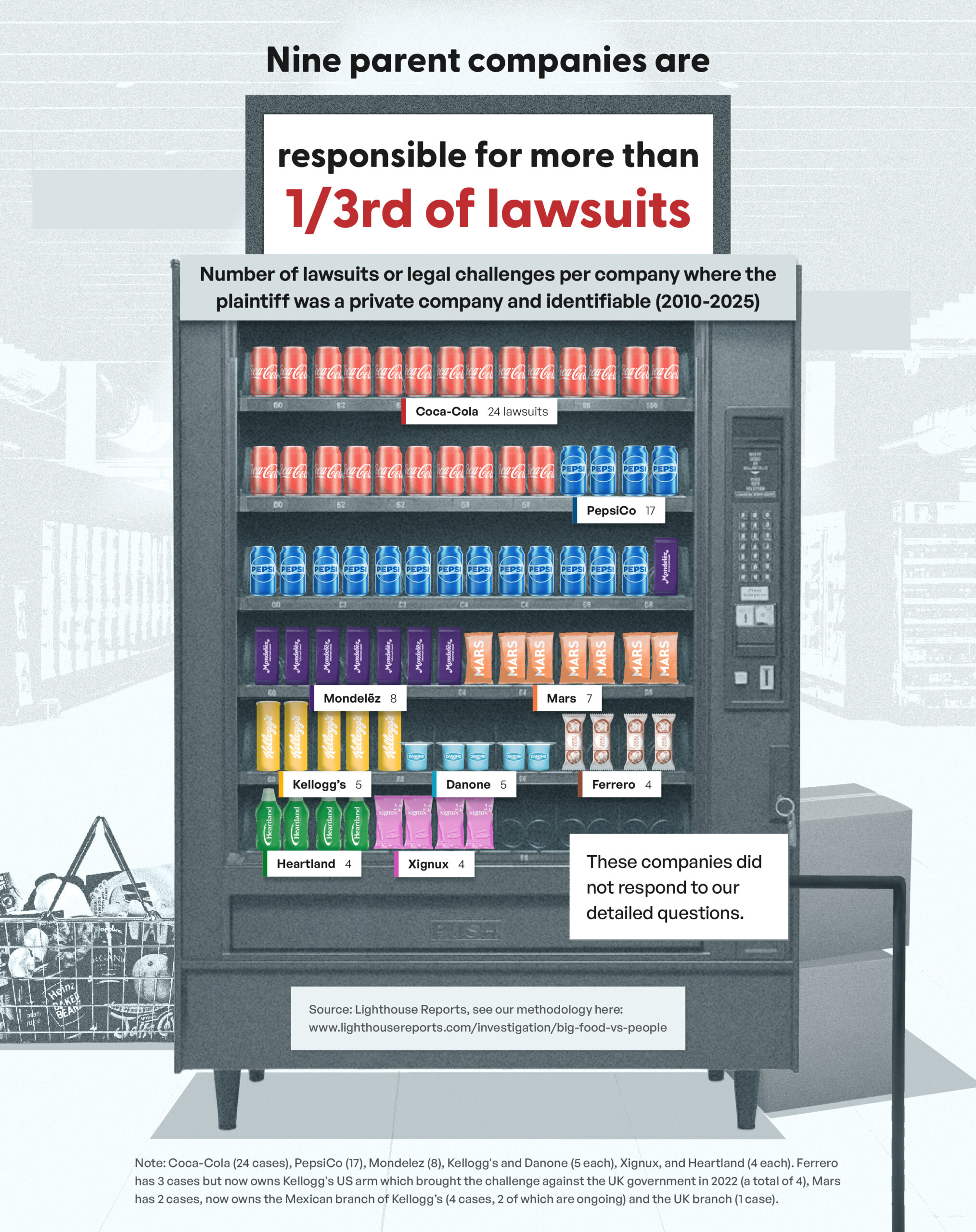
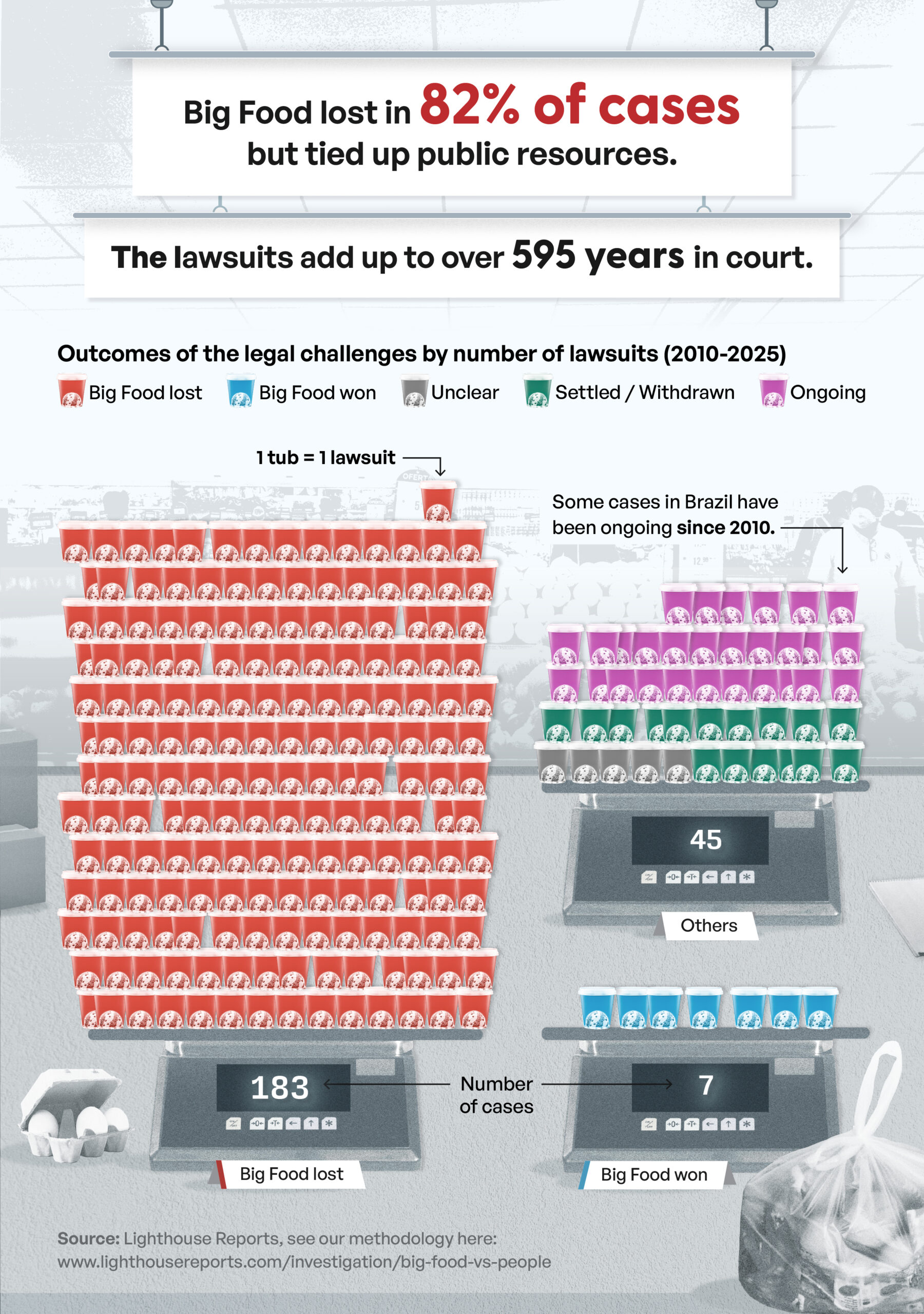
An investigation by Santa Cruz Local, Lighthouse Reports and an international group of news outlets analyzed 439 lawsuits from food and beverage companies and trade associations against governments, including a lawsuit from the American Beverage Association challenging Santa Cruz’ soda tax. (Revisual Labs)
State preemption
In 2017, after three years of fighting taxes on sugar-sweetened drinks in cities across California, the beverage industry was tired. Coca-Cola, PepsiCo and other soft drink companies had spent more than $40 million on consultants, canvassers and media campaigns to kill local tax efforts.
In some cities — Richmond, El Monte — the industry succeeded, and voters rejected the taxes. In others, like Watsonville, tax proposals were snuffed out before making it to the ballot. But voters in Berkeley, Alameda, San Francisco and Oakland all approved soda taxes, and the list of cities considering similar taxes continued to grow.
“Big Soda says ‘screw this,’” explained political consultant Larry Tramutola, who worked on soda tax campaigns in multiple cities. “‘We’ve got to make it illegal.’”
In 2018, the American Beverage Association, an industry group representing soda companies, offered the California legislature a choice. They could ban local taxes on food and drinks, including soda. Or else, the industry would throw the full weight of its money and influence behind a state ballot initiative to make passing any local tax more difficult. Already, it had spent nearly $9 million to boost the initiative.
Then-state Sen. Bill Monning (D-Carmel), who had for years tried unsuccessfully to advance a statewide soda tax, voted against the compromise even as he understood its necessity. “I told my colleagues in a caucus meeting, ‘you know, I can’t in good conscience support this bill,’” he recalled. “‘It’s subterfuge.’”
The Keep Groceries Affordable Act of 2018, which prohibits any local tax on groceries until 2031, was voted into law.
American Beverage Association spokesperson Steve Maviglio, in response to a detailed list of questions, wrote on July 16, “California’s beverage companies work and live in communities across our state and we are proud to support organizations, civic groups and lawmakers who believe as we do that Californians should be protected from discriminatory taxes that raise the cost of groceries for families.”
The statement continued, “We will always back our customers — from restaurants to corner stores to grocers — against measures that threaten their businesses and their employees, which is why we will continue to defend the overwhelmingly popular law passed by the state legislature that prevents the spread of taxes on groceries.”
The effort to tax sweetened drinks lay dormant for six years before reigniting in Santa Cruz in 2024, when the city council decided to defy state law banning grocery taxes and put a soda tax on the local ballot. As word got out, the industry’s opposition campaign machinery again sprang into action. As in other soda tax elections, the opposition amplified voters’ concerns about consumer choice and affordability, in ways as obvious as a flurry of mailers or as subtle as unspoken relationships with local activists.
Santa Cruz tax
Soon after the early success of local soda taxes in neighboring cities, city leaders in Santa Cruz looked to join their ranks. But by the time the effort gained momentum in 2018, the preemption had already taken effect, and the idea was dropped.
One major deterrent was a provision of the Keep Groceries Affordable Act that withholds sales tax money from local governments that tax food or drinks.
But in conversations with other groups supporting soda taxes, then-City Councilmember Martine Watkins became convinced that the punishment violated the state constitution. In 2020, she signed on to a lawsuit alongside Fresno-based nonprofit Cultiva La Salud to challenge the punishment provision of withholding sales tax money. The Sacramento Superior Court ruled in 2021 that the provision violated the rights of charter cities like Santa Cruz to make their own laws, and an appellate court in 2023 upheld the decision.
The bulk of the Keep Groceries Affordable Act remained intact, but Watkins and others believed that it could be vulnerable to another legal challenge. In June 2024, the council unanimously voted to place a soda tax on the ballot, anticipating a legal battle but believing they would win.
“The industry is not even pretending they’re not going to sue us over this,” Santa Cruz Mayor Fred Keeley said at a June 2024 city council meeting. If Santa Cruz became the first city to adopt a soda tax after the court ruling, it would face “the pointy end of the spear,” he said.
Over the next four months, the American Beverage Association’s opposition campaign spent $2.8 million to fight Measure Z. Much of the campaign was extremely visible: ads on social media and streaming services, a steady flow of mailers, a parade of canvassers.
But overt influence has its limits. That’s why consultants like Rodriguez Strategies, which coordinated much of the No on Z effort, emphasize the importance of “coalition building,” a strategy to assemble potential local allies. That work is sometimes much quieter.
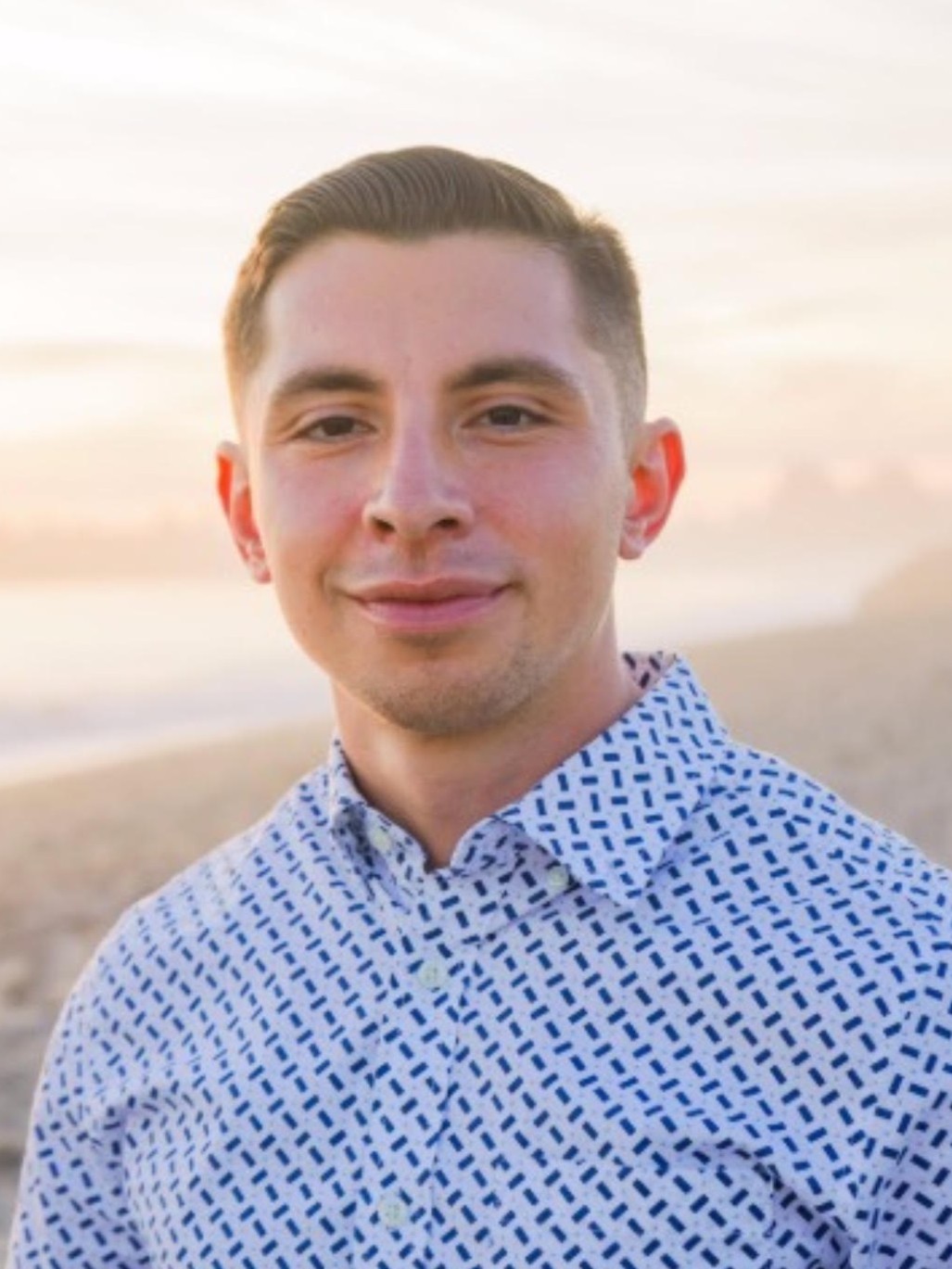
In 2024, his political targets included Measure Z, a proposed tax on distributors of sugar-sweetened drinks. (Contributed)
Activist support
Marin was first introduced to Measure Z by Santa Cruz County Supervisor Felipe Hernandez, who represents part of south Santa Cruz County. Over drinks at Lúpulo Craft House in Downtown Santa Cruz, Hernandez explained that local union leaders were concerned that the tax could threaten jobs for soft drink bottlers and distributors. There was an effort to legally challenge the tax initiative, he said, but it needed a city resident. Marin agreed to sue the city in his name.
No one in that conversation explicitly stated who was bankrolling the lawsuit, Marin said. But he understood that it was likely the beverage industry. Court documents show that Marin was represented by San Rafael-based Nielsen Merksamer, a firm with close ties to the beverage industry that went on to work on the No on Z campaign.
Marin’s suit challenged the ballot language for Measure Z, which included a list of health-based programs the tax money could be used for, even though it is legally a general tax that can be used for any purpose. A citizen committee makes recommendations on spending, but they are not legally binding. A tax for a restricted purpose would have required more than 66.6% of the vote, rather than a simple 50% majority.
It wasn’t the first lawsuit to take issue with the language of a soda tax. In 2014, an employee of Rodriguez Strategies moved to Berkeley, and soon after legally challenged its soda tax language as biased. The judge ruled that the ballot question must use the phrase “sugar-sweetened beverages” rather than “sugary, high-calorie drinks.”
Marin’s challenge was not as successful. A superior court judge allowed the ballot question to stand.
Marin continued to oppose the measure on social media, and denied rumors beginning to circulate that he was receiving payment for his vocal opposition. Those rumors resurfaced earlier this year when campaign finance documents revealed that in 2025, he had accepted money from a real estate industry-funded opposition group to oppose the 2025 Measure C real estate transfer tax. Marin had opposed the tax on the grounds it did not sufficiently tax the most expensive property sales.
He and the real estate interests “both didn’t want Santa Cruzans to be taxed, and that’s the only reason why we worked together,” he said on KSQD’s Talk of the Bay radio program in February.
In that interview, he strenuously denied accepting payment for his opposition to Measure Z. But in a recent interview with Santa Cruz Local, he acknowledged that in late summer of 2024, after the legal challenge had fizzled out, he was brought on to advise the opposition campaign for $5,000.
Marin is scornful of the beverage industry’s strategic engagement with Black and Latino communities.
“They were trying to utilize whatever equity that I had locally as a way for them to benefit,” he said. “They were backpacking on these people of color.”
But he did honestly oppose the tax, he said, albeit for different reasons than Coca-Cola and PepsiCo. And he was struggling, as he had been for years, to meet Santa Cruz’s high rents with a low-paying job as a paraeducator and intermittent side gigs as a server and dishwasher. It wasn’t wrong, he said, to take a check for devoting more time to an authentic political belief.
Besides, he said, he wasn’t the only one.
Another prominent young critic of Measure Z was Ayo Banjo, a former UC Santa Cruz student body president and past member of the Black empowerment nonprofit Santa Cruz Black. Banjo said in a recent interview that his opposition to Measure Z stemmed from an overarching commitment to reduce the cost of living. He denied accepting pay from the opposition campaign.
“I don’t care about soda,” he said. “What I care about is affordability.”
To that end, he has helped advance a taskforce for affordability in the City of Monterey, and hopes to do the same in Santa Cruz.
Banjo has been involved in Santa Cruz politics and activism for years, so he said he wasn’t surprised when he was contacted on Facebook by Joshua DuBois, a former spiritual advisor to Barack Obama and CEO of consultant and Black-led marketing firm Values Partnerships.
Banjo said he accepted a contract to help design digital platforms for political and marketing campaigns, plus a curriculum for young organizers and canvassers to be used for a future fellowship program.
Values Partnerships at the time was also working with the No on Z opposition campaign, election filings show. Banjo’s employers had mentioned the campaign, he said, but it had no bearing on his work — or his statements on social media and in interviews urging people to reject the soda tax.
“I’m nobody’s slave — not to the corporations, not to Values Partnerships, not to the city council, not to anybody,” Banjo said.
Banjo’s LinkedIn states that during his tenure with Values Partnerships from August 2024 to January 2025, he led “a high-stakes public health campaign impacting underserved communities,” and “implemented a comprehensive outreach strategy that not only educated the public but also presented equitable public health funding alternatives, enhancing community support and influencing local policy decisions.” Banjo said this verbiage, which he has since changed, was driven by a desire to secure future jobs in public health and did not reflect work on any political campaign.
Maviglio, the American Beverage Association spokesperson, said he could not confirm who in Santa Cruz had been paid by the campaign.
Marin said that Banjo had accepted money to fight Measure Z. Towards the end of the campaign, Banjo had stopped work on the effort and Marin was brought on, Marin said.
“They got themselves a new token,” Marin said.
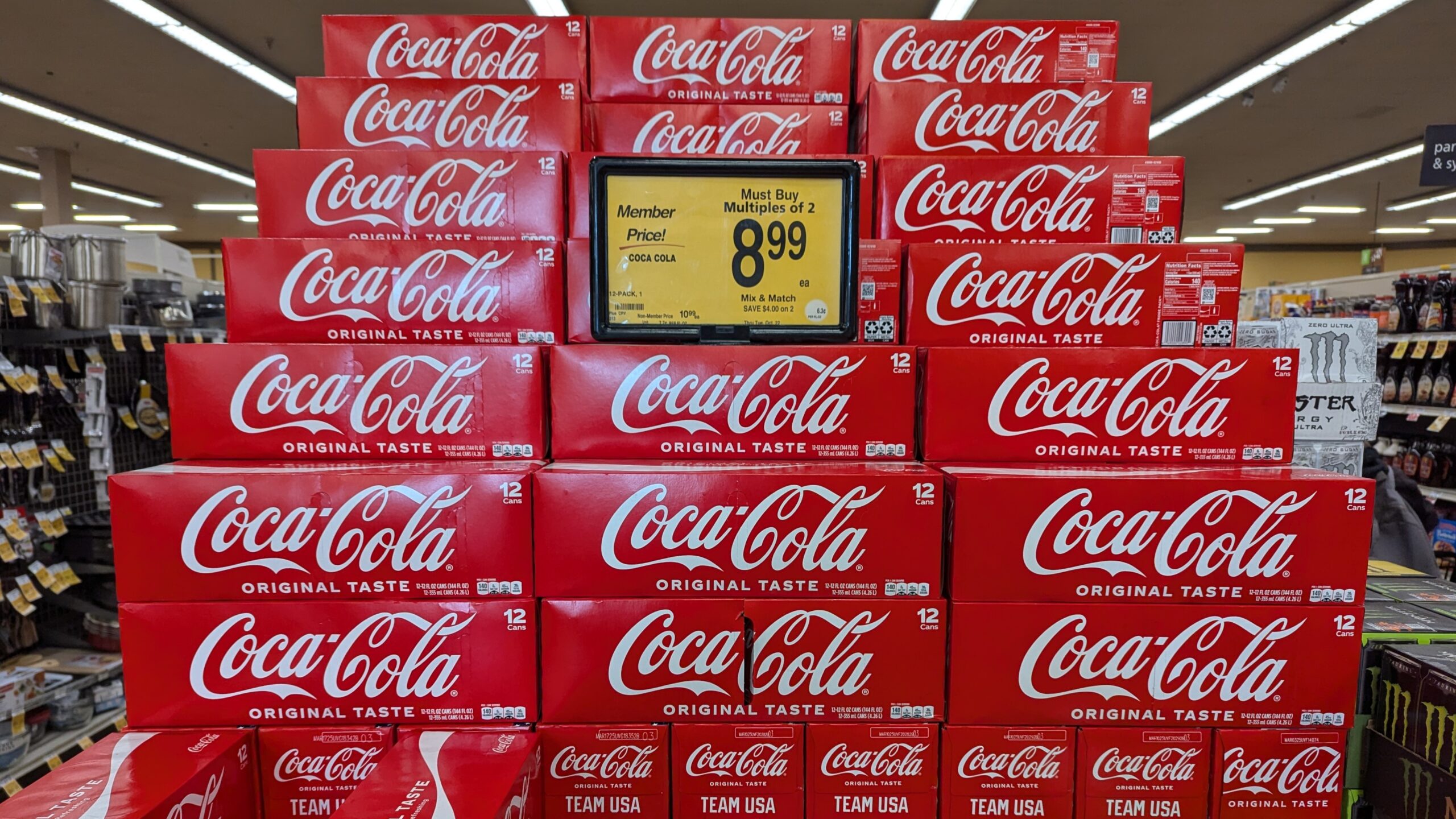
By 2017, Coca-Cola, PepsiCo and other soft drink companies had spent more than $40 million on consultants, canvassers and media campaigns to kill local tax efforts. (Stephen Baxter — Santa Cruz Local file)
A political ally
In October 2024, two weeks before the election, the opposition campaign gained a high-profile ally — Hernandez, the south Santa Cruz County supervisor.
Campaign consultants had repeatedly reached out to Hernandez to oppose the tax, he told Santa Cruz Local.
“I just ignored them for a really long time,” he said, but he ultimately spoke out against the tax in solidarity with unions who opposed it and concern for the potential loss of union jobs.
On Oct. 7, 2024, Hernandez emailed Rick Rivas, a vice president for the American Beverage Association, and Pedro Carrillo, the executive director of the Latino Caucus of California Counties, mentioning a recent meeting they had regarding Measure Z. In the email he said he had reached out to the United Food and Beverage Worker Union about the tax. Carrillo also leads Prime Strategies, a lobbying firm whose clients include PepsiCo.
Carrillo did not respond to requests for comment.
The Latino Caucus of California Counties, through multiple political action committees, was a major contributor to Hernandez’s campaign for supervisor in 2022. The caucus’ committee was funded in large part by the American Beverage Association. Neither committee contributed to his unsuccessful campaign for reelection for Santa Cruz County District 4 supervisor this year.
Hernandez said the past campaign contributions had not influenced his stance. He simply did not believe in taxing soda, he said, although he has experienced the health risk they pose.
“I used to have bottles of Pepsi or Coke, the big ones, like two of them,” he said. “And then in 2006 they told me I got pre-diabetes.” He said that now he mostly drinks water, or the occasional Coke Zero.
Hernandez did not respond to follow up requests to comment on the email or his coordination with Marin on the lawsuit to challenge Measure Z.
Loss and regroup
On election night in November 2024, as ballots for Measure Z began to be tabulated, Marin entered a swanky private room in the Hotel Paradox. It was, he said, “a legion of doom situation.”
The whole Measure Z opposition team was in attendance, including representatives from Coca-Cola, PepsiCo and Dr Pepper. Their political consultant teams, their union allies. Rick Rivas, Hernandez.
Banjo said he had attended the election night party at Hotel Paradox at the invitation of Values Partnerships, but left after realizing the gathering mostly consisted of industry donors.
The group clearly anticipated victory, Marin said. But after the first count of ballots were reported, showing early support for the tax, the mood soured.
In the final tally, Measure Z won with 52% of the vote. It wasn’t an overwhelming margin of victory for supporters — but it was a $2 million failure for the beverage industry.
Their attention soon refocused on the courtroom.
The Measure Z opposition campaign had warned of a costly lawsuit if Santa Cruz defied the 2018 state ban on food or beverage taxes. Soon after Santa Cruz voters approved Measure Z, lawyers with the American Beverage Association followed through on the threat, and sued Santa Cruz city in Sacramento Superior Court. In response, the city argued that state rules only supersede charter cities’ laws in matters of statewide importance — and that maintaining the cost of sugary drinks does not rise to that level.
In a hearing May 8 of this year, lawyers for the American Beverage Association and its co-litigants argued that the courts shouldn’t be in the business of determining if something is too unhealthy to be considered a legitimate grocery worthy of protection from taxation. “As we know, nutritional sciences is something that’s heavily debated,” said one lawyer.
Judge Stephen Acquisto peered down from the bench. “Are you saying the jury is still out on whether soda is healthy?”
On June 29, Acquisto ruled that Santa Cruz’s right to tax overrode the state preemption. But the ruling is expected to be appealed, and could remain tied up in the courts for years.
Over the next fiscal year, the city expects to collect more than $4 million through Measure Z. But though an advisory committee has been formed to make spending recommendations, the money will remain in limbo until the legal fight is resolved.
One upcoming soda tax campaign isn’t waiting on a final ruling.
The next fight
This November, Berkeley residents will consider doubling its tax on sugar-sweetened beverages — a move made legally possible because the initial tax was approved before the 2018 state ban. So far the tax has paid for school gardens and nutrition education, plus grants to community organizations for public health efforts. The new measure would legally protect the money from being used for any other purpose.
Xavier Morales, a Berkeley resident who backed the initial 2014 effort, expects the beverage industry’s opposition machinery to soon start again. He also expects it to fail — in part due to equity measures baked into the original tax design that seek to address the concerns of marginalized communities.
Well before the Berkeley campaign, Morales saw the power of the beverage industry as the executive director of the nonprofit Latino Coalition for a Healthy California, as he tried to advance statewide regulations on sugary drinks.
One of the beverage industry’s opposition strategies, he said, is to prey upon the very real economic inequities and disenfranchisement felt by marginalized communities. In Richmond, for example, a 2012 soda tax effort was resoundingly defeated, in large part due to opposition from Black community leaders. “It was just really interesting to see how the beverage industry was able to drive wedges,” he said.
Beverage industry representatives have consistently argued that soda taxes are regressive because small price increases are felt more keenly by low-income consumers, including Black and Latino communities. The Berkeley organizers learned that was partially true — people of color tend to consume more soda and would disproportionately bear the brunt of the tax.
“A well designed tax, one that reinvests the funds into communities that are experiencing the worst outcomes — to me, that’s not a regressive tax,” Morales said.
The final tax initiative explicitly called out examples of health inequities associated with sugar consumption, including that Black Berkeley residents are 14 times more likely than white residents to be hospitalized for diabetes.
Organizers had initially proposed to use the money to replace a sunsetting grant for schools gardening programs. But they also began to consider the ongoing gentrification of the city, and the health inequities among communities of color. After voters approved the tax, an appointed panel of experts recommended that more than 40% of the money be distributed to community-based organizations, prioritizing those serving marginalized communities.
When Morales in 2014 canvassed Latino neighborhoods in West and South Berkeley for the soda tax, many people he spoke with were concerned about the potential economic impact, he said. But they also strongly supported efforts to stem the consumption of soda and its associated health harms.
Even some who didn’t envision giving up soda said they wanted their families to consume less, Morales recalled.
“A lot of the older adults, the more elderly, they’re like, ‘I’m too far gone,’” Morales relayed, “‘but I don’t want my grandkids to be doing this.’”
Editor’s note: This story has been updated to clarify Ayo Banjo’s characterization of his involvement with the Measure Z campaign.
Monica Camacho contributed to this story. She is an open source investigator who worked at Lighthouse Reports, a nonprofit newsroom specializing in cross-border collaborations.
This investigation was produced in collaboration with Lighthouse Reports, Agência Pública (Brazil), Cuestión Pública (Colombia), Follow the Money (the Netherlands), Il Fatto Alimentare (Italy), L’Espresso (Italy), O Joio e O Trigo (Brazil), Quinto Elemento Lab (Mexico), The Guardian (UK) and The Wire (India).
Questions or comments? Email [email protected]. Santa Cruz Local is supported by members, major donors, sponsors and grants for the general support of our newsroom. Our news judgments are made independently and not on the basis of donor support. Learn more about Santa Cruz Local and how we are funded.

Jesse Kathan is a staff reporter for Santa Cruz Local. They hold a master's degree in science communications from UC Santa Cruz.

Elena DeBre is an investigative journalist at Lighthouse Reports, a nonprofit newsroom specializing in cross-border collaborations.