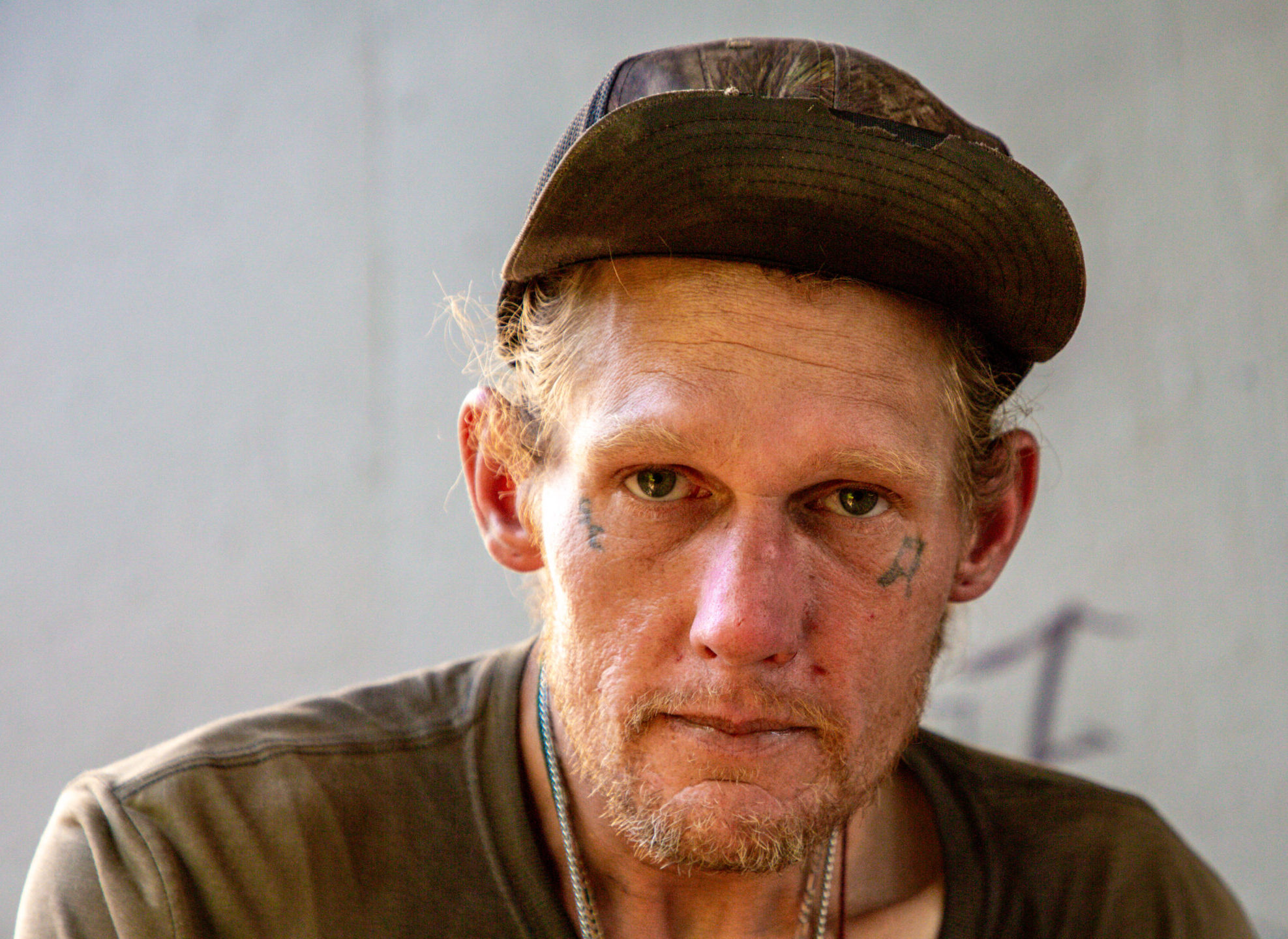
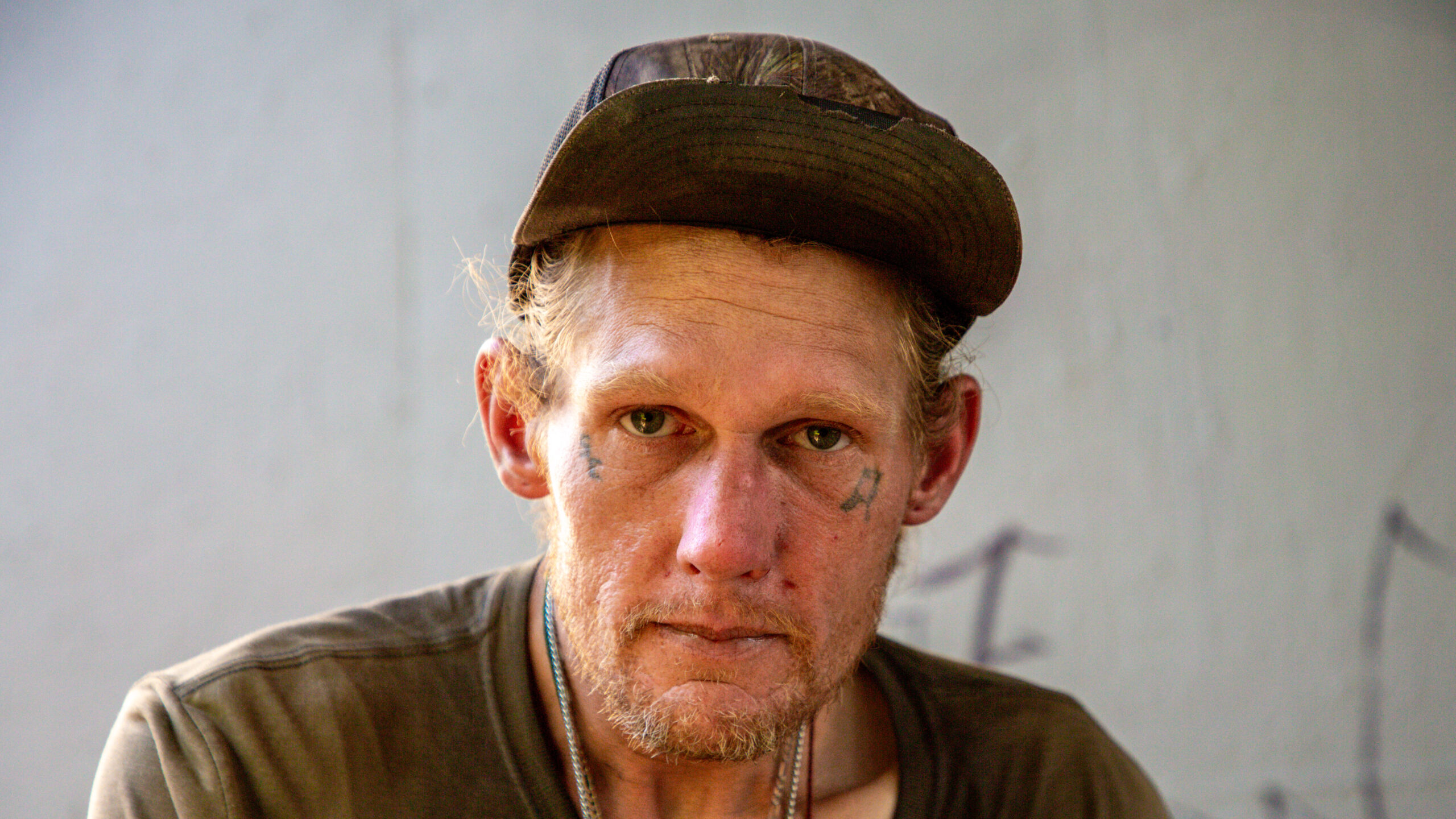
Kevin Kraft poses for a portrait on the San Lorenzo River levee. (Amaya Edwards — Santa Cruz Local/CatchLight Local)
SANTA CRUZ >> Kevin Kraft crouched with his two dogs, both named Scruffy, beneath the Highway 1 bridge over the San Lorenzo River on a recent Wednesday afternoon. Usually, the three would have been sitting next to his tent and socializing with friends nearby on Coral Street.
For the past year and a half, the city has increasingly cracked down on people living on Coral Street near nonprofit Housing Matters’ homeless services shelter, and along the train tracks nearby. On Aug. 10, the city cleared out and fenced off much of that area, forcing Kraft to move to the San Lorenzo River Levee. The following week, police swept the river levee of encampments and took most of his belongings.
“Everything — my clothes, my dog food, my tent, everything. Literally everything,” Kraft said of what he lost.
Housing Matters ended its day services earlier this year, as part of the same effort to reduce the chaos in the streets outside their campus. A 120-unit permanent supportive housing project called Harvey West Studios is set to open soon, and Housing Matters CEO Phil Kramer told Santa Cruz Local in October 2025 that they closed day services to help foster a safer environment for the people who would soon be living in the new housing.
“Casa Azul has been a really eye opening experience and has informed this decision in that we recognize that we need to do a better job at providing a safe, welcoming, conducive-to-healing environment as [residents] stabilize in their new housing environment,” Kramer said at the time.
Casa Azul is Housing Matters’ seven-unit permanent supportive housing project across the street from its Coral Street campus. An 18-month old toddler died of a fentanyl overdose at Casa Azul in 2024.
However, in an email this week, Chief Impact Officer Mer Stafford said that the fences were not a part of their own efforts to improve safety along Coral Street before the opening of the Harvey West Studios, located at 119 Coral St.
Fences went up last month to “restore access to public spaces on Coral Street and allow field crews to safely clean and maintain the area,” said city spokesperson Erika Smart.
In March, as the city conducted near-weekly sweeps of the encampment, Director of Homelessness Response Larry Imwalle said in an interview that the sprawl of the camp over sidewalks and into the street presented danger for pedestrians, drivers and camp residents.
“As a municipality, we have a responsibility to all residents,” he said. “We have a joint responsibility to care for the people that are living in encampments, as well as maintain the health and safety of our open spaces. That’s the fundamental tension in this work.”
Kramer said in March that he was supportive of efforts to dissuade the encampment, but he has advocated for the city to create more safe places for people to sleep.
“We’re asking people to move to an unknown place,” he said in an interview on March 17. “There is no magical place that is somewhere else, right? It doesn’t exist.”
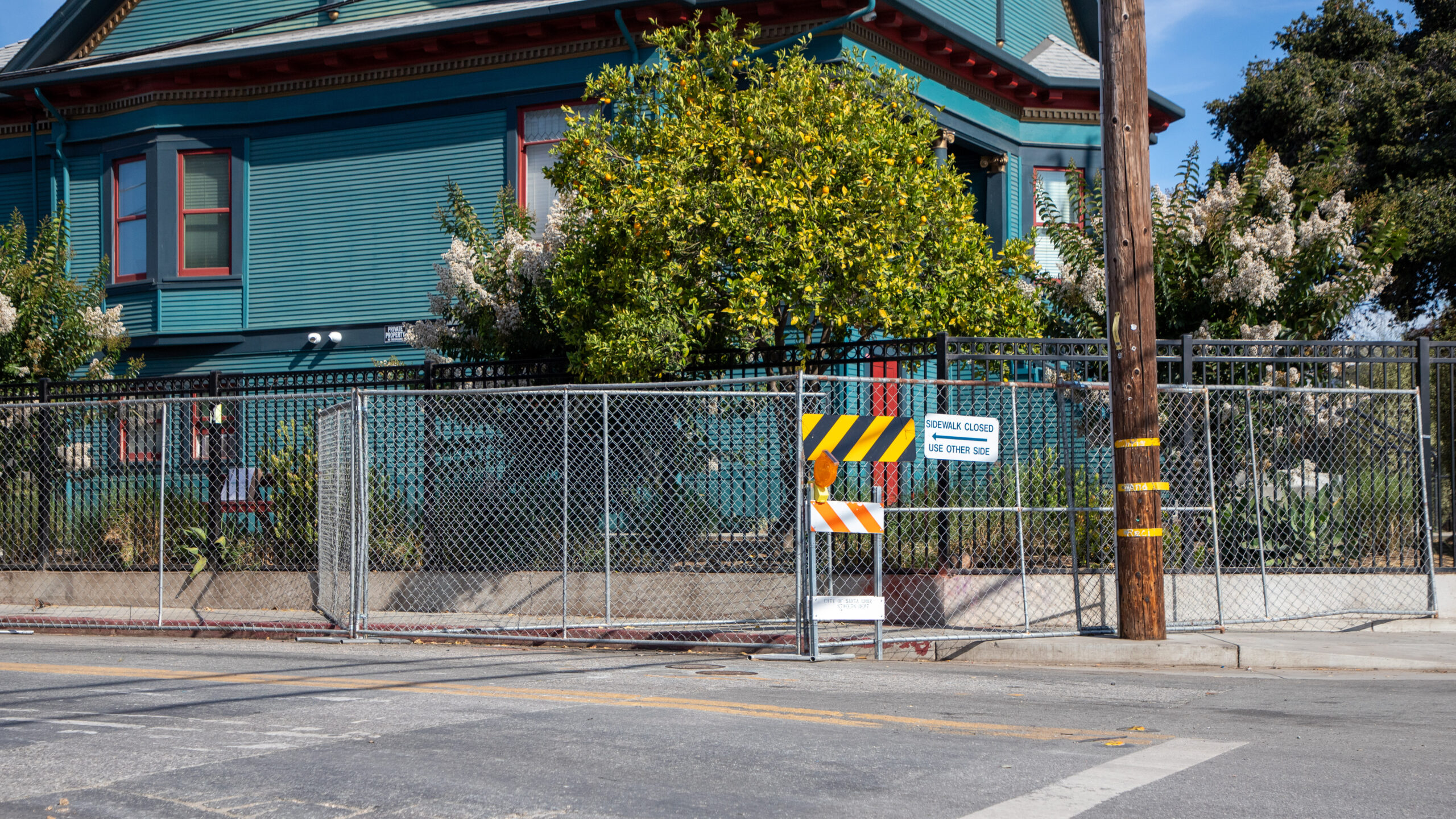
Fences placed along the north side of Coral Street near Housing Matters. (Amaya Edwards — Santa Cruz Local/CatchLight Local)
Still living outside
Homeless people no longer live outside on Coral Street. But many are still living outside, including many who have been unable to secure a shelter spot. Only now, they are scattered across the levee, the Pogonip and throughout the city, subject to frequent encampment sweeps and further isolated from outreach workers, familiar faces, and any sense of stability.
“I wouldn’t say I felt safer there, but there was a sense of community, and if I needed services it was right there,” Kraft said.
Now, he sleeps in a different outdoor spot almost daily.
Kraft said he was on a waitlist for temporary supportive housing at Housing Matter’s Live Oak Landing, a former hotel that opened in July with 20 beds. But he missed his intake appointment in July and hasn’t been able to reschedule.
Housing Matters purchased the hotel with the help of a $4.03 million Encampment Resolution Fund grant from the state. That grant also helped pay for targeted outreach efforts to Coral Street residents over the past two years.
As of mid-June, outreach funded by the grant helped 60 people into shelters, including The Loft on the Housing Matters campus and the city-funded Armory/Outlook Emergency Shelter, said Christine Smith, senior manager of campus operations at Housing Matters. Some have since moved into permanent housing or Live Oak Landing.
But the need for housing like Live Oak Landing far outpaces the supply, and those left on the street have found daily survival increasingly difficult.
Even before the camp was dismantled, Kraft and other Coral Street residents were struggling to access mail, water and electricity since the day services closed in April.
Since then, Kraft said he has struggled to keep his phone charged and stay in touch with a case manager, which is usually required for temporary housing programs. Without a consistent place to sleep, staying in touch has grown even more difficult.
A sense of community
Kit Wiggins, Nik Saxton and their chihuahua were living in their car on Coral Street for six months. Now they travel between San Lorenzo Park and different friends’ homes. Wiggins said she was working at a lab in Fremont before losing her job and hasn’t been able to get hired since 2025.
Like Kraft, they had mixed feelings about the Coral Street camp. “There’s safety in numbers,” Saxton said. “But there’s also danger in numbers.”
They haven’t yet been able to get into the Armory/Outlook Emergency Shelter. After texting a city outreach worker, they were told they were on the interest list for the shelter. That was July 20.
Along with a safe place to sleep, a shelter would give them a mailing address, something they’ve lacked since the closure of Housing Matter’s day services.
“I mean it’d definitely be a step in the right direction,” Saxton said. “People don’t realize how important it is to be able to have a place to get your mail.”
Even as Santa Cruz spends millions of dollars each year on emergency shelters, the city lacks the stable state funding necessary to grow capacity, said Imwalle, the homelessness response director, in March. Although he said Coral Street residents had been offered shelter, he acknowledged that the city’s shelters are effectively “at full capacity, because when we have an opening, we’ve got some folks in the pipeline.”
Denise Elerick of the Harm Reduction Coalition of Santa Cruz County said that displacing camps can be dangerous for people living outside. Outreach teams like those led by the coalition have a harder time providing services when a large sweep occurs and people are scattered, and often more hidden.
“I’d say one of the more shocking results of these types of events are the impacts long term on health outcomes and overdose risk for people that are now moved away,” Elerick said. “They lose a lot of prescriptions, lots of identification, necessary documents.”
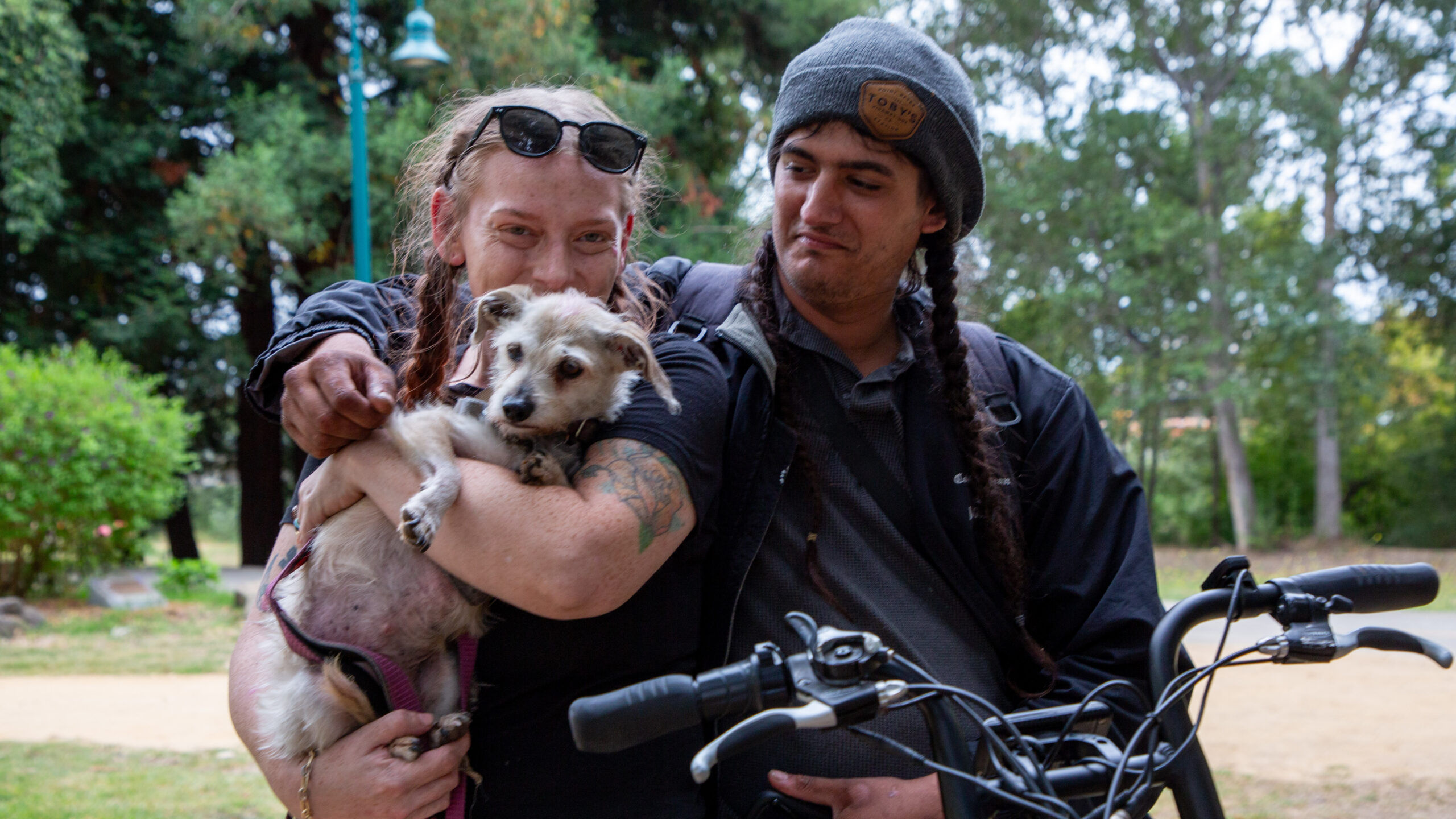
From left, Kitt Wiggins and Nick Saxton pose for a photo with their dog, Dasha, at San Lorenzo Park on Aug. 27, 2026. (Amaya Edwards — Santa Cruz Local/CatchLight Local)
Anna Koplos-Villanueva, also with the Harm Reduction Coalition, said that helping unhoused people often requires the efforts of multiple outreach workers and organizations. Sweeps break up these fragile connections.
“The direct result is that people are harmed, and that’s everything from treatment and chronic illness management to the safety and survival that happens in small communities,” Koplos-Villanueva said. “People are so interdependent in such incredible, beautiful ways, and so the fragmentation of resources also means that people lose touch with maybe their safety net, and that can extend for days to weeks at a time.”
M, 30, also left Coral Street after the fences went up and started staying near downtown. M said she escaped domestic violence and for the last three years has tried everything to get stable housing, but hasn’t been successful. Santa Cruz Local is not using her full name due to M’s fears of retaliation and to protect her identity.
She said she wishes that instead of thinking about how to get off the streets, she could instead be thinking about starting a family.
“I can’t even do that. I would love to just have a job and pay rent and go home,” she said. “It should not be untouchable.”
Questions or comments? Email [email protected]. Santa Cruz Local is supported by members, major donors, sponsors and grants for the general support of our newsroom. Our news judgments are made independently and not on the basis of donor support. Learn more about Santa Cruz Local and how we are funded.

Amaya Edwards is Santa Cruz Local's Photo and Social Media Journalist. She is a Catchlight Local Fellow.

Jesse Kathan is a staff reporter for Santa Cruz Local. They hold a master's degree in science communications from UC Santa Cruz.