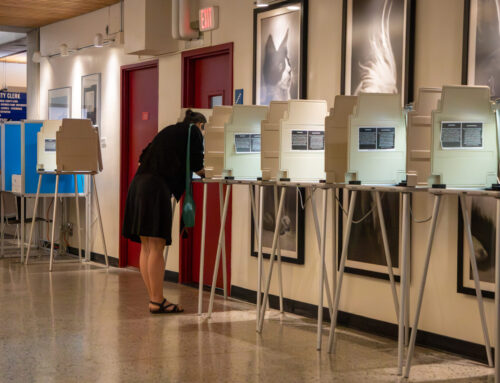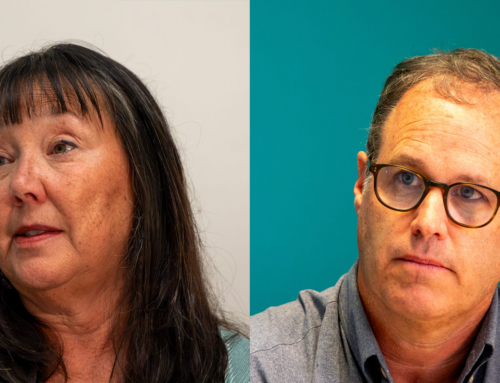

Candidates for Santa Cruz City Council and mayor answered questions about the most critical issues facing local residents at a candidate forum at the Kaiser Permanence Arena on May 14. (Amaya Edwards — Santa Cruz Local/CatchLight Local)
SANTA CRUZ >> Ahead of the June 2 primary election, candidates for Santa Cruz City Council and mayor offer sharply diverging visions for homelessness policy.
Read on to hear how candidates described their views on homelessness in interviews with Santa Cruz Local. For more on candidates’ positions on important local issues, including on affordable housing, road safety and government transparency, read the full June 2 Election Guide.
Expand forced treatment
A few candidates said that some homeless people should be forced to undergo treatment for substance use or mental illness, and that the city should leverage recent changes to state rules.
- “It’s critical that we have those tools to get people off the streets and the help they need,” said mayoral candidate Ryan Coonerty.
- Mayoral candidate Gillian Greensite said based on her family’s experience with people in need of mental health care, she thinks forced treatment “would be helpful.”
- “If it works to improve the mental health challenges of our residents,” people should be forced into treatment to “ensure that we provide a safer Santa Cruz for everyone,” said Hector Marin, district 4 city council candidate.
- District 6 City Councilmember Renee Golder, who is seeking reelection, said she sees the lack of forced treatment as the abandonment of people in dire need of help. “As a society, it’s gross to me that we’re letting people live like this,” she said.
In a 2025 survey of about 400 homeless people in Santa Cruz County, 54% reported psychiatric or emotional conditions and 50% reported substance use disorder.
The recent changes to state law include CARE Court, which provides a treatment plan for people with severe mental illness like schizophrenia or bipolar disorder. The program is voluntary, but those who don’t complete it may be referred to involuntary conservatorship. Statewide, the program has helped fewer people than expected in its first two years.
Separately, state law has expanded the definition of “grave disability” to include severe substance use disorder. Those with grave disability can be held for 72 hours, and those still unable to care for themselves may be subject to more extensive forced treatment or long-term conservatorship.
In a December report to the supervisors, county staff wrote that they anticipate more short-term substance use treatment, but don’t anticipate many more long-term conservatorships. In San Luis Obispo county, which started enforcing the expanded criteria in 2024, “most people stabilized with short-term treatment, detox support, or housing-focused services, and did not meet the higher legal standard” for conservatorship, staff wrote.
Open more shelters
Many candidates agreed that the city needs to open more emergency shelters for homeless people, including tiny homes or small-scale managed tent camps.
- Mayoral candidate Chris Krohn said would support more small, low-barrier tent sites. Although he does not want to recreate past unsanctioned camps like the Ross Camp, “there were less people sleeping all over town” when camping was more centralized, he said.
- Joy Schendledecker said each of the city’s six electoral districts should choose potential sites for small camps, transitional housing and sober living. “You can choose where, but you can’t not choose,” she said.
- Ami Chen Mills called for a “half-managed” encampment. “People need to feel some empowerment. They need to take some responsibility,” she said. “If we’re down to people who are more chronically homeless, we need to really think about what’s going to work for these people.”
- “If we’re seeing a recurring theme that our housing solutions aren’t enough, then that’s not a problem with the people who are living in their tents,” said Gabriella Noack, candidate for district 6 city council member. “That’s a problem with the solutions that we’re presenting.”
- Marin said he wants to open a warming shelter throughout winter and part of spring, and ensure any new shelters are not too close to schools.
The proposals for new shelters come amid declining state and federal funds for homelessness services, while other federal cuts threaten to push more people into homelessness.
City officials have already signaled that they may consider closing a 24-hour safe parking site at the Armory Overlook Shelter because of the program’s high cost.
Local nonprofit Housing Matters announced Friday it would reduce capacity in two of its shelters by 20 beds total, beginning next month. Housing Matters ended day services for homeless people in April, significantly impacting homeless Santa Cruz residents’ access to services.
As with plans to expand affordable housing, new homelessness services could require a new source of local funding.
More enforcement
Some candidates want to increase enforcement efforts for people camping in public areas.
- Coonerty said he wants to offer homeless people mental health treatment, shelter placement or a path to relocate through an expansion of the county’s Homeward Bound Program. Those who decline those options should be subject to camping restrictions, he said. If more people in shelter are routed into housing, treatment or a path out of town, more shelter beds will be available for those on the streets, he said.
- Greensite said she wants “zero tolerance for camping in our open space lands — they’re too vulnerable. We cannot afford to have fires in there as we go in summer.”
Though city shelters have frequent turnover, the number of homeless people outnumbers available shelter beds. A 2024 court ruling would allow Santa Cruz Police to enforce camping bans even if they cannot guarantee a shelter bed.
Fewer sweeps
Other candidates are advocating for the opposite tack, scaling back homeless sweeps to save money on police and to prevent the trauma and health risks researchers say accompany displacement.
Santa Cruz Police currently conduct frequent sweeps of an encampment on Coral Street near the Housing Matters homelessness services campus. Homeless residents and advocates have decried the practice, even as city and Housing Matters leaders say they are necessary to address health and safety risks. Housing Matters has called for the city to establish more safe places for people to sleep.
- Schendledecker said of encampment sweeps, “How is that doing anybody any good, and how much is that costing our police department?”
- Sweeps are “literally illogical,” said Noack, “because where are people going to go?”
- Chen Mills said although she sees the need for sweeps, “I’m not sure the way we’re doing it is the best, or the most humane.” She said she’d like for non-police staff to do cleanups, and to ensure people’s belongings are cared for.
- Marin said although he doesn’t want more sweeps of homeless encampments, he wants more response to safety concerns from Downtown businesses. He said he wants to hire more police officers and mental health liaisons to respond to disturbances and route people towards mental health and shelter services.
Read our 2026 election guide
Questions or comments? Email [email protected]. Santa Cruz Local is supported by members, major donors, sponsors and grants for the general support of our newsroom. Our news judgments are made independently and not on the basis of donor support. Learn more about Santa Cruz Local and how we are funded.

Jesse Kathan is a staff reporter for Santa Cruz Local. They hold a master's degree in science communications from UC Santa Cruz.