
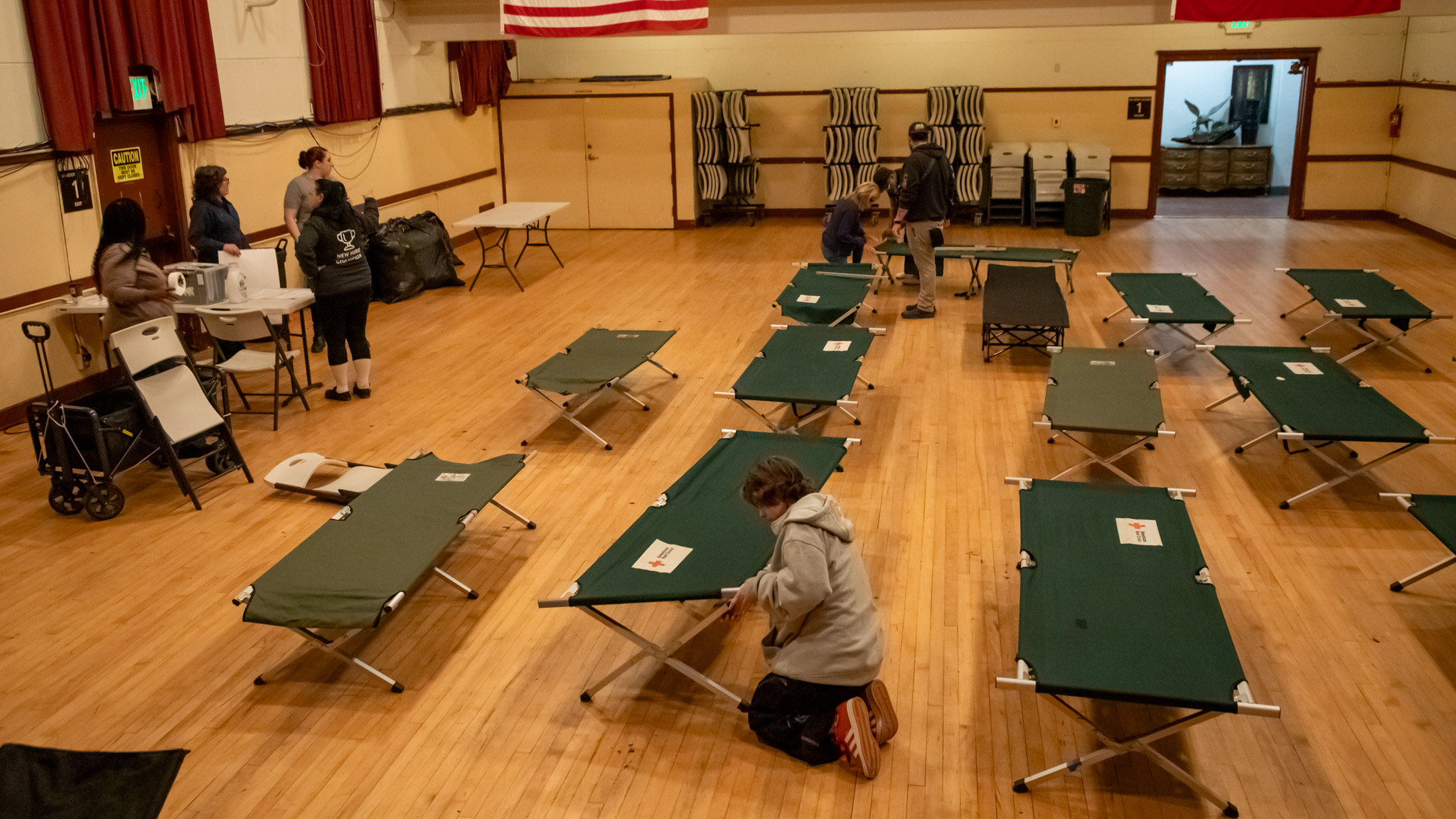
Volunteers and workers with People First prepare to open the extreme weather shelter at the Santa Cruz County Veterans Memorial Building in Santa Cruz on Friday, Jan. 9. (Amaya Edwards — Santa Cruz Local/Catchlight Local)
SANTA CRUZ >> On a recent Thursday night, the Santa Cruz Veterans Hall is quiet, apart from snoring and the occasional cough.
Dozens of cots form a grid beneath the tall ceilings with faded art deco flourishes. About 60 people sleep beneath blankets, their backpacks by their sides. At 10 p.m., as the temperature drops near 40 degrees, people are still filtering into the shelter.
Dawn Jacobson, 43, winds her way between the cots, in constant movement between the two floors of the Veterans Hall and the outside entrance. A short, speedy woman with a faded tattoo on her temple, Jacobson helps run the severe weather shelter for local nonprofit People First of Santa Cruz County, which is contracted with the county to open shelters in Watsonville and Santa Cruz during cold snaps and floods.
The contract, which is partially funded by the cities of Santa Cruz and Watsonville, allows for up to 20 nights of operation a year. The shelters open when temperatures are forecast to drop below 38 degrees for two or more consecutive nights, when there are inland flood warnings, or when the county issues evacuation orders due to excessive rain.
In December, with heavy rains and temperatures in the low 40s, the shelters remained shuttered.
Advocates say it’s not enough. Jacobson and Sara Coon, another shelter worker, want the county to expand its protocol to include three or more nights of weather below 42 degrees.
County leaders could reconsider the thresholds for opening the shelter during budget talks in May. But the ask for more funding comes as the county contends with federal cuts to other homelessness and welfare programs.
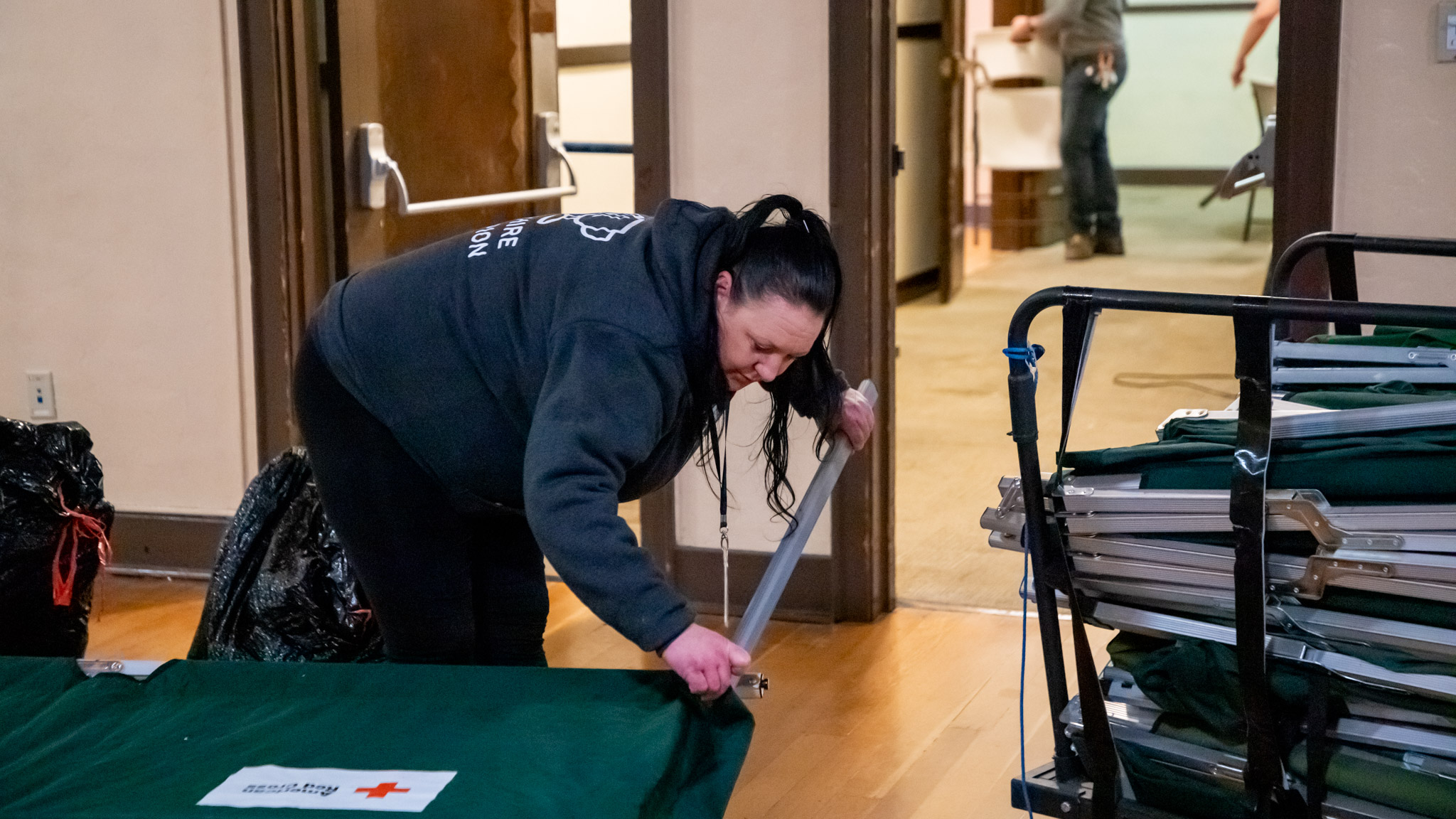
Dawn Jacobson, severe weather shelter site manager for nonprofit People First of Santa Cruz County, sets up cots at the Santa Cruz Veterans Hall on Friday, Jan. 9. (Amaya Edwards — Santa Cruz Local/Catchlight Local)
Homeless helping homeless
Jacobson has been at the shelter since 7 p.m., after a full day’s shift at Chipotle, and won’t leave until nearly 2 a.m.
A lot of the guests are familiar faces. Like many of the people working, she is formerly homeless herself. After more than a decade struggling with alcoholism, Jacobson is now sober and living in a mobile home in Scotts Valley.
“I’ve been going from being a major alcoholic, like having seizures if I didn’t drink, to being where I’m at, where I got three jobs,” she said. In addition to working at the severe weather shelter for the past three years, she also works for People First doing outreach.
Not all the nights at the shelter are so quiet, she said. Many of the guests have an addiction, mental illness or physical disability — all of which can be worsened by being out on the street, especially in recent rains and cold snaps.
When problems or conflicts do arise during the night, workers with lived experience of homelessness can be effective at de-escalating the situation, said Coon, who is also formerly homeless.
“Homeless respect the other homeless, and they’ll listen to them,” she said.
As the hours stretch past midnight, a dozen or so cots sit empty. Jacobson worries that people on the San Lorenzo River levee or in the Pogonip may not have heard that the shelter is open. She also worries about the rest of the winter season — with few alternatives, people will inevitably spend frigid nights without shelter.
Waitlists, limited options
The largest shelter in the county is the Armory Overlook Emergency Shelter, which hosts up to 135 people at the National Guard Armory in DeLaveaga Park. It’s full most nights, and people may be on the waiting list for days before they’re offered a spot, said Evan Morrison, executive director of People First, which manages the Armory shelter.
“I think you’re going to find a wait list everywhere,” he said. There are 12 shelters in Santa Cruz County with fewer than 500 beds combined. The most recent count of the homeless population estimated that about 1,120 homeless people in the county live without shelter in vehicles, camps or on the street.
Even when spaces are available, some people can’t stay in a typical shelter, Morrison said. Some have had a bad experience and don’t want to try again, while others “know their challenges and they know their personalities and they know that shelter spaces aren’t going to work for them,” he said.
But many people will visit the severe weather shelter for a night away from the elements. Morrison said ideally they would open for about 30 days a season, rather than 20.
The severe weather shelters are managed by the Santa Cruz County Office of Response, Recovery and Resilience, which deals with natural disaster response. The thresholds for the shelter opening were developed in 2023 to align with similar nearby emergency shelters, said director Dave Reid.
It costs $7,200 to operate each site for one night, Reid said, and the county hasn’t found any state or federal grants to bear part of the cost.
Within the past decade, the availability of winter shelter has varied year to year. In 2024, Santa Cruz County Supervisor Justin Cummings, who represents most of the city of Santa Cruz, helped push through a contract with People First that instituted the requirements to open the shelters. The following year, the county established joint funding for the shelter with the cities of Santa Cruz and Watsonville.
But with threats of defunding critical programs at the federal level, Cummings said the county will focus its limited funds on bracing for possible cuts to Medi-Cal and CalFresh. They might consider expanding the thresholds for the shelter, but he said it’s not guaranteed.
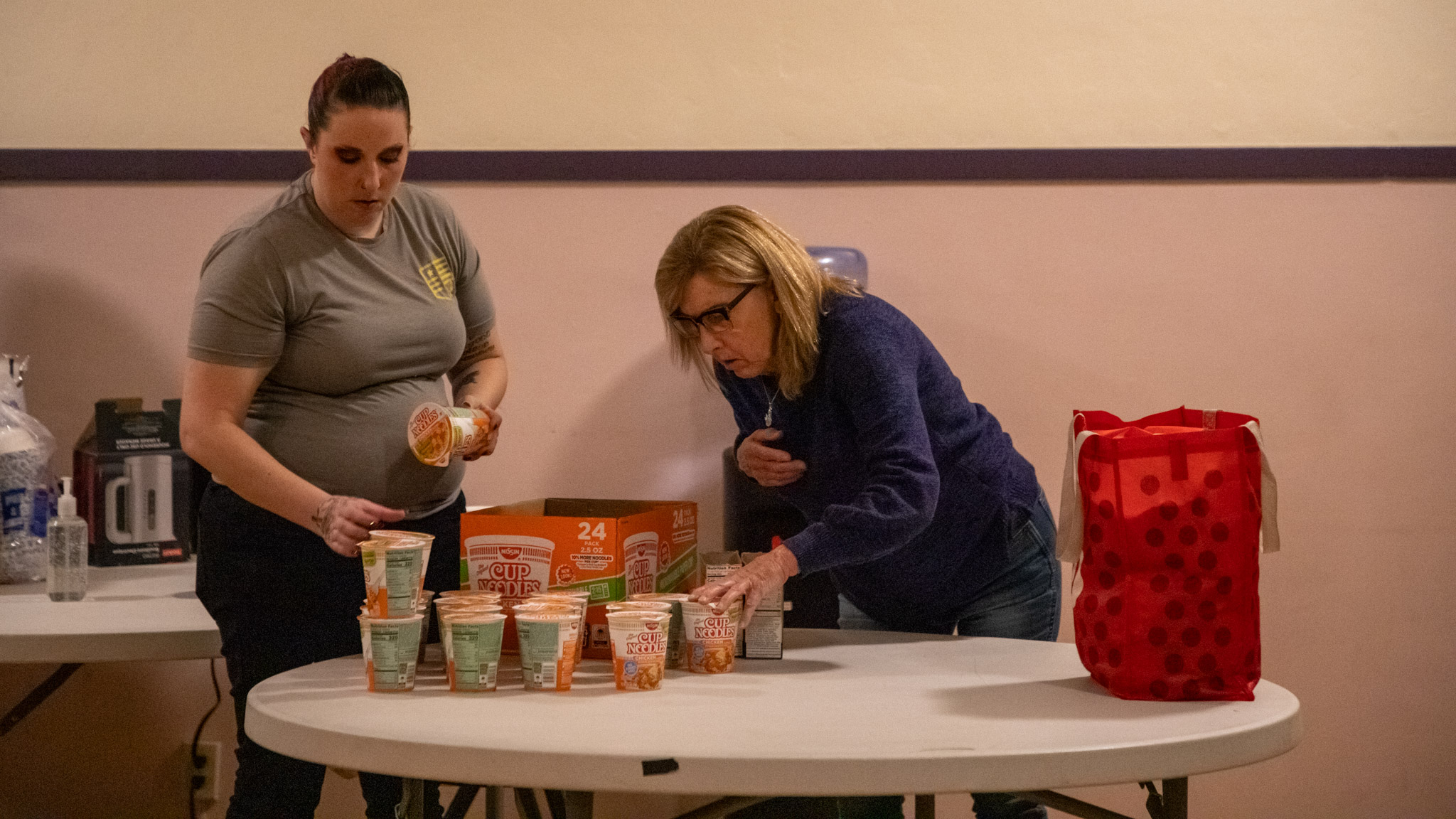
Ashley Hoelscher, left, supervising case manager at Nation’s Finest Veteran Services, and Doreen Tighe, right, organize food for those staying at the city’s extreme weather shelter on Friday, Jan. 9. (Amaya Edwards — Santa Cruz Local/Catchlight Local)
The night shift
As it grows colder, work at the shelter continues.
Jacobson takes the elevator upstairs to check on the makeshift all-night diner with pizza, granola bars, water and a phone charging station — then rushes down to open the front entrance for a wheelchair user.
Up again to get an extra blanket, then down to help a man who vomited over the side of his cot onto a garbage bag of his belongings.
A few other workers help her clean the mess and disinfect the floor. Then they help the man into his wheelchair and outside for some fresh air.
“You look good, Dawna,” said a man on his way in, an old friend from the streets. “I looked good when I was sober, too.”
It took her years to get here, after more than a decade in and out of jail for driving under the influence and drug possession. “I thank God for People First, because my life was just somewhere it shouldn’t have been,” she says.
Living in an RV on Delaware Avenue, a People First outreach worker offered her a spot at the safe parking facility at the Armory, where she could park her RV and get help securing permanent housing. Once there, she started to gain more stability.
But getting into a home, she says, was mostly luck. Her grandmother died and left enough money for Jacobson to buy a mobile home in Scotts Valley. She now lives with her 20-year-old son, who spent most of his childhood raised by his grandmother.
Around 1:30 a.m., Coon arrives to take over until the shelter closes at 8 a.m.
By the time Jacobson’s son picks her up, she only has seven hours until she has to be at Chipotle for another eight-hour shift. Then she’ll be back at the Veterans Hall, letting people in from the cold.
Questions or comments? Email [email protected]. Santa Cruz Local is supported by members, major donors, sponsors and grants for the general support of our newsroom. Our news judgments are made independently and not on the basis of donor support. Learn more about Santa Cruz Local and how we are funded.

Jesse Kathan is a staff reporter for Santa Cruz Local. They hold a master's degree in science communications from UC Santa Cruz.