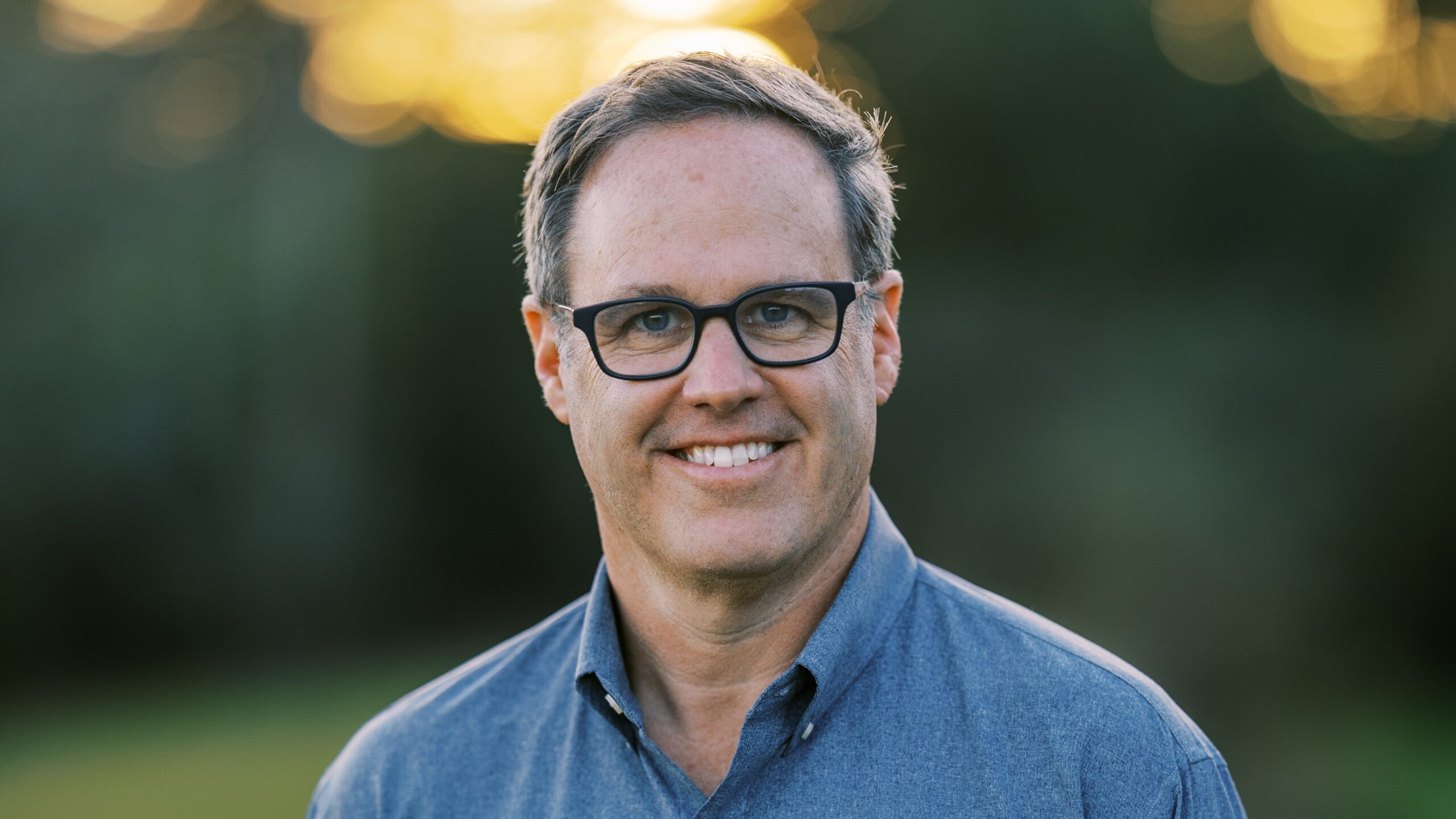
Ryan Coonerty, who has served on the Santa Cruz City Council and the Santa Cruz County Board of Supervisors, announced his candidacy for mayor. (Tori Ow — Contributed)
SANTA CRUZ >> Days into the official start to the race for Santa Cruz Mayor, former Santa Cruz City Councilmember and Santa Cruz County Supervisor Ryan Coonerty announced his candidacy — and received unanimous support from the sitting council and mayor.
As of yet he is the sole candidate vying for the four-year seat.
Coonerty is centering his campaign on a vision for a cleaner, more economically vital and equitable Santa Cruz, and said he isn’t as focused on specific ideas of how to get there.
“I’m more focused on the day-to-day feel and vitality of our community, and tangible action, rather than any specific policy ideas,” he said. “We make a lot of policy in Santa Cruz. We have a lot of conversations. I really want to focus on action.”
In the coming months, Santa Cruz Local will report in depth on the mayoral race and others in the June primary. First, here’s a primer on Coonerty’s record and campaign priorities.
He has deep ties to the Santa Cruz political scene, and deep support.
Coonerty has spent a cumulative 16 years as a local elected leader. He sat on Santa Cruz City Council from 2004 to 2012, serving as an appointed mayor in 2008 and 2011. He was then a county supervisor from 2014 to 2022.
He followed in the footsteps of his father, Neal Connerty, who served two terms as supervisor and had a stint on the city council in the 1990s. In 2014, Coonerty took over the District 3 county supervisor seat from his father.
After two terms on the board of supervisors, in 2022 he chose not to seek a third, citing a desire to spend more time with family and allow more diverse candidates to run for office.
Now, he said he’s back because of the political moment.
“I really was certain I was done, I told my family I was done,” he said. But “we’re in this big moment of crisis and change and uncertainty, and both at the national level and the local level, and I feel like I have value to add to help us navigate through that and hopefully emerge stronger at the end of it.”
Unlike Coonerty’s previous one-year terms as an appointed mayor, he said the four-year directly elected seat established in 2022 will allow him time to pursue his agenda.
“I really feel like we can get some immediate results, but then also work on some long term initiatives that will pay dividends in decades and generations,” he said.
Coonerty has already garnered significant support from current and former local elected officials, including all five members of the Santa Cruz City Council, Santa Cruz Mayor Fred Keeley, Assemblymember Gail Pellerin (D-Santa Cruz) and U.S. Sen. Jimmy Panetta (D-Santa Cruz).
Some supporters have already worked closely with him. Coonerty was an employee for Keeley during Keely’s tenure on the California State Assembly. City Councilmember Susie O’Hara worked alongside him as a board member at defunct nonprofit Santa Cruz Next, and worked under him as a county analyst during his terms as a supervisor.
“I found him to be a great collaborator, somebody who was always interested in hearing other people’s perspectives and really, really trusted his staff,” she said.“His long-term vision comes, I also think, from having lived his entire life here, and seeing so much change throughout his, you know, 50 years. And I think that is a great resource for us.”
Coonerty has also garnered the support of San José Mayor and California gubernatorial candidate Matt Mahan, for whom he’s worked as a city employee advising him on state and federal relations.
He wants to clean up Santa Cruz, from weeds to tent camps.
The first priority on Coonerty’s campaign website is beautifying the city. “I think we need to mobilize the city and the community to clean and beautify our city, everything from weeds and medians to trash in our parks to vacant buildings, you know, behind chain link fences,” he said.
He wants to encourage volunteerism and bring back a new version of the Downtown Streets Team, a program that enlisted homeless people to pick up litter on streets and sidewalks. The nonprofit that ran the statewide program shuttered last year, and Coonerty hopes to create a similar program with city funding.
Community cleanliness has been a longstanding concern for Coonerty. As a city council member in 2008, Coonerty championed the Clean Oceans, Rivers and Beaches initiative, a parcel tax that funds cleanups on rivers and beaches.
As county supervisor, he challenged harm reduction and needle exchange programs because of syringe litter. With changing patterns of drug use and less syringe litter, he’s not planning on re-opening that conversation, he said.
Another potentially contentious aspect of Coonerty’s goal for clean streets is his intention to take a harder stance on street homelessness and tent camps.
“I believe that we need to offer people an opportunity for shelter, or treatment, or a bus ticket home,” he said. If they don’t accept one of those options, Coonerty wants to use recent changes to state law that can route more people into voluntary or involuntary mental health treatment.
That includes CARE courts, a voluntary legal process for people with severe mental illness unable to meet their own needs, and expanded conservatorship laws that allow more institutionalization of people with severe mental illness and substance use disorders.
“We cannot have people living in our streets and parks,” Coonerty said.
He has focused on public safety — with mixed results.
Coonerty worked to expand the Community Partnership for Accountability, Connection and Treatment (PACT), a collaborative anti-crime project between the county and nonprofits that focuses on improving outcomes for repeat offenders. The project has since become part of the county’s Intensive Services Court. Diversion programs like PACT became less effective as Prop 47, a voter initiative approved in 2014, reduced penalties for some drug and property crimes, he said. He’s interested in expanding the program following recent state changes that rolled back some elements of Prop 47 and allow tougher prosecution of crimes like shoplifting.
In 2010, Coonerty and attorney Caleb Baskin drew on research from statisticians and a program from the Santa Cruz Police Department to create PredPol, a predictive policing software that used crime data to focus police response to likely areas of future crimes. The company was listed as one of the top inventions of 2011 by TIME magazine and gained contracts with law enforcement agencies nationwide, including the Los Angeles Police Department.
But by 2017, Santa Cruz Police said they had stopped using the program because it was unhelpful. In 2020, then-City Councilmember Justin Cummings, now a county supervisor, led a charge to ban the technology. A 2021 investigation from The Markup found that the program disproportionately sent police to non-white neighborhoods. A follow-up investigation in 2023 reported that in one New Jersey city, the program accurately predicted a future crime less than 1% of the time.
Coonerty stepped down as Predpol’s government relations official in 2013 ahead of his run for county supervisor. He still held stock in the company in 2018, according to financial disclosure records for his second term. Coonerty said he donated his shares soon after that financial disclosure. In 2023 part of the staff of Predpol, since renamed Geolitica, was hired by law enforcement technology company SoundThinking.
Connerty pointed to the technology’s early success in Santa Cruz reducing both crime and arrests. But he acknowledged that the technology “did not have the oversight and transparency that was needed to build trust among the public.” He added, “I don’t have any interest in bringing a program like that back to Santa Cruz.”
Data collection, Coonerty maintains, can be useful for policing. He said he supports the city council’s decision in January to end a contract with automated license plate reader company Flock Security, following the unintentional sharing of city data with out-of-state law enforcement. But he still thinks ALPRs are useful for detecting crime, and is open to creating a contract with another company in the future.
He is committed to boosting Santa Cruz small businesses.
“I think that the primary role that the mayor plays is driving economic development and opportunity, and so that is retaining and growing our existing businesses and recruiting new ones,” Coonerty said.
Santa Cruz has struggled to fill empty storefronts, and last year created new rules to encourage shopping and discourage vacancies.
Coonerty and his family have long-running ties to downtown businesses. In 2008 Coonerty founded Nextspace, one of the first co-working businesses in town. The company was sold to San Francisco-based Pacific Workplaces in 2017.
Bookshop Santa Cruz was originally owned by Neal Coonerty, Ryan Coonerty’s father, and is now owned by Ryan Coonerty’s sister, Casey Coonerty Protti. Ryan Coonerty’s wife, Emily Coonerty, owns Dell William’s Jewelers.
Though the building is in his wife’s name, Ryan Coonerty represents property owners on the board of the Downtown Management Corporation, a body that sets assessment rates for downtown businesses and runs the Downtown Ambassadors program.
He said he would consult with the city attorney on a case-by-case basis to determine if he is required to recuse himself from any votes that affect Downtown businesses.
Correction: This article has been updated to correct the details of Coonerty’s employment with Matt Mahan.
Questions or comments? Email [email protected]. Santa Cruz Local is supported by members, major donors, sponsors and grants for the general support of our newsroom. Our news judgments are made independently and not on the basis of donor support. Learn more about Santa Cruz Local and how we are funded.

Jesse Kathan is a staff reporter for Santa Cruz Local. They hold a master's degree in science communications from UC Santa Cruz.