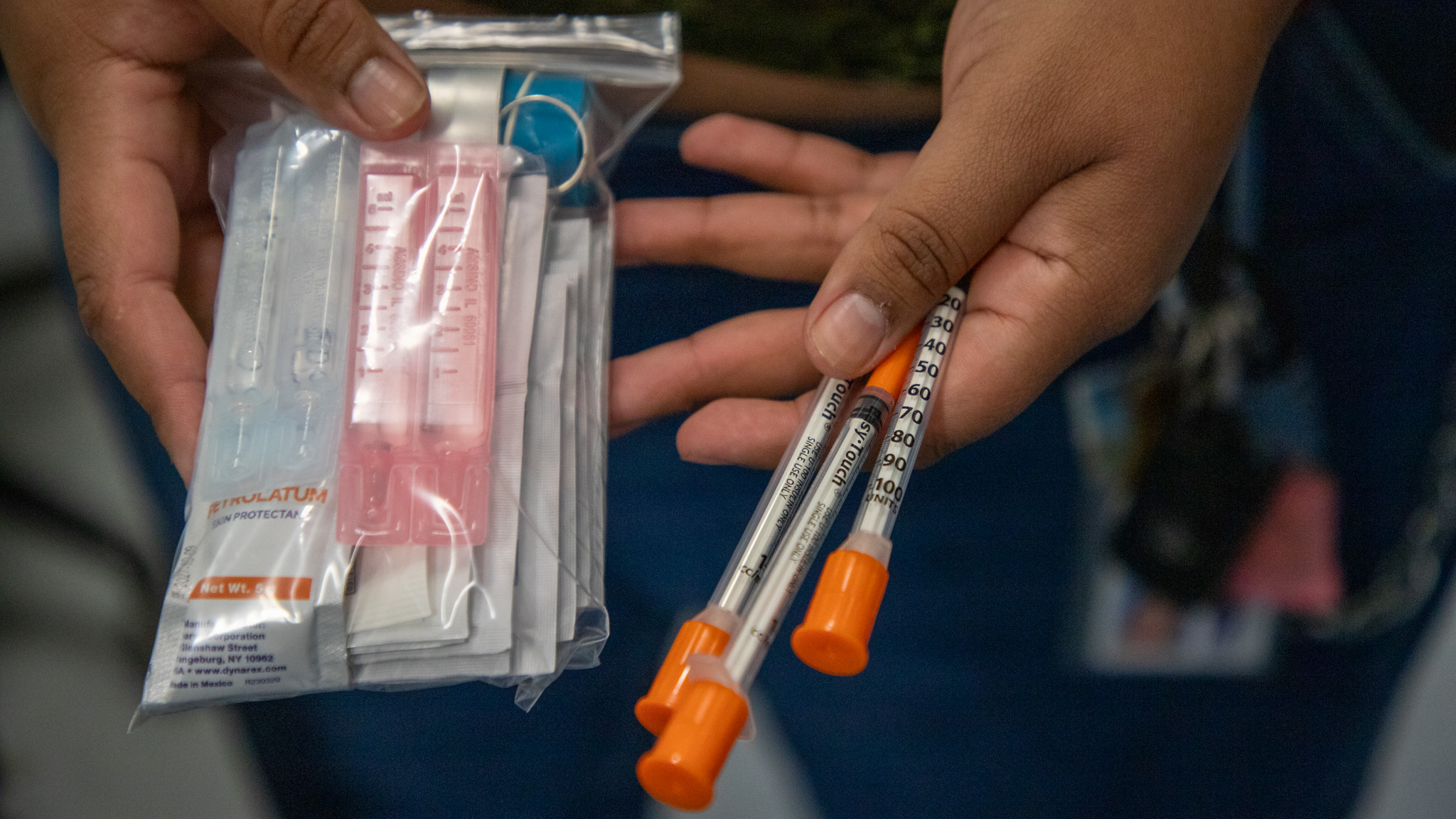
Syringes and other items are distributed at the County of Santa Cruz’s Safe Use and Overdose Prevention Program. (Amaya Edwards — Santa Cruz Local/CatchLight Local)
SANTA CRUZ >> As syringe use and litter has declined in recent years due to an increase in smoking fentanyl, the Santa Cruz County Board of Supervisors voted in June to adopt a needs-based approach to its syringe services program rather than a one-for-one exchange.
People who use drugs can now get as many free, clean syringes as they need through the county’s Safe Use and Overdose Prevention Program (SUOPP). Syringe exchange helps reduce the transmission of diseases like HIV and hepatitis C.
“It is really great to finally be able to provide needs-based services to the community,” said Santa Cruz County Health Officer Lisa Hernandez, because it is “more effective at reducing disease and injury and death.”
The county program distributed about 158,000 clean syringes in 2024.
Since the program launched as a one-for-one in 2013, it has collected more syringes than it disbursed, according to county health officials. Since 2018, it has collected about 4,000 to 62,000 more syringes than it has distributed each year — plus more from “sharps” boxes.
Residents also can get free syringes from the nonprofit Harm Reduction Coalition of Santa Cruz County or buy them at pharmacies.
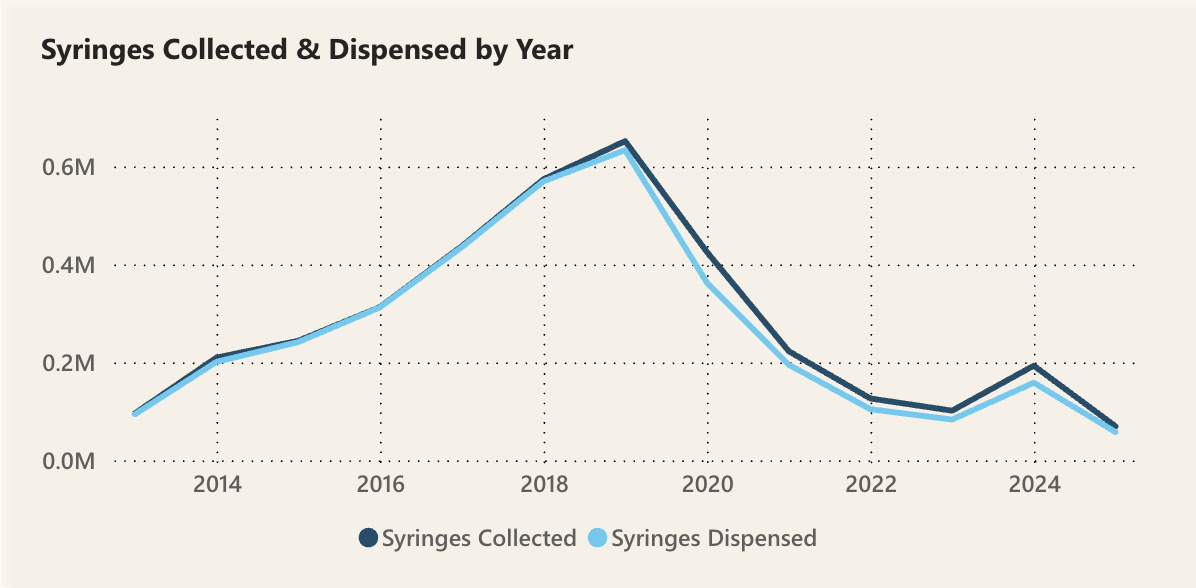
Syringes dispensed by county health workers peaked in 2019. Syringes collected on this chart are only from the county’s exchange and do not include those collected at “sharps” boxes. (County of Santa Cruz)
Several studies have suggested that syringe exchanges do not lead to increased syringe litter, in part because they provide a disposal place and ways to learn about disposal. A study of 20 U.S. cities by the Centers for Disease Control and Prevention found that the more syringes distributed per injection drug user, the more likely that syringes would be disposed of safely.
Despite globally accepted health practices, Santa Cruz County supervisors opposed a needs-based approach to the county’s syringe exchange since it started in 2013 mainly because of residents’ concerns with syringe litter. Stray needles were a flashpoint in the county in the 2010s after hundreds turned up in parks, waterways and on beaches like Cowell’s and Santa Cruz Main Beach.
Now, people who have an opioid addiction are increasingly smoking fentanyl instead of injecting heroin. As local demand for syringes has plummeted, so has syringe litter.
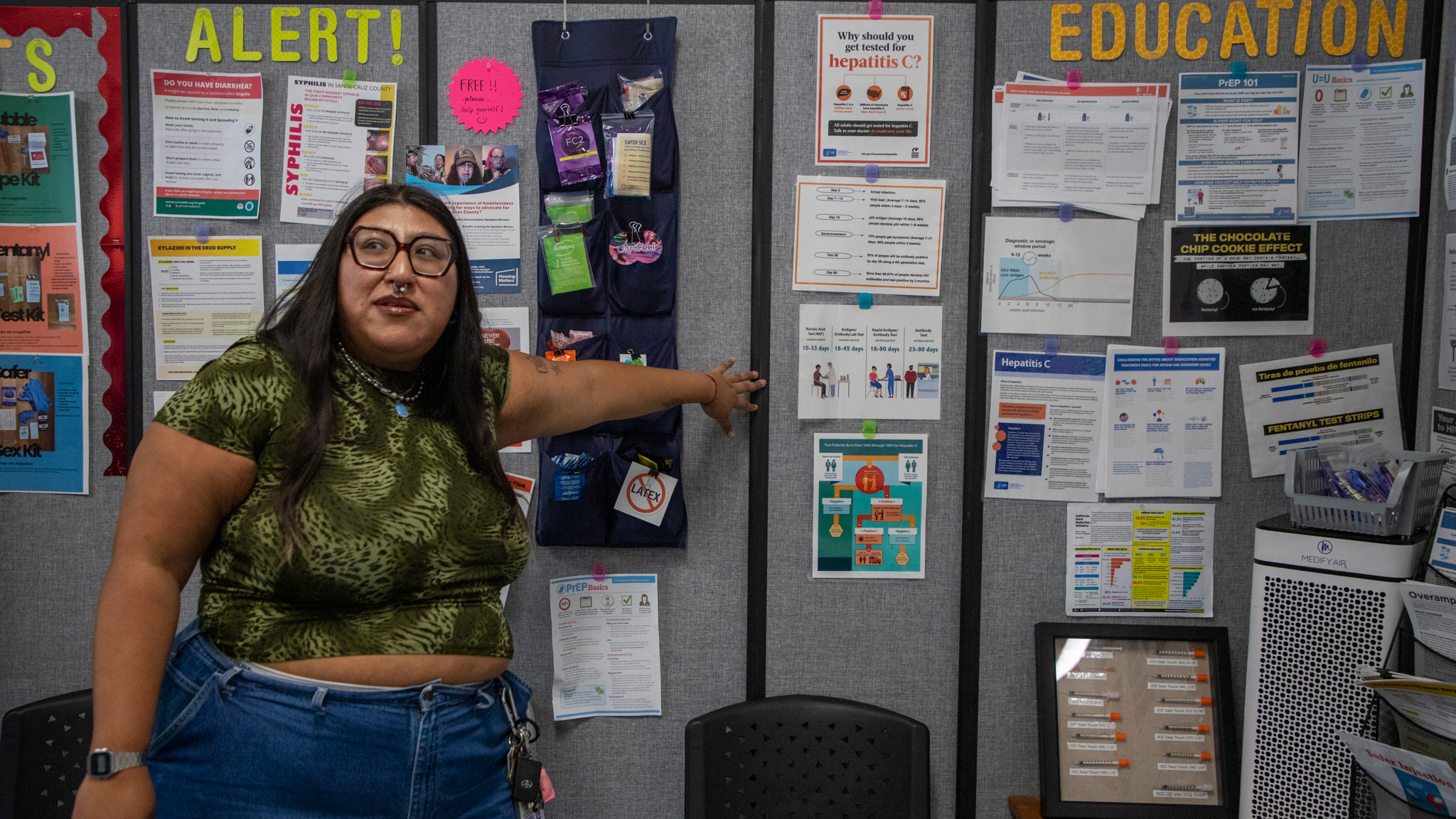
“I’m really excited we’re needs based,” said county health program specialist Alejandra Montes Tepozteco. “There’s so many hurdles when it comes to accessing health care, and I think just us being able to remove one is a big win.” (Amaya Edwards — Santa Cruz Local/CatchLight Local)
The county program operates from 1060 Emeline Ave., Building F, Room 105 and from 1430 Freedom Blvd., Suite B in Watsonville.
Supervisors also voted to make permanent a mobile approach that county health officials had tested as a pilot. The mobile exchange takes place in Santa Cruz and Watsonville and focuses on high-need areas like the San Lorenzo River levee.
“We use a wagon and sometimes a backpack to distribute supplies and collect syringes,” Hernandez said.
Declining syringe use and litter
Groups that distribute and collect needles said there are fewer in circulation.
- The Downtown Streets Team, contracted by the county to pick up syringe litter across the county, found 1,504 syringes from July 2023 to July 2024. That’s down from 5,097 syringes in the prior 12 months.
- Syringes collected through the county’s eight syringe kiosks have decreased in recent years.
“With current drug use trends over recent years — both locally and statewide — we’ve seen an overall decrease in syringes requested and disbursed,” said Anna Koplos-Villanueva, director of the Harm Reduction Coalition of Santa Cruz County. People are requesting more pipes than syringes, Koplos-Villanueva said.
The Harm Reduction Coalition of Santa Cruz County is a nonprofit that runs a syringe and pipe exchange separate from the county’s program. The nonprofit operates an exchange in Santa Cruz on Sundays and delivers to people who are homebound or have mobility challenges.
The nonprofit temporarily lost its authorization to operate a syringe and pipe exchange after Santa Cruz City Councilmember Renee Golder and others brought a lawsuit against the program. The nonprofit won the initial case but an appeal against the California Department of Public Health forced the state to revoke its authorization of the program in November 2023.
The nonprofit regained its state authorization in December 2024 and restarted services.
“That definitely impacted services in our community,” Hernandez said. “It’s not just exchange of syringes, it’s not just the distribution of pipes. It’s other resources that both programs provide. And without both exchanges operating, we are impacted as a community.”
Changing attitudes to syringe exchanges
When Hernandez was the county health officer in 2013, she was verbally attacked and threatened by residents who opposed the county’s syringe exchange and called for limiting the service to a one-to-one.
“That has definitely calmed down,” Hernandez said.
The board of supervisors has also changed, with supervisors Monica Martinez and Kim DeSerpa replacing Bruce McPherson and Zach Friend.
“The board of supervisors is more supportive of public health approaches when it comes to the opioid epidemic,” Hernandez said.
Despite hundreds of stray needles found in the 2010s, there has never been a reported needle stick in Santa Cruz County that has transmitted disease, Hernandez and other authorities have said. It would require blood-to-blood contact.
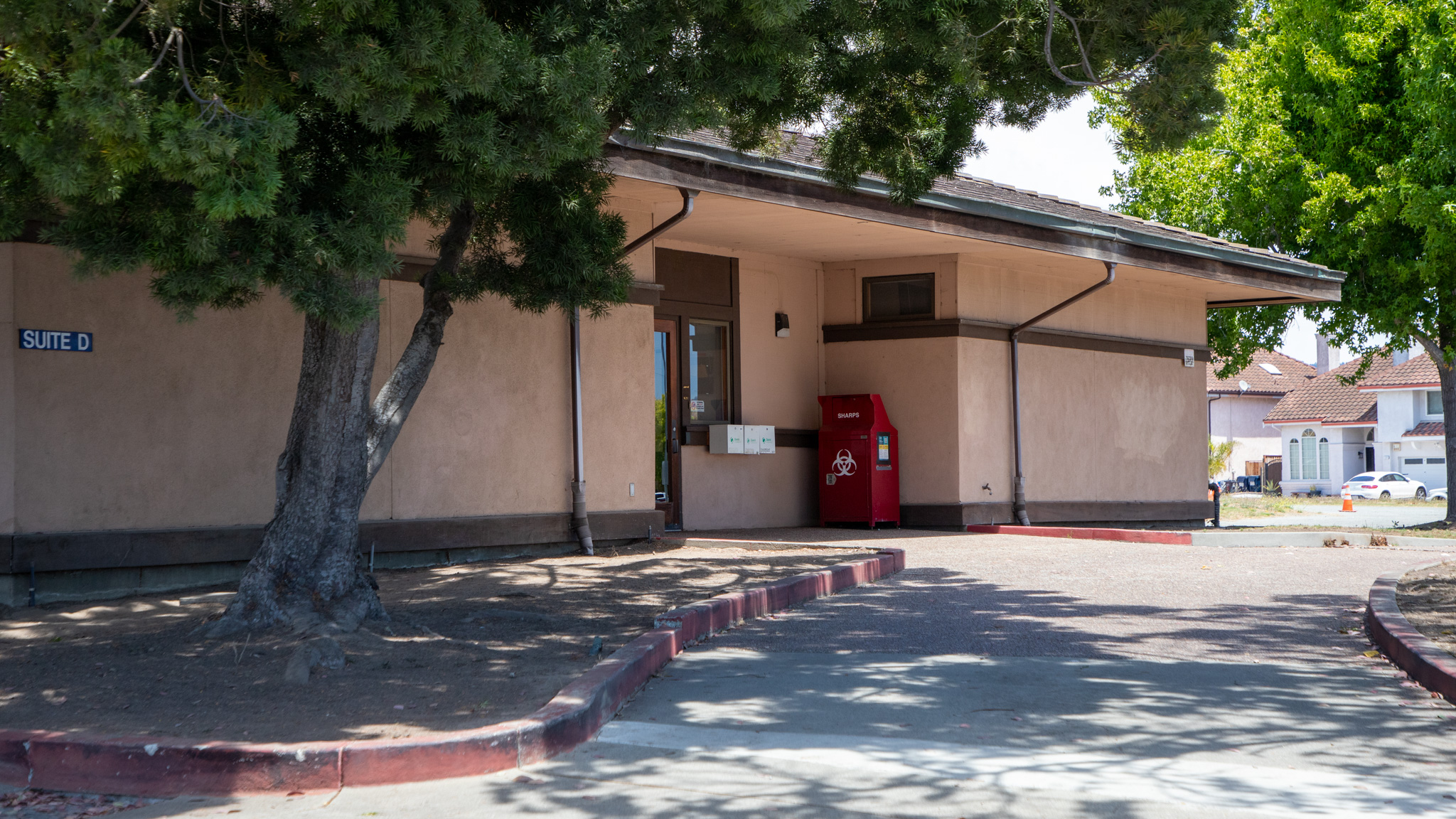
County health leaders maintain eight sharps collection boxes across the county for safe syringe disposal. (Amaya Edwards — Santa Cruz Local/CatchLight Local)
Since the county began operating the exchange, county health staff had recommended a needs-based approach because it is backed by research as a best practice.
One reason one-for-one syringe exchange is not considered a best practice — and can lead to more litter — is because drug users have to tote them around and bring them to an exchange rather than discarding them in a sharps box.
Santa Cruz County Supervisor Manu Koenig, who took office in 2021, said that after opposing a needs-based exchange for years, he changed his position in part because syringe litter had declined.
There has been less concern from his constituents recently, he said, which is “different from when I first took office when this was definitely one of the biggest hot button issues around.”
Koenig added, “I think the board decided we were ready to try out a needs-based program as long as we have this measure that we were continuing to count the number of needles.”
Santa Cruz Police Chief Bernie Escalante has said syringe exchange is a public safety issue. When pressed by Santa Cruz Local, he said he was concerned about illegal, public drug use and said residents call police about it.
“In most cases, they’re injecting or using illegal drugs, illegal substances in the open public, which becomes an issue for us because people call. They complain about the conditions around areas where these distributions are taking place,” Escalante said.
Though Escalante said he had concerns about the exchange service, he said he did not oppose the harm reduction programs altogether. He said he supports the other services offered because they can help people with addiction enter treatment.
“I’m sure the more outreach, the better, because it takes a long time to get people to build a relationship and trust,” Escalante said.
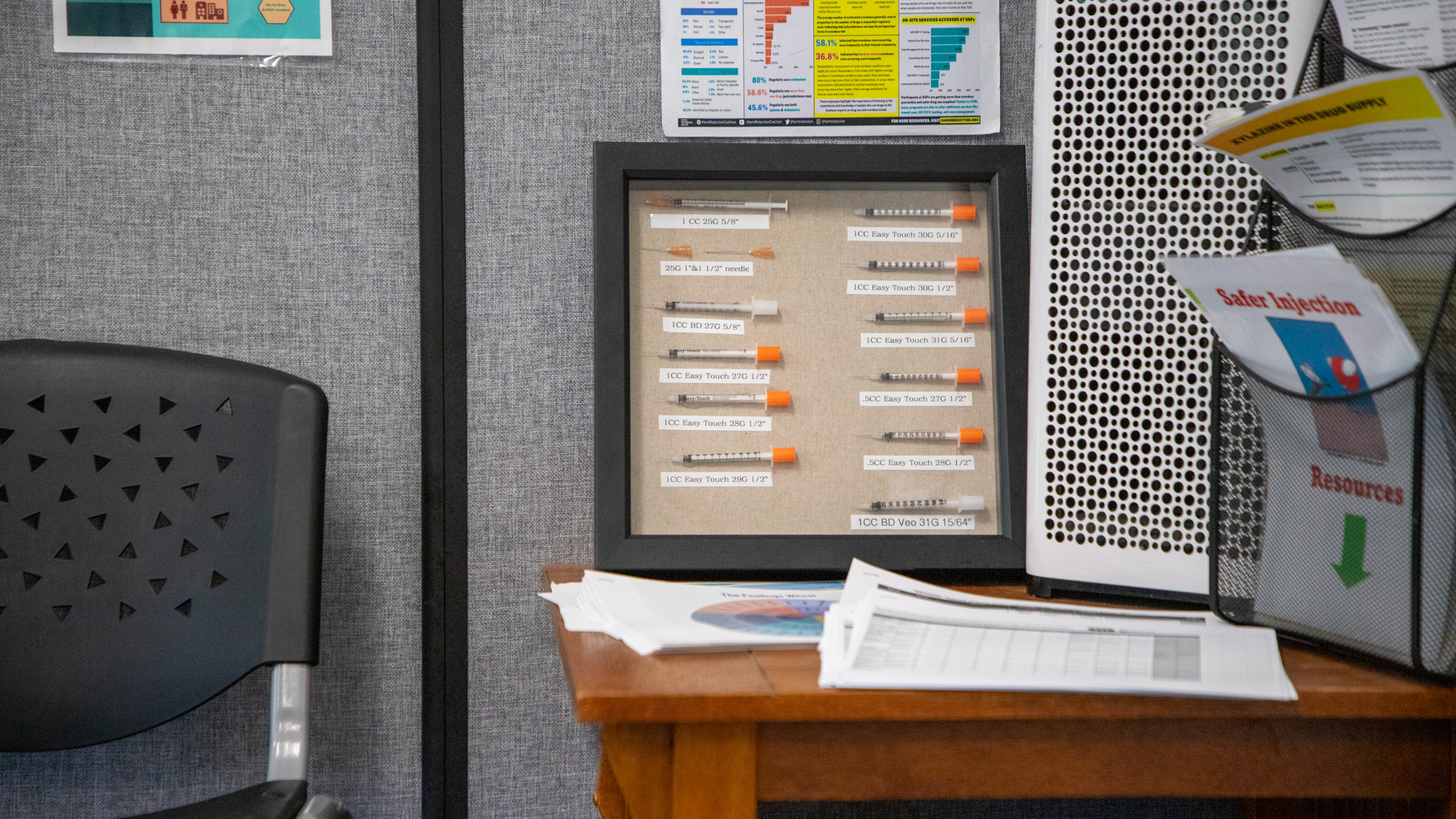
Different syringe types are displayed at the Safe Use and Overdose Prevention Program site in Santa Cruz. (Amaya Edwards — Santa Cruz Local/CatchLight Local)
More than syringe exchange
The Harm Reduction Coalition has two branches to its organization, said Koplos-Villanueva, the non-profit’s director. One branch is the syringe and pipe exchange and the other handles case management and low-barrier access to medication-assisted treatment in partnership with the county.
Medication-assisted treatment pairs medications that subdues cravings and alleviates withdrawal symptoms with counseling and other services to help people kick an opioid habit.
The nonprofit doesn’t prescribe those medications, but works with the county to make it more accessible for people who might face barriers to the treatment, including homeless people. Coalition workers may take people to appointments, bring them medication to their encampments or provide support in court.
“There are many barriers that prevent someone from accessing treatment,” Koplos-Villanueva, the coalition director, wrote in a text message. “Low-barrier pathways to [medication-assisted treatment] are the only opportunity for the majority of unhoused community members to receive treatment.”
The nonprofit also trains local school employees and community organizations on how to use the opioid overdose-reversal drug naloxone.
Questions or comments? Email [email protected]. Santa Cruz Local is supported by members, major donors, sponsors and grants for the general support of our newsroom. Our news judgments are made independently and not on the basis of donor support. Learn more about Santa Cruz Local and how we are funded.

Nik Altenberg is a bilingual reporter and assistant editor at Santa Cruz Local. Nik Altenberg es reportera bilingüe y editora asistente para Santa Cruz Local.