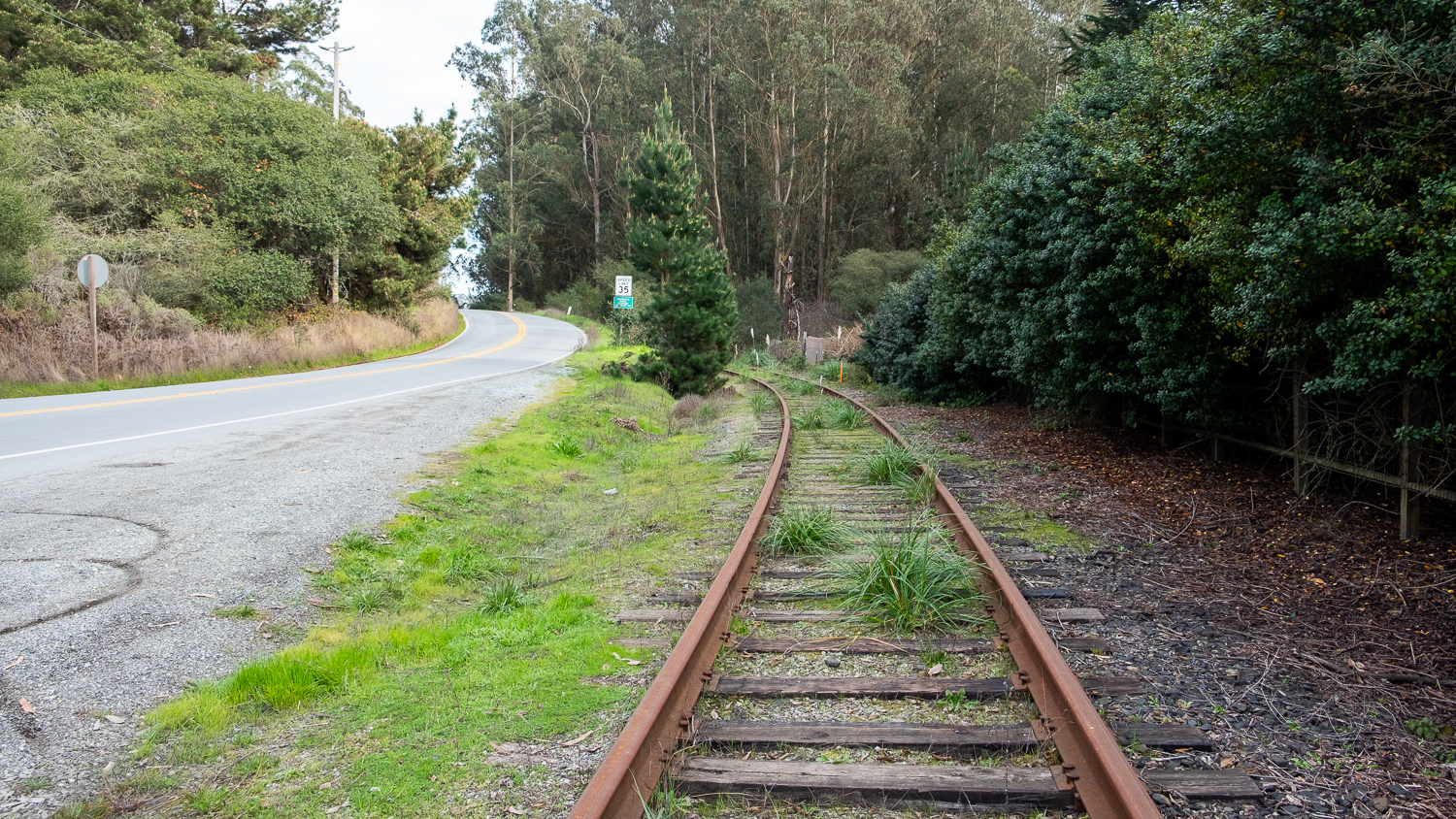
Regional Transportation Commissioners narrowly approved an “interim trail” design for a six-mile segment of the 32-mile Coastal Rail Trail through Live Oak, Capitola and Aptos on Dec. 4. (Nik Altenberg — Santa Cruz Local file)
Editor’s note: This story has been updated to accurately reflect the regional transportation commission’s vote and the cost savings of an interim trail plan.
SANTA CRUZ >> The Santa Cruz County Regional Transportation Commission voted to pause plans for a trail with room for passenger rail on several miles of the Coastal Rail Trail corridor — at least for now. The rail trail section from Santa Cruz to Aptos has been awarded about $122 million from state and federal grants, but faces a $77 million shortfall.
In a 7-5 vote Thursday, commissioners approved an “interim trail” design with a trail only for 6 miles of the 32-mile Coastal Rail Trail through Live Oak, Capitola and Aptos. Commissioners risked losing the $122 million in grants if construction does not begin on time. Building a trail on top of the train tracks, instead of leaving room for a passenger train line, is expected to close the funding gap.
Commissioners requested a report on potential designs for the interim trail, including options which would not require removing the tracks, and plan to work with the California Department of Transportation on potential funding mechanisms for a passenger rail line.
The vote was part of a “peace plan” proposed ahead of the meeting by Commissioners Fred Keeley and Manu Koenig. Keeley has been a long time supporter of a passenger rail line and Koenig a supporter of a trail only, but they struck a deal amid a shared desire to move the project forward and commitment to not losing the grant money.
The plan calls for building the interim trail without pursuing railbanking, a federal process that would allow the rail corridor to be preserved as a trail, though the tracks may be buried or removed. The idea is that building the trail without railbanking is more likely to allow a future passenger train to move forward.
“The very premise that we can build the trail and keep the rail exactly as it is today is false. We have to use the space where the tracks are if we are going to deliver a trail,” Koenig said in the meeting.
Discussion over railbanking and the rail trail’s final project concept report lasted hours, with dozens of county residents lobbying their support for the passenger rail or the interim trail.
“There is no alternative design, partial build or cheaper alignment that closes the $77 million gap,” Aptos resident Jack Brown said at the meeting. “Keeley [and] Koenig’s peace deal solves this. Lets build the trail over the existing track now, without forfeiting the corridor.”
Supporters of the passenger rail voiced worries that building over the tracks, whether by railbanking or not, would result in the passenger rail line never being realized — against the will of voters. They pointed to Measure D, when 73% of voters in 2022 turned down a county general plan amendment supporting the trail-only option.
“The Keeley-Koenig proposal we’re going to hear today to demolish the railroad tracks and replace them with a so-called interim trail is an affront to the will of the people,” said Santa Cruz resident Jim Weller.
The future for passenger rail
The commission’s vote didn’t close the door on long-term plans for passenger rail. The “peace plan” directed staff to continue to pursue funding options for the full rail and trail project using $1 million allocated in the commission’s November meeting.
Commissioners largely shared the desire to keep pursuing the passenger rail project.
Andy Schiffrin, Commissioner Justin Cummings’ alternate, suggested looking for an interim trail plan that would leave part of the train tracks intact, as well as inviting officials from Caltrans to present more information about the federal Corridor Identification and Development program. The program provides guidance and dollars to help develop intercity passenger rail projects nationwide.
Schiffrin also proposed formally asking the California Transportation Commission whether the commission could keep all of the awarded grant money while reducing project scope. The commission previously explored this option at the October meeting, but were discouraged from pursuing this by state officials.
“If we could get 100% of the money for 75% of the project, it would be worth doing that,” Schiffrin said.
Keeley and Koenig both disagreed, with Keeley saying the request was “asked and answered” in previous conversations with the state commission. Koenig said it could jeopardize the transportation commission’s reputation with the state.
A vote on that proposal led by Schiffrin died 4-8.
Opponents of passenger rail have cited its $4.3 billion price tag as unrealistic. A peer review of the passenger rail plans by representatives from multiple transit organizations was published Thursday. Riley Gerbrandt, an associate engineer with the regional transportation commission, said the review found the cost estimate to be accurate.
Commission Chair Eduardo Montesino said he didn’t think the interim rail was an ideal solution, but that a decision needed to be made.
“We’ve been turning rocks over from the community saying ‘try this, try that.’ We’ve done it all, and we’re at this point that we need to make a decision, and this is a compromise,” Montesino said. “At this time, this is one of the best options we have for our community.”
Commission staff are expected to have a potential plan for the interim trail on these sections early next year.
Questions or comments? Email [email protected]. Santa Cruz Local is supported by members, major donors, sponsors and grants for the general support of our newsroom. Our news judgments are made independently and not on the basis of donor support. Learn more about Santa Cruz Local and how we are funded.

B. Sakura Cannestra is a politics and governance journalist based in San Jose. She previously reported for San José Spotlight and POLITICO California. She graduated from UC Berkeley in 2023 with a Master's of Journalism, where she also got her start as an undergraduate in 2016 covering the university and city of Berkeley for the Daily Californian.