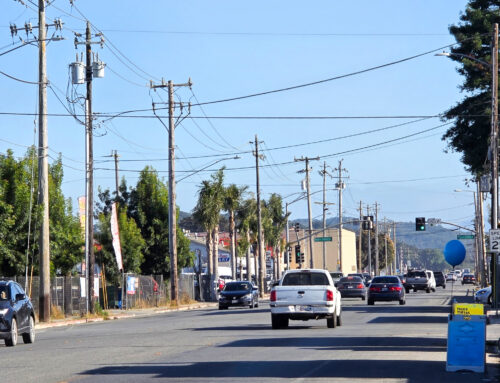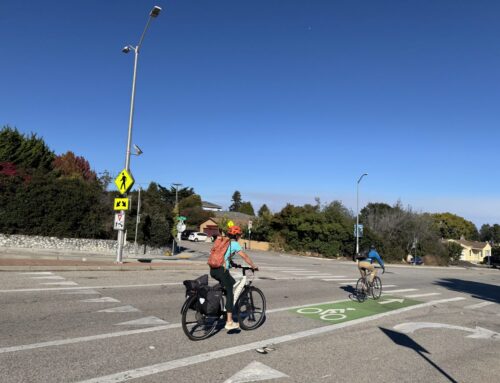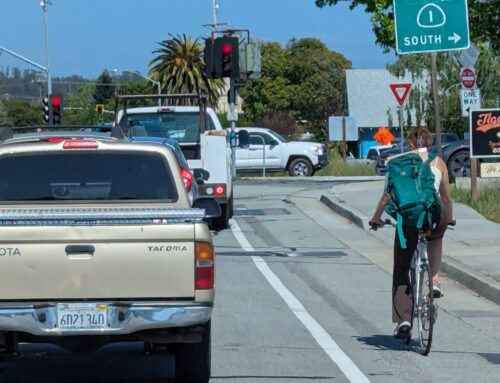
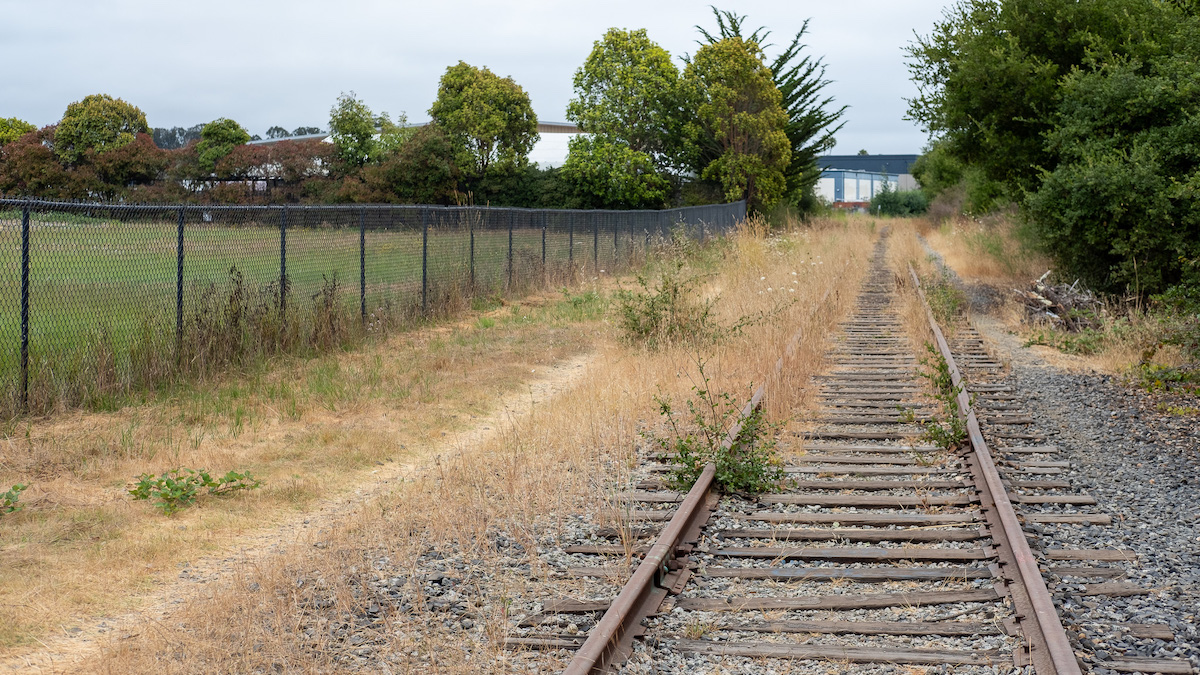
Seven miles of the planned 32-mile rail trail were largely funded by a grant from the California Transportation Commission. But cost estimates have since soared, and the project now has a multi-million dollar shortfall. (Nik Altenberg — Santa Cruz Local file)
Santa Cruz County Regional Transportation Commission meeting
- 9 a.m. Thursday, Dec. 4.
- Attend at 275 Main St., Fourth Floor Watsonville. Join on Zoom, or call 312-626-6799, meeting ID 895 9717 3447.
Update: The Santa Cruz County Regional Transportation Commission on Thursday voted to pursue the interim trail built on top of the train tracks. Full story to come Friday.
SANTA CRUZ >> As the Santa Cruz County Regional Transportation Commission considers backtracking on a decision to build a trail beside train tracks from Santa Cruz to Aptos, staff say that a plan for a trail atop the tracks is the only path forward for the project.
“We’re not in a good position,” said Sarah Christensen, executive director of the Regional Transportation Commission. “Let’s be honest, we had a vision to build these projects. That vision, turns out, is not financially feasible. We’re trying to adapt so that we could still bring these amazing benefits to our community.”
Seven miles of the planned 32-mile rail trail were largely funded by a state grant in 2022. But cost estimates have soared, and the project now has a $77 million shortfall. The commission has considered building only part of the stretch, but state leaders said they may take back part of the grant if the entire trail is not constructed.
Now, Santa Cruz Mayor Fred Keeley and Santa Cruz County Supervisor Manu Koenig have proposed a way forward: halving the construction costs by building the trail atop the tracks, rather than alongside them. Building the trail on the railbed removes the need for costly retaining walls and viaducts, transportation commission staff have said.
The so-called “interim trail” atop the tracks was already considered and rejected in 2024. At the time, the plan for the interim trail involved railbanking, a legal process that removes the obligation to keep the freight lines intact.
At Thursday’s meeting, Keeley plans to propose a vote to pursue the interim trail while resolving to work with the California Department of Transportation to pursue future funding for a passenger train.
The new proposal would use alternative bureaucratic procedures to allow uses other than freight rail on the line. “If railbanking isn’t accepted, or something that the community is supportive of, and maybe commissioners aren’t supportive of it, then we’re looking at alternative designations that would be more acceptable,” Christensen said. Staff are still determining the process and timeline of pursuing those alternative designations, she said.
Proponents of the passenger rail on the Santa Cruz Branch Rail Line have pushed back against the plans amid concerns they will slow or stop long-term plans for a train.
“The proposed ‘peace deal’ will achieve no such thing, unless it is amended to no longer violate the will of the voters with its plan to rip out the publicly-owned rail line through the heart of the county,” said Matt Farrell, Board President of Friends of the Rail & Trail in a press release on Dec. 3. The commissioners should consider designs used in Humboldt County to place a walkable path within the existing tracks, he wrote.
In 2021, county voters rejected Measure D, which would have included a trail without rail on the rail corridor in the county’s General Plan. Many rail proponents have cited that vote as evidence of public support for a train.
Melani Clark, CEO of Felton-based Roaring Camp Railroads, also opposes the interim trail, she wrote in a statement. “Roaring Camp’s current and future success as a local rail operator depends on access to rail lines,” she wrote. “We do not support any plan for the Santa Cruz Branch Line that includes removing tracks, ties or ballast materials.”
But staff from the regional transportation commission and Santa Cruz County have said there’s no other way to ensure the trail gets built.
Measure D, a countywide sales tax that supports transportation projects, will not raise enough money over its remaining lifespan to cover the cost, and no other grants exist to fund the $77 million shortfall.
“There really is no other way to deliver the trail project,” said County Planner Rob Tidmore. “Not only would losing the $96 million in grants mean that these projects don’t happen for a very long time, it also would take away or reduce our reputation” with the state and other grantors.”
Christensen acknowledged it’s “not exactly the perfect path forward”, but said it’s better than having nothing.
“If we mess this up, we’re not going to have either rail or trail,” Christensen said.
Questions or comments? Email [email protected]. Santa Cruz Local is supported by members, major donors, sponsors and grants for the general support of our newsroom. Our news judgments are made independently and not on the basis of donor support. Learn more about Santa Cruz Local and how we are funded.

Jesse Kathan is a staff reporter for Santa Cruz Local. They hold a master's degree in science communications from UC Santa Cruz.