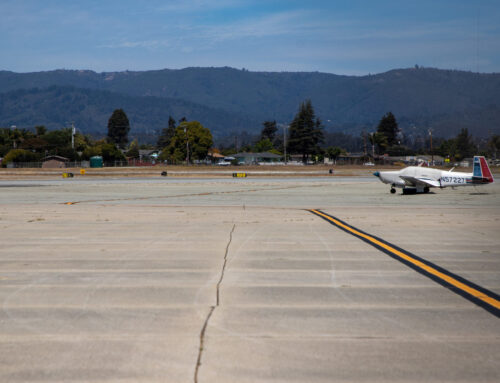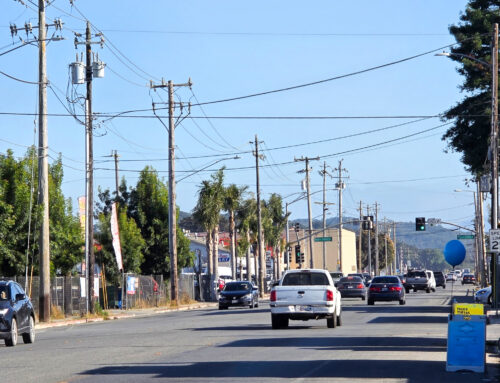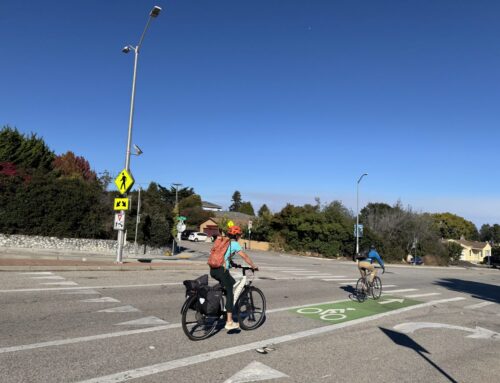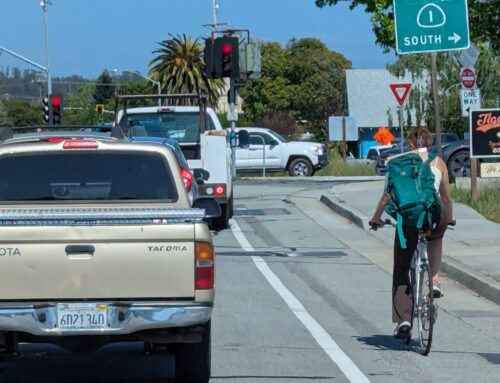
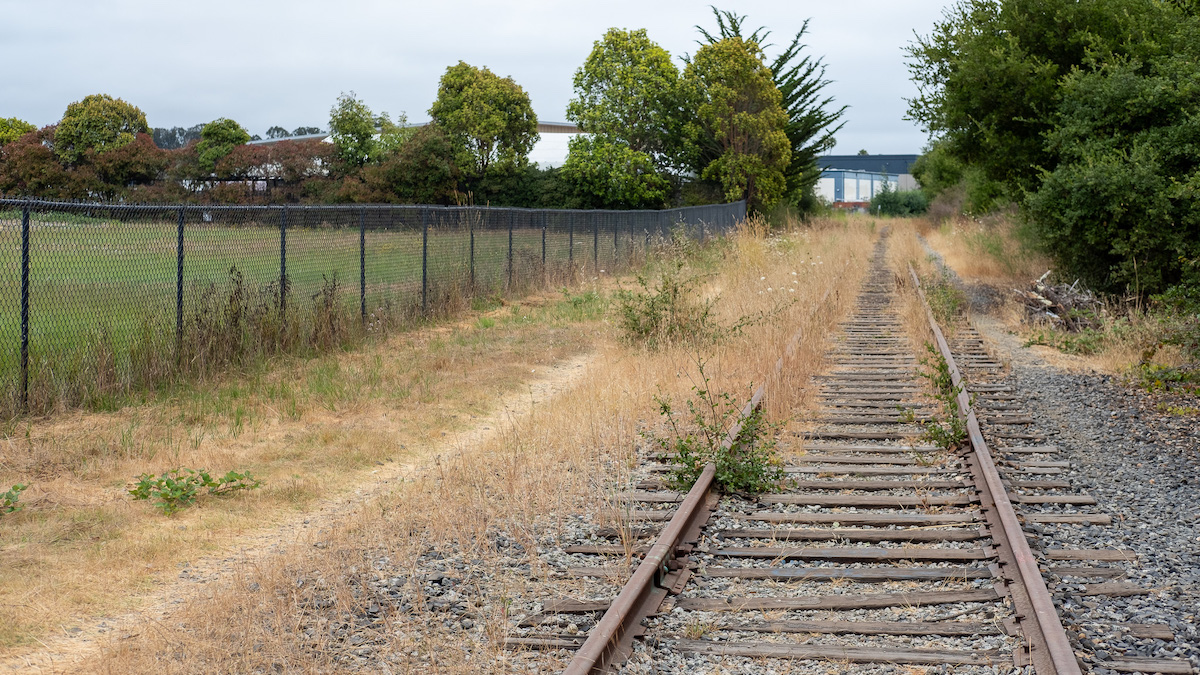
The Santa Cruz Branch Rail Line runs through Live Oak between 7th and 17th avenues. In one option for phased construction of Coastal Rail Trail Segments 8 to 11, the trail would not initially be built this far. (Nik Altenberg — Santa Cruz Local file)
WATSONVILLE >> Santa Cruz County transportation officials are running out of time to advance plans for about 7 miles of the Coastal Rail Trail amid a multimillion dollar shortfall.
The Santa Cruz County Regional Transportation Commission is weighing options to reduce costs on Segments 8 through 11 of the Coastal Rail Trail, a planned 32-mile walking and bike path that primarily runs along the Santa Cruz Branch Rail Line.
That could mean constructing the segments in phases or pursuing an interim trail build that would require temporarily removing the train tracks, both of which would need state approval. Three options for phased construction were presented at an Oct. 2 commission meeting, and some commissioners and residents called for an interim trail over the tracks.
Segments 8 to 11 are largely funded by a state grant, and the commission needs to be construction ready by March 2027 to meet the grant’s timeline. The commission is short on money for preconstruction work that must begin this year to keep the project on schedule.
The four segments stretch from Santa Cruz to Aptos and are expected to cost a combined $228 million. Construction estimates rose while transportation commission staff looked for savings, leaving a $77 million hole.
“This is a complex project, so trying to move forward through that final design in the time period we have right now is already very tricky,” said Regional Transportation Commission planner Grace Blakeslee at the meeting.
She said the commission needs to begin work on the final design and right of way certifications by the end of this year, or risk losing $96.6 million in state money that was awarded to the project.
Trail construction options
The commission could choose a phased approach, and construct a portion of the four segments to move the project forward. Blakeslee said anything that decreases the project scope would require state approval and likely proportionally decrease state’s investments in the project.
To move forward with what’s available, Blakeslee outlined three options for phased construction.
The largest option would construct 3.7 miles of the project’s 7 miles, but still has a $40 million shortfall and would exhaust remaining Measure D funds set aside for active transportation. This option would complete the trail from Pacific Avenue in Santa Cruz to 47th Avenue in Capitola.
The only option without a shortfall would construct 1.5 miles of trail, from Pacific Avenue in Santa Cruz to 7th Avenue in Live Oak.
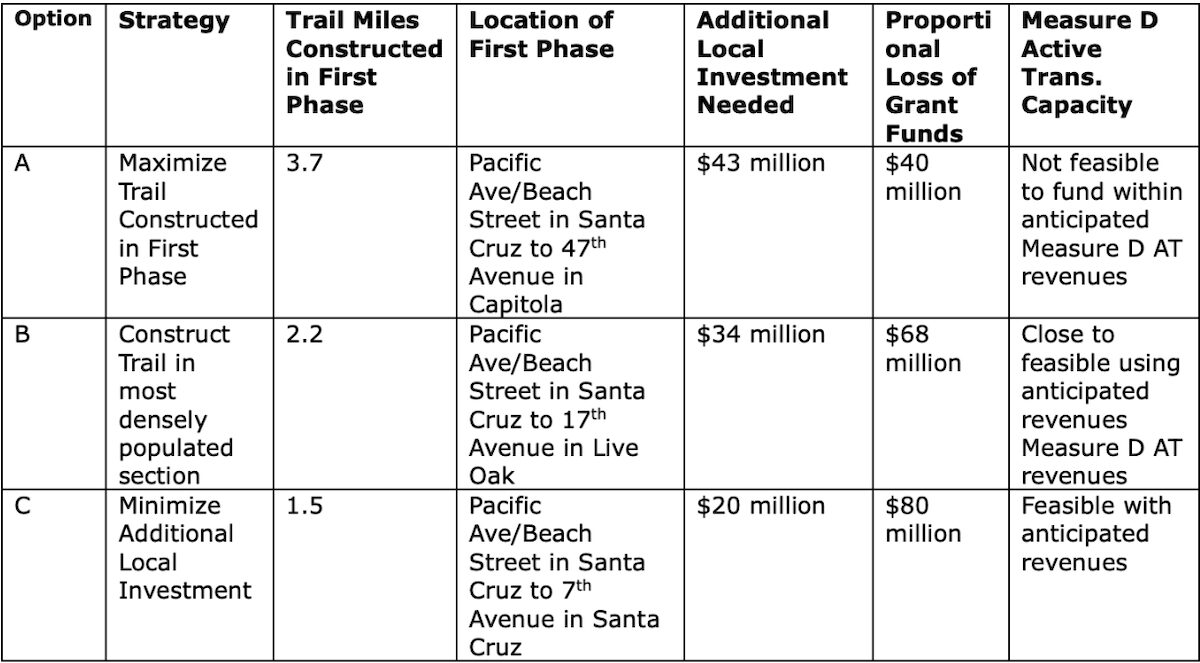
Santa Cruz County Regional Transportation Commission staff presented three options for a phased approach to constructing Segments 8 to 11. (Santa Cruz County Regional Transportation Commission)
Commissioners were dismayed by the budget constraints and some pushed for more information on possible alternatives.
Commissioner Manu Koenig, a Santa Cruz County supervisor, advocated for an “interim trail” option, in which the train tracks are “railbanked,” or temporarily removed, to make way for a bike and pedestrian trail in the rail corridor. Building a trail directly over the tracks would be cheaper than building next to the rail line.
The Santa Cruz County Board of Supervisors, which is helming Segments 10 and 11, voted down plans for an interim trail through Live Oak, Capitola and Seacliff in 2024 — in part because it could conflict with proposed passenger train service.
Based on a 2023 study, Blakeslee said changing Segments 8 through 11 to an interim trail design would bring costs down for the full 7 miles to about $107 million, saving roughly $25 million. Koenig said he supported this option for the cost effectiveness and opportunity to build the four segments in full.
“We’ve promised that we’ll build a trail throughout the entire county,” Koenig said. “The idea that we would instead stop at 7th Avenue and say ‘Hey, we’re out of money for basically the next 20 years on the existing measure, sorry.’ I think that’s untenable. I think that’s a violation of our promise to voters, let alone the funding agencies.”
Pursuing the interim trail would require railbanking, a process that removes the obligation to keep freight tracks intact. It is a lengthy process that would require federal approval from the U.S. Surface Transportation Board, and could provoke pushback from leaders of Roaring Camp Railroads, which would be cut off from the state rail network. The corridor could be re-converted to a rail line in the future, though most railbanked lines across the country have remained trails without rail.
The transportation commission in 2022 opted not to pursue railbanking, and soon after commissioned a conceptual report on rail service. A draft version of that report released in August estimated a $4.3 billion price tag to build a passenger rail line. In December, the commission is set to vote on next steps for the train project, and could decide to abandon the plans and instead pursue railbanking.
Andy Schiffrin, Commissioner Justin Cummings’ alternate, said the commission needs to explore every option, including pushing state representatives to not decrease grant funding on the project.
The commission created a subcommittee to meet with state representatives to discuss funding. The subcommittee includes Koenig, Commission Chair and Watsonville Mayor Eduardo Montesino, and Commissioner and Santa Cruz Mayor Fred Keeley.
Commissioners also asked staff to come back in November with cost estimates for the final design portion of the trail alternative options, including an interim trail, and for more details on constructing segments 13 through 20.
“My hope as a commission is that if we’re going to start exploring alternatives and challenges to the assumptions here, that we explore all of them,” said Monica Martinez, a commissioner and county supervisor.
Questions or comments? Email [email protected]. Santa Cruz Local is supported by members, major donors, sponsors and grants for the general support of our newsroom. Our news judgments are made independently and not on the basis of donor support. Learn more about Santa Cruz Local and how we are funded.

B. Sakura Cannestra is a politics and governance journalist based in San Jose. She previously reported for San José Spotlight and POLITICO California. She graduated from UC Berkeley in 2023 with a Master's of Journalism, where she also got her start as an undergraduate in 2016 covering the university and city of Berkeley for the Daily Californian.