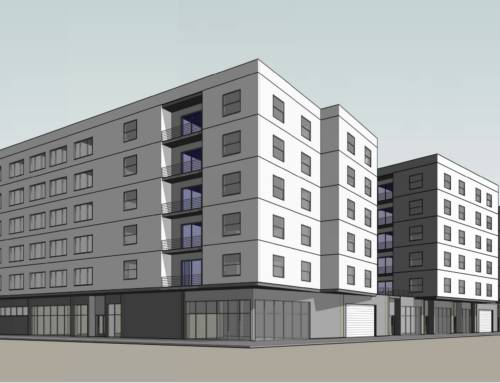
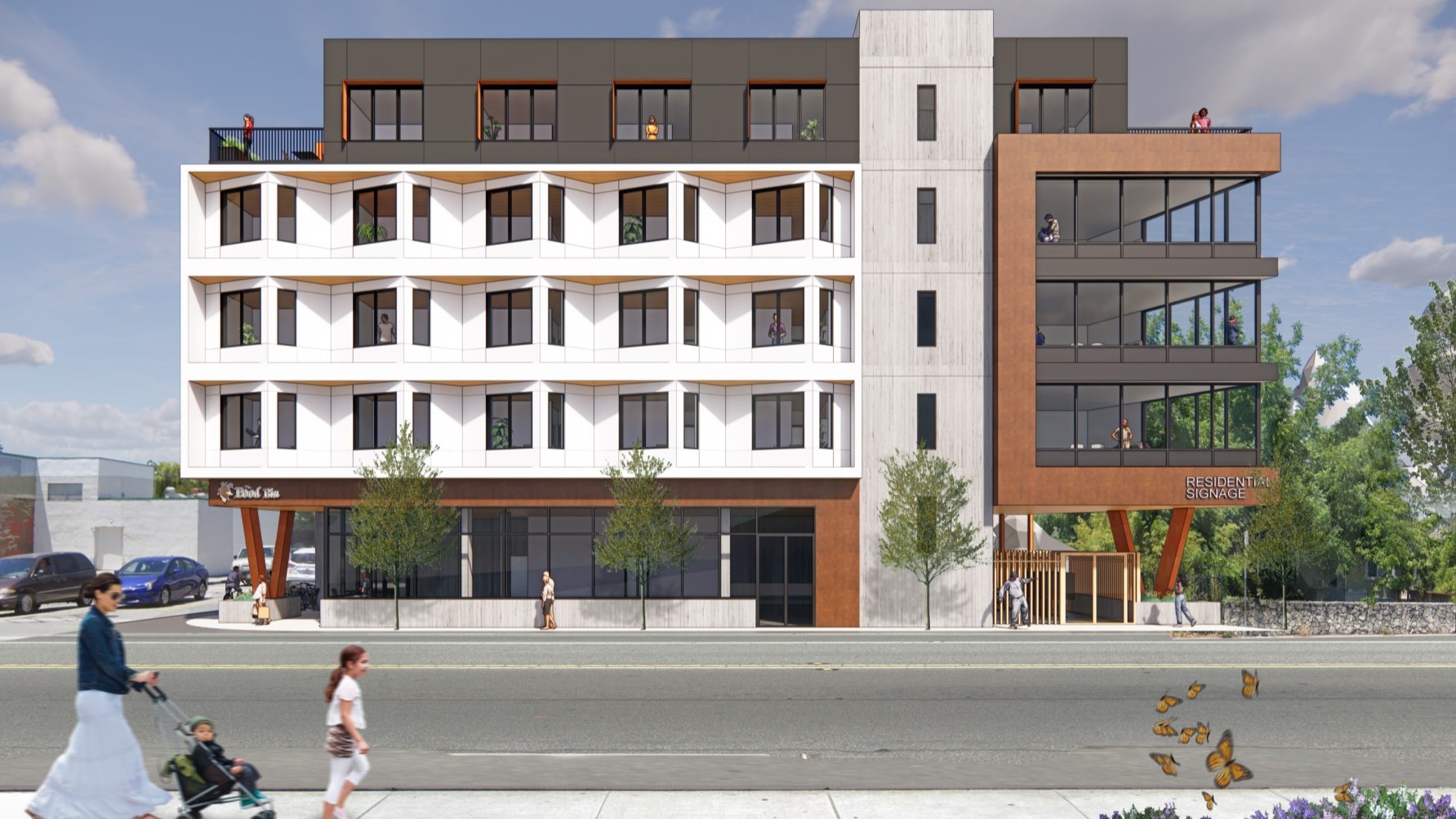
The Food Bin and Herb Room are expected to be redeveloped and remain at 1130 Mission St. below apartments. (Workbench)
SANTA CRUZ >> Food Bin co-owner Doug Wallace and developer Workbench appealed a dismissal of a lawsuit against the City of Santa Cruz this week, in a case brought over the city’s refusal to allow 11 storage spaces to be converted into additional units in a proposed apartment building.
The 48-unit project is slated for the site of the Food Bin and Herb Room at 1130 Mission St. The Santa Cruz City Council approved the five-story project in May 2024, but rejected plans to include storage spaces that would be converted into 11 ADUs, or accessory dwelling units. Wallace and Workbench sued in August 2024, and said they would not pursue the project without the 11 additional units. The judge tossed the case last month.
Workbench claimed that the city violated the law by excluding the storage spaces from the final project, and the city claimed that it followed the law by approving the project’s 48 listed units.
State density bonus laws prevent local governments from denying or changing housing proposals with a certain amount of affordable units, so long as the projects meet local development objective standards.
Confused about housing jargon?
Read Santa Cruz Local’s housing glossary to learn common words, phrases and laws.
Santa Cruz County Superior Court Judge Rebecca Connolly decided the storage units were not protected under the density bonus law.
Connolly cited case law that found cities cannot deny basic amenities in a project, like storage space, but wrote that “the ‘storage’ amenities were never intended to be storage, and to approve them as such would have exceeded the density allowed.”
Another Workbench project, the Clocktower Center, was approved by the city council this week. The eight-story, 178-unit project next to the Town Clock on N. Pacific Avenue has the potential for up to 46 additional ADUs, according to a planning commission staff report.
The city council discussed the potential additional units at its Tuesday meeting, but did not vote to block them.
Because the Clocktower plans were not explicit about whether they intended to convert to ADUs and were described in plans as a steam room, a chef’s kitchen and a music room, Santa Cruz City Attorney Tony Condotti said the city could not force a redesign that effectively blocked the building as designed.
Condotti said at the meeting that Workbench “obviously learned its lesson from the Food Bin case.” In the Food Bin project, the storage spaces were described in the planset as future ADUs.
When asked about whether the Food Bin project informed the amenity descriptions in the Clocktower project, legal counsel for Workbench Ryan Patterson said “one project informs the next.”
Wallace, the Food Bin co-owner, said he wasn’t taking a leading role in the Food Bin lawsuit, and wouldn’t comment on ongoing litigation.
Read more
- Santa Cruz City Council allows Food Bin housing project — May 29, 2024
- Santa Cruz Clocktower apartments approved at 8 stories — Aug. 13, 2025
- Planning commission approves Food Bin housing project in Santa Cruz — Jan. 19, 2024
- Food Bin owners explain Santa Cruz housing proposal — April 21, 2023
Questions or comments? Email [email protected]. Santa Cruz Local is supported by members, major donors, sponsors and grants for the general support of our newsroom. Our news judgments are made independently and not on the basis of donor support. Learn more about Santa Cruz Local and how we are funded.

Tyler Maldonado holds a degree in English from the University of California, Berkeley. He writes about housing, homelessness and the environment. He lives in Santa Cruz County.