Santa Cruz City Council

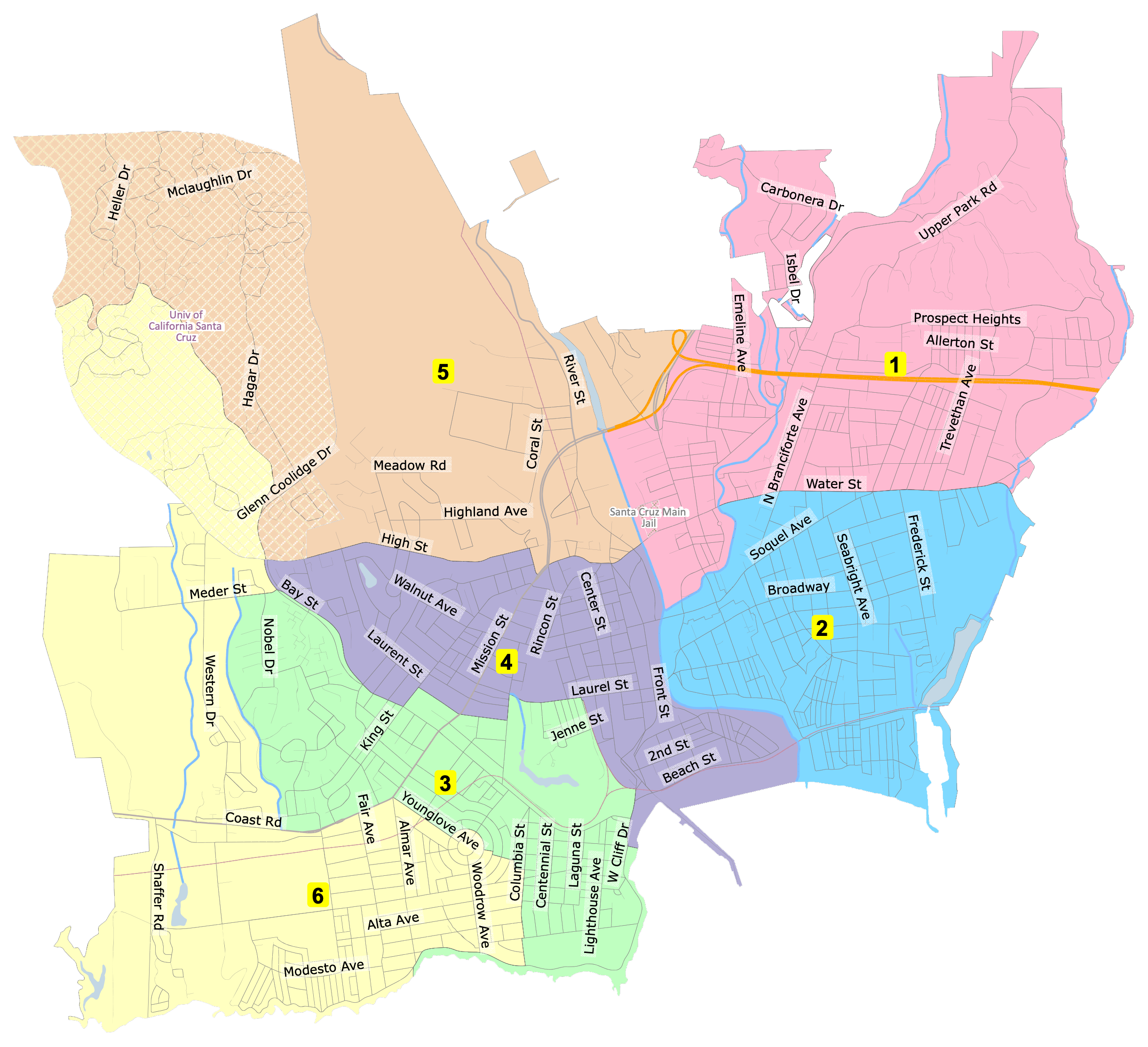
Santa Cruz City Council Districts 6 and 4 are up for election. See a district map.

Meet the District 6 candidates

In District 6, incumbent Santa Cruz City Councilmember Renee Golder faces off against Gabriella Noack.
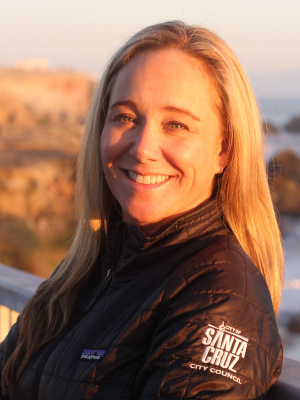
Renee Golder (incumbent)

Age: 45.
• Occupation: Elementary school principal.
• Political background: Sitting City Councilmember for District 6. Former Vice Mayor, Director representing the Monterey Bay Region for the League of California Cities.

Gabriella Noack

Age: 24.
Occupation: UC Santa Cruz student set to graduate in June, volunteer tech educator with nonprofit Barrios Unidos and cashier.
Political background: Community organizer and first-time candidate.

District 6 candidates quick comparison

Issue Renee Golder Gabriella Noack
What would you do to address the housing affordability crisis?
  • Encourage owners of apartment buildings to convert units into condominiums.
  • Maintain the current level of support already available for renters.
  • Establish an elected rent board to enforce tenant protections.
  • Grant people undergoing eviction the right to legal counsel.
  • Consider tax initiatives to fund housing subsidies.
What would you do to address the acceleration of housing developments?
  • Urge the state to pause changes to building codes.
  • Build denser housing downtown while preserving single-family neighborhoods.
  • Open single-family lots to duplexes, triplexes and fourplexes.
  • Tax breaks for affordable housing.
  • Encourage fewer large market-rate buildings.
What policies would you try to enact in regard to homelessness?
  • Offer “a carrot and a stick” approach, offering shelter to those who need it and enforcing consequences for those who refuse.
  • Mandate treatment for people with substance use disorder or serious mental illness.
  • Stop encampment sweeps.
  • Open more shelters.
  • Incentivize a higher minimum wage.
How would you address road safety?
  • Continue progress on creating more bike lanes and other street improvements.
  • Consider long-term plans for traffic circles on Soquel Avenue.
  • Pay wheelchair users, cyclists and pedestrians to identify safety concerns.
  • Create distributed, rather than dense, housing development.
What would you do to spur more public engagement?
  • Continue holding town halls and responding to emails and phone calls.
  • Use open source technology for more residents to share opinions and ideas.
How would you address racial equity and inclusion?
  • Continue ensuring equity in city recreation programs.
  • Partner with organizations led by people of color like Barrios Unidos.

District 6 candidates on the issues

Santa Cruz Local interviewed and surveyed residents in the City of Santa Cruz about their priorities for city council candidates. The following questions are based on what we heard from voters.

Do you support policies like rent control, rental assistance or enhanced eviction protections? Do you have other plans for making existing housing stock more affordable?

Golder said there are currently “robust tenant protection systems here in Santa Cruz where people can get the support they need,” and there isn’t a need for more funding or regulations.

“The reality is, if you’re renting, your housing is not necessarily stable as it is when you’re owning,” she said. There are “going to be times when people might have to move out, and that’s part of being a renter.”

Golder said she wants to:

  • Support people in buying homes by encouraging developers to offer more units for sale.
  • Collaborate with owners of older apartment buildings to convert units to condos. City law requires 20% of new condos to be offered for below-market prices.

“A large majority of people who are providing rental units in Santa Cruz are homeowners who are renting and are great landlords,” she said. “But there are a large amount of slum lords who are not taking care of their tenants, are not taking care of the houses that the tenants live in, and are pushing out their tenants anytime that they want to increase their rent.”

Noack said she wants to:

  • Use money raised by the Measure C property transfer tax for direct housing subsidies for tenants who cannot afford rents.
  • Consider a new property transfer tax on the selling of second and third homes.
  • Establish the right to legal counsel for tenants undergoing eviction.
  • Create a local rent board to enforce state and local tenant protections.

How would you balance the pressures of state housing mandates with the desires of current residents?

Golder said she supports denser development downtown. “I think from talking to people in the community, most people would prefer to see a couple of buildings there, then that kind of development in the single family neighborhoods.”

Golder said she wants to:

  • Continue using her position as a board member of the League of California Cities to urge state lawmakers to pause changes to building codes intended to allow more development.
  • Continue pursuing opportunities for workforce housing. Golder worked with the Chancellor of UC Santa Cruz to build workforce housing for university staff alongside student housing in a development on Delaware Avenue.

Proposed market-rate projects along Mission Street are “not really addressing Santa Cruz’s needs,” Noack said. “We need affordable and middle-income housing. We don’t need luxury apartment buildings.”

Noack said she wants to:

  • Allow higher density in single-family neighborhoods, including duplexes, triplexes and fourplexes.
  • Buy property to create more parks and green space for people living in denser neighborhoods.
  • Offer tax abatements for properties that provide more than the minimum required below-market-rate housing, homeowners building ADUs, and developments that use union labor.
  • Partner with local businesses to provide more workforce housing.

What do you believe works or doesn’t work about the city’s homelessness policy? What changes would you propose?

“We’re investing over $10 million out of our city’s general funds to address street homelessness. We’re offering shelter, we’re offering services, we’re collaborating with the county. We’re doing everything within the city’s power,” Golder said.

Golder said she wants to use “a carrot and a stick approach” that offers shelter to those who need it, but enforces consequences for those who refuse it. During the years that her father-in-law was unhoused, her family was “frustrated with the amount of people giving him handouts and things, because we really wanted him to get to a place where he was willing to choose a different path,” she said.

Golder said she wants to take advantage of new state laws that allow mandated treatment to people with severe mental illness and substance use disorder.

“As a society, it’s gross to me that we’re letting people live like this,” she said.

“The people who can’t afford to live in Santa Cruz can’t afford housing, not because of personal decisions, but because of growing structural inequities,” Noack said.

She wants to create measures to incentivize local businesses to pay a living wage, and consider raising the local minimum wage in a way that doesn’t harm small businesses.

She also wants to expand shelter options for homeless people. “If we’re seeing a recurring theme that our housing solutions aren’t enough, then that’s not a problem with the people who are living in their tents,” she said. “That’s a problem with the solutions that we’re presenting.”

Sweeps of homeless encampments are “literally illogical,” she said, “because where are people going to go?”

What policies would you propose to make roads safer and easier to navigate for all residents?

Golder said she’s already been actively working on road safety, pointing to her support of new bike lanes on Bay Street, the completion of the rail trail through the city, and progress towards the city’s Vision Zero plan to eliminate traffic deaths.

Golder is part of a working group with nonprofit Ecology Action, UC Santa Cruz and other local governments in the county, to create long-term plans for safer streets.

One idea under preliminary consideration, she said, is redesigning Soquel Avenue to reduce the number of vehicle lanes, create roundabouts at intersections and put in new or expanded bike lanes.

The city should hire people “to try and navigate the entire town in a wheelchair, to try and navigate the entire town on a bike, to try and navigate the entire time as a pedestrian, and to create solutions and really highlight what areas are the most dangerous,” said Noack. The work of advocacy can’t be an unpaid responsibility of pedestrians, cyclists or those in wheelchairs, she said.

She also sees more distributed housing development as a way to promote walkable and bikeable neighborhoods. “If we have large hubs of super dense housing, that instantly creates a traffic jam right where that is, and anybody trying to get through any part of the town has to go through,” she said.

How would you create spaces for residents to share their needs and desires? How would you incorporate residents’ voices in your policies and votes?

Golder said since the city’s districts were created in 2022, she has held annual town hall meetings to “manually update people about what’s going on.” She said she has offered to speak with anyone who emails her about a city issue, and freely shares her cell phone number with constituents, critics and activists.

“I just have always made myself available to listen,” she said.

Noack envisions using technology to allow more residents to suggest ideas for the city and share opinions.

One option she said interests her is Polis, an open access tool that allows participants to anonymously suggest ideas or share opinions about an issue. The Right Livelihood Center at UC Santa Cruz is using the tool for a “civic imagination project” to envision the future of the university in 2050.

Digital tools are needed for elected leaders to hear from residents, “because the people with jobs, families and hobbies can’t really make it to town hall meetings all the time,” Noack said. “Just having the email contacts of local politicians isn’t enough.”

How do you plan to use your office to advance racial equity in Santa Cruz and make the city a more welcoming place for Black and Latino residents?

The idea that Santa Cruz is marked by racism “is not my experience for Black people living in this community,” including her friends, she said.

For people of all races, “if you’re poor, that’s where you’re having bad outcomes,” she said.

As part of her job as a principal at Bay View Elementary, Golder said she has worked to “explicitly erase systematic racism and make sure that demographics don’t determine outcomes for children in our community.” She said most recently she’s helped in supporting families facing heightened fears over U.S. Immigration and Customs Enforcement, or ICE.

As a city council member, “I’ve helped ensure that we have equity in registering for Parks and Recreation classes for youth and access to scholarships with our Children’s Fund, I’ve made sure that we are starting to see the demographics of our community reflected in the demographics of our recreation,” she said.

Noack said she won’t lead conversations about racism, “because I’m white, so I’m not going to have the best solutions for that.” Instead, she said she wants to use her position of power to “make space for and highlight the voices that have been working towards racial equity.”

Those organizations, she said, include nonprofit Barrios Unidos, which she said the city could support by backing their proposed affordable housing and community center project.

Another organization to look to for ideas to address racial equity, she said, is the local Rise Together Coalition, which gives grants to people of color to increase their economic opportunities.

Advancing racial equity “also means supporting unions,” Noack said. She said she wants to advocate for better retirement health care for unionized city employees.

Meet the District 4 candidates

In District 4, incumbent Santa Cruz City Councilmember Scott Newsome faces off against Hector Marin.
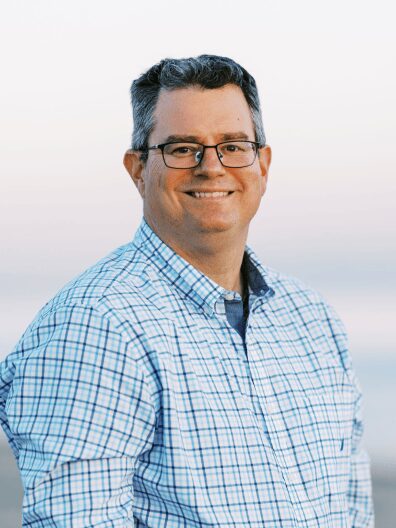
Scott Newsome (incumbent)

Age: 45.
• Occupation: UC Santa Cruz lecturer.
• Political background: Incumbent city council member, Santa Cruz Metro board member, Director for the Association of Monterey Bay Area Governments.
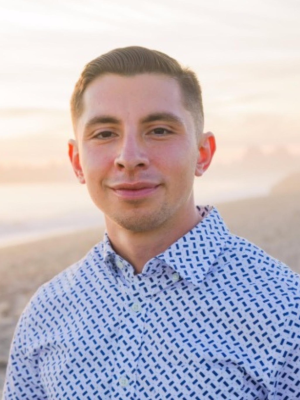
Hector Marin

Age: 28.
Occupation: Paraeducator at Harbor High School.
Political background: California Democratic Renters Council board member. Former union organizer. Ran for Santa Cruz City Council in 2022 and 2024.

District 4 candidates quick comparison

Issue Scott Newsome Hector Marin
What would you do to address the housing affordability crisis?
  • Ensure buildings with expiring rent restrictions stay affordable.
  • Direct money to eviction protection programs.
  • Reduce the annual allowable rent hike.
  • Create a city office to mediate conflicts between renters and landlords.
What would you do to address the acceleration of housing developments?
  • Change local housing policies to accommodate neighbor feedback, within limits of the law.
  • Continue affordable housing development.
  • Hold more community town halls with developers and neighbors.
  • Protect downtown venues with historic value.
What policies would you try to enact in regard to homelessness?
  • Increase shelter capacity.
  • Ensure access to homeless day services.
  • Replace homeless day services and create a year-round warming center.
  • Consider new business taxes to pay for homelessness services.
  • Increase enforcement of camping ban.
How would you address road safety?
  • Focus transportation funding on improvements for bikes and pedestrians.
  • Create a dedicated fund for street safety improvements.
  • Advocate for expanded and improved roads throughout District 4, particularly in Beach Flats.
  • Create a pilot program to close Pacific Avenue to cars on Saturday nights.
What would you do to spur more public engagement?
  • Continue responding to constituent emails and calls.
  • Hold town halls if residents request them.
  • Hold regular town halls and community events like block parties.
How would you address racial equity and inclusion?
  • Continue routing federal money towards a community center in Beach Flats.
  • Continue encouraging diverse applicants to city advisory boards.
  • Advocate for a fund to combat disinvestment in the Beach Flats neighborhood.
  • Connect with Spanish-speaking constituents.

Editor’s note: Following publication, Hector Marin provided additional information about his proposed homelessness response policies.

District 4 candidates on the issues

Do you support policies like rent control, rental assistance or enhanced eviction protections? Do you have other plans for making existing housing stock more affordable?

If reelected, Newsome said he wants to keep securing the affordability of buildings with expiring rental restrictions, and direct money to eviction prevention programs.

In his first term, Newsome said he:

  • Proposed a rent cap ordinance to prevent major rent hikes for residents of St. George Residences, following the expiration of a deed restriction mandating below-market-rate rents. Following a lawsuit against the city, the council rescinded the ordinance and agreed to a settlement that limited the rent hike to 8.8%.
  • Helped secure a $1 million city loan for the owners of the Palomar Apartments to temporarily prevent rents rising to market rate, following the expiration of deed restrictions.
  • Directed $2 million raised from selling city-owned land for the Cruz Hotel downtown to the city’s Affordable Housing Trust Fund. The fund helps develop below-market-rate housing and helps fund eviction prevention programs.
  • Helped develop Measure C, a 2025 voter initiative that created a property transfer tax to benefit the Affordable Housing Trust Fund.

Marin said he wants to increase tenant protection policies, “while at the same time remaining fair with the homeowner and their right to own property.” He said new tenant protections would be “less extreme” than those proposed under the Measure M ballot initiative in 2018.

Marin said he wants to:

  • Introduce an annual 2.75% cap on rent hikes in new developments. State law allows a 5% annual increase plus inflation, or a maximum of 10%.
  • Create an “Office of Housing Stability” to mediate conflicts between renters and landlords.
  • Increase investigations for health and safety violations like mold.

How would you balance the pressures of state housing mandates with the desires of current residents?

“State law has really limited what we can and can’t do,” Newsome said. But, he said, he tries “to listen to everybody and implement their concerns and address their concerns as much as possible.”

In his first term, Newsome said he:

  • Helped facilitate new housing developments in Downtown, including major below-market-rate projects like Pacific Station North and South
  • Limited the city’s Downtown Density Bonus to buildings under 85 feet, or about 8 stories. 

Denied approval to a version of the Food Bin redevelopment project he believes violates state law. Developer Workbench sued the city over the denial.

Marin said he plans to hold more community town halls with developers to “inform the public on the basis of the development that they are trying to pass,” he said, “and then we will work together and collaborate with a developer to ensure that these new developments adhere to the character of our neighborhoods.” 

Marin said he also wants to:

  • Ensure there is more open dialogue. While he said he didn’t want to run afoul of state housing law, “one thing that we can do is ensure that we have more transparency.”
  • Continue gathering signatures for a citizen’s initiative that aims to protect long-time cultural venues from redevelopment.

What do you believe works or doesn’t work about the city’s homelessness policy? What changes would you propose?

Newsome said he’s already seen a lot of progress on homelessness. “That’s something I think should be celebrated in our community, and something we keep in perspective when talking about this issue,” he said. However, “there is more work that needs to be done.”

Newsome said he wants to expand the city’s shelter capacity, particularly in the portion of the Coral Street neighborhood recently rezoned to allow interim shelter. At the same time, “We shouldn’t have people sleeping in the public right of way, or in storefronts,” he said. “That’s not beneficial for our community or for those who are unhoused.”

Marin said he wants more transparency on homelessness spending. He wants to introduce a homelessness trust fund to make the city’s homelessness spending more public and create a dashboard with data about the city’s progress.

 Marin said he wants to:

  • Hire more mental health liaisons and community service officers, and increase enforcement of camping bans on public property.
  • Replace the day services for homeless people, including showers and bathrooms, no longer offered by nonprofit Housing Matters.
  • Create a warming center open throughout the winter and part of spring.
  • Explore new or expanded tax measures to fund homelessness services, including a gross receipts tax on businesses that bring in more than $1 million annually and a higher transient occupancy tax on hotels.

What policies would you propose to make roads safer and easier to navigate for all residents?

Newsome said he:

  • Wants to focus transportation funding on improvements for bikes and pedestrians.
  • Wants to collaborate with other council members to create room in the city budget for more street safety improvements, possibly with a dedicated fund. 
  • Is open to the closure or partial closure of Pacific Avenue to car traffic, if residents push for it. He said first he would want city staff to investigate the idea to ensure support from local businesses. 

Marin said he wants to:

  • Push new developments to dedicate enough space for bike lanes.
  • Create more parking for bicycles and e-bikes 
  • Introduce new e-bike regulations for youth.
  • Create a pilot program to close Pacific Avenue to cars on Saturday nights.
  • Advocate for expanded and improved roads throughout District 4, particularly in Beach Flats.

How would you create spaces for residents to share their needs and desires? How would you incorporate residents’ voices in your policies and votes?

“If I had constituents reaching out to me who wanted me to hold a town hall style meeting, who wanted me to do something like that, I’d be more than happy to,” he said.

Newsome said during his first term he incorporated feedback from residents by capping the city’s Downtown Density Bonus to 8 feet, rather than the proposed 12 feet. 

Although he did not host any town halls for district residents in his first terms, he said he regularly met with people who contacted him about city issues.

“We want to excite our residents about local government, and I know that can be very, very difficult,” he said, “but within the means of social media, within the means of these town halls, within the means of fostering community events, like perhaps having more block parties, we can make these informative educational events a much more fun experience for all Santa Cruzans.”

Marin said he will hold regular community town halls to inform residents about the city government and listen to their needs and concerns.

How do you plan to use your office to advance racial equity in Santa Cruz and make the city a more welcoming place for Black and Latino residents?

“As a husband to an African American woman and a father to two biracial children, I want everyone to feel welcome and have a sense of belonging in our community,” Newsome said. 

During his first term, he said he supported a policy to pay people who sit on city advisory commissions to encourage renters, people of color and younger people to get civically engaged.

Over the past three years, he said he has pushed to increase the portion of the city’s Community Development Block Grant, an annual pot of federal money, for the Nueva Vista center in Beach Flats. 

“I’m the only candidate that can provide authentic, bilingual representation for our fellow community members and for our Latinos and for our migrant community during a time when our migrant communities are under attack,” Marin said.

He particularly wants to advocate for the Beach Flats neighborhood, he said, which has more Latino and low-income residents than the rest of the city. 

Marin envisions a Beach Flats Impact Fund that requires the Seaside Company and other corporations to pay for community benefits, including road and park improvements. An impact fund to benefit Beach Flats was first proposed by former Councilmember Drew Glover in 2020, who envisioned increasing parking fees in Beach Flats during the summer. 

Campaign donations

District 6 candidates

Renee Golder$12,588 total reported contributions for 2026, for the filing period of Jan. 1 —  April 18.

  • Total Expenditures: $9,657.27.
  • Cash on hand: $2,930.73.
  • Loans: none as of April 18.

Gabriella Noack$917 total reported contributions for 2026, for the filing period of Jan. 1 —  April 18.

  • Total Expenditures: $0.
  • Cash on hand: $917.
  • Loans: none as of April 18.

District 4 candidates

Hector Marin$2,450 total reported contributions for 2026, for the filing period of Jan. 1 —  April 18.

  • Total Expenditures: $0.
  • Cash on hand: $2,450.
  • Loans: none as of April 18.

Scott Newsome — $7,738 total reported contributions for 2026, for the filing period of Jan. 1 —  April 18.

  • Total Expenditures: $5,774.18.
  • Cash on hand: $1,963.82.
  • Loans: $2,000 from himself.

What does the Santa Cruz City Council do?

The Santa Cruz City Council is a seven-member elected body that creates city laws, sets the city’s budget and oversees city functions including Santa Cruz police, fire and Parks and Community Services. Santa Cruz City Council members serve four-year terms. The mayor is elected at-large.

The council has the power to:

  • Decide where and how much housing gets built in the city.
  • Set policies to address homelessness.
  • Hire and fire the city manager.
  • Propose taxes and other ballot measures.

Qualifications and salaries

Santa Cruz City Council candidates must be a registered city voter for at least 30 days and live in the district they represent. Other desirable qualifications for candidates include:

  • A willingness to work with other council members to craft policies.
  • An ability to understand complex budgets.
  • Broad interests: The council’s oversight includes the city’s water and wastewater systems, contracts with city employee unions, planning for growth, and public buildings and facilities.

The Mayor of Santa Cruz receives $3,420.68 per month, and Councilmembers receive $1,710.35 per month. Members of city council receive vehicle allowance, data stipend and cell stipend. They are also eligible for health benefits and can opt into CalPERS retirement.

What we heard from Santa Cruz voters

This year, Santa Cruz Local talked to residents of the City of Santa Cruz in a focus group and an online survey. Their most common questions and issues were taken to the candidates.

The top themes raised by Santa Cruz residents were:

  • Affordable housing availability.
  • Local response to state housing construction mandates.
  • Traffic and road safety.
  • Homelessness and homeless services.
  • Transparent communication between local elected leaders and residents.
Home » June 2 Election Guide » Santa Cruz City Council