
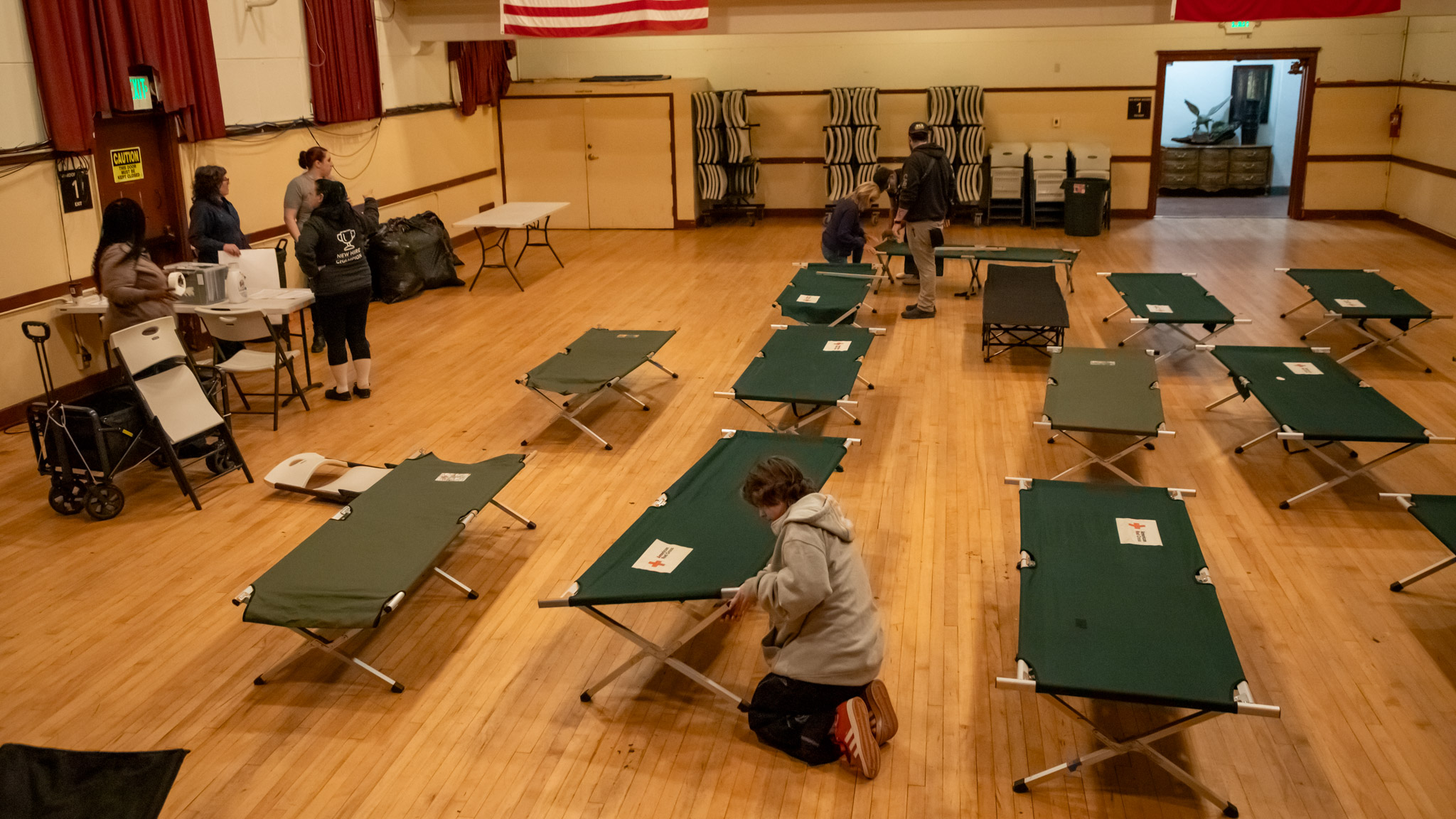
The Veterans Memorial Building in Santa Cruz is the site of one of the county’s two extreme weather shelters that open during cold snaps or flooding. County leaders hope to fund more shelter days ahead of anticipated rains from El Niño. (Amaya Edwards — Santa Cruz Local/CatchLight Local file)
Santa Cruz County emergency resources
- Find a list of shelter sites on the county’s website.
- City resources for unhoused residents.
- Read the city’s Point in Time Counts for unhoused population.
Story at a glance
- Increased rain as a result of El Niño is expected to impact the county’s unhoused residents.
- Officials are preparing for the storms but warn that current funding may not be enough for expected operations.
- Experts highlight that the cities homelessness problem continues independent of weather patterns.
SANTA CRUZ >> From the foot bridge that connects San Lorenzo Park to River Street, Christopher Mullis stood watching the water below. In rays of the early fall sun, its current looked steady and calm, but he reflected on all the times the river had quickly turned on him and others seeking shelter along its banks.
“You only have a few seconds because the river is rising, and you have to decide what to keep,” he said on a recent afternoon. “No one likes to make those decisions.”
The 36-year-old has lived in Santa Cruz for 15 years, and has lived in a tent along the San Lorenzo for some of that time. He said he’s seen people who camp close to the waters’ edge lose tents and belongings to the surging river.
This year, he worries that anticipated powerful storms will put his older friends and loved ones in danger. Temperatures in the South Pacific indicate that a potentially historic “super” El Niño weather pattern will come to Santa Cruz in the coming months, bringing a higher likelihood of raised seas and heavy rainfall across the county.
For people that live outdoors, who are most vulnerable to the dangers posed by El Niño, severe weather shelters have historically offered a dry place to find respite from the elements. But officials tasked with keeping unhoused residents safe are faced with a balancing act of deciding how much of the county’s homelessness response money to divert from long-term solutions to pay for temporary shelters and other emergency measures.
As officials and local nonprofits are gearing up to offer increased support this season, they underscored that current funding likely won’t be enough.

Christopher Mullis, 36, speaks to Santa Cruz Local on Wednesday. Mullis is worried about how his community is going to make it through the upcoming El Niño. (Amaya Edwards — Santa Cruz Local/CatchLight Local)
Winter shelter
On Tuesday, the Santa Cruz County Board of Supervisors approved loosening the threshold for the county’s severe weather shelters for the coming winter. Currently, the shelters open when temperatures are forecast to drop to 38 degrees or below for two consecutive nights, when inland flood warnings are issued, or when the county issues evacuation orders due to excessive rain.
The new cold-and-wet threshold would mean doors open when the forecast overnight low is 40°F or colder with an 80% or greater chance of rain for at least two consecutive nights, offering more shelter opportunities to unhoused residents.
The shelters are typically operated out of veterans halls in the cities of Santa Cruz and Watsonville, though this year the county is considering switching the Santa Cruz shelter to a location on Emeline Avenue. Some years see more than a dozen activations of the shelter, last year saw four.
Evan Morrison, executive director of People First of Santa Cruz County, the local nonprofit that runs the winter shelters, said that the old criteria meant shelters couldn’t always open when they were needed. Despite above-average rainfall in November and December of last year, doors stayed shuttered.
“We have folks on our team who have been homeless and they’re like, ‘look, when you are soaked through, it sucks. It doesn’t matter that it hasn’t got to 38 degrees yet. You can still get hypothermia if you’re soaked through in the low 40s.’”
Wet weather can also damage and wash away important belongings people may have with them — items like birth certificates and medications. Morrison also worries that cold, rainy weather could also lead to increased hospitalizations for medically vulnerable individuals.
While Morrison is “cautiously optimistic” that the wet-and-cold threshold will allow his team to operate when needed, he also cautioned that more nights will inevitably drive up costs. He’s currently budgeting for 20 at least nights of operation, which is expected to have a total cost of around $287,000 total. But he said that if El Niño and the new criteria were to push that number to 40 nights, costs could exceed $500,000.
“It’s still hard to predict right now, but it makes sense to be prepared for that amount,” Morrison said. “We need to have more money allocated to this program.”
The new wet-and-cold criteria will next be shared with the cities of Santa Cruz and Watsonville, asking them to support this realignment. Supervisors also suggested sharing the recommended changes with partner organizations, like People First, to confirm they have the capacity to support the increased thresholds. The board is expected to confirm the final recommendations no later than Nov. 17.
A tight budget and many needs
Dave Reid, director of the county’s office of response, recovery, and resilience, said the current budget may be stretched thin this winter. According to the Oct. 20 presentation, $325,479 is currently available for the operation of winter shelters, including at least $130,000 from the county, $140,000 from the City of Santa Cruz, and the rest coming from a rollover of 2025/26 funding. He said Watsonville city leaders are still determining how much they’ll contribute.
“I would say if we have a winter like 2023 or worse,” Reid said, “the existing budget will probably not be sufficient to pay for all of the nights that we would need to activate.”
According to a chart presented by Reid at the Oct. 20 meeting, severe weather in 2023 triggered 57 activations under the current criteria. Under the new recommendations, his team estimated that the 2023 number would have been closer to 72 activations.
In terms of immediate safety, Reid said flooding is the biggest concern. Unhoused residents often camp inside the city’s levee system and along waterways, like the San Lorenzo and Pajaro rivers.
Reid said sheriff’s deputies and Santa Cruz police patrol flood prone areas to make sure people have moved out before heavy rains. Reid said the officials focus on high risk areas like river levees, but that smaller creeks and rivers are also a concern.
While the preventative measure pushes people to lower-risk areas, Morrison said it also can make getting in touch with them, connecting them with services and getting the word out about severe conditions more challenging.
Robert Ratner, director of the county’s Housing for Health Division, said that taking on the issue of homelessness means making hard decisions with limited funding.
“Every day it’s a disaster having so many people who are unsheltered, and these inclement weather events in and of themselves don’t change that,” he said.
Federal disputes over funding for permanent housing projects have further tied up money, making investing in long term solutions a challenge.
“The loss of federal support for long-term affordable housing is going to have more negative impacts on the health of low-income people who experience homelessness than El Niño will,” Ratner said.
Morrison and his team are gearing up to provide the support they can in the immediate future. He stressed that investing in support, shelter, and longer term housing in the present will help save money down the line. “It’s most certainly an overall cost savings, because folks are much less likely to go to the hospital and have more negative medical events.”
Back at the San Lorenzo footbridge, Mullis looked towards the running water and at the crowd of unhoused residents congregating along it. While he said he’s worried about the upcoming winter, he also stressed the importance of seeking help and looking out for others as the storms build this winter.
“Look towards your resources,” he said. “And just make sure you take care of the right things, your family and the stuff that does matter.”
Questions or comments? Email [email protected]. Santa Cruz Local is supported by members, major donors, sponsors and grants for the general support of our newsroom. Our news judgments are made independently and not on the basis of donor support. Learn more about Santa Cruz Local and how we are funded.

Alonso Daboub joins Santa Cruz Local as a California Local News Fellow. He earned a master’s degree in Science Communication at UC Santa Cruz.