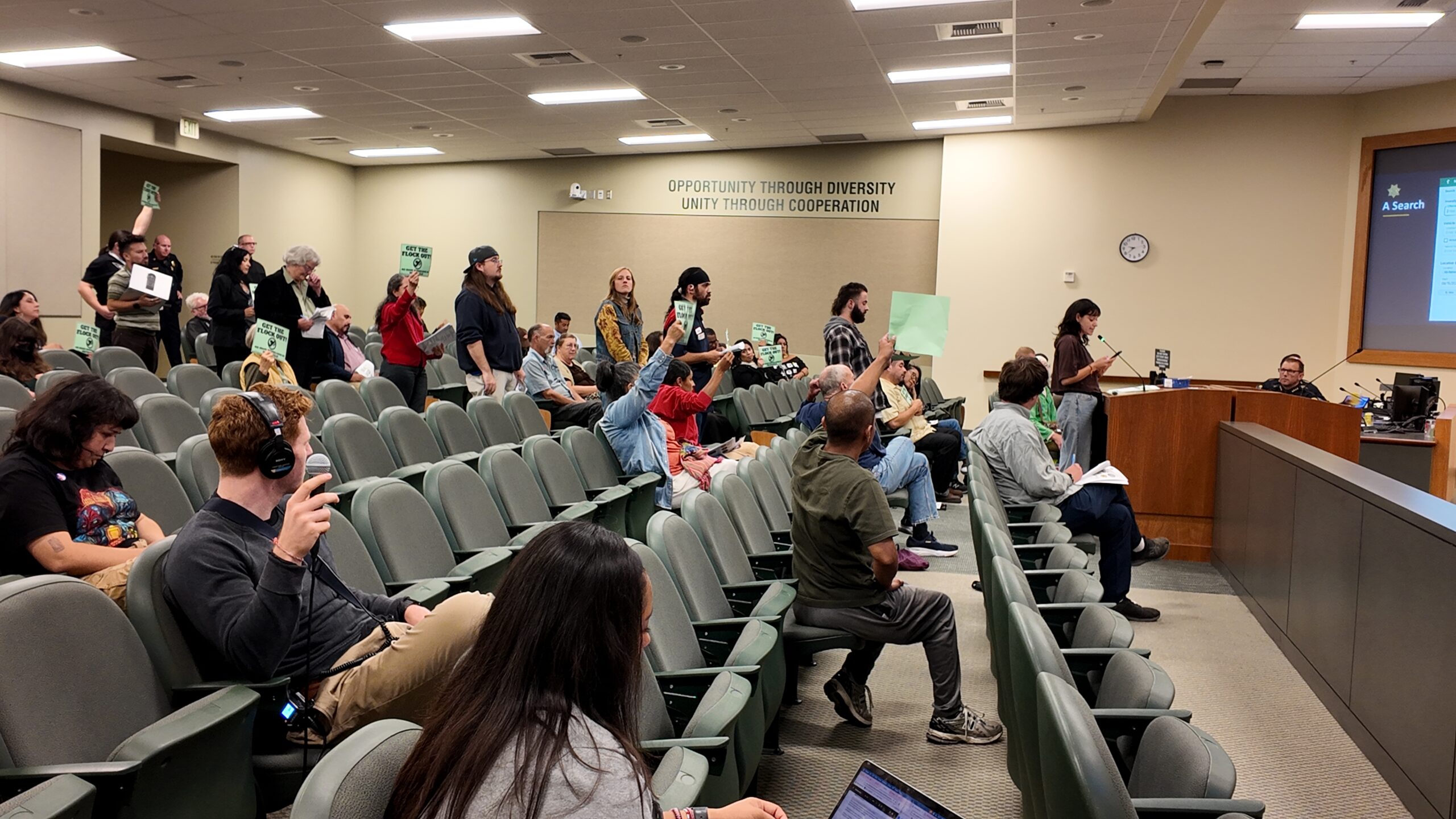
The Watsonville City Council on Sept. 22 adopted tighter restrictions on the use of automated license plate readers. (Erandi García — Noticias Watsonville)
WATSONVILLE >> Amid heated public debate over safety and surveillance, the Watsonville City Council on Tuesday adopted tighter restrictions on the use of automated license plate readers. Council leaders renewed the contract with Flock Safety for the ALPRs last September, but as scrutiny increased nationwide, Councilmember Ari Parker brought the issue back to the council for consideration.
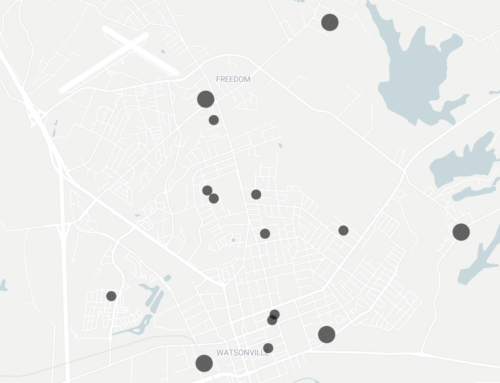
The vote at Tuesday’s meeting reduces the number of Flock cameras in Watsonville to 20 from 37, limits data retention to seven days from 30 and ends the sharing of information with other jurisdictions, including neighboring law enforcement agencies. The council also mandated quarterly independent audits and community engagement — including a town hall for residents with the CEO of Flock Safety and the Watsonville Police Chief.
ALPRs track people by capturing images of cars, including the license plate, make, model, color, bumper stickers and other identifying features. Police searching for a suspect can look up a car by its license plate or with a description of the car and track potential matches.
Investigations by CalMatters and Santa Cruz Local revealed how ALPR data in California, including Capitola and Santa Cruz police’s data, had been accessed on behalf of federal immigration agents by other law enforcement agencies in California in 2025. Santa Cruz voted to end its contract with Flock in January 2026.
Watsonville’s current contract with Atlanta, Georgia-based Flock Safety expires in September 2027.
The 5-2 vote followed more than four hours of discussion and public comments in a meeting that ended just before midnight. Councilmembers Maria Orozco, Ari Parker, Casey Clark, Jimmy Dutra and Vanessa Quiroz-Carter voted in favor of the restrictions. Councilmember Eduardo Montesino and Mayor Kristal Salcido voted against it.
Watsonville Police defend Flock cameras
Watsonville Police Chief Brian Shab said in a presentation to the council that the cameras can help an investigation progress more quickly. He cited examples where the cameras aided in identifying vehicles or suspects in investigations of homicide, sexual assault, indecent exposure and vehicle theft.
“The responsibility of the police department to use this technology lawfully, narrowly, transparently, and with meaningful oversight and it has serious consequences for misuse,” Shab said, adding that the department conducts audits twice a month to review unusual activities and verify that its personnel are complying with the rules of use.
He also said that not all employees have access to the system and there is no evidence that any employee has misused it.
The chief presented statistics that, he said, in the past year from September 2025 to September 2026, reflect the system’s usage. The department conducted 7,813 internal searches that resulted in 894 cases in which Flock assisted the department.
During the presentation, he also noted that Flock currently uses a default retention period of 30 days and prior to the council’s motion said he would be willing to evaluate whether seven days would be appropriate for Watsonville.
“A shorter retention provides greater identity protection, but it also means [it] reduces the window in which that information is available to investigators,” he said, in particular for crimes that are not reported immediately.
Questions about oversight
Council members had questions about how the system is monitored and who has access to the data.
Quiroz-Carter asked Shab to explain how investigations were conducted before Watsonville began using Flock. She also asked for details about the department’s policy governing the system’s use.
Shab said the policy was available online but was unable to specify at the moment where precisely on the website it could be found. Visibly displeased, Quiroz-Carter said she could not find it and questioned why more detailed information and the policy itself had not been brought to the meeting.
Orozco asked how many agencies in California have access to Watsonville’s data. Shab was unable to provide that number during the meeting.
Parker asked what happens when a user violates the system’s rules and what the consequences are.
Shab said the city could completely eliminate data sharing with other agencies or limit it to nearby jurisdictions. Reducing data sharing, he said, could affect the system’s usefulness for some investigations.
Parker also stated that her trust in the police chief was separate from her opinion of the technology.
“I don’t believe in Flock. I believe in you, but I don’t believe in Flock,” Parker said.

Watsonville’s current contract with Atlanta, Georgia-based Flock Safety expires in September 2027. (Erandi García — Noticias Watsonville)
The public was divided on Flock
The council chamber was initially full during the discussion, but as the conversation continued, some people began to leave. At least 30 people spoke in person, with another 20 or so speaking via Zoom.
The comments reflected conflicting positions. The vast majority expressed their opposition to Flock. Those opposed raised concerns about privacy, data sharing and potential misuse of information.
“The question is not do we trust the Watsonville PD, the question is should Watsonville participate in a system where the data we collect could be vulnerable to misuse beyond our local control” a community member commented.
Yesenia Jimenez, a District 7 resident, said the department’s defense of Flock was undermining trust and questioned whether officers should have spent time at the meeting rather than patrolling the streets.
“I get that you’re trying to save a tool that is helping you. You are eroding trust right now” Jimenez said. “I would rather you have spent less time here, or whoever, whatever officers are back here, to be out on the street patrolling than to be wasting their time listening to this.”
A mother of two girls said she would feel safer knowing the cameras were in place and that she did not see surveillance as a concern given how common cameras and smartphones already are in the community.
“If Flock is a safe thing for my kids, I agree with you guys,” she said.
Watsonville began using 20 Flock Safety cameras in June 2023. In September 2025, the city council voted 5-2 to renew the $251,000 contract for 24 months and increase the number of cameras to 37.
Questions or comments? Email [email protected]. Santa Cruz Local is supported by members, major donors, sponsors and grants for the general support of our newsroom. Our news judgments are made independently and not on the basis of donor support. Learn more about Santa Cruz Local and how we are funded.

Erandi García reports on the Latino community, covering issues and decisions that shape life in the Pajaro Valley and across Santa Cruz County. "My goal is to provide accurate, accessible journalism that helps the migrant residents stay informed and engaged in their communities. I live in the Pajaro Valley and enjoy spending time with my family, exploring local events and staying connected with the community I have called home for most of my life."
Before joining Santa Cruz Local, Erandi spent more than a decade as a television journalist, reporting and anchoring for Spanish-language news. Her reporting focused on public safety, local government, immigration, crime, education and agriculture. Most recently, she served as Director of Community Outreach and Education at Hospice Giving Foundation, where she led bilingual outreach initiatives and worked with community partners throughout Monterey and Santa Cruz counties.