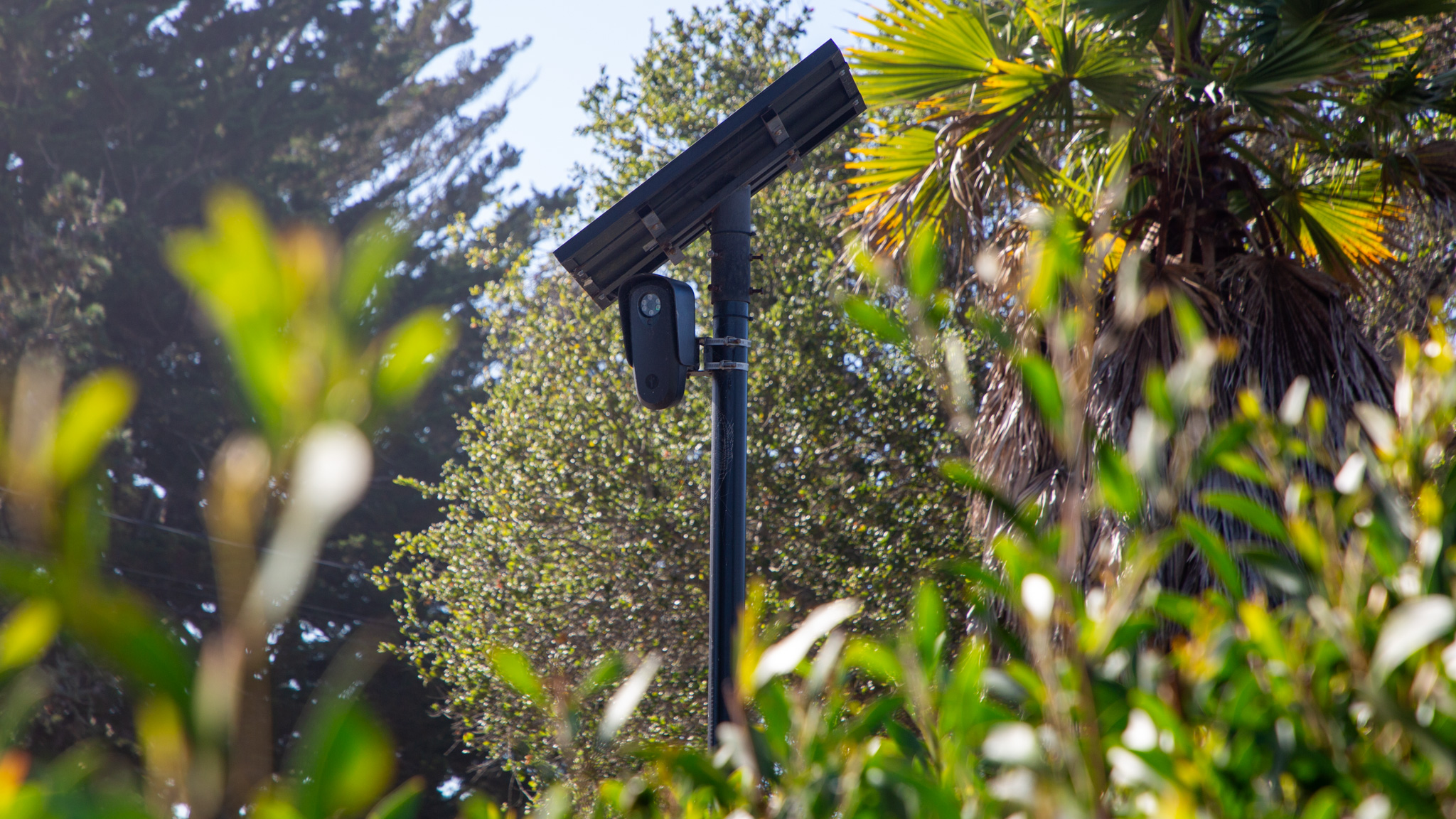
Capitola Police lease 10 cameras from security company Flock Safety that capture license plates of passing vehicles. (Amaya Edwards — Santa Cruz Local/CatchLight Local)
CAPITOLA>> Throughout 2024 and early 2025, federal and out-of-state law enforcement agencies searched Capitola Police Department’s database of automatic license plate readers more than three million times, violating multiple laws. At least 190 were done by sheriffs offices and police departments running searches on behalf of U.S. Immigrations and Customs Enforcement, or ICE.
Capitola Police have confirmed that they violated state law in sharing data with out-of-state agencies, and said the violations were unintentional. Now, the department is increasing its oversight into how other agencies use its data.
“The City remains committed to transparency, accountability, and maintaining the trust of our community,” Capitola Police Chief Sarah Ryan wrote in a Nov. 7 email.
Capitola Police “does not assist Immigration and Customs Enforcement (ICE) officials in enforcing civil immigration law violations,” she said.
Capitola police lease 10 cameras from security company Flock Safety that capture license plates of passing vehicles. The data is stored on a Flock-administrated online database for 30 days. That database can be searched by Capitola Police officers and other law enforcement agencies, primarily to locate stolen cars or track down suspects.
Legally, Capitola Police can only share data with other law enforcement agencies within California. But the department had opted into a tool offered by Flock that allowed Capitola Police to search license plate data nationwide —- and allowed out-of-state searches of Capitola’s own data, a Flock spokesperson said in a Nov. 7 email.
Those searches violated California laws that forbid local and state law enforcement from sharing license plate camera data information with any out-of-state agency. Although ICE officials did not directly search Capitola’s data, public records suggest that out-of-state agencies performed searches on behalf of ICE.
Flock disabled nationwide sharing for public agencies in California in February to ensure compliance with state law, the Flock spokesperson said. But Capitola Police didn’t realize the data had been available to out-of-state agencies until a whistleblower alerted them in late October.
The violations of state law “were inadvertent and were not the result of any deliberate attempt by City staff to circumvent California law,” Ryan said by email. Ryan was sworn in as chief in December 2024, nine months after the Capitola City Council voted to lease the license plate cameras.
To ensure ongoing compliance with state law, Ryan has ordered a monthly audit of searches other agencies have conducted of Capitola’s data, she wrote.
Search records
The out-of-state searches were first identified by a retired security network analyst who lives in Santa Cruz County, after he started noticing the cameras around the area in April. “I was then immediately concerned about, okay, how are they storing the data?” recalled D., the security analyst, who asked only to be identified by his last initial out of fear of retaliation from law enforcement or Flock. He has worked in network security for 10 years.
“Especially given that they are a startup,” he added. “I’ve done security for startups, and I know that a lot of times, security is not as strong as it should be.”
The Atlanta, Georgia-based surveillance company Flock Safety says over 5,000 agencies in 49 states use its automated license plate reader. The cities of Capitola, Santa Cruz and Watsonville all operate Flock license plate cameras. Police chiefs have praised the cameras as an effective way to track down suspects of serious crimes and recover stolen vehicles.
But amid the increasing surveillance, arrest and deportation of unauthorized immigrants, city contracts with Flock have sparked pushback from activists, academics and state legislators.
In October, D. submitted a public records request to the Capitola Police for its network audit, a document that logs times other agencies have searched Capitola’s data, for 2024 and 2025. Those searches scoured databases of thousands of agencies across the country.
The logs Capitola provided D. left off the reasons out-of-state officers conducted each license plate search. But by looking at unredacted search logs from other police departments, D. was able to identify dozens of cases where out-of-state agencies searched Capitola data for immigration enforcement purposes.
For example, on Dec. 19, 2024, the Lowndes County Sheriff’s Office in Georgia searched data from 5,770 agencies, including Capitola Police Department, and listed the reason as “ICE.” U.S. Immigration and Customs Enforcement has tapped local law enforcement agencies to search license plate data in pursuit of unauthorized immigrants, 404 Media reported in May. 404 Media is a digital publication reporting primarily on cybersecurity, technology and surveillance.
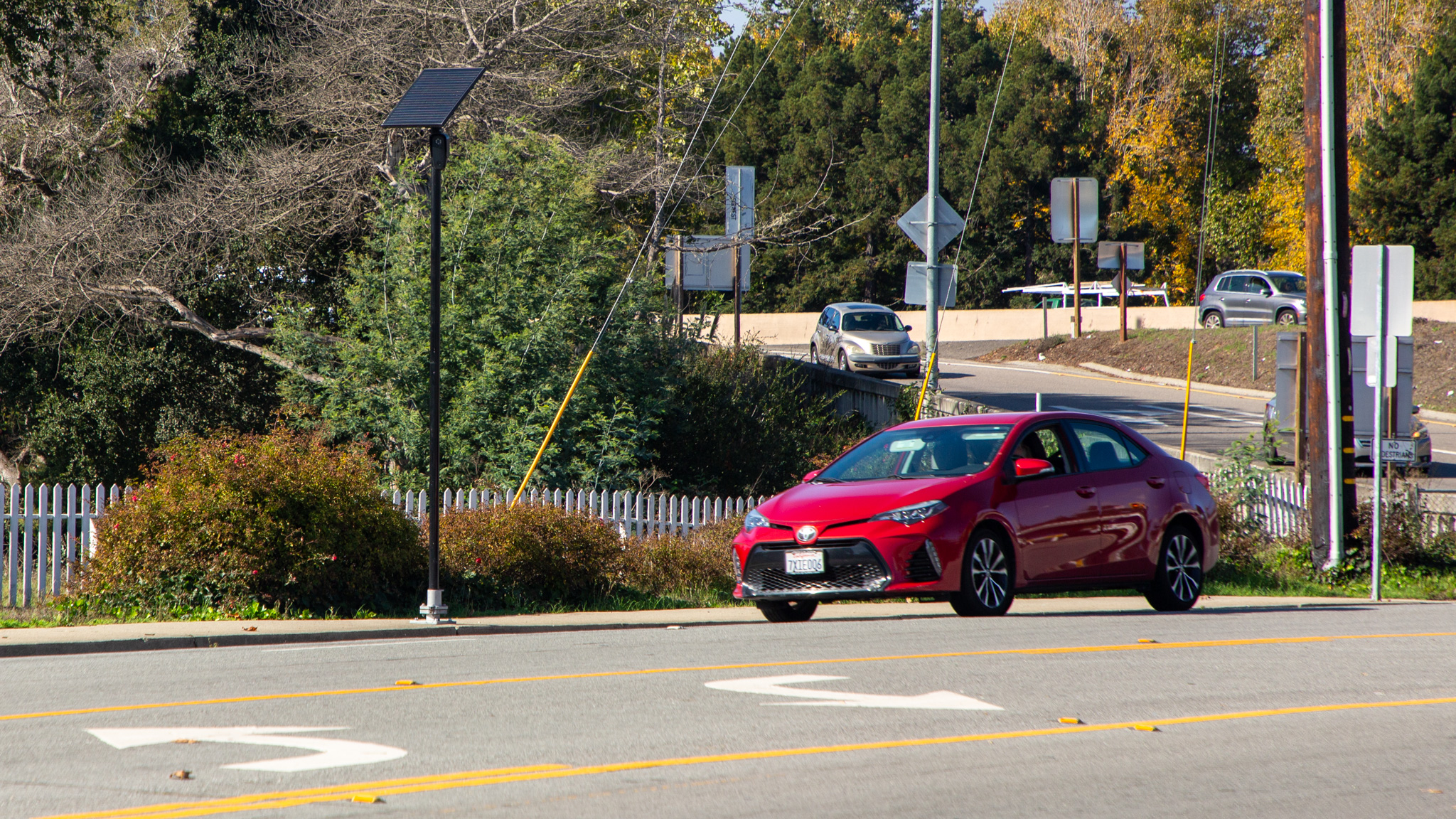
A red car drives past a Flock license plate reader camera located on Bay Avenue in Capitola on Nov. 6, 2025. (Amaya Edwards — Santa Cruz Local/CatchLight Local)
A Santa Cruz Local analysis of data from the City of Capitola and two other cities showed more than 200 immigration-related searches of Capitola’s data from dozens of out-of-state agencies from January 2024 to February 2025.
On at least one occasion, a federal agency — the U.S. Bureau of Alcohol, Tobacco and Firearms — searched Capitola’s license plate camera data from a field division in Nashville, Tenn. The reason was listed at “Federal ERO Assist” — ERO likely referring to ICE’s Enforcement and Removal Operations.
California’s SB 54, the 2018 California Values Act, prohibits local law enforcement from cooperating with federal immigration enforcement. Another law, SB 34, places limits on data collection from license plate cameras, and requires agencies to notify the public if their data has been breached.
License plate camera data may only be shared with other public agencies within California, according to legal guidance from California Attorney General Rob Bonta published October 2023.
But some law enforcement agencies, including the Los Angeles Police Department, continued to conduct searches on behalf of ICE, Calmatters reported in June 2025.
For members of Get the Flock Out, a local anti-Flock group, the records from Capitola underscore long-running concerns about local use of license plate cameras.
Local police “may be trying to handle the data well, but we’re seeing from these public releases that actually they’re not handling the data well,” said Get the Flock Out member Ami Chen Mills. “I think this is beyond the capacity of our small communities to handle.”
Even if California police departments are prohibited from sharing data out of state, Get the Flock Out has ongoing concerns about Flock’s ability to access the data and its history of collaboration with immigration enforcement. When determining the trustworthiness of license plate camera programs, “we can’t just look at our communities and our police departments,” Chen Mills said.
Local police say the cameras help public safety. But as people are “being abducted and detained against our Constitution,” Chen Mills said, “who do we want to keep safe?”
Santa Cruz Local's Methodology
Reporter Jesse Kathan replicated a data analysis by a retired network security analyst of Capitola Police Department’s Flock network audit from Jan. 1, 2024 to Sep. 30, 2025. The audit logs times other agencies have searched Capitola’s data.
For example, at 2:41 a.m. on Jan. 1, a Dallas Police officer searched Capitola’s data. Documents provided by Capitola Police do not include the reason for that search.
The officer’s search scoured data from thousands of other agencies, including Mukilteo Police Department. Documents released from police in Mukilteo, Wash. record the same search at the same time and date, along with the reason that wasn’t included in Capitola’s logs: “ICE+ERO,” likely referring to ICE’s Enforcement and Removal Operations.
Using the programming language R, we used timestamps to match up the searches between Capitola Police, Mukilteo Police and police in Danville, Ill. That revealed the reasons for each search in Capitola’s logs.
In combing through the data, we used key phrases, including “ICE” and “immigration” to identify searches related to immigration enforcement.
The network audits do not show whether any of the searches successfully identified suspects or vehicles in the Capitola data.
Questions or comments? Email [email protected]. Santa Cruz Local is supported by members, major donors, sponsors and grants for the general support of our newsroom. Our news judgments are made independently and not on the basis of donor support. Learn more about Santa Cruz Local and how we are funded.

Jesse Kathan is a staff reporter for Santa Cruz Local. They hold a master's degree in science communications from UC Santa Cruz.