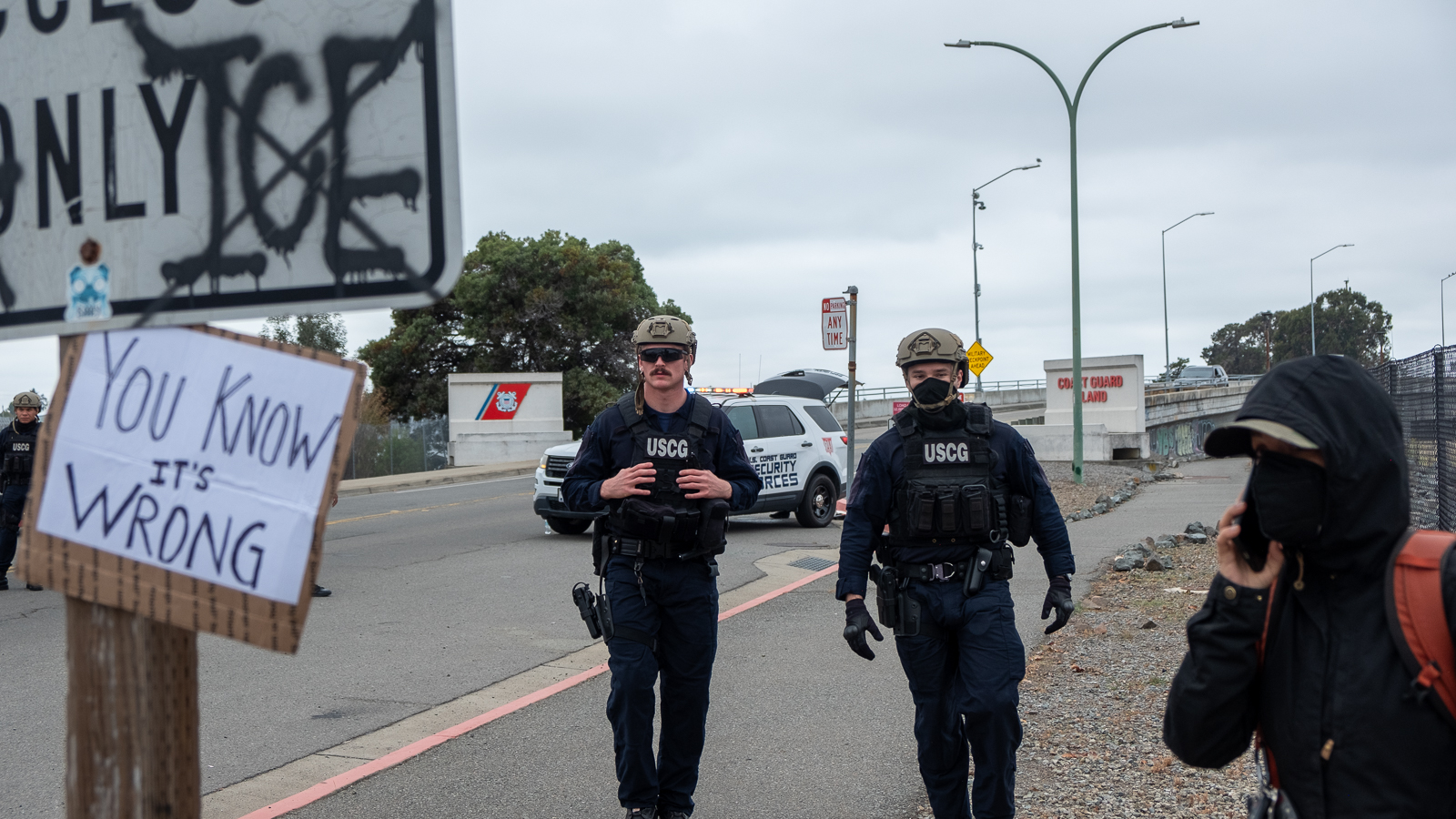
A federal crackdown on immigrants was poised to begin in the San Francisco Bay Area in October 2025 before President Donald Trump called off the effort. Pro-immigrant groups protested outside a U.S. Coast Guard base near Oakland where immigration agents were staged. (Nik Altenberg — Santa Cruz Local file)
SANTA CRUZ COUNTY >> Federal data released in August shows that immigration enforcement in Santa Cruz County has picked up over the past three months, but has not seen the same staggering increases documented in Northern California as a whole.
Here’s what we know:
- Immigration authorities have arrested at least three people in Santa Cruz County over the past three months, according to federal data.
- Six of seven documented arrests since January 2025 were of people convicted of crimes or with pending criminal charges.
- The number of courtesy notices that U.S. Immigration and Customs Enforcement, or ICE, has given local law enforcement agencies to inform them of planned activity has fluctuated since January 2025, and fewer notices were given this year than last. At least two arrests have been made without documented notification.
Following the election of President Donald Trump and the subsequent surge of immigration enforcement across the nation, Santa Cruz County’s immigrant communities have faced heightened fears of arrest and deportation, sometimes bolstered by false reports of ICE activity. Santa Cruz Local is using data from local and federal agencies to provide ongoing, verifiable documentation of immigration enforcement.
For this story, Santa Cruz Local analyzed data compiled by the Deportation Data Project, which obtains data from federal immigration authorities through public records requests. ICE has previously disputed the accuracy of the Deportation Data Project, without disputing specific records of arrests or deportations.
At least four arrests this year
Santa Cruz Local identified seven arrests in Santa Cruz County over the past two years in federal data. Additional arrests may have occurred if federal agents did not clearly document their location. Numerous arrests in the data are missing location information.
Across Northern California, ICE has increasingly targeted people without a criminal record. But in Santa Cruz County, most documented arrests have been of people with charges or past convictions.
An ICE spokesman shared details about two recent cases but declined to elaborate on the details of all cases identified by Santa Cruz Local, or to confirm the total number of arrests in Santa Cruz County since 2025.
On Aug. 5, ICE agents arrested 29-year-old Mexican national Martin Sebastian Cruz Diaz in Watsonville, ICE spokesperson Jason Sweeney wrote in a Sept. 4 statement. After years in jail, he was convicted in February of numerous charges, including lewd and lascivious acts with a child aged 14 or 15, and released later that month on time served.
Three people arrested in the county had criminal convictions, and two had pending charges, according to the federal data. One person was documented as having violated only immigration law, and another as having outstanding charges in another country.
One of the two without a criminal record in the U.S. is 64-year-old Canadian national Charles Peter Billone, arrested July 29, who officials said had an arrest warrant in Canada for sexual assault and sexual contact with a child under 14.

One arrest on April 15, 2025, took place at the Santa Cruz County Jail as part of the Criminal Alien Program, a federal effort to arrest people in the country illegally as they leave jail or prison for other offenses.
Ashley Keene, a spokesperson for the Sheriff’s Office, wrote in an Aug. 31 email that their office had no knowledge of the arrest at the jail.
“We do not participate in nor do we coordinate with ICE regarding immigration enforcement actions,” she wrote. “ICE being able to take someone into custody at or near the jail does not mean our agency transferred the person to ICE or cooperated with ICE’s immigration enforcement.”
Phil Neff, lead analyst for the Deportation Data Project, confirmed in an email that not all arrests through the Criminal Alien Program involve collaboration with local law enforcement. This is in part because immigration officials can use jail information shared with the Federal Bureau of Investigation and publicly available jail and court records, to locate and arrest non-citizens leaving jails.
U.S. Customs and Border Protection, or CBP, can also arrest people for immigration-related charges. Increasingly, CBP has carried out arrests far from the borderlands. As border crossings dropped precipitously at the start of Trump’s second term, CBP, which includes border patrol, has had more capacity to conduct enforcement in the interior and to support ICE.
The CBP data obtained by the Deportation Data Project includes the date and time of those arrests, but not the location — meaning the agency may have also arrested people in Santa Cruz County.
An arrest reported by Lookout Santa Cruz alleged to have occurred on Jan. 18, 2025 was not identifiable in ICE, CBP or detention center data. A CBP spokesperson said there was no record of the arrest. Santa Cruz Local was not able to independently verify the arrest and did not include it in our data analysis.
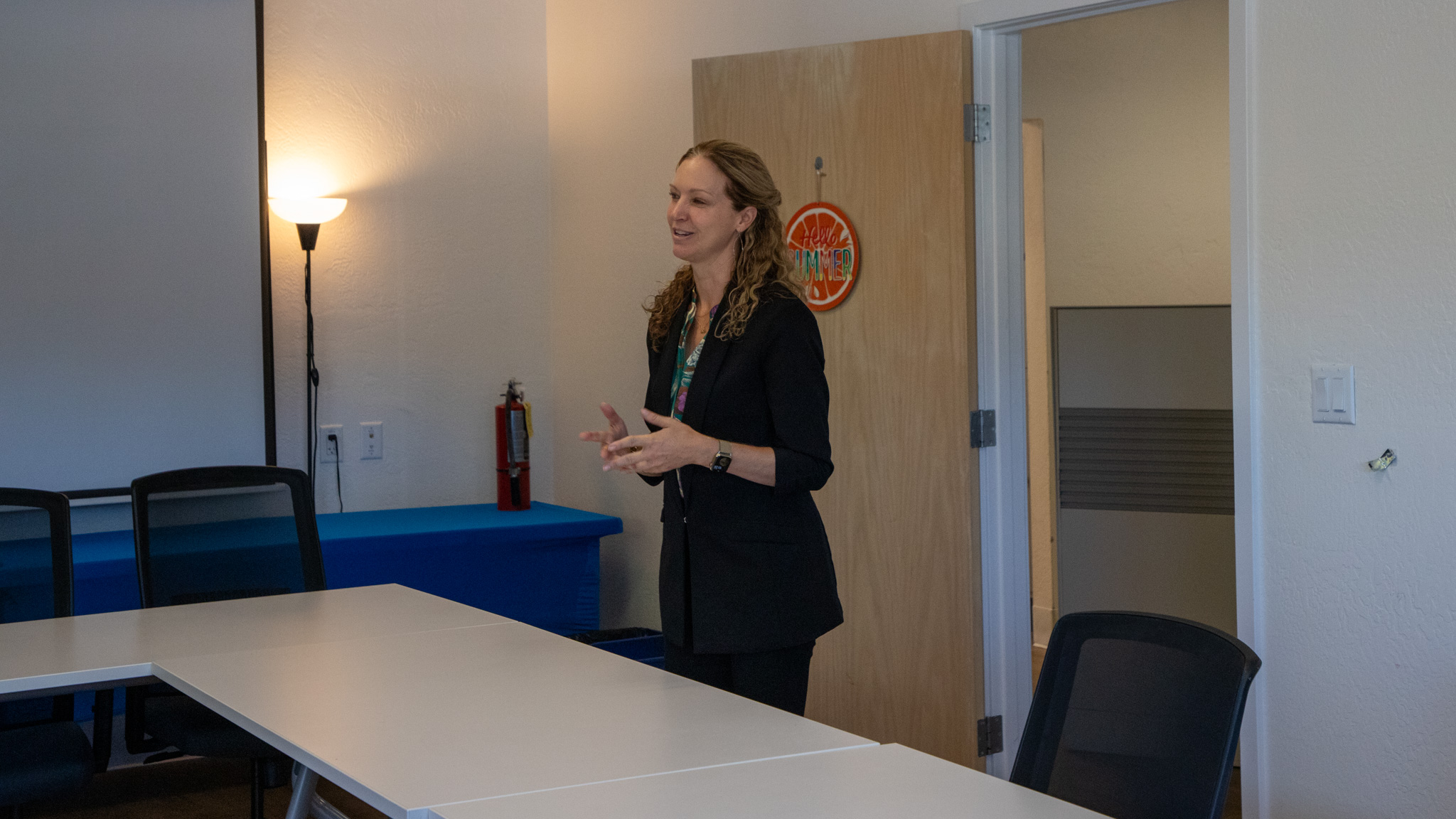
Santa Cruz County Public Defender Heather Rodgers has called for more funding for immigration attorneys in her office to assist residents and expand the services it provides. (Amaya Edwards — Santa Cruz Local/CatchLight Local file)
Notifications to local law enforcement have slowed
Federal immigration agents often notify local law enforcement of their presence ahead of time. Santa Cruz Local is requesting and compiling documentation of these “courtesy notices” in Santa Cruz County on an ongoing basis.
Notices to local law enforcement have decreased since a high of five visits in January, with one visit a month reported in June, July and August. It’s unclear how many visits have been made without informing local law enforcement. For example, there is no record of federal authorities notifying Watsonville Police Department ahead of the Aug. 5 arrest.
See notices provided to Santa Cruz Police, Watsonville Police, and the Santa Cruz County Sheriff’s Office. Scotts Valley Police and Capitola Police reported no notices from federal immigration authorities in the past two years.
Arrests nationally and regionally are increasing
Across the San Francisco Area of Responsibility, which includes Northern California, Hawaii, Guam and the Saipan, arrests have sharply increased over the past six months.
The city with the most arrests since January 2025 — 2,481 — is San Francisco, where an immigration court has been the site of more than 140 courthouse arrests and more than 500 people were arrested during immigration appointments at an ICE field office. Some of those arrested could have been Santa Cruz County residents because San Francisco and Concord are the closest immigration courts.
Other cities with the most arrests include Fresno, Bakersfield, Sacramento and Stockton.
Officials are increasingly not taking people into detention after they are arrested, possibly a sign that other means, including ankle monitors, are being used to monitor arrestees awaiting a court date. That doesn’t appear to be the case for any of the documented arrests in Santa Cruz County.
And although nearly all the people arrested in Santa Cruz County had current or pending criminal charges, an increasing number of people in Northern California have been arrested with no criminal record.
Legal resources for immigrants
Some criminal sentences can bar non-citizens from pursuing legal status, or otherwise place them at a higher risk of deportation. Some people with these sentences may be able to retroactively remove the parts that impact immigration pathways.
The Santa Cruz County Office of the Public Defender assists non-citizens who pled guilty or no-contest without fully understanding their sentence. Often, people plead guilty, “not understanding that it was going to be devastating to their immigration pathways,” said Public Defender Heather Rodgers, “which in turn could impact their ability, especially in this administration, to stay with their families and to raise their children and continue on with their life in this country.”
Public defenders petition the District Attorney to remove or substitute immigration-related penalties. “We have a very high success rate on those petitions,” she said.
In some cases, the public defender’s office may be able to dismiss charges, expunge or seal criminal records, or obtain a vacatur that essentially erases the conviction.
There’s no guarantee that any of these measures will decrease someone’s likelihood of arrest or detention. “At times during this administration, things have felt a little arbitrary,” Rodgers said.
People with pending criminal charges should seek attorneys in both criminal and immigration court, Rodgers said. The Public Defender’s office represents those who cannot afford a private attorney in criminal court, but does not work in immigration court.
Nonprofits that provide immigration legal assistance include Santa Cruz County Immigration Project: Catholic Charities, Watsonville Law Center, and Latinan.
For a private immigration lawyer, Rodgers suggests relying on referrals from a trusted source, like nonprofit legal agencies or the Lawyer Referral Service of Santa Cruz County. Scams are common, especially on social media like Facebook. Notaries are not authorized to provide legal services.
Read more about immigrant rights, making an emergency plan for arrest and other resources.
What do you think?
Questions or comments? Email [email protected]. Santa Cruz Local is supported by members, major donors, sponsors and grants for the general support of our newsroom. Our news judgments are made independently and not on the basis of donor support. Learn more about Santa Cruz Local and how we are funded.

Jesse Kathan is a staff reporter for Santa Cruz Local. They hold a master's degree in science communications from UC Santa Cruz.