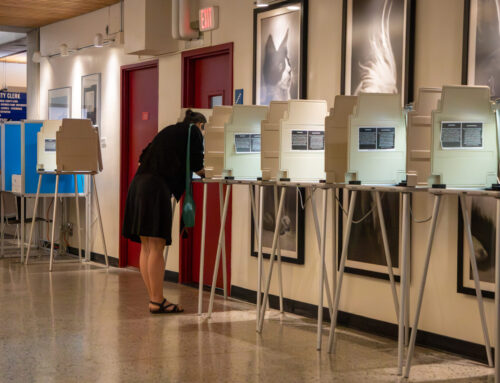
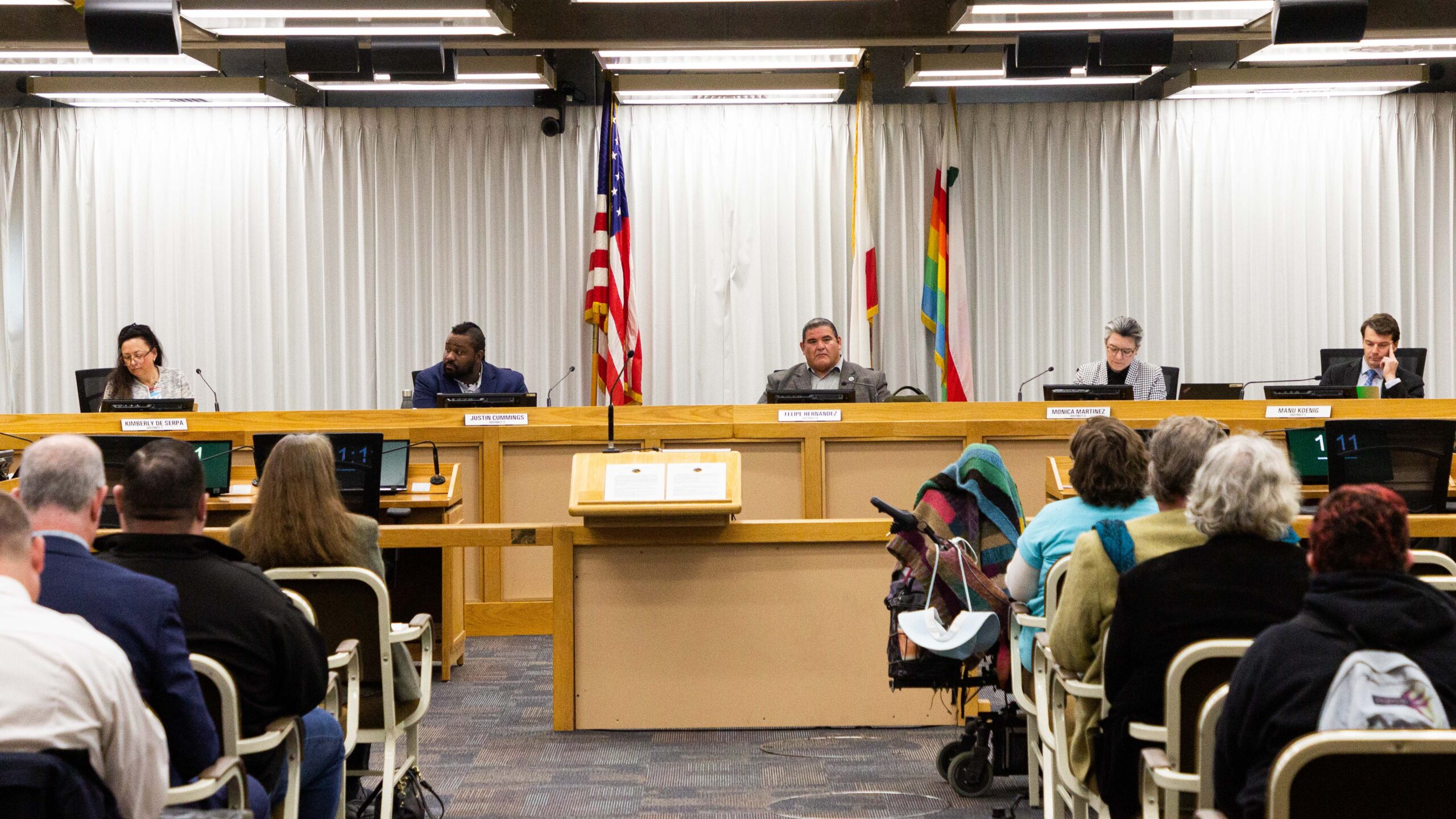
The Santa Cruz County Board of Supervisors is seeking approval from the state to propose a new countywide sales tax hike. (Marcello Hutchinson-Trujillo — Santa Cruz Local file)
SANTA CRUZ >> Santa Cruz County leaders are seeking state approval to allow a half-cent sales tax to come before voters as early as November. The revenue could fund safety net services for county residents affected by cuts in the federal budget, called the One Big Beautiful Bill, like health care and food assistance.
The budget bill “will poke pretty big holes in the safety net unless we do something to close them, so that’s what we’re looking at,” said county spokesman Jason Hoppin. The county estimates a half-cent sales tax hike would bring in $27 million annually, Hoppin said, and is expecting to propose the measure as a temporary, five-year tax hike.
The county first needs state approval to put the tax measure before voters, because sales taxes in the cities of Santa Cruz, Scotts Valley and Watsonville are at 9.75%, the maximum allowed without approval from the legislature.
If the state legislature greenlights the bill, SB 1078, supervisors could place the measure on the Nov. 3 ballot where it would need more than 50% voter approval. All county voters would see the measure on their ballots and if adopted, the countywide tax would be levied in unincorporated areas and the four cities.
Separately, residents who support Santa Cruz Metro have proposed a countywide half-cent sales tax for the November ballot. If both measures were to come before voters and be approved this year, sales taxes could grow as high as 10.75%.
‘No lifelines’ in state budget
The possibility of a countywide sales tax hike to benefit the county budget comes as the impacts of federal budget cuts are just beginning to be felt locally. Last year, when the federal government shut down for 35 days as Democrats and Republicans tangled over cuts to Medicaid, about 42 million recipients of federal food assistance nationwide were affected.
Locally, service providers and nonprofits strained to meet the need for food assistance and city and county governments donated hundreds of thousands of dollars to Second Harvest Food Bank to help it feed hundreds more participants. Those days were likely a glimpse of what’s to come in the months and years ahead.
The budget bill, also called HR1, will have “profound impacts on our ability to deliver services,” Hoppin said. Among the federal changes was to require households who benefit from federal food assistance to renew their paperwork twice a year instead of once.
“Those increased requirements will throw people off the rolls just because they can’t keep up with the paperwork,” Hoppin said. The additional paperwork also means a greater burden on county case workers. “We’re going to see people lose access to services unless we do something to address it, like increase the benefits service workers to handle the higher caseload.”
Hoppin said county leaders may not propose a tax hike if there are changes to the California state budget, proposed by Governor Gavin Newsom in January, that help the county.
“There were no lifelines, there were no life preservers, in the governor’s proposed budget,” he said.
The California State Association of Counties is asking Newsom for $1.9 billion to help counties address the vast — and expensive — need for safety-net services left by the federal budget cuts. A revised state budget proposal is due in May.
Offering a lifeline to Watsonville Community Hospital is another goal of a potential tax measure. The hospital is in dire straits as it confronts a severe lack of cash on hand: the hospital has taken out two short-term loans this year to make ends meet as it awaits a nearly year-overdue payment from Centers for Medicare and Medicaid Services.
The hospital has less than $6 million of liquid assets, far below the recommended minimum of $40 million, said Marcus Pimentel, Pajaro Valley Health Care District board member, at a district meeting Wednesday.
The health care district is betting on a partnership with a larger health care system to bail it out, like Sutter or CommonSpirit, which owns Dominican Hospital. But after months of talks to that end, district leaders had little in the way of an update at its Wednesday meeting.
Tony Nuñez, board chair for the district, said they were “very close” to reaching an agreement and more would be shared soon.
Amaya Edwards contributed reporting.
Questions or comments? Email [email protected]. Santa Cruz Local is supported by members, major donors, sponsors and grants for the general support of our newsroom. Our news judgments are made independently and not on the basis of donor support. Learn more about Santa Cruz Local and how we are funded.

Nik Altenberg is a bilingual reporter and assistant editor at Santa Cruz Local. Nik Altenberg es reportera bilingüe y editora asistente para Santa Cruz Local.