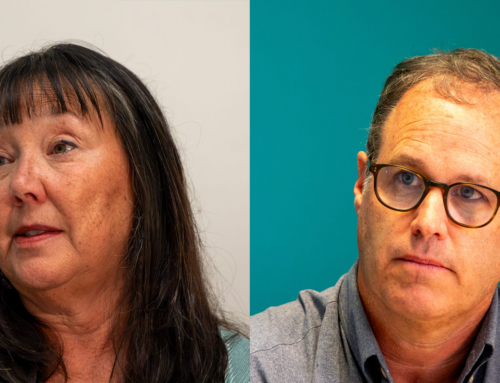

Santa Cruz County Sheriff Chris Clark discusses his first year heading the department in a Dec. 3 interview. (Amaya Edwards — Santa Cruz Local/CatchLight Local)
LIVE OAK >> Santa Cruz County Sheriff Chris Clark sat down with Santa Cruz Local to discuss his first year in office, which began Dec. 7 last year.
The 46-year-old was born in the UK, his dad worked as a military contractor and his family moved around a lot. He said of everywhere he’s been — including Egypt, Kuwait, Japan, and many U.S. states — he has always felt drawn to Santa Cruz County since he first came here.
He moved to Santa Cruz County and joined the Sheriff’s Office in 2006, because his uncle worked for UC Santa Cruz police and told him about a job opening. But after two years, the cost of living drove him out, so he moved to Sacramento and spent six months in their sheriff’s office. He then returned to Santa Cruz, because he missed the work he was doing in this county, he said, and “from there, worked just about every assignment here.”
Dressed in a collared shirt and slacks, his sheriff’s hat and formal attire adorned a tall wardrobe on one side of his office at the Sheriff’s Office headquarters in Live Oak. He said he doesn’t wear the hat often — usually just for funerals — as it messes up his hair.
On Clark’s desk was a football helmet pen holder — Louisiana State University, because he’s a fan of college sports and lived in New Orleans for part of high school — and a few other mementos. On a bookcase behind his desk sat several photos, including one of him and his late uncle at his swearing in ceremony in Sacramento. His uncle died of cancer several months after the photo, which was “really impactful for me,” he said.
Several of his uncles worked in law enforcement, and one of them advised him not to pursue the career because “the job is just way too hard,” but Clark said it didn’t deter him.
“What I love about it is the fact you get to help people every day, and you can truly make a difference in somebody’s life,” he said. “Policing’s got a painful history, and we can help push that the other way.”
While the sheriff is a public office that is theoretically determined by voters, Clark was not elected — former Sheriff Jim Hart retired two years into a six-year term and tapped then-Undersheriff Clark to succeed him. Clark was then appointed by the Santa Cruz County Board of Supervisors.
That’s the same way the last three sheriffs obtained the position — Hart in 2015, Phil Wowak in 2009 and Steven Robbins in 2004.
Clark will be up for re-election in 2028.
Jump to a section:
- Clark eyes new mental health jail facility
- Jail deaths: ‘Sometimes things happen’
- A novel approach to overdose deaths
- Clark on Flock license plate cameras
- Looking ahead: wildfire, DNA, baseball
Clark eyes new mental health jail facility
Like his predecessor, Clark is calling for a new jail to replace the 44-year-old Main Jail on Water Street. Sheriff’s Office leaders pushed for a new facility in 2023, and Clark said he has continued to work with the county executive office on planning for one.
“We need a new jail,” Clark said. “There’s no question about that.” Many of the people incarcerated in the county have substance use disorders, mental health challenges and other medical needs, he said, and the incarcerated population is growing older. He said the main jail is not designed for a population with specialized medical needs.
The number of inmates in Santa Cruz County with a psychiatric prescription grew from an average of about 50 people in 2002 to about 150 people in 2025, while the overall jail population dropped from more than 600 people to roughly 300 people over the same period.
“We’ve got 70% of our incarcerated population is on some form of medication, 50% is on some form of mental health medication,” Clark said. “With what we have now, it’s meeting the need, but it’s not doing it in a way that I believe is most conducive for producing better outcomes for folks.”
Despite having a smaller number of inmates to accomodate, Clark said the current facilities do not meet the needs of the county.
“It’s not a medical and mental health designed facility. Frankly, it’s a cold jail,” he said.
While an estimate for a new jail was about $100 million to $200 million in 2023, Clark said now it could be more along the lines of $350 million.
“Building new jails just isn’t popular,” he said, and the county would be hard pressed to fund it amid ongoing fiscal challenges, adding that county residents are growing tired of bond measures.
Clark said he’s eyeing an alternative solution — a mental health unit like one that recently opened in Ventura County, to house incarcerated people with mental health and substance use related medical needs. The Ventura County facility opened in 2023 with space for 64 people at a cost of $61 million to build.
Clark said a mental health jail facility wouldn’t necessarily have to be built from the ground up, and his office is looking at existing county facilities for potential conversion.
Jail deaths: ‘Sometimes things happen’
On May 10, 2020, 21-year-old Santa Cruz native Tamario Smith died in custody at the Main Jail. A lawsuit filed against Hart, the county and California Forensic Medical Group, the former jail medical provider, alleged his death was due in part to weeks of medical and psychiatric missteps, inappropriate isolation in a segregated cell, a lacking response from correctional officers who found him unconscious, and the jail’s broken intercom buttons.
The county and Hart settled with Smith’s family last year for $2.2 million. Another lawsuit stemming from a jail death, that of 24-year-old Watsonville native German Carrillo who was strangled to death by his cellmates in 2019 and whose body went undiscovered for 36 hours, was settled for $3.25 million in 2022.
A 2024 report from the Santa Cruz County Office of Inspector General called for detailed reports of the jail deaths of Smith, Carrillo and others who “the public has not forgotten about” to identify “performance, structural, or other issues that were not optimal,” according to the recommendation.
Of the 21 recommendations from that report, the Sheriff’s Office addressed or complied with all except for that one.
“We declined. We, I mean, for one, it’s all been litigated. So all of the information that occurred around both those deaths, all that information was provided to the defense attorneys, the plaintiff’s attorneys on both of those cases,” Clark said.
Both cases settled before going to trial, potentially preventing the publication of depositions and other confidential materials that would have shed light on the circumstances surrounding the deaths.
When pressed on the settlements, Clark said, “There’s reasons why some things settle, and there’s reasons why some things don’t. And I would say in most cases things are settled. It’s, you know, is it a matter of practice? That’s more of a question for our counsel.”
Referring to another case, that of Mark Beckner who died of an aneurysm in jail in 2022, he said: “They came in and they ended up dying, you know, in custody. And so that’s terrible, right? But at the same time, there are certain things that we don’t have a whole lot of control over.”
A lawsuit from Beckner’s family against the county and the former jail medical provider for alleged medical neglect remains in court.
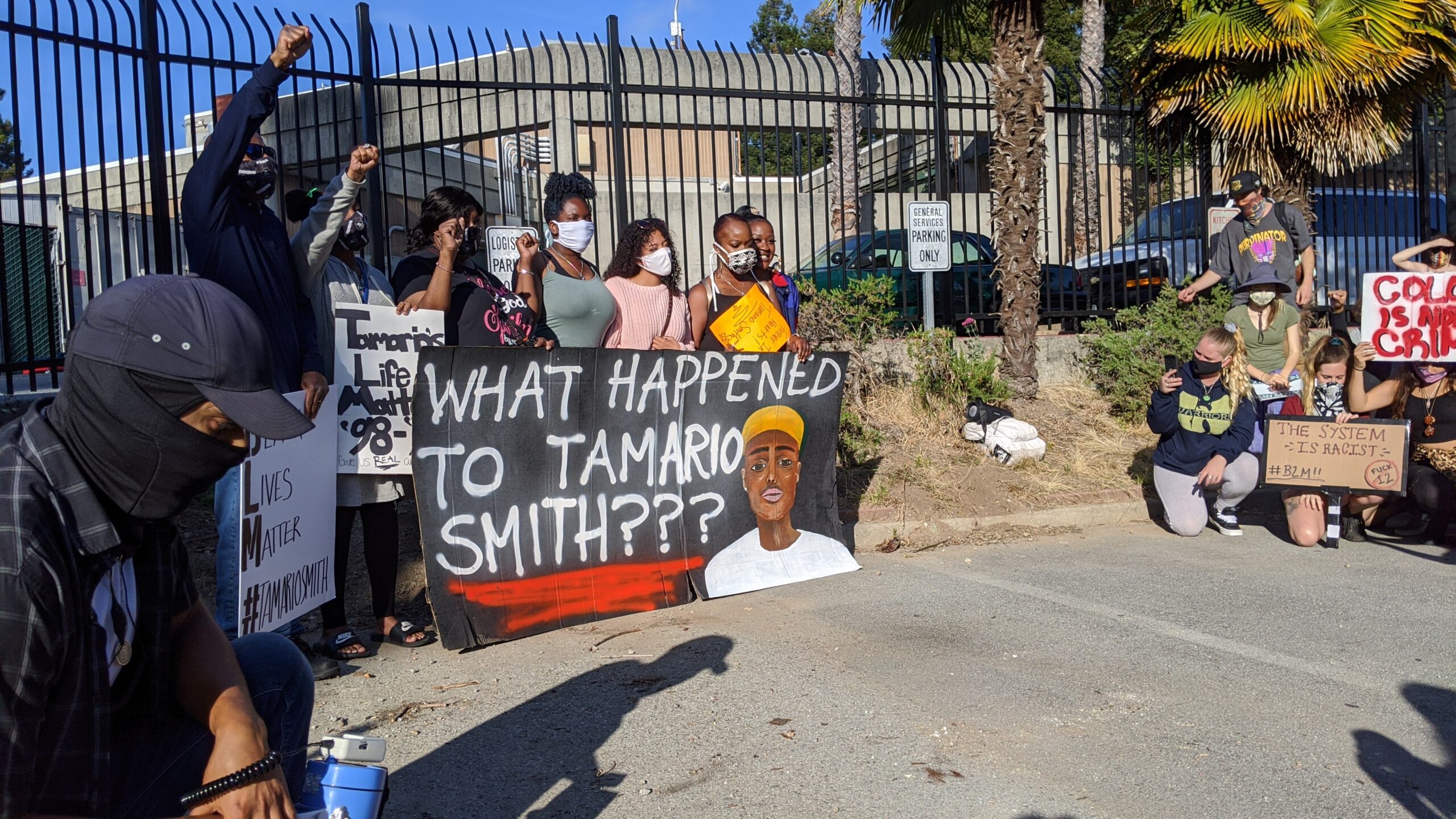
After 21-year-old Tamario Smith died in Santa Cruz County Jail in 2020, family and supporters rallied at the jail. (Mat Weir — Santa Cruz Local file)
“Sometimes things happen. We investigate those things, we look into it,” he said, adding that he isn’t trying to obscure facts in those cases. “There’s no smoking gun, there’s no hidden anything.”
When asked whether he would release more information than his predecessor about jail deaths should the public call for that in the future, Clark said it would depend on the circumstances.
“I am not going to hide any sort of misconduct on behalf of our staff. If our staff made a mistake, if we did anything, you know, blatantly wrong, you’re going to know about it,” he said.
A new approach to overdose deaths
When Clark took his oath last December, one of the priorities he named was tackling the crisis of fentanyl overdoses. Clark supervised the coroner’s office for several years and he said that one part of the job is to conduct a comprehensive death review every time a minor died, regardless of the cause of death.
“We would put together a multidisciplinary team from public health, [Child Protective Services], our team, and go over that death and that particular case to see what, if anything, could have prevented the death,” Clark said.
In regards to overdose deaths, Clark said he had an idea: “Why don’t we do a fentanyl death or drug death review just like we do with kids?”
As Sheriff, Clark implemented the idea and now each month the office conducts a review of every drug death.
“Public health’s involved, the [District Attorney’s] office is involved, our investigators, our coroner team,” he said. “Everybody goes over each specific death to look at, what is the demographic of the person that had passed away? What are the circumstances that led up to the person dying? How did they die in terms of what drug [and method of] ingestion? And then, where did they get the drugs?”
The goal is twofold: support county public health to address the health and safety of people who use drugs, and support investigators and prosecutors in tracking down the source of deadly drugs and arresting dealers, he said.
“And we’re not talking about people selling drugs for the sake of furthering their habit,” Clark said. “We’re talking about large-scale dealers.”
Since implementing this drug death review process, he said they have arrested some high-level dealers and have made many arrests in the area near Costco in the Harvey West neighborhood. The main target drug is fentanyl, he said, but methamphetamine is also prevalent in the county.
Clark said they were also able to link two overdose deaths, including one in a different county, to a specific dealer and work with the U.S. Attorney’s Office on a broader investigation. Clark said the dealer was arrested, but he wasn’t sure of the current status of the case.
Clark on Flock license plate cameras
Last month, Santa Cruz Local broke the story that federal immigration agents had illegally accessed license plate data from Capitola police. Santa Cruz Police Chief Bernie Escalante also admitted out-of-state agencies had accessed their data without their knowledge. Both departments said it was unintentional, and are looking for ways to increase oversight.
Capitola, Watsonville and Santa Cruz city have contracts with Atlanta, Georgia-based Flock Safety for automated license plate readers to help track down cars flagged as stolen or suspected in a crime. These repeated breaches of data, which breaks state law, have raised concern among local immigrant advocates about the surveillance devices.

A Flock automated license plate reader on Green Valley Road near Watsonville. The surveillance technology has come under scrutiny as illegal sharing of data with federal immigration agents was reported. (Amaya Edwards — Santa Cruz Local/CatchLight Local file)
The Sheriff’s Office does not contract with Flock, but Clark praised the technology.
“On one hand, I believe it’s a good tool,” he said, adding that it has a bad reputation. “If there’s good policy and good guardrails around that tool, it can be very, very helpful.”
Clark said he is not actively considering a contract with Flock, which generally costs more than $3,000 per camera per year, but wasn’t ruling it out either. He said he still had some questions about how the technology works and how data can be safeguarded.
“People aren’t going to call 911 if they’re afraid that when they need help that somehow their immigration status is going to come into play,” he said. “I can’t help keep people safe if people are scared to reach out to us, you know? We have a duty and an obligation to try to protect everybody in this county.”
Looking ahead
Clark said one of his biggest priorities for the coming year is strengthening the county’s wildfire readiness. This year, he held a number of town halls in partnership with Supervisor Monica Martinez. He said his team has been focused on meeting with residents in Lompico, as it’s a one-way-in and one-way-out forest neighborhood with no alternate evacuation route.
Other goals he mentioned included improving the office’s social media presence, filling open positions like correctional officers and deputies, certifying the department’s newly operational DNA lab, and “doing different community events to bring people together.”
Specifically, he hopes to reinstate a Little League program called Junior Giants.
Questions or comments? Email [email protected]. Santa Cruz Local is supported by members, major donors, sponsors and grants for the general support of our newsroom. Our news judgments are made independently and not on the basis of donor support. Learn more about Santa Cruz Local and how we are funded.

Nik Altenberg is a bilingual reporter and assistant editor at Santa Cruz Local. Nik Altenberg es reportera bilingüe y editora asistente para Santa Cruz Local.