
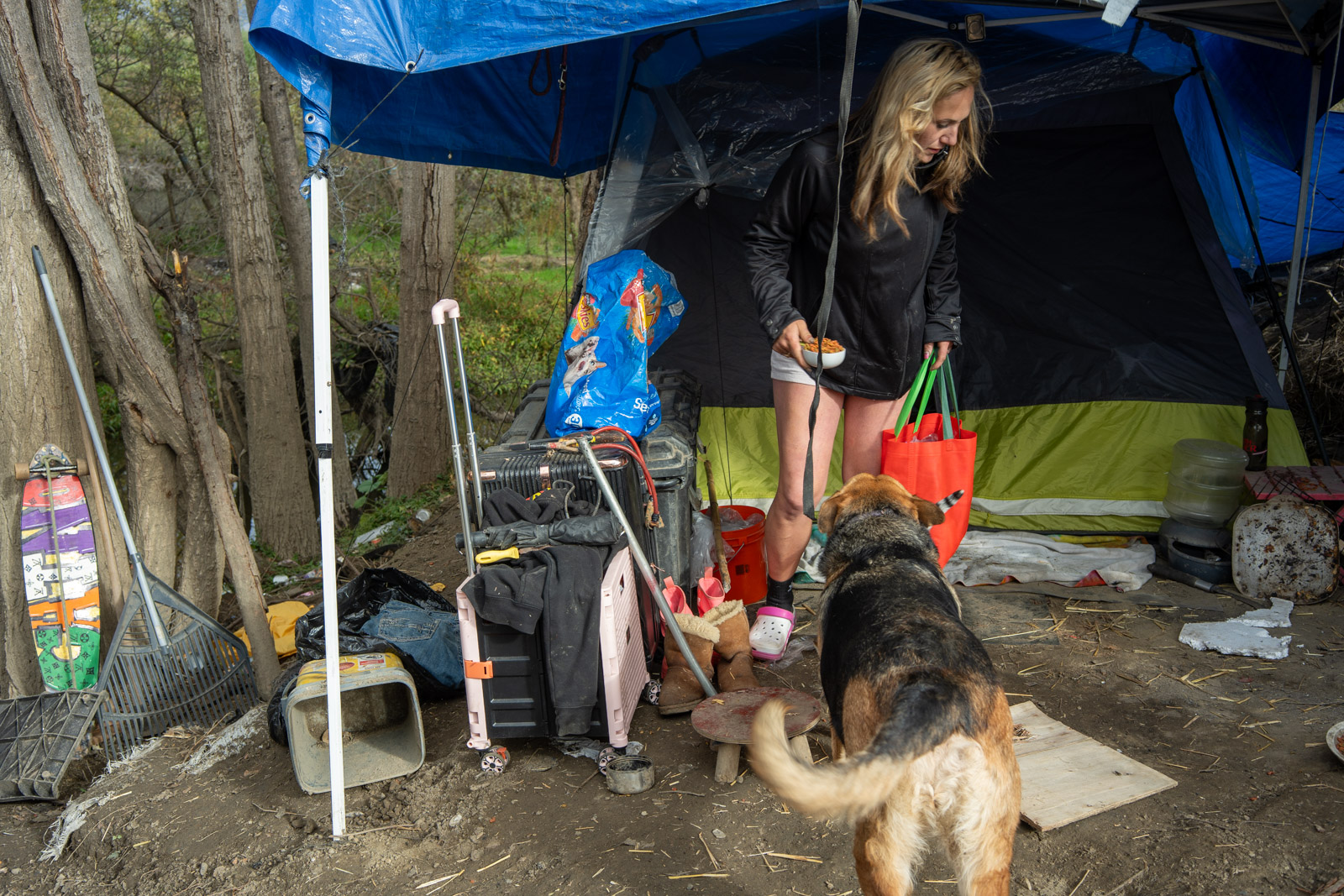
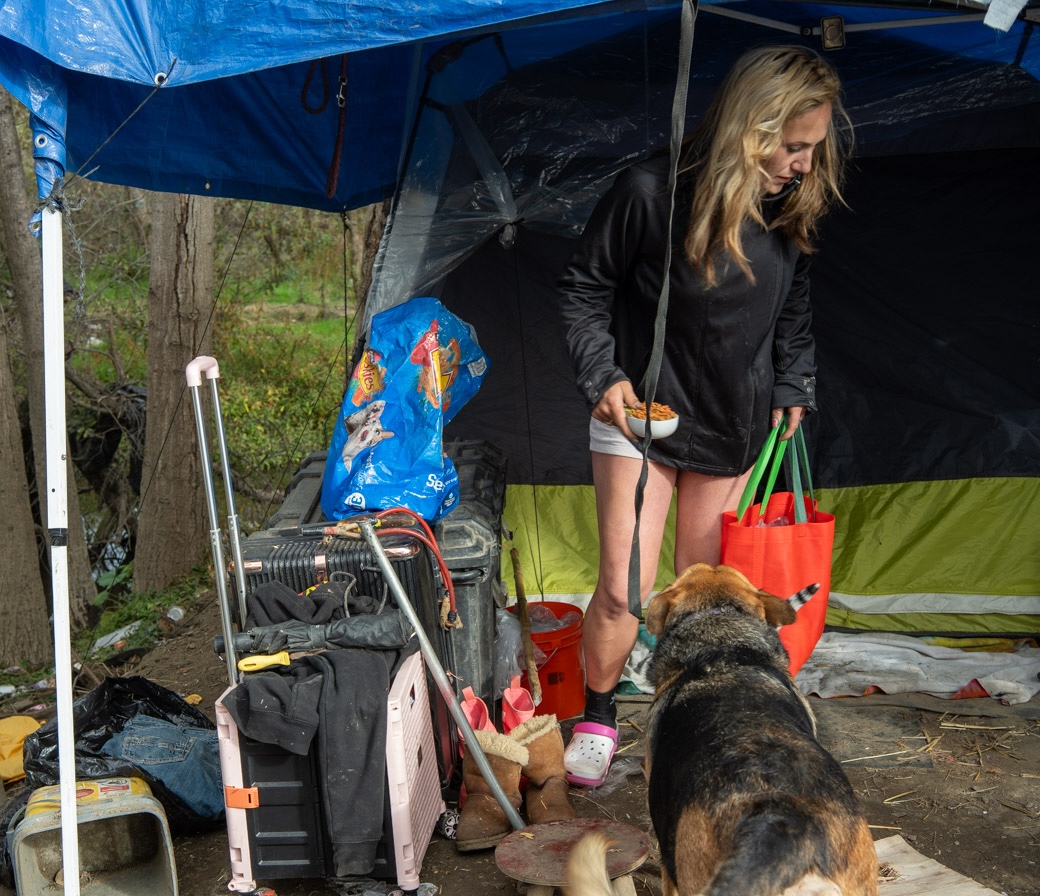
Liz Zavala tends to her pets at her home on the Pajaro River levee on Nov. 15. (Nik Altenberg — Santa Cruz Local)
Key takeaways
- HOPE Village is a temporary shelter program in Watsonville meant to provide wrap-around services and get people into permanent housing quickly.
- After nine months of operations, the program is significantly underperforming its stated goals for moving people into permanent housing. In the past week as many as 10 people returned to homelessness after exiting the shelter.
WATSONVILLE >> On Sunday morning on the Pajaro River levee, there was birdsong and woodsmoke in the air. It was chilly, but Liz Zavala wore crocs, shorts and a sweater, as she refilled her cats’ food bowls and assessed if the tarps above her tent would hold in the coming rainstorms.
Zavala and her boyfriend have lived on the levee for most of the past six years, but this time was different. They had just moved back outside after staying for more than eight months at HOPE Village, a temporary shelter program in Watsonville meant to provide wrap-around services and get people into permanent housing quickly.
But after six months without securing housing, and multiple monthlong extensions still did not yield results, they were among nine people recently asked to leave by staff of nonprofit Community Action Board of Santa Cruz County, which operates the shelter.
On Thursday, they packed up and moved their belongings the four blocks back to the levee to rebuild a home among the trees. The next day it rained, hard.
“It was a nice vacation for a few months, but now we’re back out here,” Zavala said. “They said they’re going to still help us and provide services. So we’ll see if that happens but I don’t think if they couldn’t help us when we’re 5 feet away from them I don’t know how they can help us when we’re back out here.”
Zavala said on Friday her friend Nikki Mori was sitting in her tent in the rain, without a tarp, seemingly stunned to find herself back on the levee.
“It didn’t seem like they had any concern or anything by just kicking us out on the street,” Mori said Sunday. Mori, who’s lived on the levee for at least 10 years, said the housing navigation provided at HOPE Village was “nothing really, because they didn’t, they didn’t even work with me on that, really at all.”
An investigation by Santa Cruz Local found that HOPE Village is significantly underperforming its stated goals for moving people into permanent housing. In addition to the challenges inherent to the area, like limited availability of affordable housing and rental subsidies, interviews with former shelter residents and staff revealed other barriers to success, like staff turnover, a program design that doesn’t fit the needs of guests, a lack of connection between participants and case managers, and a steep learning curve for the nonprofit.
“This service delivery model is most successful when guests have some pathway to permanent housing,” wrote MariaElena De La Garza, executive director of Community Action Board, in an email this week. “Improved outcomes will rely on a community response to better support neighbors who have been disconnected and disenfranchised for so long.”

Nikki Mori left HOPE Village on Thursday, Nov. 12 after more than six months at the temporary shelter did not result in a permanent housing placement. (Amaya Edwards — Santa Cruz Local/Report for America)
Returning to homelessness
HOPE Village is a 34-unit low-barrier navigation center — a temporary shelter designed to move homeless individuals into permanent housing quickly. In this case, the program serves people living along the Pajaro River, which divides Santa Cruz and Monterey counties.
The shelter operates as a partnership between the two counties and is mostly funded by an $8 million state grant that Monterey County staff obtained in 2023. After facing opposition from neighbors, the shelter opened in February two years behind schedule.
Since then, four of the at least 50 people who have stayed at HOPE Village have moved into permanent housing, according to the County of Santa Cruz’s homeless information system. Two people entered substance use treatment, two moved in temporarily with family and one person died.
At least 10 returned to homelessness, but the total is likely higher because last week’s exits had not yet been recorded. Community Action Board did not provide updated numbers this week, saying the system is updated periodically. They did not specify when the last update occurred.
Monterey County’s grant application set a goal of having 60% of shelter guests exit into permanent housing, which was likely ambitious. Statewide, 27% of participants leaving similar shelters went to permanent housing while more than half returned to homelessness, according to state Encampment Resolution Fund data.
Still, at HOPE Village the rate is significantly lower. About 12% of exits were to permanent housing, according to county data and information provided by Community Action Board.

HOPE Village is on First Street in Watsonville. (Nik Altenberg — Santa Cruz Local)
So far, seven residents have been “housed,” according to De La Garza, but the count included people who entered treatment or moved in temporarily with family. She said the two key challenges they face are shelter guests’ lack of income and “an extreme lack of truly affordable housing options in our region.”
However, the shelter’s housing navigator — a role that is tasked with helping people plan, make a budget and apply for housing — resigned in June and has not been replaced.
That work now falls to the two case managers. De La Garza said the change was supported by funding partners and that case managers “help in the search for housing and other placement options.” Staff at both counties also assist with connecting residents to permanent housing, she said.
The caseloads at HOPE Village are within the limits described by Santa Cruz County’s Housing for Health Partnership, which says 15-20 people per case manager is acceptable.
“There are so many steps out of homelessness for people who have lived unsheltered for 5, 10, 15 years,” she wrote. “HOPE Village is a good early step that meets guests where they are.”
De La Garza also said that for the residents who left last week, “the timing was unfortunate due to the weather.” Residents are told about the six-month limit when they arrive, she wrote, and have several check-ins with case managers before they are asked to leave.
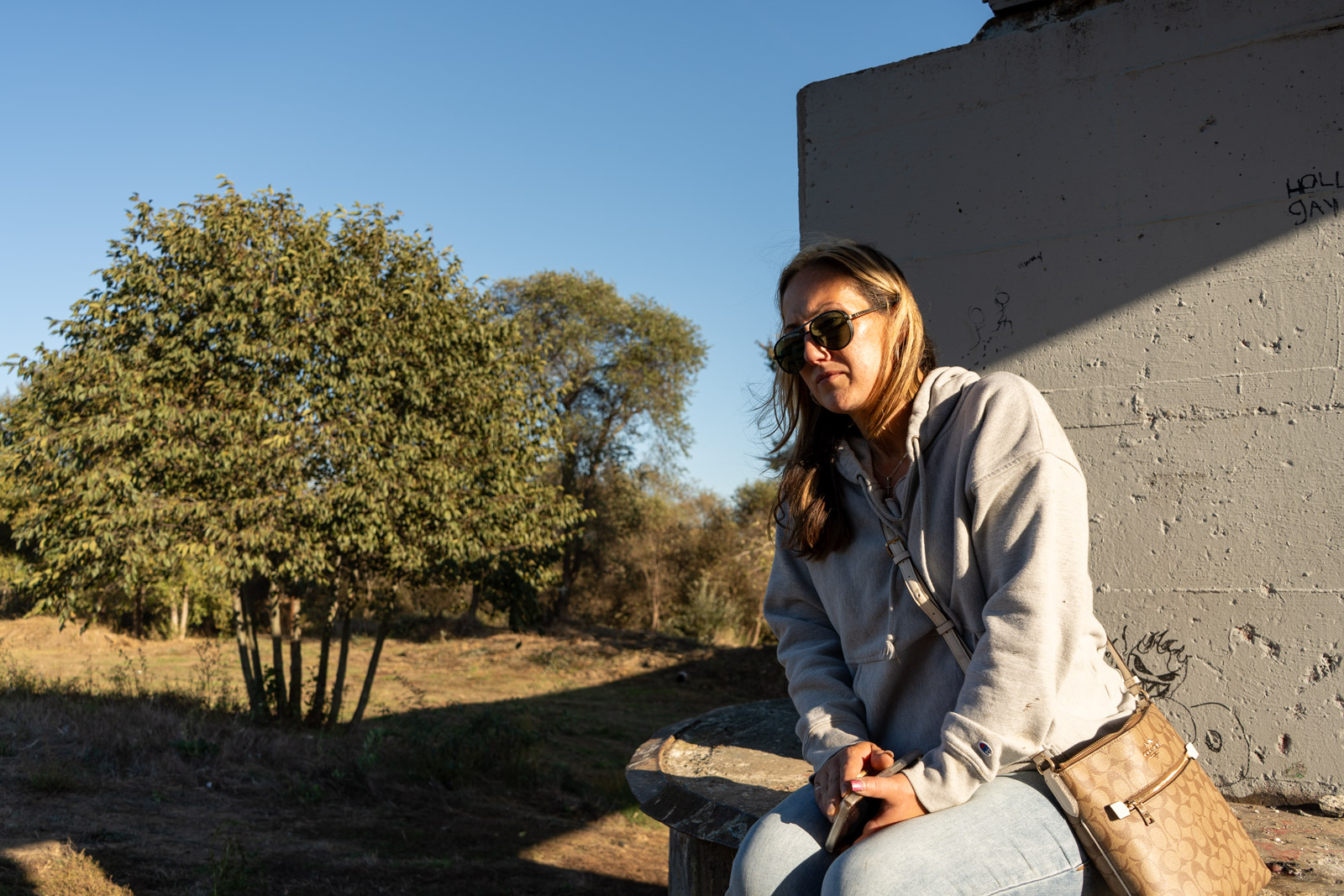
Liz Zavala discusses her impending departure from HOPE Village in an interview Nov. 4. (Nik Altenberg — Santa Cruz Local)
For her part, Zavala said she felt the housing navigator at HOPE Village was helpful, while her case manager was not. She said she saw her casemanager on average once a month, while Santa Cruz County’s guidelines recommend once a week.
A steep learning curve
Community Action Board has deep ties and experience serving homeless people in the Pajaro Valley, but HOPE Village is its first foray into operating a 24-hour shelter.
“It can take years for people to really build up a new program and have it mature and working as well as possible,” Robert Ratner, director of the County of Santa Cruz’s Housing for Health Division, said in a phone call on Monday. “We’re still kind of early on in the evolution of the program.”
Mike Kittredge, HOPE Village’s former director who left in September, said in an Aug. 19 interview that the organization’s inexperience was a challenge. He also said success depends on residents.
“You’re going to get out of this what you put into it. So if you don’t put much in, you know, we can’t house you,” Kittredge said. “We’re not here to do ‘for’ people. We’re here to do ‘with’ people.”
(Kittredge did not respond to a follow up request for comment this month.)

Clothes hang to dry on the levee on Nov. 15 after heavy rains came through the area over the weekend. (Nik Altenberg — Santa Cruz Local)
Ratner said effective case managers know how to navigate the systems and help push clients through bureaucratic “sludge.” But the technical skills are just part of the recipe: “it starts with that connection and relationship-building and trust, and people feeling like you really care about them.”
He also said the challenges described by residents at HOPE Village are not unique, and there is room to improve homeless services and navigation centers across the board.
‘Instead of helping me, they put me down’
Back on the levee Sunday, a cat’s tail flicked from the opening of Zavala’s tent on a flat spot about 10 feet above the river. She and her boyfriend began rebuilding their spot weeks earlier, knowing the extensions would run out.
Marco Martinez, whose tent sits about 20 yards downstream, said he felt he had just begun to make progress with Watsonville Works, another Community Action Board program that partners closely with shelter guests, when he got notice his six months were up. He was one of a handful of guests left on Thursday.
“I just kind of lost track again, I had to be worried about where I’m gonna be staying out here,” Martinez said. “I appreciate they gave me somewhere to stay for six months, I really do. But help-wise, like for me to succeed in life, they didn’t help me at all.”
Martinez had several complaints about his stay: “no housing manager or navigators like that to help us. It was, it was bad. Like I don’t know. It was just real bad. Instead of helping me, they put me down.” He added that he felt judged by staff.
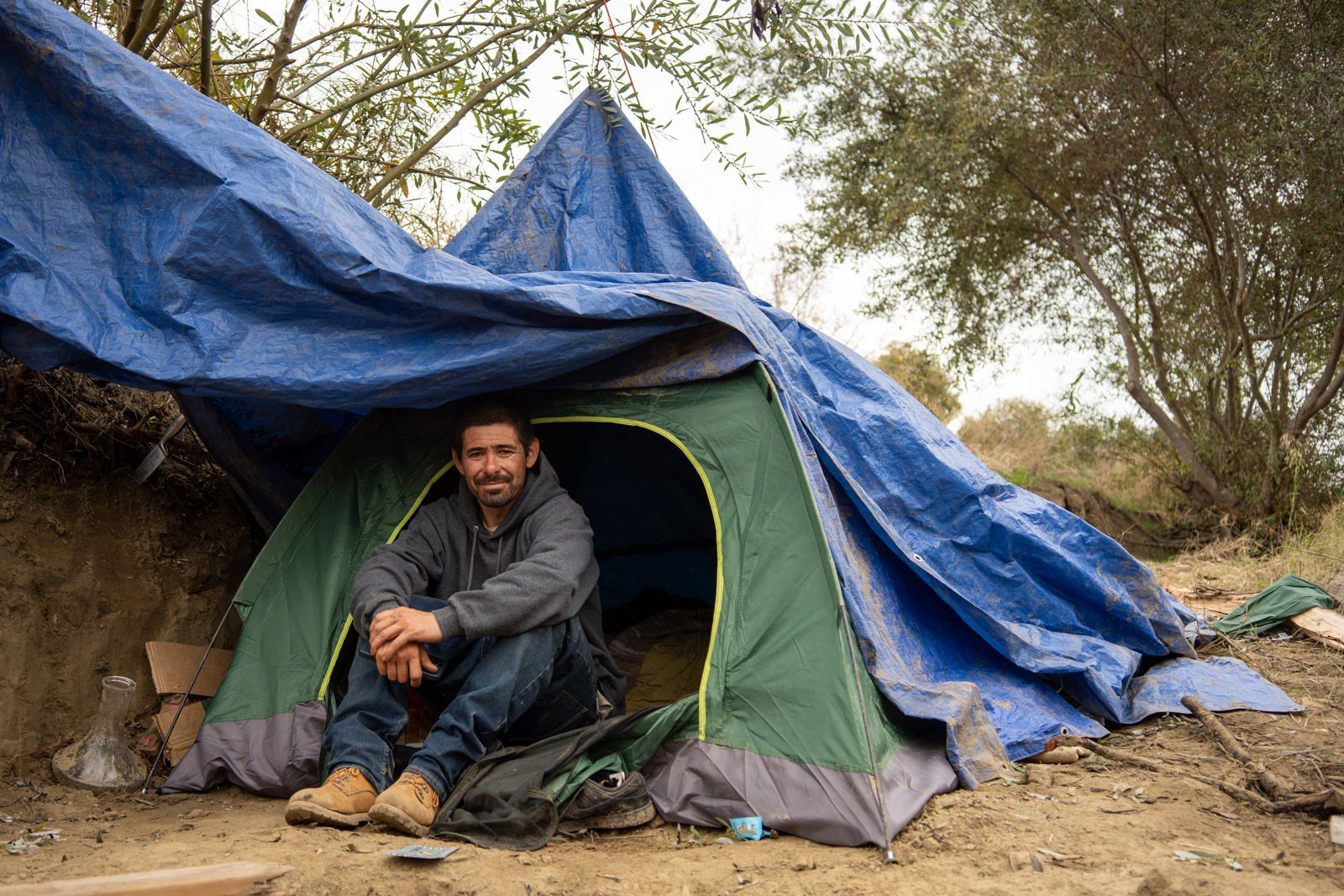
Marco Martinez sits in his tent on the levee on Nov. 15. (Nik Altenberg — Santa Cruz Local)
“I had an attitude or whatever, but it’s just the way they would approach me wasn’t cool. Like I wouldn’t feel comfortable. Like it wasn’t somebody I could talk to,” he said.
De La Garza wrote that staff “are committed to providing dignity and humanity.”
Like several people Santa Cruz Local spoke with, the shelter’s program structure didn’t fit Martinez’s needs or lifestyle. He said it was “real strict.” For example, people said they had to ask a staff member if they wanted food from the kitchen after meal times were over. Martinez said he would prefer to have access to a fridge on his own schedule.
Zavala explained it simply: “There’s like no time on the levee.”
“It’s just kind of going by the sun,” she said, adding that shelter staff seemed to expect people who had spent years in the “no man’s land” of the river to adjust to strict rules and routines overnight. “That’s what I think is the part where they don’t understand.”
Ratner, the county homelessness director, said “anytime you change someone’s routine and habits it’s a big ask, and sometimes it’s underappreciated.”
‘One day at a time’
HOPE Village is funded through June 30. De La Garza wrote that they are “currently meeting with partners to discuss next steps and any potential changes.”
For those back on the levee, next steps are still being figured out.
“I don’t give up hope. God still gives me the opportunity to live another day,” Martinez said. “So it’s just getting back on track. One day at a time.”
He gestured to Mori and Zavala. “This is my home right here. These are my people. This is my family. So this is what I’m with right now.”
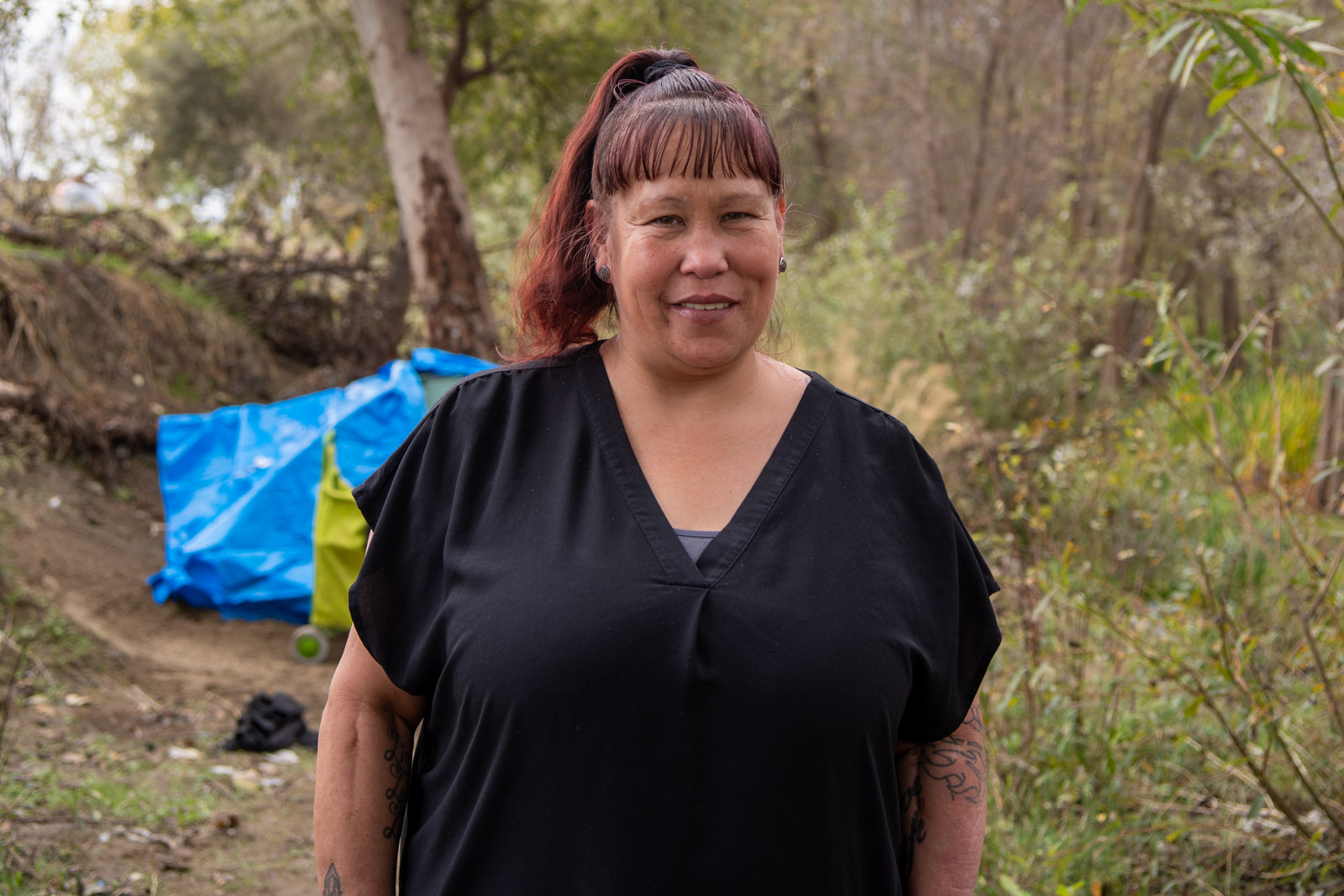
Nikki Mori poses for a photo Nov. 15. (Nik Altenberg — Santa Cruz Local)
Reporters Amaya Edwards and Alonso Daboub contributed to this story.
Questions or comments? Email [email protected]. Santa Cruz Local is supported by members, major donors, sponsors and grants for the general support of our newsroom. Our news judgments are made independently and not on the basis of donor support. Learn more about Santa Cruz Local and how we are funded.

Nik Altenberg is a bilingual reporter and assistant editor at Santa Cruz Local. Nik Altenberg es reportera bilingüe y editora asistente para Santa Cruz Local.