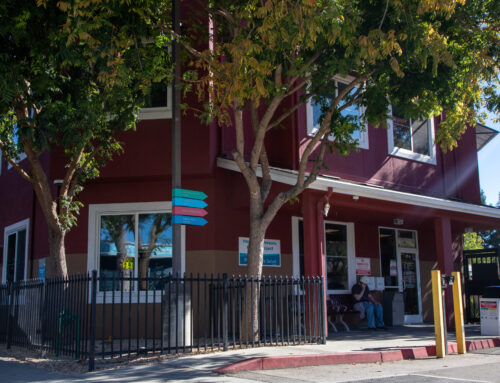

A parking lot north of Santa Cruz Bible Church is the proposed site of a townhome complex, shown in June 2025. (Tyler Maldonado — Santa Cruz Local file)
SANTA CRUZ >> Two proposals for new housing are moving forward, even as neighbors push back against developments they say are out of place in single-family neighborhoods.
Frederick Street townhomes
Thursday, the Santa Cruz Planning Commission recommended approval for 19 townhomes near Arana Gulch to be offered for sale.
The project at 528 Frederick St., next to Santa Cruz Bible Church, was downsized from a prior proposal in August 2025. That version included 23 townhomes and would have removed 11 “heritage-sized” trees. The new plan keeps more of the land as open space, and removes five heritage-sized trees.
The new plans include:
- Four three-story buildings.
- Four homes priced below-market rate for low- or moderate-income households.
- 38 parking spaces.
Following the planning commission’s unanimous vote, the Santa Cruz City Council is set to consider the project for final approval. State housing laws greatly limit the city’s ability to block or change the development.
Submit comments or questions about the project on the city’s website or contact Senior Planner Rina Zhou at [email protected].

The site is on Frederick Street in Santa Cruz. (BDE Architecture)
7th and Brommer
A 100-unit below-market-rent housing proposal near the Santa Cruz Harbor is moving forward without a public vote, instead using new rules that allow approval by county staff.
The Santa Cruz County Zoning Administrator on Friday morning held a public meeting about the project at 7th Avenue and Brommer Street. The property is owned by the county and would be developed by San Diego-based nonprofit Community HousingWorks.
The project includes:
- One four-story, 55-foot-tall building.
- 46 one-bedroom units.
- 27 two-bedroom units.
- 27 three-bedroom units.
- 66 parking spaces.
All but one manager’s unit will be priced for households earning between 30% and 60% of the area median income, set annually by the state. Twenty-five units will be set aside for residents with intellectual or developmental disabilities.
The project has received federal funding, and is therefore subject to an environmental review to comply with the National Environmental Policy Act. County staff will consider that review and public comment before issuing a building permit and coastal permit.
For questions or comments, contact county planner Jonathan DiSalvo at [email protected].
Housing context
Attendees at both meetings raised concerns about the new developments’ size and potential impacts on neighborhood privacy, traffic and the environment. Increasingly, state housing laws have incentivized or required local governments not to be swayed by such concerns.
The Frederick Street townhouse project is on privately-owned land in a neighborhood zoned for the kind of small-scale multifamily housing being proposed. The city is therefore legally obligated to approve the project if it meets certain objective rules — and the city cannot impose new rules after an application is submitted. The owner did not fully take advantage of state density bonus laws that would have cleared the way for a larger development.
The 7th Avenue property is owned by the successor agency to the county’s Redevelopment Agency, a former tax-funded effort to promote urban revitalization and affordable housing. Redevelopment Agencies were dissolved statewide in 2012, and successor agencies are now responsible for the money and land they acquired.
Both projects count towards local state-set requirements for the construction of new housing. If a city or county does not allow enough housing, it can lose more local control over development or face a lawsuit. The state laws aim to reverse decades of rapid population growth without comparable housing growth — a pattern many housing policy experts consider central to the state’s housing affordability crisis.
Still, many new developments across the county have faced strong opposition from neighbors.
Leah Boone was one of more than a dozen people who spoke during Friday’s meeting about the 7th Avenue proposal. She echoed her neighbors’ concerns that the new homes could add congestion to the street, especially during evacuations.
“We all know someone who’s moved away due to affordability issues in our area, and we all know we need more housing. This is about residents who feel the county has seemingly not considered them,” she said. “It’s not cheap or easy to live here, and all of this makes it harder.”
Questions or comments? Email [email protected]. Santa Cruz Local is supported by members, major donors, sponsors and grants for the general support of our newsroom. Our news judgments are made independently and not on the basis of donor support. Learn more about Santa Cruz Local and how we are funded.

Jesse Kathan is a staff reporter for Santa Cruz Local. They hold a master's degree in science communications from UC Santa Cruz.