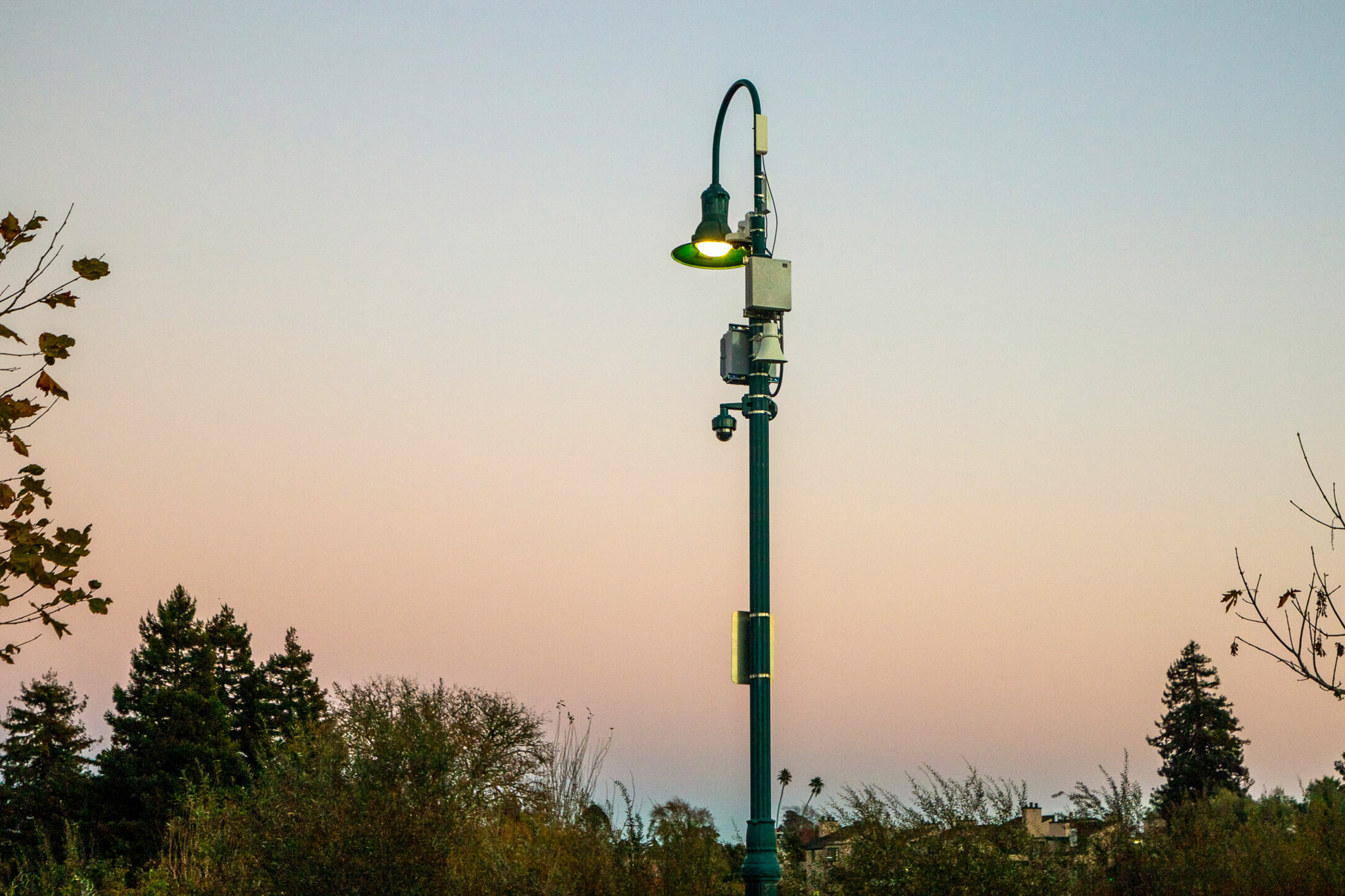
A camera and speaker monitors the Santa Cruz Riverwalk near Trader Joe’s. (Amaya Edwards — Santa Cruz Local/Report for America)
SANTA CRUZ >> On a recent Tuesday evening, the Santa Cruz Riverwalk across from Trader Joe’s was cold, dimly lit and vacant, save for the occasional cyclist. A Santa Cruz Local reporter stood by the low retaining wall that borders the path and held a phone as a flashlight. Then, a voice sounded from above.
“Individual with the flash on,” it said. “Loitering is not permitted in this area at this time. Please remove yourself and your belongings from the levee.”
The voice came from a discreet speaker bolted to a lamppost along with a camera, one of two on the Riverwalk installed Oct. 12. The voice belonged to an employee of Bandit Systems, a Santa Cruz-based company that films and monitors the area 24 hours a day.
A three-year contract with Bandit Systems aims to keep the levee path clear and safe for cyclists and pedestrians with less police intervention. But some homeless people say the cameras represent the city’s continued efforts to disperse any gathering place for the unhoused, and some privacy activists are alarmed that people are being surveilled without their knowledge.
Contract details
The camera next to the parking lot and another beneath the adjacent pedestrian bridge both are on narrow sections of the Riverwalk path. City of Santa Cruz Director of Homelessness Response Larry Imwalle described them as frequent “chokepoints” for cyclists and pedestrians blocked by people in the path.
Those monitoring the cameras deter people from standing in the path or committing crimes like vandalism and illicit drug use, he said.
Several respondents to Santa Cruz Local’s 2025 survey of cyclists and pedestrians raised similar concerns.
“Riding on the river levee is sketchy and unsafe,” with people and their belongings frequently blocking the path, and visible drug use, one respondent wrote. “It’s supposed to be a safe place for riders, walkers, women and children,” the person wrote.
In the month the cameras were installed, there have been fewer reports of blocked paths, Imwalle said.
Last Tuesday, a Santa Cruz Local reporter standing next to the path at 6 p.m. was told through the speaker to leave the area. After the reporter did not move, the voice cautioned that further loitering would result in law enforcement being called.
After Santa Cruz Local shared the experience with Imwalle, he said that response should not have occurred. Bandit Systems owner and Santa Cruz resident James Mueller said the company had been enforcing the closure of the Riverwalk as a park facility after sunset, only open at night for transportation.
City staff have since instructed the company to tell people to move only if they are sitting or standing on the path, but that staying to the side of the path or on the retaining wall is permitted any time, Imwalle and Mueller said.
The three-year contract with Bandit Systems did not require the approval of Santa Cruz City Council because it is included in the city budget and is below the spending amount that requires a public hearing, Imwalle said. The contract currently includes 24-hour monitoring, but the city in the future could decrease to as few as eight hours a day. The city could pay up to $78,000 over the three years.
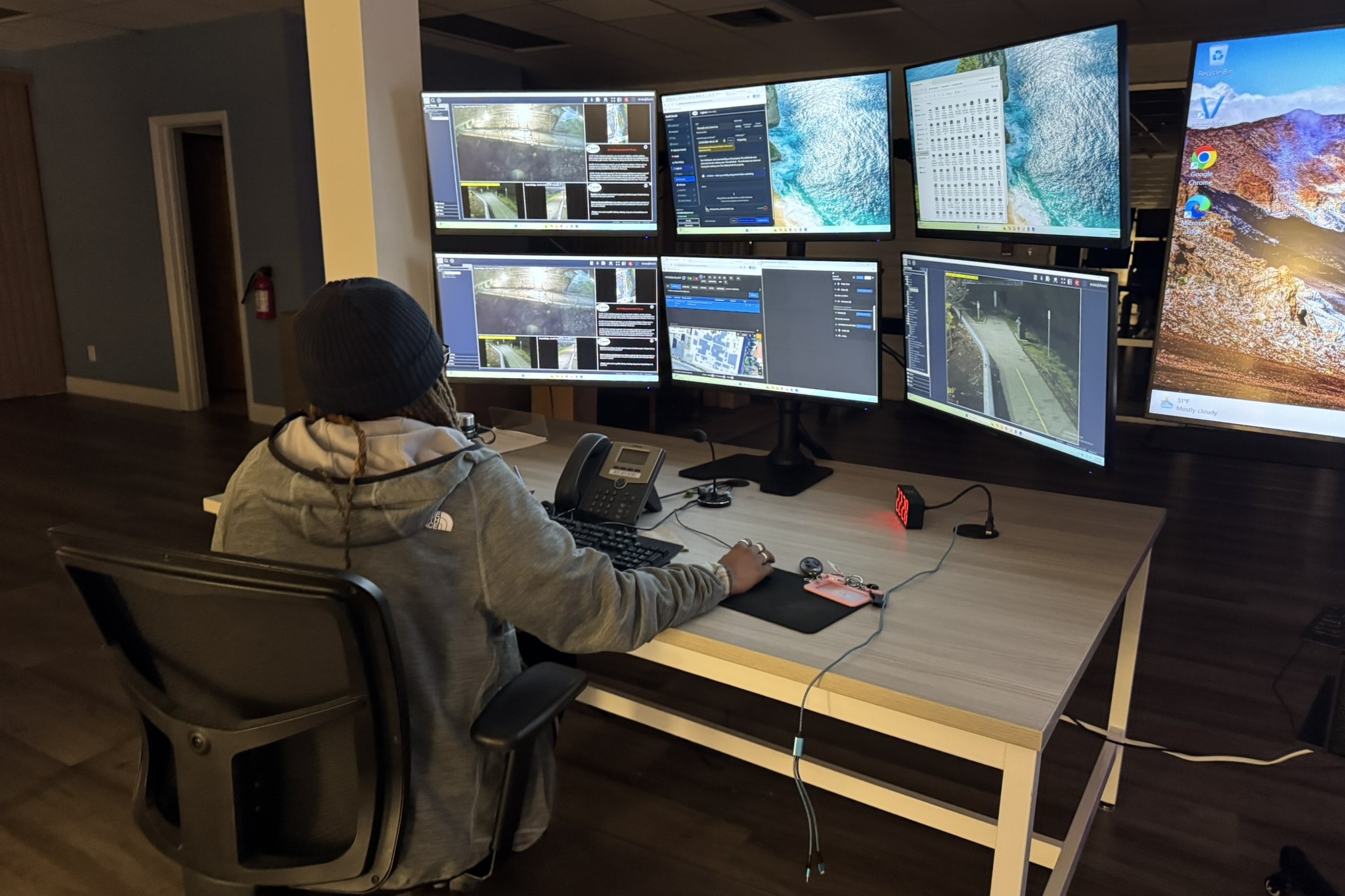
A Bandit Systems employee monitors the Riverwalk cameras. (Jesse Kathan — Santa Cruz Local)
Bandit Systems
Monday night at 10 p.m., three Bandit Systems employees in a fluorescent-lit Mission Street office sat in front of six screens each, showing parking lots, alleys and package rooms across California. An algorithm alerted one employee to a possible irregularity — a person on screen for more than two minutes, or a fast-moving object. Bandit Systems monitors more than 2,000 cameras, most on private property.
Deep-learning algorithms, a form of AI, detect people, bikes and cars. The software determines if objects are moving, and tracks how long they have been in sight. Anomalous activity is flagged for review. But “all decision-making really relies on humans,” Mueller said. Twice, the algorithm detected fast-moving objects at a monitoring site — coyotes loping across an empty parking lot.
Mueller said his system is more effective than the automated motion-activated responses in some private spaces, like the CVS parking lot next to Trader Joe’s. “I want to live in a world where security is invisible unless it’s needed,” he said. “Where it’s not prevalent, like RoboCop out there in the middle of an intersection.”
When employees do respond through speakers, they run through an established script — first telling people to leave, then reiterating the request, and eventually saying that law enforcement may be contacted. Across all the sites, about 1% of real-time responses result in calls to emergency services, Mueller said.
Unlike most of the sites Bandit Systems monitors, the Riverwalk is accessible to the public at all hours. But like most sites, activity near the cameras thinned within days as people were dissuaded from the area, Mueller and Imwalle said.
When the cameras were first installed, employees were responding over the speaker about 20 times a night, Mueller said. Since then, they have contacted emergency services fewer than six times, including for a suspected overdose and people lighting fires. The city receives weekly reports of each time operators respond to people on camera, Mueller said.
The cameras record 24 hours a day, and Bandit Systems keeps the footage for 365 days to comply with state rules for surveillance video.
Criticism
The new cameras come months after the Santa Cruz City Council ended a contract with Flock Safety following reports that federal immigration enforcement had indirectly accessed data from many California cities.
Mueller says the “human-centered” nature of the alert system, and the fact that the city has sole access and ownership to the camera footage, makes Bandit Systems very different from Flock. But for Peter Gelblum, a former lawyer who chairs the Santa Cruz County chapter of the American Civil Liberties Union of Northern California, the 24-hour surveillance without a judicial warrant “is very much like Flock cameras.”
The vast majority of people on the Riverwalk “are not doing anything wrong, and yet they’re being surveilled constantly,” he said. Especially disturbing to Gelblum is that there are no signs to alert people they are being monitored. Some people, he said, would likely walk out of their way to avoid being recorded. But “they don’t even know about it, so they don’t have a choice,” he said.
Some of the people who are most aware of the cameras, homeless people who frequent the levee, also have concerns. Though some people continue to hang out at the Riverwalk, just out of view of the cameras, the crowd is smaller — a measure of success for the city, but a concerning sign for others.
Greg Bengtson, a formerly homeless person still in touch with those living outside, said he understands why the city wants to ensure that pathways remain clear and that people don’t openly sell and use drugs. But dispersing areas where homeless people meet also affects those trying to track down a friend or find community, he said.
“They’re taking away all the areas of our social fabric where we keep in touch with each other,” he said.
The cameras come after the end of day services, like showers and phone charging, at the Housing Matters campus on Coral Street in April. In August, an encampment on Coral Street was cleared and fenced off, leaving many who live on the street with less stability.
For Kirill Romanov, who is homeless and part of a group that used to monitor frequent sweeps of the Coral Street camp, the cameras are part of a continuous, fruitless strategy to push unhoused people around the city. The apparent success of the two new cameras could pave the way for more “at the next place people congregate,” he said. “It’s an endless supply of excuses to endlessly install surveillance.”
Where unsheltered homeless people should go is “obviously a challenging question,” Imwalle said. Outreach workers are frequently on the levee to offer services, he said. But the city’s homeless population outnumbers its shelter beds. Nonprofit Housing Matters recently cut its shelter beds, and further reductions are expected in January.
Still, “independent of somebody’s housing status,” the Riverwalk is legally classified as a bikeway and blocking it is not allowed, Imwalle said. There are no plans for installing more cameras, he added.
Mueller said he recognizes that “we’re not solving homelessness,” and that he instructs employees to speak respectfully to people “who have just been through worse experiences than any of us can probably ever imagine.” He added that he plans to use the speakers to alert people when severe weather shelters are open.
The company is “in a sticky situation sometimes, trying to navigate some of the ethical issues out there,” and tries to do so “in a wholesome way,” he said.
Back on the levee on Tuesday evening, the Santa Cruz Local reporter repeatedly told to leave the levee did so before law enforcement was contacted. The voice called out a final time, “thank you for your cooperation.”
Questions or comments? Email [email protected]. Santa Cruz Local is supported by members, major donors, sponsors and grants for the general support of our newsroom. Our news judgments are made independently and not on the basis of donor support. Learn more about Santa Cruz Local and how we are funded.

Jesse Kathan is a staff reporter for Santa Cruz Local. They hold a master's degree in science communications from UC Santa Cruz.