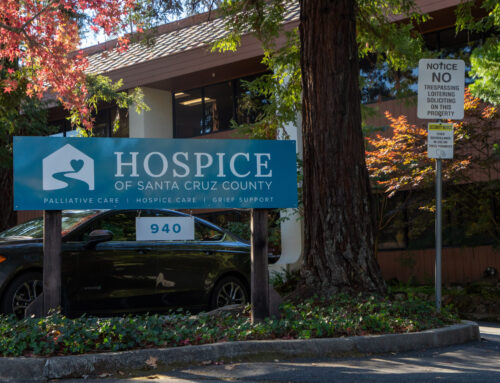

People vote at the Sant Cruz County Clerk Elections office on June 2. (Amaya Edwards — Santa Cruz Local/CatchLight Local)
SANTA CRUZ COUNTY >> Local programs that provide health care, food and other basic needs are facing rising demand and diminishing resources following last year’s federal budget bill. Measure E aims to buoy programs and institutions that provide social services with a temporary sales tax hike.
The measure would increase sales tax rates across Santa Cruz County by 0.5%, adding an additional 50 cents to a $100 purchase. It would expire in 2032. Groceries, prescription medicine and some other products are exempt from sales taxes.
“We have many residents who ask, ‘What can we do? What can we do to stand up against this federal administration?’” said Santa Cruz County Supervisor Monica Martinez at an Aug. 5 meeting of the Board of Supervisors. “This ballot measure is an opportunity for them to do something.”
But opponents have cautioned that Measure E is a general tax that can legally be used for any county purpose, and that a county resolution to prioritize the money for safety net services is nonbinding.
As a general tax it requires more than 50% of the vote — a special tax, where money can only be used for a specific purpose, would have required 66.7% voter approval.
Effects of H.R. 1 and arguments for Measure E
Measure E aims to address the effects of the 2025 federal budget bill H.R. 1, known as the “One Big Beautiful Bill Act.” The bill decimated funding for health care, food assistance and other social safety net services. It also tightened restrictions on who can receive welfare benefits. Though the law was enacted last year, many of the changes to welfare programs have yet to take effect.
The law has “a cascading effect across the community,” said Tony Nuñez, chair of the Pajaro Valley Health Care District, who was elected to the Board of Supervisors in June and will take office in 2027.
That cascade starts with people who directly lose Medi-Cal or CalFresh. Santa Cruz County residents could lose a combined $16.8 million annually in CalFresh food assistance, county staff have projected. About a third of county residents who receive Medi-Cal, approximately 25,000 people, could lose coverage by the end of 2028, according to estimates from the Central California Alliance for Health.
The loss of health care benefits then affects health care clinics, hospitals and county departments who must make up the cost of providing emergency care for uninsured patients. That could cost the county an extra $7.5 million annually and further strain the dire financial state of Watsonville Community Hospital. The closure of that hospital would leave one emergency department to serve the entire county.
Even programs like Meals on Wheels, which is mostly not directly affected by H.R. 1, expect a surge in demand as people without public benefits seek help elsewhere, Nuñez said.
Martinez, the supervisor, said “Measure E impacts everybody,” not just those who rely on government assistance.
For example, she said, the federal cuts could make ambulances less available — which would greatly impact rural and older residents of the San Lorenzo Valley.
County staff have estimated that the county and other other organizations that serve welfare recipients, including local hospitals, will lose $200 million annually. Measure E wouldn’t fill that gap completely — it’s estimated to raise $6.7 million between April and July 2027, and approximately $27 million annually thereafter.
That means the county and local organizations wouldn’t see most of the benefits of Measure E until 2028.
“This measure is an opportunity to put a Band-Aid on a gaping wound,” Supervisor Justin Cummings said at the Aug. 5 supervisors’ meeting.
Arguments against Measure E
Opponents of Measure E have argued that because there is no legal guarantee the money would actually be spent on mitigating the effects of H.R. 1, the money could instead go towards consultants, pension debt or other costs unrelated to social services.
“While they adopted what they’re calling their guidance framework for what they would do with the money, it is absolutely not binding at all,” said Aptos resident and former supervisorial candidate Becky Steinbruner.
Steinbruner also said that:
- Given the financial urgency described by supervisors, they should have renegotiated its contract with county employee unions, rather than approve a 4% raise. Supervisors have also changed county law to allow raises to their own pay, though they have not pursued such a raise.
- Sales taxes disproportionately weigh on low-income residents — the same population the tax aims to help.
- The Pajaro Valley Health Care District should instead expand and levy its own tax to benefit the hospital.
Steinbruner and other opponents have also criticized the way county leaders have documented and spent money from prior sales tax measures.
Santa Cruz County voters have previously approved two other half-cent sales tax hikes: Measure G in 2018 and Measure K in 2024. They apply only to areas of the county outside of cities, unlike Measure E.
A 2022 Santa Cruz County Grand Jury report on Measure G said that the ballot question included misleading language about oversight and audits that never materialized. In an Oct. 6 email, county spokesperson Jason Hoppin wrote that the county had followed through on the priorities identified by supervisors for Measure G, including improvements at parks.
Measure K has followed through on promised spending on roads, housing and homelessness. It has also spent significant money protecting the county against potential lawsuits.
“In an era of budget austerity and with rising costs,” the county used Measure K to cover liability costs “to help preserve department programs and services,” Hoppin wrote.
Martinez, the supervisor, once “held a similar mindset about sales tax being regressive,” she said. “the reason I’m supporting this is because, first of all, a lot of essential services like groceries, diapers, formula, prescriptions, all of them are not taxed,” she said.
“More importantly, our tourism sector, which is like one of our biggest sectors, will also be paying for this,” she added. ”It’s a good opportunity for us to pass this cost along to people who are enjoying our space here temporarily while we’re working hard to save the safety net.”
Questions or comments? Email [email protected]. Santa Cruz Local is supported by members, major donors, sponsors and grants for the general support of our newsroom. Our news judgments are made independently and not on the basis of donor support. Learn more about Santa Cruz Local and how we are funded.

Jesse Kathan is a staff reporter for Santa Cruz Local. They hold a master's degree in science communications from UC Santa Cruz.