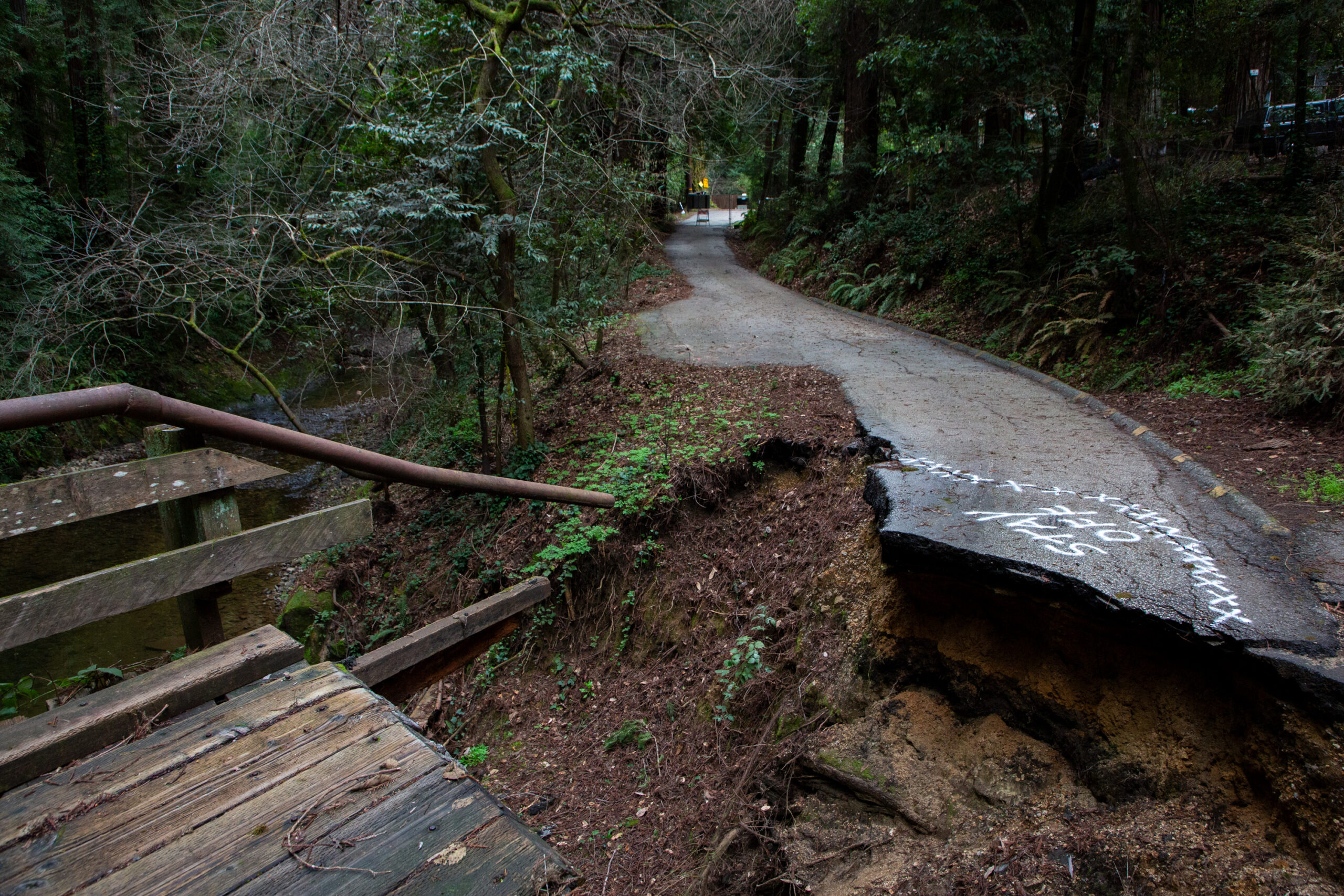
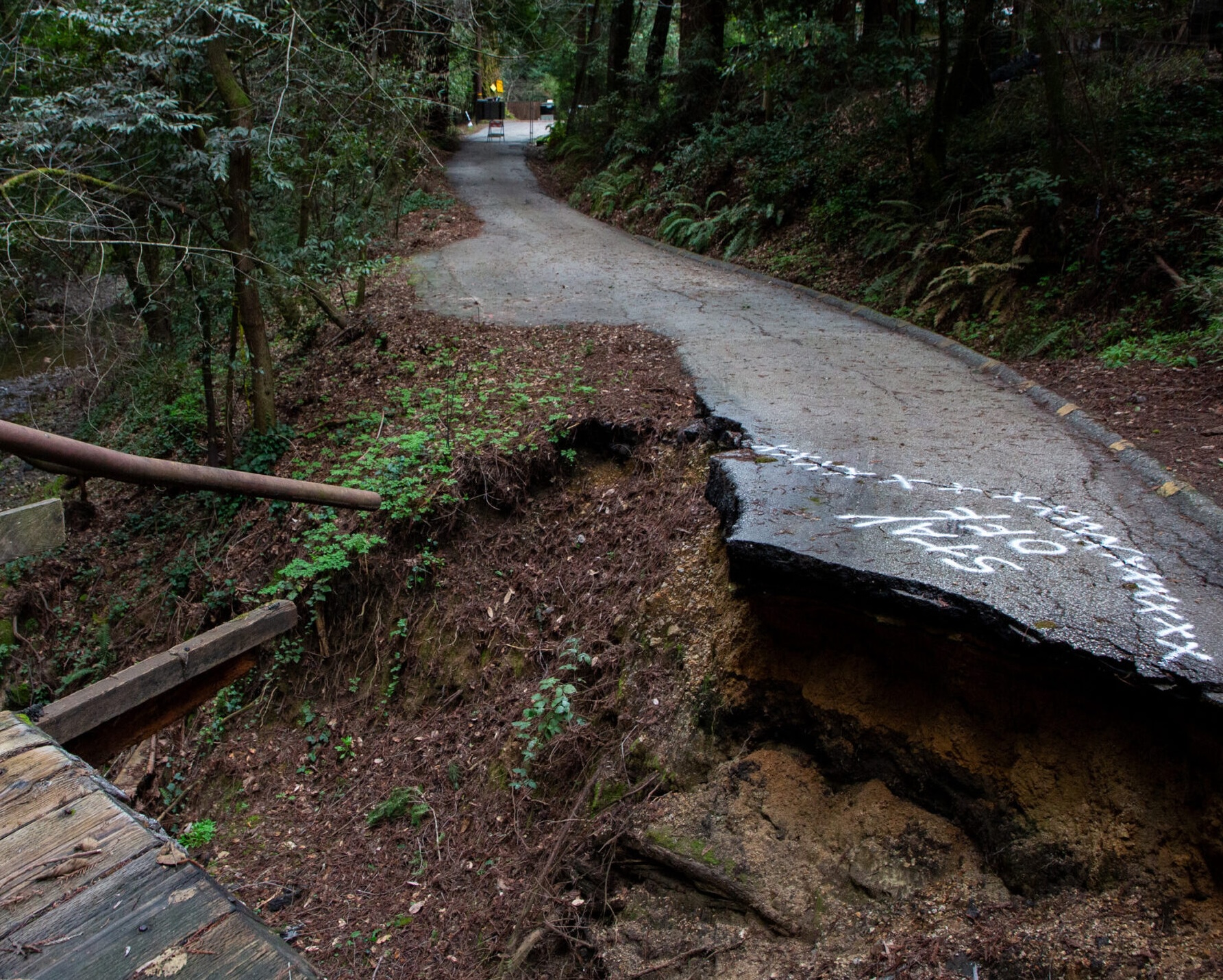
Part of Lank Tree Lane in Boulder Creek collapsed during heavy rain in February 2025. (Amaya Edwards — Santa Cruz Local/CatchLight Local file)
Santa Cruz County emergency resources
- Read the county’s El Niño guide for residents.
- Access the CruzAware portal to register for alerts (portal de registro en Español).
- See rainfall reports and water levels of local creeks and rivers on OneRain.
SANTA CRUZ >> Climate experts warn that California’s Central Coast will likely see an increased risk of severe weather events this winter as a result of a “very strong” El Niño weather pattern. Local officials are making preparations for potential flooding and erosion throughout the county.
“What we know to be true is that a single storm, or a collection of storms, can impact our community and our county significantly,” said Dave Reid, director of the Santa Cruz County Office of Response, Recovery, and Resilience. While leaders can’t know exactly when or how the winter weather will pan out until it comes, Reid hopes that improved efforts in forecasting, infrastructure preparation and alerts will help residents stay safe.
El Niño, which is characterized by warmer than average sea surface temperatures in the South Pacific, typically brings an increased risk of extreme weather to many areas of California. But this year, “sea surface temperatures are as high as we’ve ever seen,” said Michael Beck, Director of UC Santa Cruz’s Center for Coastal Climate Resilience.
El Niños are typically forecasted when these sea surface temperatures are persistently 0.5 C° above normal for an extended period. However, this year temperatures have exceeded 2 C° above normal, prompting its classification as a “super” El Niño event. “That’s what’s really driving the concern about this year’s El Niño — the conditions for it to be an exceptionally strong one are there.”
On top of stronger waves and storms, high water temperatures are expected to raise water levels by 6-12 inches.
“We’re already seeing 9 [inches],” Beck said. He noted that this increase in water level is of particular concern when it coincides with king tides, the year’s highest tides expected during the winter, usually starting in November.
Powerful waves, higher sea levels and strong storms bringing lots of rain are all possible with El Niño, potentially affecting residents from Pajaro to Bonny Doon, Reid said.
“Everybody in the county is subject to some level of impact,” he said.
Different regions in the county will each have their own localized risks to look out for. In coastal neighborhoods, high seas and strong waves mean a higher likelihood of coastal flooding, especially in less protected areas like Rio Del Mar. While many of these neighborhoods like Pleasure Point have armoring — reinforcements like sea walls or revetments designed to prevent coastal erosion — high wave energy is still expected to increase the risk of erosion.
Increased precipitation, on the other hand, means a higher risk for flood-prone low-lying communities near the Pajaro and San Lorenzo rivers as well as Corralitos creek. In the mountains, increased rainfall can cause soils to saturate, leading to a higher potential for landslides and road failures.
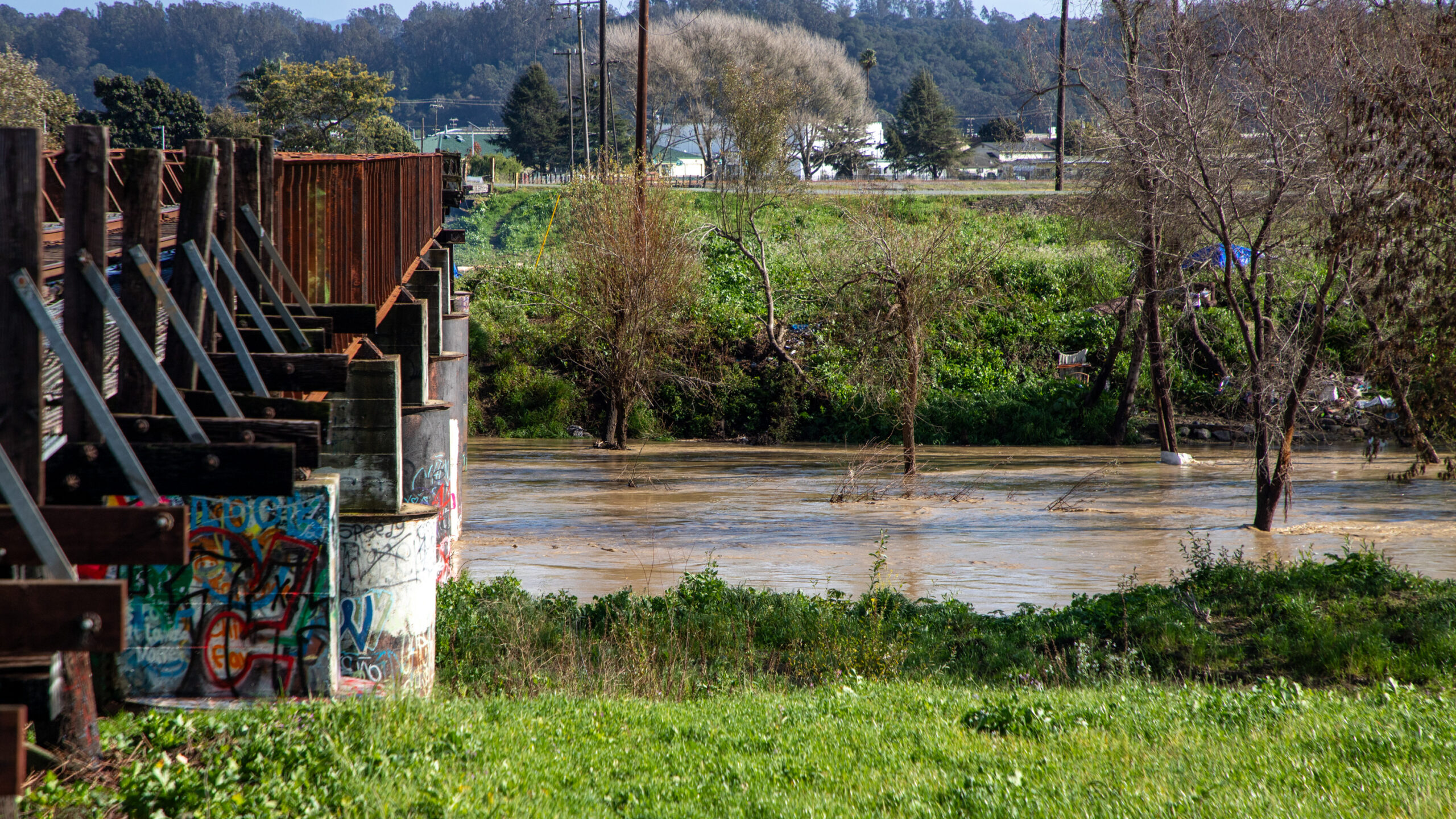
The Pajaro River levee failed in March 2023, displacing thousands of residents in Pajaro. (Amaya Edwards — Santa Cruz Local/CatchLight Local file)
While the county’s wet season can be expected to start around November as usual, seasonal rainfall is expected to be above average starting in December, according to the National Oceanic and Atmospheric Administration.
The county’s Community Development & Infrastructure Department is preparing roads in unincorporated county areas by clearing culverts, drains, bridges and roadside ditches to ensure water has a place to go.
So far, county workers have completed about 215 miles of roadside ditch clearing, said Alex Sandoval, the department’s maintenance superintendent. The target is 250 miles of ditch clearing, which he hopes they’ll complete in the next month and a half.
“Ditch clearing is one of the biggest efforts that we can do to reduce flooding, reduce storm damage, and control water conveyances through our system,” he said.
Both Reid and Sandoval hope to improve the county’s ability to respond to major weather events. The last El Niño, which came in 2016, brought an estimated $9 million in damage to Santa Cruz County as a result of severe weather, while 2023’s atmospheric rivers caused an estimated $27 million in damages.
Reid said his teams are putting more resources and attention into forecasting weather conditions and providing information to residents. They’ve used Measure Q money to develop monitoring tools for Corralitos Creek, which flooded in 2023.
“That will give us an opportunity to communicate with the public faster and earlier, based on what we’re seeing from rainfall and storm and river response,” Reid said. His teams also expect to send more frequent alerts through CruzAware, a service that sends email and text alerts to Santa Cruz residents, to keep the community up to date on weather conditions.
“First and foremost, I would say now’s the time to be prepared,” said Beck, the UCSC climate expert. “In all likelihood, this is going to be a very tough winter for us.”
While getting ready for what could be a very destructive winter is essential to keeping residents safe, Beck also said that this El Niño season is an opportunity to think more long-term about preparing for effects brought on by climate change.
“This does give us a pretty good picture of what we’re likely to see in the coming future on a regular basis,” he said.
Questions or comments? Email [email protected]. Santa Cruz Local is supported by members, major donors, sponsors and grants for the general support of our newsroom. Our news judgments are made independently and not on the basis of donor support. Learn more about Santa Cruz Local and how we are funded.

Alonso Daboub joins Santa Cruz Local as a California Local News Fellow. He earned a master’s degree in Science Communication at UC Santa Cruz.