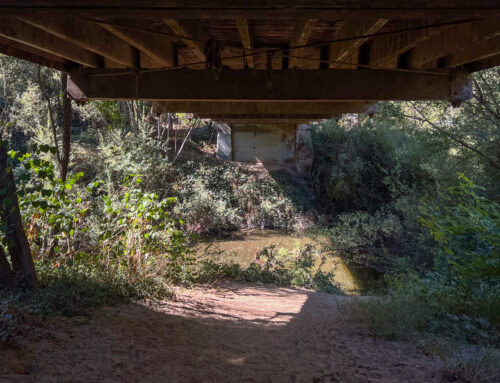
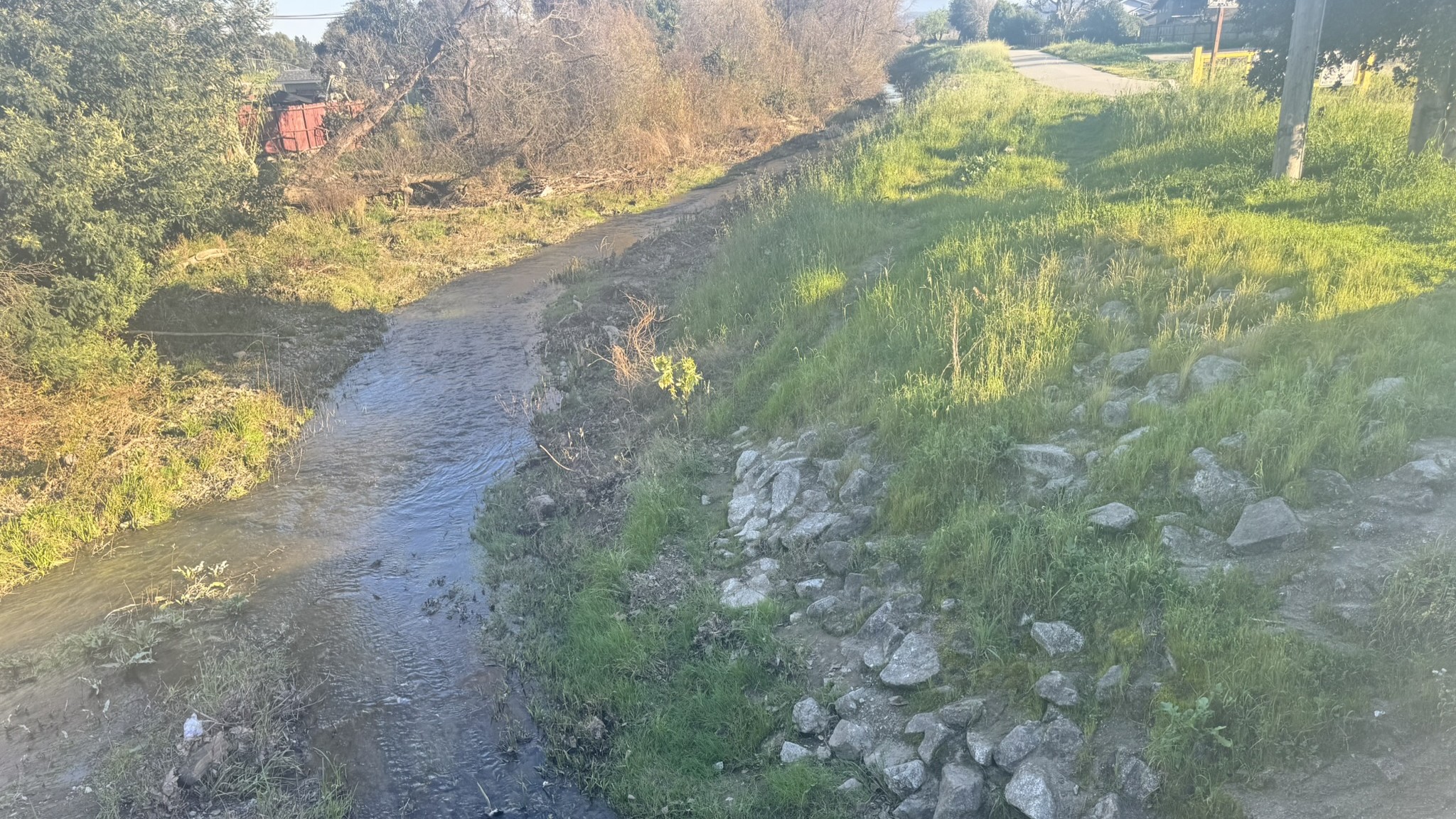
The stretch of Corralitos Creek under East Lake Avenue has a small levee to one side, and no flood protection on the other. (Jesse Kathan — Santa Cruz Local)
WATSONVILLE >> On New Year’s Eve 2022, Sonia Corrales and her family watched the floodwaters rise in their Watsonville neighborhood. The Corralitos Creek, which borders the neighborhood, swelled with heavy rains and splashed over the levees to either side.
By 8 p.m., the water had entered their house. Surrounded by water too deep to drive through, she, her parents, three children and three sisters had to evacuate with the help of the fire department. “This whole street looked like a lagoon,” Corrales, 35, recalled.
Following the floods, her family received money from the U.S. Federal Emergency Management Agency to rent another home. But it wasn’t enough to pay for a house large enough to accommodate all nine family members. They instead crammed into makeshift quarters in their garage as Corrales’ parents worked to repair the damage to the house.
After three months of repairs, they hoped to soon move back into the main house. That’s when the second flood hit. “Everything they had fixed went to waste,” she said in Spanish.
This was not an anomaly. Watsonville and Pajaro have seen decades of repeated flooding from the Pajaro River and its tributaries, Corralitos and Salsipudes creeks. A long-term project to better protect residents from floods broke ground late last year, and is set to have several miles of new levees constructed by early 2027.
But because of the sheer size of the project, many areas of Watsonville and Pajaro affected by flooding may not be protected for nearly a decade, even as climate change fuels stronger storms with heavier rains.
A history of floods
For thousands of years, the lands around the Pajaro River were floodplains subject to seasonal inundation that nourished the soil and sustained local wildlife. Like many rivers in California, it has been hemmed in by development and agriculture.
Levees built in the 1940s have proved inadequate to prevent floods.
Some areas had eight-year flood protection — enough protection that the creeks are expected to flood the area no more than once every eight years— and some areas along the Corralitos and Salsipuedes Creeks had none.
Plans for fortifying the levees locally were delayed for decades, in large part because agricultural lands and low-income communities weren’t deemed important enough to protect.
The Pajaro River Flood Risk Management Project, a joint effort of the U.S. Army Corps of Engineers and the Pajaro Regional Flood Management Agency, was created in 2021 and seeks to both better protect homes and cede some of the historic floodplain back to the river. One solution has been to knock down old levees and construct new ones further from the riverbed — in some areas, more than a football field’s length away.
Besides flood protection, the expanded riverbanks are designed to provide new habitat for riparian plants and animals, and let water seep into the soil to replenish groundwater aquifers. Groundwater basins in the county, including the Mid-County and Pajaro Valley basins are critically overdrafted and at risk of saltwater intrusion if not refilled.
In some areas where Corralitos and Salsipuedes creeks run closer to homes and businesses, new floodwalls are planned.
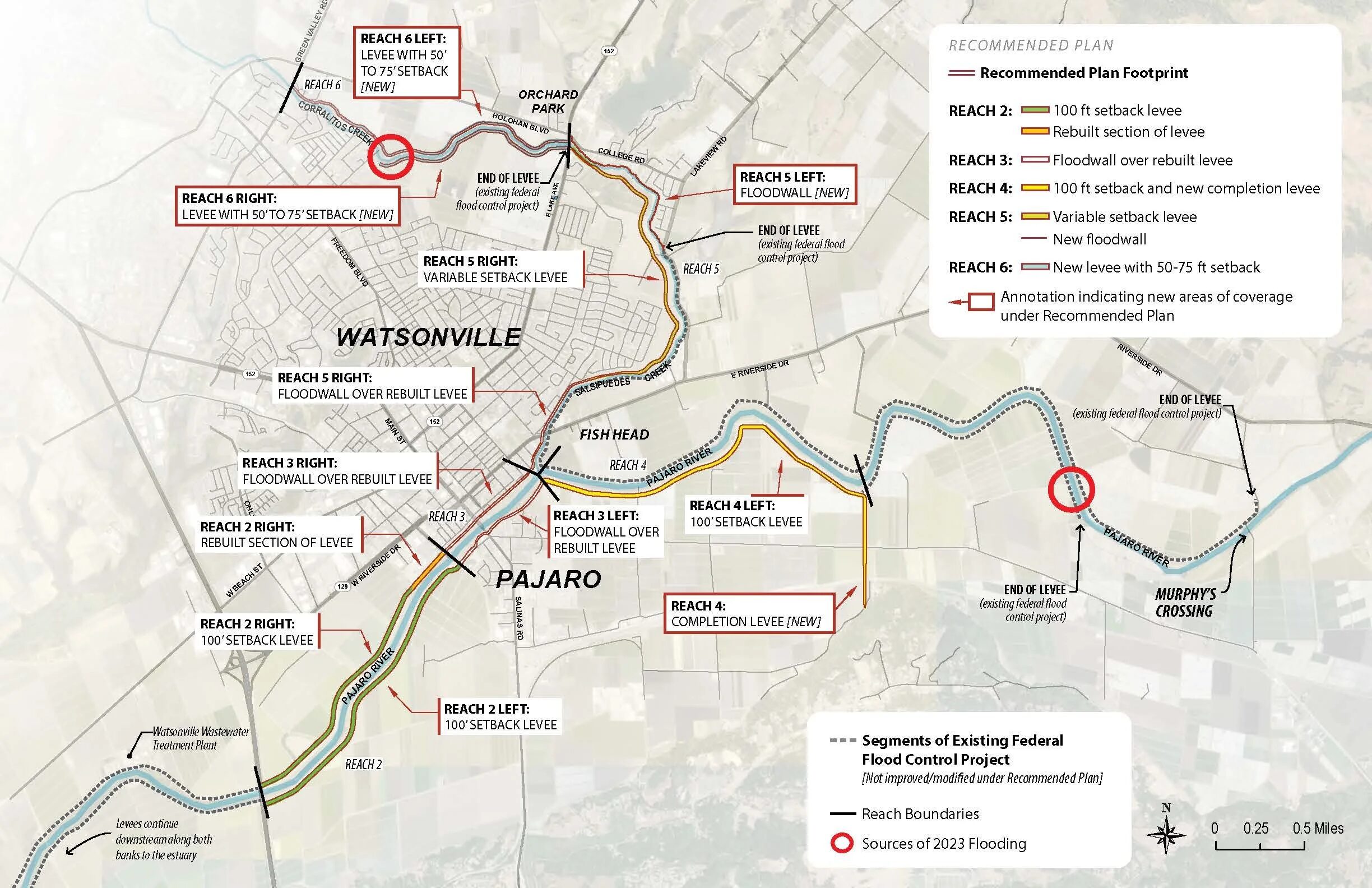
A map shows planned flood protection improvements along the Corralitos and Salsipuedes creeks and the Pajaro River. (Pajaro Regional Flood Management Agency)
Project details
The project in South Santa Cruz County has five phases, each designed, funded and constructed separately.
The first phase includes Corralitos Creek between Green Valley Road and East Lake Avenue, which has no levee and has seen repeated flooding over the years. Contractors started removing trees in late 2025, and are set to start earthmoving within weeks, said Mark Strudley, executive director of the flood management agency. That segment is expected to be completed by late this year or early 2027.
In 2027 or 2028, work is set to start on a longer stretch of Corralitos and Salsipuedes creeks from East Lake Avenue to the confluence with the Pajaro River, near Downtown Watsonville. The existing levees, including those near Corrales’ home, have been repeatedly overtopped by the rising creek during storms.
Benjamin Villanueva, who like Corrales lives near the Corralitos Creek, was forced from his home in January 2023 when more than 2 feet of water flooded his house. He and his wife and four children stayed for a month in cramped quarters with his mother-in-law. His house also faced another round of destruction in March of that year.
And in January 2024, the water rose once more, though it stopped just short of his house. Without a strengthened levee, “it could happen at any moment,” he said.
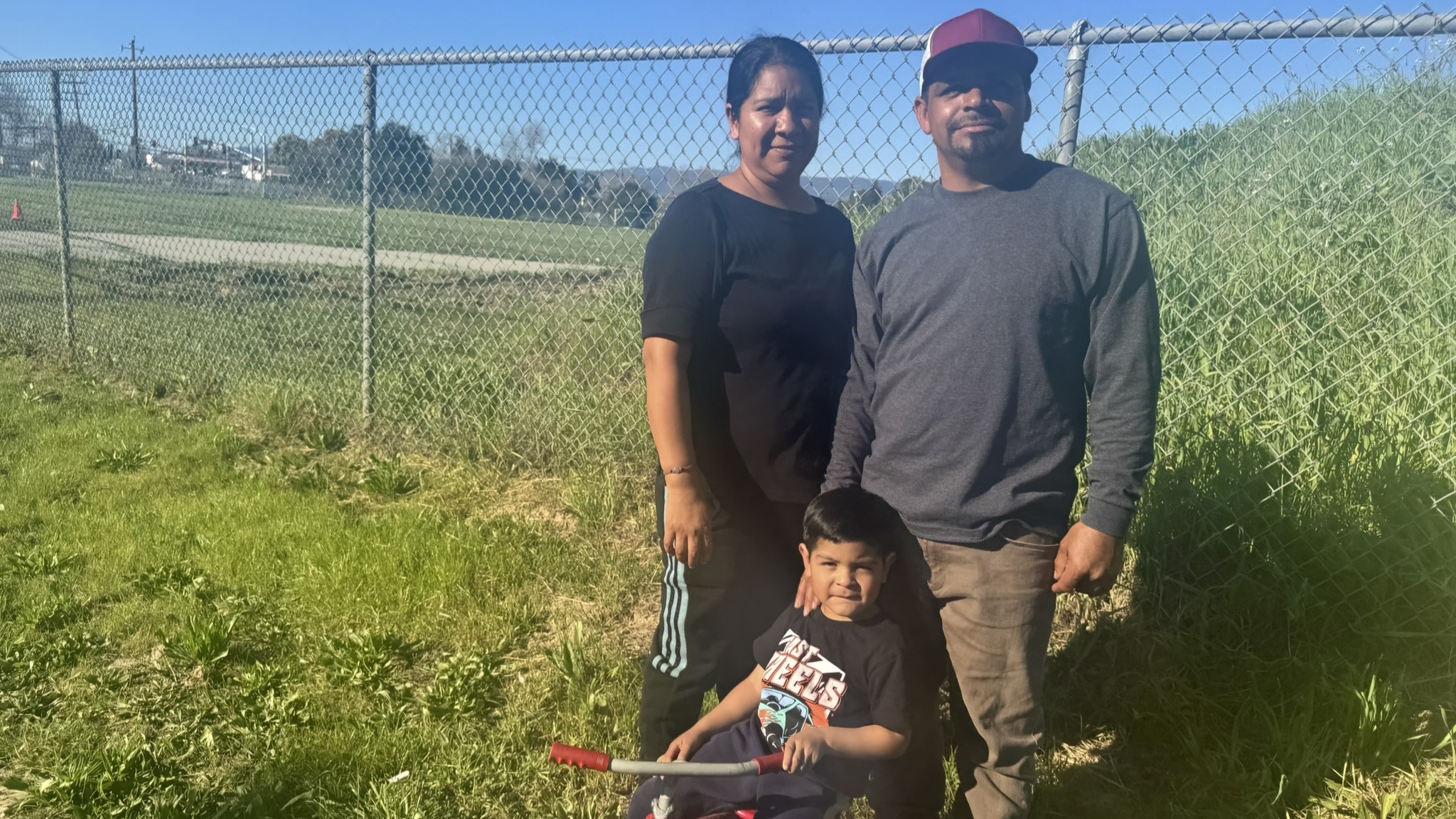
Benjamin Villanueva, Jessica De Leon and their 4-year-old son stand near their home, which has been repeatedly flooded by the Corralitos Creek. (Jesse Kathan — Santa Cruz Local)
Uncertain future
As Villanueva and his family coped with the repeated destruction of their home, his friends in Pajaro were also struggling, he said. A catastrophic levee breach on the Pajaro River sent floodwaters miles west over farmland and into Pajaro, and displaced around 3,000 people. Like Villanueva, his friends lost furniture, clothes and other belongings.
Villanueva’s home should be protected by the new levees and floodwalls along Corralitos and Salsipuedes creeks, expected to be completed by 2030. But the timeline for constructing the levees to protect Pajaro is more uncertain.
“It gets a little hard to to prognosticate” beyond the next four years, Strudley said. But he estimates that the remaining phases could be done between 2032 and 2035. Meaning for the coming years, Pajaro residents remain vulnerable to whatever the weather brings.
A long stretch of new and bolstered levees is planned to protect Pajaro from the mainstem of the river. Preliminary designs include a new levee set back more than 300 feet from the river for several miles before veering south, perpendicular to the river, to provide a wall between Pajaro and potential upstream flooding. Design work is continuing, but it’s uncertain how long the process will take.
Federal and state agencies have pledged to fully fund the five phases of the $600 million project, while a local assessment on landowners pays for ongoing maintenance. But receiving the federal funding has still hit snags. The promised money must be appropriated each year, and last year’s appropriations were reallocated by President Donald Trump’s administration towards red states, clawing back nearly $40 million for the project. The loss didn’t affect the timeline for construction, Strudley has said.
Will it be enough?
The new levees and floodwalls are designed to give urban areas of Watsonville and Pajaro 100-year flood protection. That means a flood is expected no more than once every century, essentially a 1% chance of a flood each year.
But the same economic calculations that prevented upgrades to levees for decades is still leaving homes behind. Some agricultural areas will have a lower 25-year flood protection — like the neighborhood where Villanueva and Corrales live with their families.
The neighborhood, between College Road and Kelley Lake, was deemed not economically valuable enough to warrant the expense of 100-year flood protection. Santa Cruz County leaders have pledged to help build a bigger floodwall to provide the same amount of protection as other residential neighborhoods. The plan would require allocating a portion of federal money that goes to the county for public infrastructure and would need federal approval, Strudley said.
But some say even 100-year level protection isn’t enough, especially as climate change is driving more frequent and more powerful atmospheric rivers, which can bring a rapid succession of torrential rains. Some water policy experts have advocated for a beefed-up 200-year flood protection as the new standard.
Strudley said there’s simply no funds to build that kind of protection.
“I know there’s a lot of planning going on, and it’s supposed to be much better protection, but I just feel like nobody really understands or can predict what it’s really going to be like as climate change accelerates,” said Nancy Faulstitch, executive director of climate justice organization Regeneración Pajaro Valley. “All bets are off.”
For the time being, Watsonville is seeing mostly sunny days and mild showers, and the Corralitos Creek is a narrow, slow-moving stream. But for those near the waters, the fear of future storms remains.
Janet Linney, who lives near Corralitos Creek and has also faced repeated floods, said, “I don’t find the sound of rain soothing anymore.”
Questions or comments? Email [email protected]. Santa Cruz Local is supported by members, major donors, sponsors and grants for the general support of our newsroom. Our news judgments are made independently and not on the basis of donor support. Learn more about Santa Cruz Local and how we are funded.

Jesse Kathan is a staff reporter for Santa Cruz Local. They hold a master's degree in science communications from UC Santa Cruz.