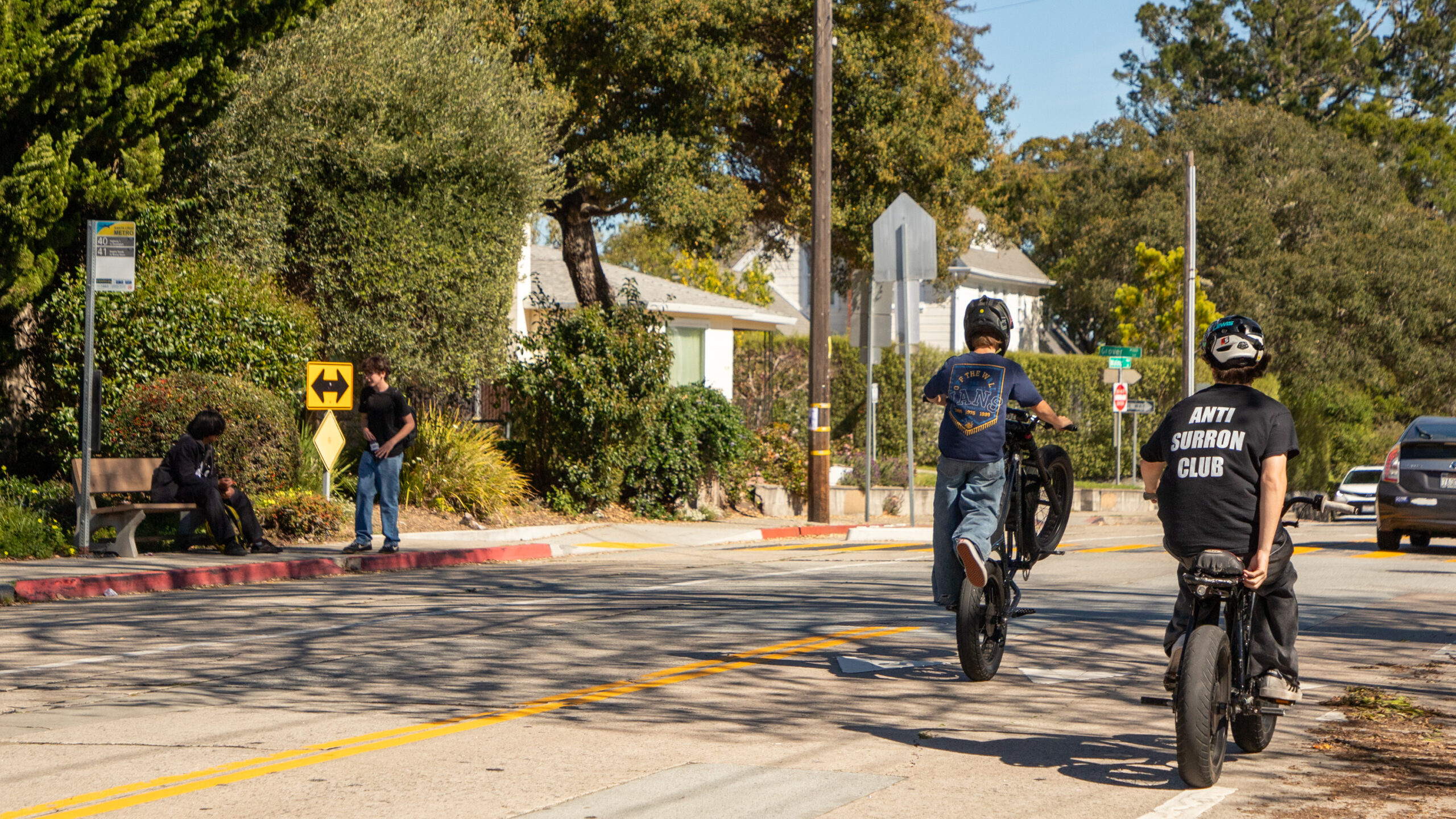
Young riders on e-bikes while wearing helmets on Mar. 12 on a street in Santa Cruz. (Amaya Edwards — Santa Cruz Local/CatchLight Local)
SANTA CRUZ >> Santa Cruz city leaders want residents to be smarter with their electric bike usage — and it starts with the kids. Last month, the Santa Cruz City Council approved an update to e-bike rules, including age restrictions and fines for riding on sidewalks.
E-bikes have gained popularity among young people in the county and across the state, allowing many teens to get around faster without a driver’s license. But because many electric bikes don’t require a license, some youth lack instruction on the rules of the road.
Officials elsewhere in the state have tried to clamp down on dangerous e-bike behavior, but have found enforcement unrealistic.
The Santa Cruz ordinance aims to establish:
- A minimum rider age for class 1 and class 2 e-bikes.
- Speed limits for e-bikes on multi-use paths.
- Fines for riding e-bikes on sidewalks.
Of those, only setting a fine for riding on the sidewalk is already within the city’s jurisdiction.
Assembly Bill 2346, introduced in February, would allow cities to set speed limits for e-bikes in multi-use paths. If the bill is not adopted by the state legislature, city staff could try to pursue local speed limit rules anyway.
Regulations for minimum rider age are set by state authorities and currently, only class 3 e-bikes have a minimum age of 17. City staff are pursuing inclusion of Santa Cruz in state legislation that would allow the city to set a minimum rider age for these vehicles, potentially of 10 years old.
Claire Gallogly, Santa Cruz principal transportation planner, said the city is working with regional and state partners to determine the best recommended age minimum.
E-bikes vary in pedal operation, throttle and maximum speed and are categorized into three classes:
- Class 1 e-bikes can go up to 20 mph, and only add speed while the rider pedals.
- Class 2 e-bikes can go up to 20 mph, and can use a throttle and/or pedal assist.
- Class 3 e-bikes can go up to 28 mph with a combination of throttle and pedal assist. Riders must be 16 or older.
E-bikes have emerged quickly as a transportation mode, Gallogly said, and the city has not entirely caught up yet. She said she has heard concerns about youth riding in the wrong direction, not obeying traffic signals and riding recklessly. Gallogly said that includes weaving in-and-out of traffic and doing tricks down the middle of the road.
However, despite consistent complaints about youth riders, Gallogly said, the rate of e-bike injuries and fatalities is much higher in older adults than youth according to county emergency responder data.
While e-bike regulation is mainly governed at the state level, Gallogly said, one of the biggest ways Santa Cruz will work to expand its safety measures is through increased e-bike messaging and education.
Santa Cruz Police also started trying to clamp down on illegal e-bikes, and started impounding them in August 2025. Eight out 16 impounds were from drivers under 18, according to the police.
E-bikes mean transportation freedom for many youth
Gallogly said the increased access to e-bikes helped decrease truancy at Branciforte Middle School, as the bikes helped students get to school on time without relying on family cars.
E-bikes also allow many youth without driver’s licenses to attend extracurricular activities. However, there is a gap in formalized safety education around e-bikes.
“The only time that people get rules of the road education is when they’re going through driver’s education,” Gallogly said. “And if you are riding a bike and not driving, there’s no other time that you get that formalized education.”
To help close that gap, the city is launching an in-person e-bike education and training program with Branciforte and Mission Hill middle schools.
The training will be a mandatory part of obtaining a newly required parking permit for e-bikes on these campuses, said Casey O’Brien, director of student services for Santa Cruz City Schools.
Beginning this spring, students will take a three-part e-bike safety course involving classroom safety instruction, learning about their own bikes on the blacktop and riding a course around campus and neighboring streets in an activity similar to a driver’s education course. Only after completing the course can students get a registration sticker to put on their bikes on campus.
“I’m hoping to see safer streets, fewer accidents and kids having more knowledge and making better decisions around their transportation,” O’Brien said.
Gavin Roth, an eighth grader at Mission Hill, doubted how effective the training would be, adding that the school already had some e-bike training sessions.
Instead, Roth said, he wants to see better enforcement of existing rules to discourage reckless riding and illegal modifications.
Roth, who rides his own class 2 e-bike to get to school and elsewhere, said the bikes enable people to have more independent transportation.
“They’re great for the environment, they’re great for transportation independence, and those who are seeking to completely ban them or require permits I think don’t fully understand the issue,” he said.
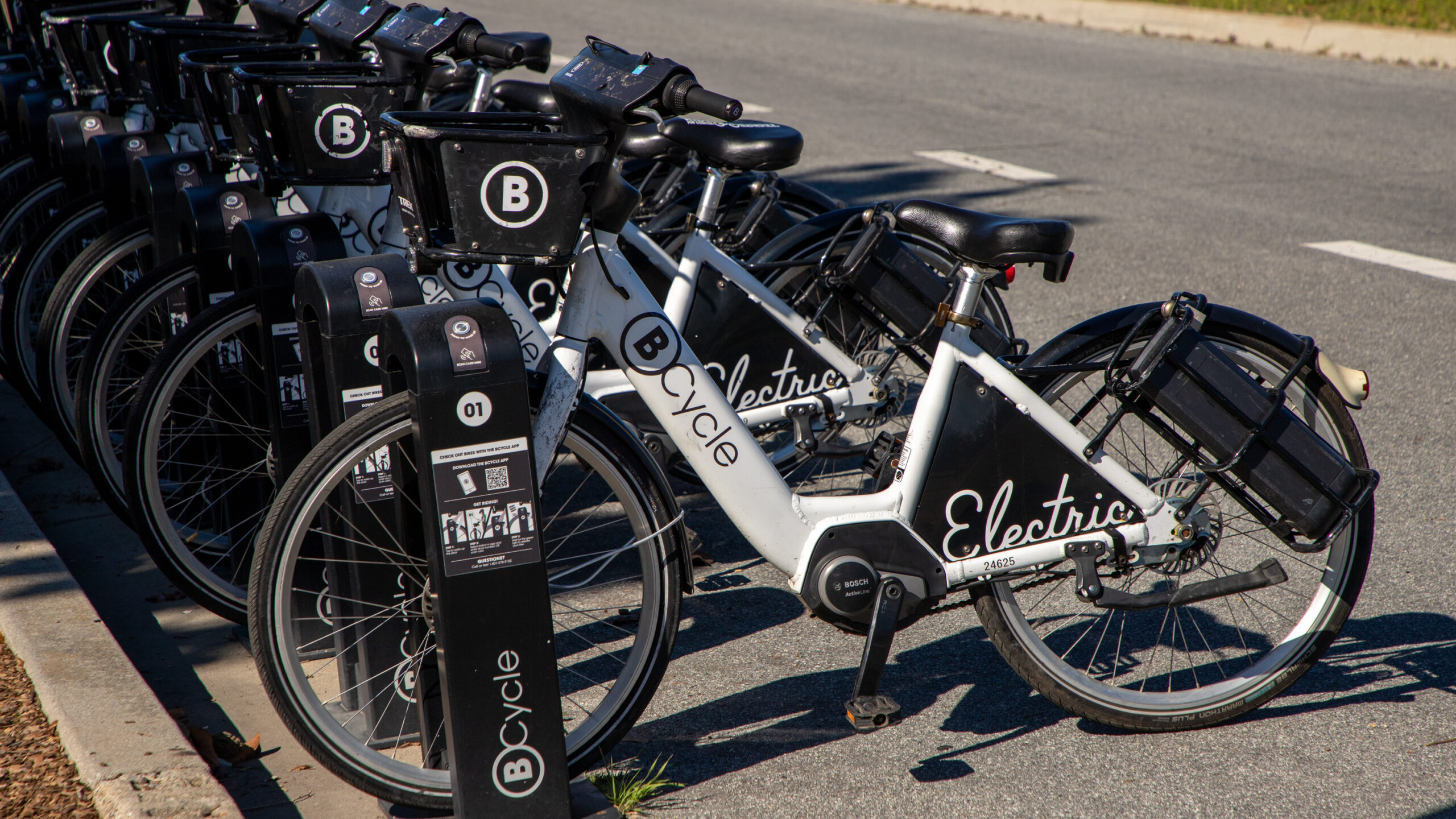
BCycle electric bikes for rent as e-bike usage is on the rise with no end in sight. (Amaya Edwards — Santa Cruz Local/CatchLight Local)
Enforcement woes
Marin County established the Marin Electric Bicycle Safety Pilot Program in 2024, which enabled cities within Marin County to prohibit people under 16 to ride a class 2 or class 3 e-bike. The county also established an outreach education campaign for teen riders and their parents.
Talia Smith, deputy county executive for Marin County, said the safety program has been difficult to enforce. Law enforcement agencies have said their agencies are already stretched thin.
“The response, which is totally valid, is ‘we are so resource strapped as it is, if people start calling 911 saying they see a 12-year-old on an e-bike, I want you to respond’ — are we creating unrealistic expectations for people? So where we landed was” focusing on education and outreach, Smith said.
The laws were intended to work in tandem with interactions that law enforcement agencies already have with kids on e-bikes instead of being a proactive enforcement tool to pull over people, Smith said. She added that the new laws also act as a messaging tool for parents to better enforce following the rules.
Marin’s e-bike safety program, implemented in cities like Novato, San Rafael and Mill Valley, was one of the most unanimously supported issues she had ever worked on, Smith said.
However, Smith added that there is no perfect solution. Having a patchwork of different laws across the state only muddles the issue, saying she hopes e-bikes will eventually make their way into statewide policy.
Questions or comments? Email [email protected]. Santa Cruz Local is supported by members, major donors, sponsors and grants for the general support of our newsroom. Our news judgments are made independently and not on the basis of donor support. Learn more about Santa Cruz Local and how we are funded.

Gabrielle Gillette is a reporter based in Santa Cruz. She graduated from UCLA where she was the metro editor for the Daily Bruin. She interned for Lookout Santa Cruz and the Orange County Register. She contributes to the Orange County Register and the Monterey Herald.