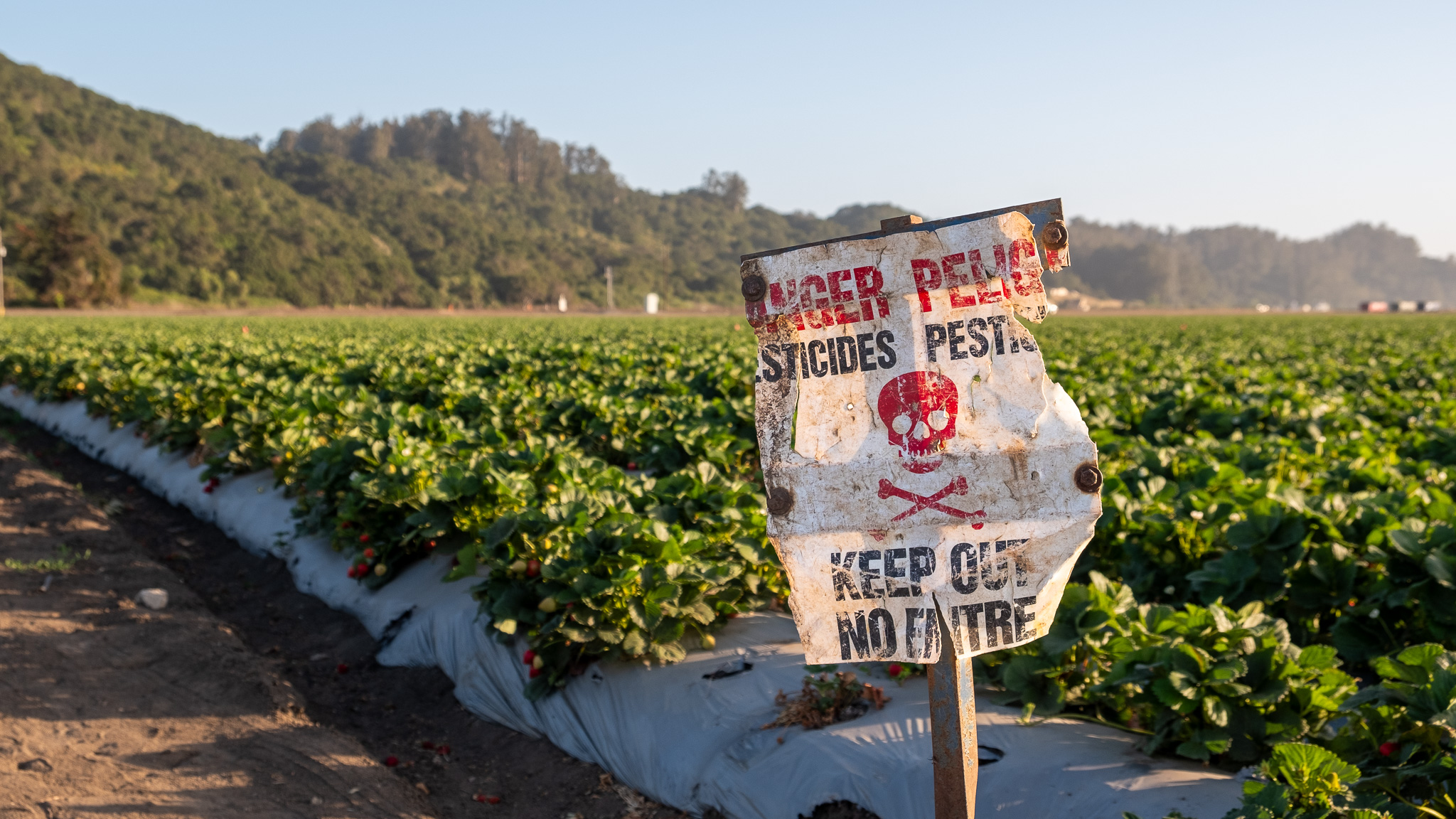
A sign bearing a skull and crossbones is a warning to keep out of a strawberry field recently treated with pesticides on San Juan Road near Pajaro in June. (Nik Altenberg — Santa Cruz Local file)
WATSONVILLE >> A month after new state regulations went into effect for a pesticide widely used in the Pajaro Valley, local activists have filed a lawsuit challenging the rules. The lawsuit alleges the regulations are inconsistent and do not adequately protect human health.
The lawsuit marks a return to court for pesticide activists that have, for nearly a decade, battled the state over its regulations of the soil fumigant 1,3-dichloropropene — or 1,3-D (“one three dee”) for short.
It’s a highly toxic chemical that likely causes cancer and is commonly used to sterilize soil ahead of planting strawberries. It’s one of the most widely used pesticides in California and has largely taken the place of methyl bromide, which has mostly been phased out because of concern over health harms and ozone depletion.
The new rules for 1,3-D took effect Jan. 1 and pertain only to “occupational bystanders,” in other words, farmworkers who aren’t applying the pesticide but can be exposed by working nearby. The regulations were developed after a 2023 court order forced the California Department of Pesticide Regulation (DPR) to review its exposure limits for workers.
Rules for how much 1,3-D can be in the air where people live, in other words “residential bystanders,” were not affected by that court order and remain in place today at a less-protective level. With the two different regulations, residents can legally be exposed to more of the hazardous chemical than workers.
Pesticide activists filed a lawsuit Wednesday in Alameda County Superior Court claiming that the two regulations violate state law because of that inconsistency.
Rocio Ortiz, who grew up in Watsonville and picked strawberries as a high schooler, is the lead plaintiff in the case.

Rocio Ortiz, right, speaks with Omar Dieguez at a press conference on Sept. 30 marking the end of Dieguez’s 30-day hunger strike against the use of pesticides near schools. Ortiz and Dieguez both grew up in Watsonville and advocate for pesticide reform. (Nik Altenberg — Santa Cruz Local file)
“DPR had years to get this right. Instead, they created confusing, contradictory rules that put our communities at risk of harmful exposure,” Ortiz said in a statement last week. “We should not have to keep suing the state just to be protected from cancer-causing chemicals.”
The lawsuit is the latest in a saga over the regulation of pesticide 1,3-D, which is marked by industry influence. The pesticide, which is commonly referred to by the brand name Telone, is solely produced by Dow Agrosciences, which has advocated for loosened regulations over the years. The agricultural company is based in Indianapolis, Ind.
In the creation of the residential bystander rules, Dow advocated for an exposure limit that was ultimately adopted by state pesticide regulators and is higher than state cancer scientists deemed was safe.
A DPR spokesman declined to comment, citing the pending lawsuit.
Former DPR Director Julie Henderson said in a 2025 interview with Santa Cruz Local that DPR’s models indicated that residents were expected to be exposed to around the same amount that worker bystanders would be, though the air concentration targets are different. That’s in part because residents are not expected to be exposed to 1,3-D as often as farmworkers.
California’s 1,3-D regulations are some of the strictest in the country. They require the use of impermeable tarp to contain the pesticide and mandatory buffer zones from where people are working. The soil fumigant would theoretically stay in the soil, but wind can disturb the tarps and let the dangerous gas escape.
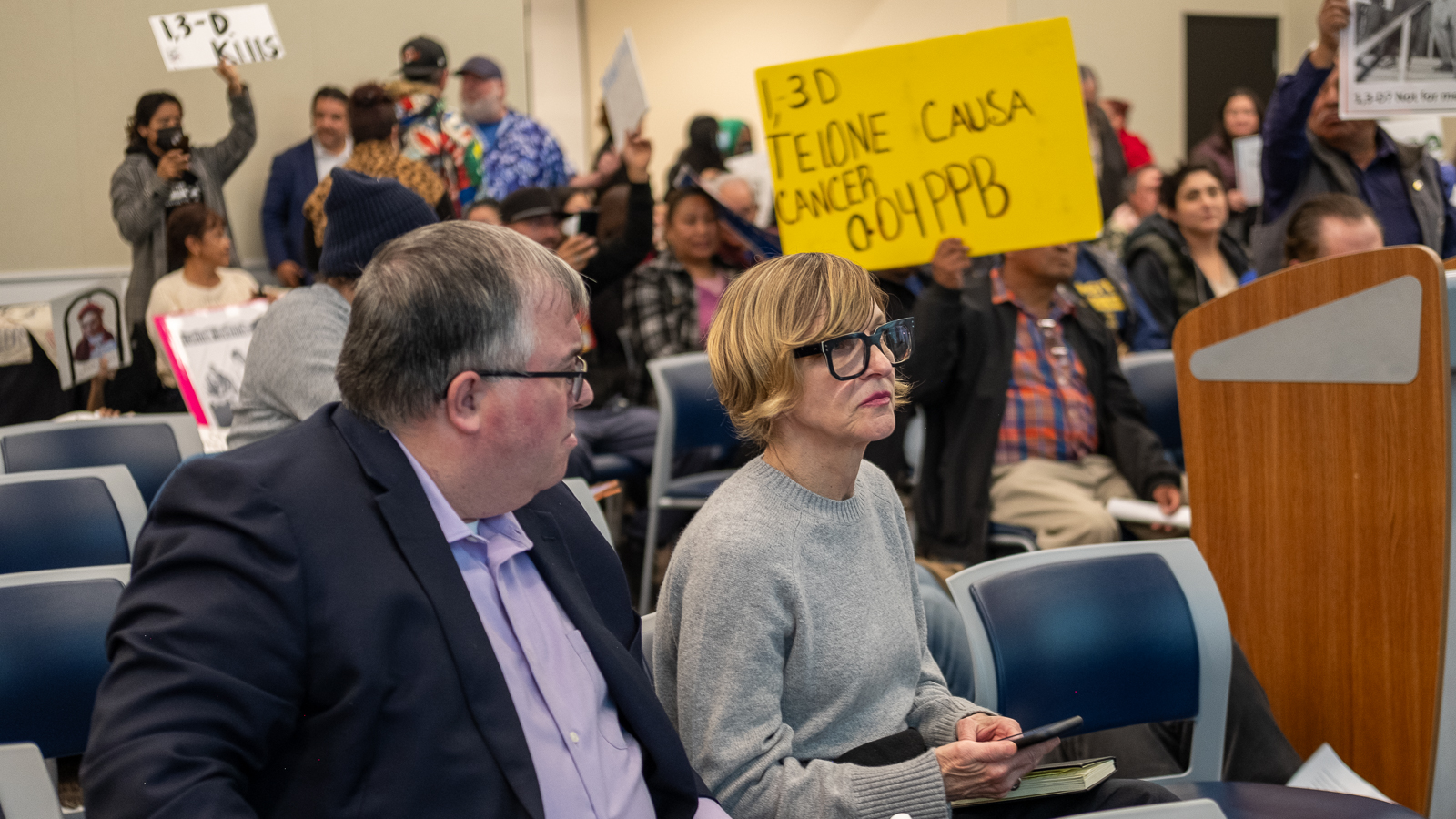
Former California Department of Pesticide Regulation Director Julie Henderson listens as protestors disrupt a hearing on regulations of the soil fumigant 1,3-dichloropropene in Salinas on Jan. 16, 2025. (Nik Altenberg — Santa Cruz Local file)
This “pesticide drift” can cause mass poisoning of farmworkers if the fumes drift in high concentrations onto nearby workers, and the dispersed gas can drift in the wind for miles and expose nearby residents to lower concentrations.
“We were hoping, really hoping that DPR would do its part and really try to protect human health,” said Yanely Martinez, an organizer with local pesticide advocacy group Safe Ag Safe Schools. Martinez said the two regulations with different air concentration limits could set a precedent for confusing and inconsistent regulations to be allowed.
“DPR proved again that they’re not willing to cooperate or to protect human health,” she said. “If we allow this to happen and to continue, DPR is just going to do that with every single other pesticide that they have, and so we really want to make sure that we hold them accountable.”
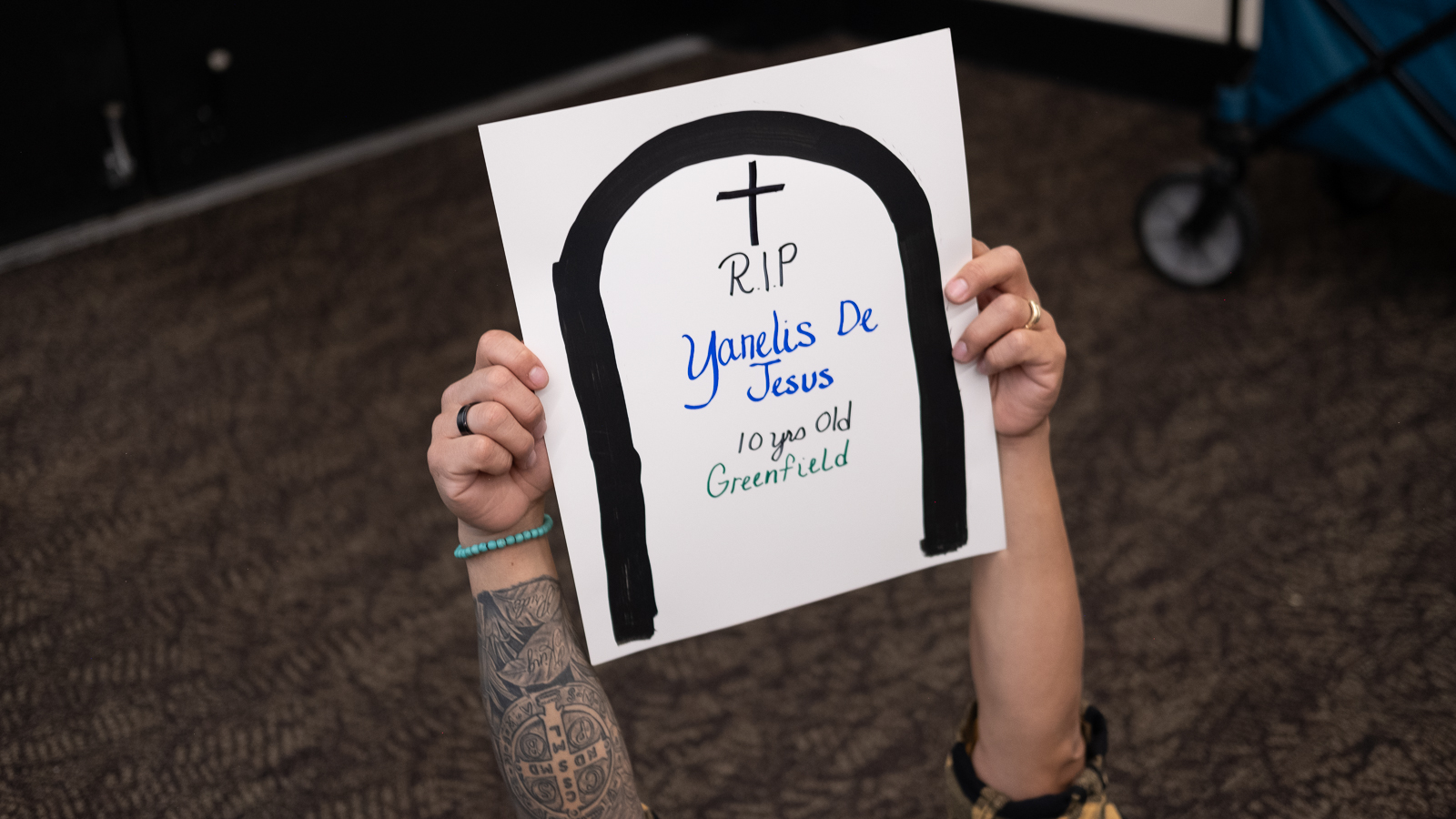
Pesticide activists staged a ‘die in’ to disrupt a California Department of Pesticide Regulation hearing on 1,3-dichloropropene regulations in Salinas on Jan. 16, 2025. Some held signs in the form of gravestones with the names of residents who had died from cancer. (Nik Altenberg — Santa Cruz Local file)
Questions or comments? Email [email protected]. Santa Cruz Local is supported by members, major donors, sponsors and grants for the general support of our newsroom. Our news judgments are made independently and not on the basis of donor support. Learn more about Santa Cruz Local and how we are funded.

Nik Altenberg is a bilingual reporter and assistant editor at Santa Cruz Local. Nik Altenberg es reportera bilingüe y editora asistente para Santa Cruz Local.