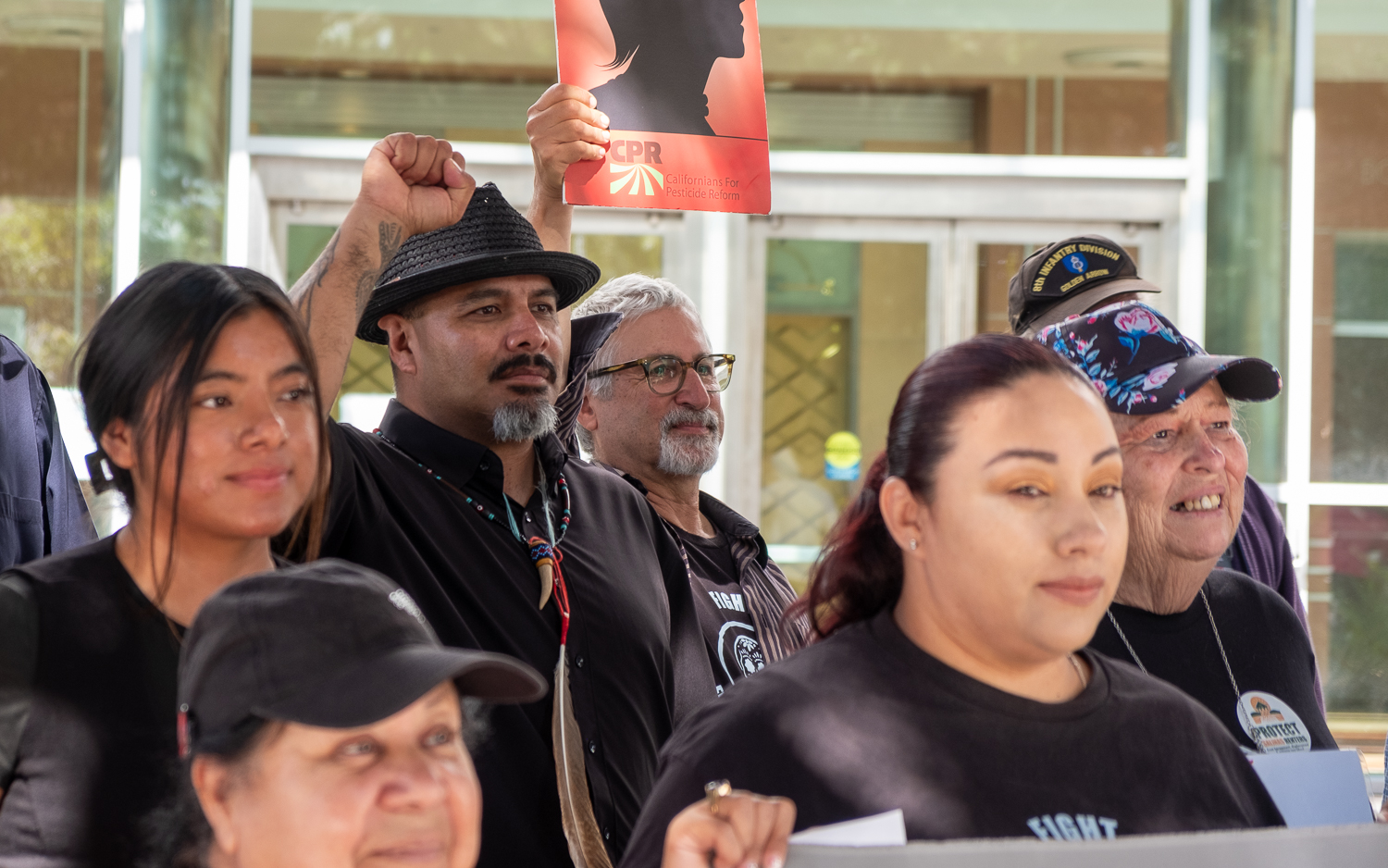
Omar Dieguez raises a fist at a rally against pesticides in Salinas on Sept. 30, the last day of a 30-day hunger strike to bring attention to the issue. (Nik Altenberg — Santa Cruz Local)
SALINAS >> Watsonville activist Omar Dieguez finished a 30-day hunger strike against pesticides Tuesday, marking the final day of the protest by attending a Safe Ag Safe Schools rally in Salinas. Dieguez, 48, made it to the finish line after a brief hospitalization on Sept. 26 following severe stomach pains, where he was administered an IV and then released.
“The mission was accomplished on bringing awareness to the problem of pesticides,” Dieguez said at the rally, adding that he was relieved to be done with the fast and would spend the next week recovering before considering his next steps. Dieguez said he lost 26 pounds in the 30 days and was one pound shy of a threshold that his doctor said would be a dangerous weight.
About 20 people attended the rally that was meant to draw attention to a new study that examined pregnant residents’ proximity to some pesticides in California.
Several pesticide activists, nurses and a former senator spoke at the event. Providence Martinez Alaniz was also in attendance. She fasted alongside Dieguez for 18 days before being hospitalized and ending her fast.
The main goals of the fast were to educate residents on the potential effects of pesticide exposure and to pressure local berry growers to transition fields near schools to organic farming practices. While state law prevents the use of pesticides within a quarter mile of schools, gaseous pesticides can drift for miles on the wind.
Dieguez specifically targeted Watsonville-based Driscoll’s, Inc., one of the largest berry companies in the world, to reduce pesticide use near schools. The company did not publicly acknowledge his protest.
Emily Nauseda, Senior Vice President for marketing firm Allison Worldwide, sent a statement on behalf of Driscoll’s in a Sept. 24 email. It said that the company “remains deeply committed to transparency, accountability, and the health of our neighbors” and follows all pesticide regulations.
Dieguez began the monthlong fast speaking at schools and colleges in Santa Cruz and Monterey counties. Dieguez works as a youth advocate at Barrios Unidos and Partners for Peace. He also recently helped restart the youth-focused group Watsonville Brown Berets.
He intended to continue with speaking engagements throughout the hunger strike, but presentations planned at Pajaro Valley High and Watsonville High were cancelled last minute, Santa Cruz Local reported Sept. 18.
“My heart was broken at the fact that Pajaro Valley Unified School District does not allow us to come in to educate the community that’s mostly harmed by pesticides,” he said. “But we will continue to do the work, continue to spread the message, and we will find a way to get either in the classrooms or get to the students one way or the other.”
Dieguez claimed the district was blocking him from presenting in the schools but district spokesman Alejandro Chavez denied the claim.
“Every school is following board policy,” Chavez wrote in a Sept. 23 email. The policy requires parental consent prior to presentations on “controversial” topics, according to Chavez. Dieguez said he followed all requirements of the policy but the presentations were still canceled.
The principals of each school did not respond to requests for comment.
Still, Dieguez said he was able to connect with students at schools in Salinas and Santa Cruz and hear out youth who said they were worried about their parents being exposed to pesticides while they work in the fields. Dieguez said he “shared tears” with some youth and felt deeply connected to the community through the hunger strike.
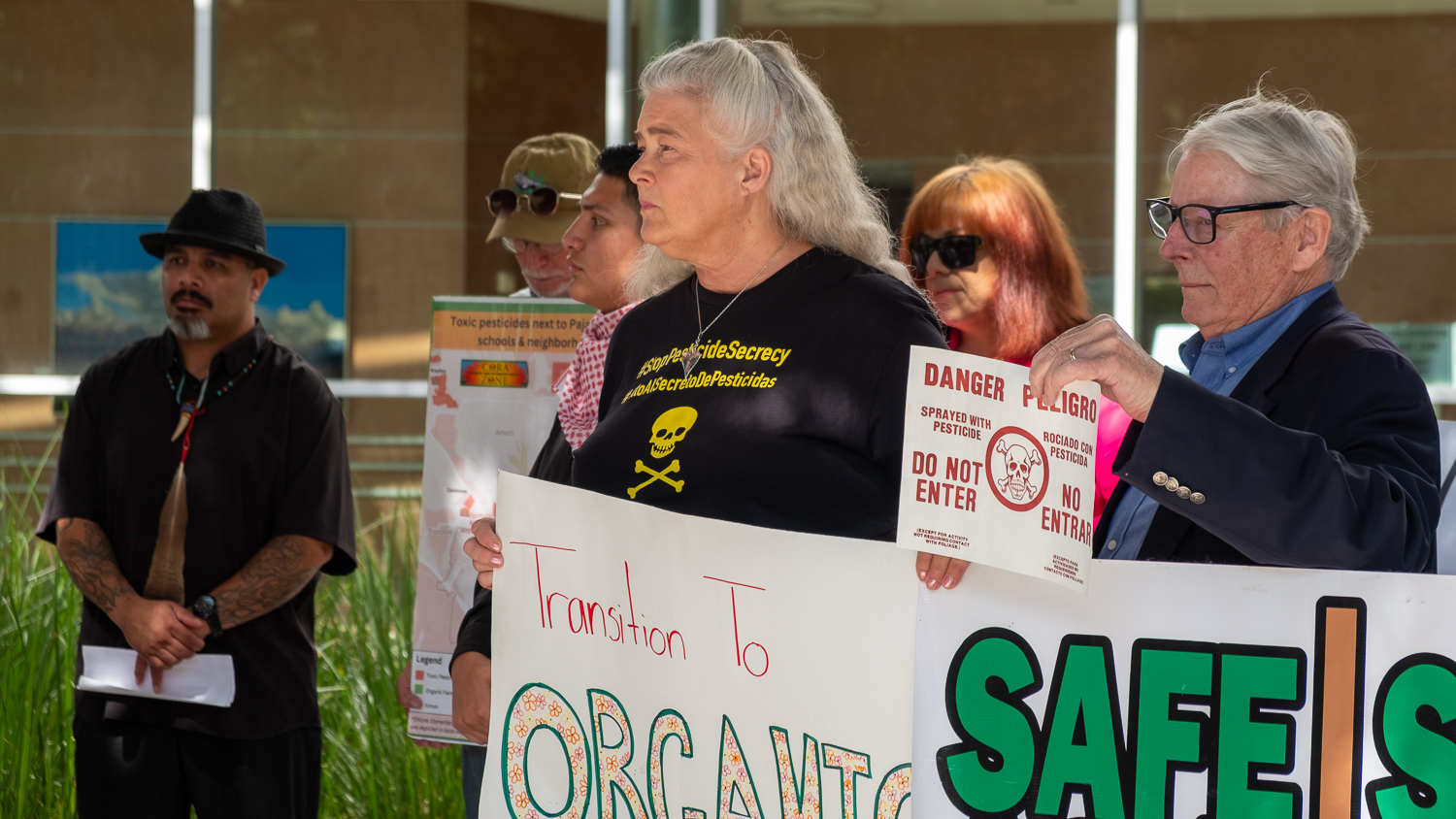
Former California Senator Bill Monning, right, holds a “skull and crossbones” sign at a rally Sept. 30 in Salinas. Fields recently sprayed with pesticides must have the signs posted, a California law that came after years of advocacy by farmworker and pesticide activists. (Nik Altenberg — Santa Cruz Local)
New study on organophosphates and pregnancy
At the Tuesday rally, activists called for the state to ban the use of organophosphate pesticides.
Organophosphates are a class of insecticides that work by targeting insects’ nervous systems, including neurotransmitters in the brain. Organophosphates have repeatedly been linked to neurodevelopmental harms in children who were exposed in-utero — including poorer cognitive functioning, behavioral problems and ADHD, among other effects.
In one 2011 study, researchers found that for each 10-fold increase in exposure to organophosphates during pregnancy, the IQ scores of 7-year-olds were 5.6 points lower.
A new study published on Sept. 30 in the journal BMC Public Health found that 29% of mothers that gave birth in Santa Cruz County in 2021 lived within 1 kilometer of organophosphate pesticide use.
“We know that especially during pregnancy, even low levels of chronic exposure [to organophosphates] have a profound effect with adverse consequences on fetal development,” Dr. Antonio Velasco, a Salinas-based doctor who has treated farmworkers exposed to pesticides since the 1980s, said at the rally. “It’s time we place the value of a healthy population above the profits of petrochemical companies.”
The study examined trends in organophosphate use in California following the 2020 ban of chlorpyrifos, an organophosphate pesticide linked with neurodevelopmental harm in children. In Santa Cruz County, malathion is another organophosphate pesticide still used on crops.
“It’s an old, broad spectrum insecticide. It’s still used with some frequency but people try to get away from that chemistry,” said Santa Cruz County Agricultural Commissioner Dave Sanford in a June interview.
Former California Senator Bill Monning, who represented parts of Santa Cruz and Monterey counties in the 17th District from 2012 to 2020, said in an interview that agricultural companies and pesticide manufacturers have “extraordinary influence” on policies and pesticide regulations.
“In Sacramento and Washington, D.C. they have full-time paid lobbyists who are very effective,” Monning said, referencing the 2010 Supreme Court ruling which allowed corporations unlimited campaign contributions. “The more money you have, the more free speech you have.”
An action like Dieguez’s hunger strike, Monning said, continues a long legacy of nonviolent protest including labor leader and United Farm Workers co-founder Cesar Chavez’s 36-day hunger strike against pesticides in 1988.
“No change ever comes without struggle,” he said.
Read more
Questions or comments? Email [email protected]. Santa Cruz Local is supported by members, major donors, sponsors and grants for the general support of our newsroom. Our news judgments are made independently and not on the basis of donor support. Learn more about Santa Cruz Local and how we are funded.

Nik Altenberg is a bilingual reporter and assistant editor at Santa Cruz Local. Nik Altenberg es reportera bilingüe y editora asistente para Santa Cruz Local.