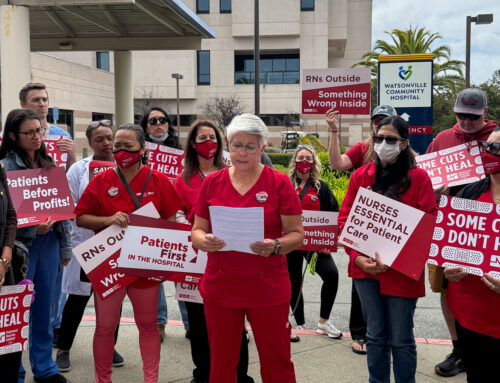

Farmworkers harvest strawberries near Watsonville on Thursday. (Amaya Edwards — Santa Cruz Local)
Editor’s note: This story is the second in a series on pesticides and health in Pajaro Valley. It was supported by The Commonwealth Fund and a Journalism & Women Symposium Health Journalism Fellowship.
WATSONVILLE >> Santa Cruz County’s $1.5 billion agriculture industry relies on more than 1 million pounds of pesticides annually to help boost crop yields. Farmworkers, who apply pesticides and pick produce, carry the heaviest health risks from pesticide exposure — and workers who are pregnant can expose their children to a lifetime of health problems.
California pesticide regulations are too lax to keep farmworkers safe, activists said, and sometimes workers are exposed to even higher levels of the chemicals. Santa Cruz Local spoke with half a dozen farmworkers who described experiences where pesticides were sprayed so close to them that the smell was overwhelming and the fumes burned their eyes, lips and throat.
In part due to the risks pesticides pose, farmworkers are eligible to stop work on the first day of pregnancy and collect state disability insurance payments that they have paid into — regardless of immigration status. But barriers to access the payments persist, including language access challenges, a lack of money to cover the delay to the first payment, immigration enforcement fears and a lack of awareness of the system.
Most women also don’t know they are pregnant until several weeks into pregnancy.
“I didn’t know what I was being exposed to while I was pregnant and working,” said Ernestina Solorio, a 54-year-old farmworker and mother of four in Watsonville. “If I had known, I never would have done it, because my children are suffering the consequences,” she said, fighting back tears.
Solorio has worked in Santa Cruz County berry fields since 1993. Of her four children, her younger two struggle in school and at home — each with an ADHD diagnosis, mental health challenges and learning difficulties — and her older two children do not.
The difference, she believes, was her exposure to pesticides during pregnancy. Solorio worked in the fields while pregnant with each of her children that has ADHD, and she did not work while pregnant with her other two children.
A slew of health harms to children have been linked with pesticide exposure during pregnancy, including childhood brain cancer and leukemia, lower cognition, premature birth, and symptoms and diagnoses of autism spectrum disorder and attention-deficit/hyperactivity disorder, or ADHD. These studies indicate correlation, but don’t prove pesticides cause these health harms.
Solorio’s younger two children, now teenagers, are “constantly going to medical appointments with counselors and psychologists, and it’s very difficult for me to see how they’re not able to get better and progress,” she said, adding that they also suffer from depression. “The truth is that it’s been very hard.”
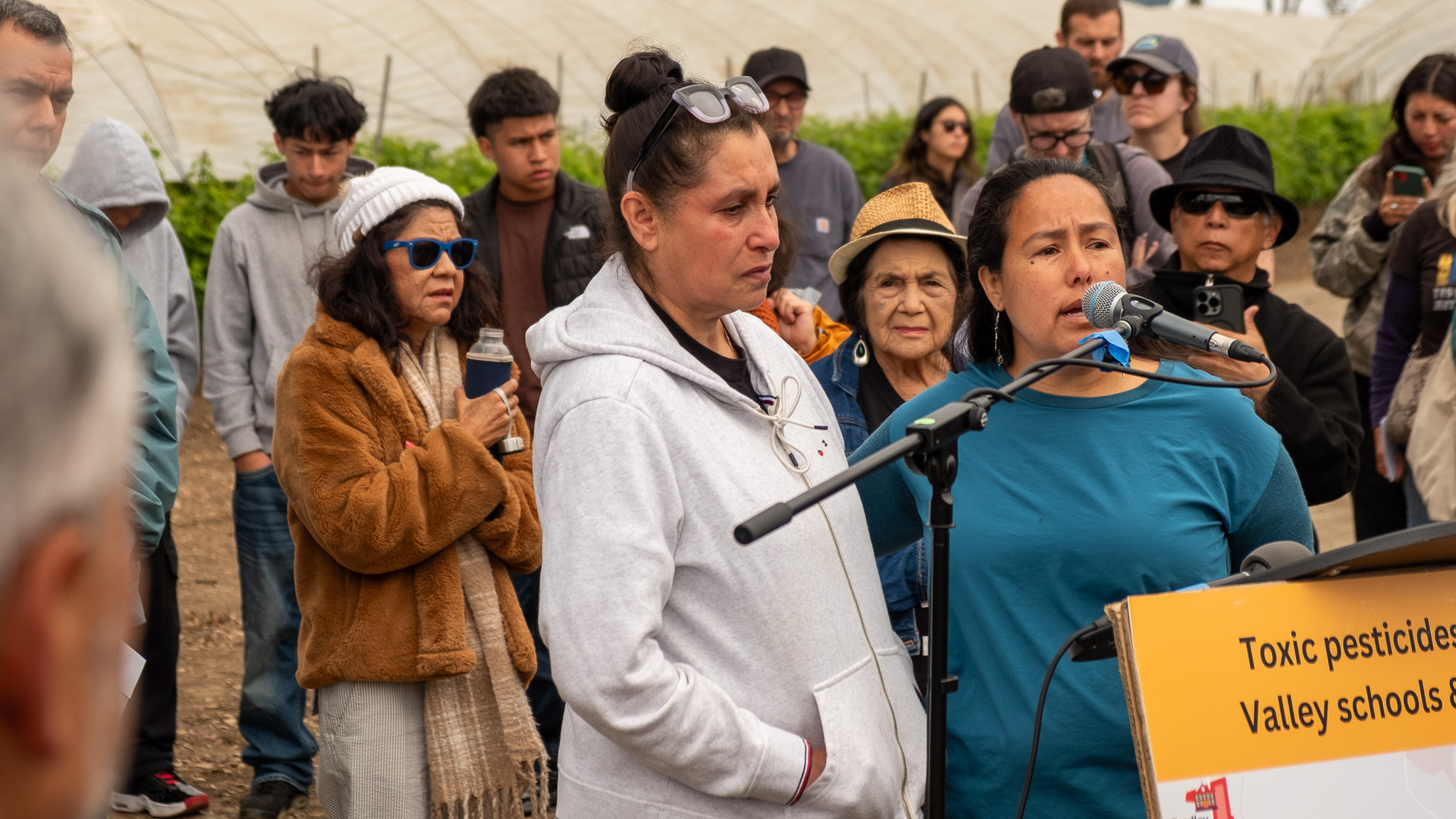
Ernestina Solorio, center, speaks with the assistance of an interpreter at a rally outside T.S. MacQuiddy Elementary School in Watsonville in May to protest the use of pesticides near schools. (Nik Altenberg — Santa Cruz Local file)
An individual’s illness usually cannot be attributed to a specific chemical, in part because many factors affect health. But some local doctors who treat farmworkers have observed health harms that are associated with pesticides.
“I see many more people, young people, moms and their children with a cancer diagnosis, and with loss — any kind of like neonatal loss, stillbirth — or childhood cancer diagnoses. Many more here than I ever saw when I was working in Santa Cruz,” said Katie Gabriel-Cox, a maternal care doctor at Salud Para La Gente, a group of health clinics for low-income Pajaro Valley residents including many farmworkers.
“Pregnancy is a susceptible period for exposure to pesticides,” said Bob Gunier, an environmental health scientist. “It can affect the child’s neurodevelopment for many years down the road.” Gunier is a researcher with CHAMACOS, a decades-long effort to study the effects of pesticides on farmworkers and their children in the Salinas Valley.
“The strongest and most persistent relationship that we see is that the mother’s exposure during pregnancy is related to the child’s neurodevelopment later,” he said.
Regulations fall short, activists say
Often based on laboratory studies of individual pesticides on rats and rabbits, state pesticide regulators determine how much of a harmful chemical workers and nearby residents can legally be exposed to each day.
“These studies specifically evaluate potential effects in fetuses during pregnancy and postnatally in pups,” said Craig Cassidy, a California Department of Pesticide Regulation information officer.
Anti-pesticide activists often point out that exposure limits are based on an assumption of a 40-hour work week, which is not common for farmworkers.
Pesticides are registered for use, then the state “continually evaluates them for adverse human health and environmental effects and can take further action to regulate or restrict the pesticide’s use,” Cassidy wrote. As an example, Cassidy pointed to chlorpyrifos, a pesticide now banned in California.
Chlorpyrifos was first registered for use 60 years ago, with health concerns leading to a federal ban on household use in 2000. A ban on agricultural use in California started in 2021.
Chlorpyrifos is an organophosphate, a class of insecticides that work by targeting insects’ nervous systems, including neurotransmitters in the brain. Organophosphates have repeatedly been linked to neurodevelopmental harms in children who were exposed in-utero — including poorer cognitive functioning, behavioral problems and ADHD. In one CHAMACOS study, researchers found that for each 10-fold increase in exposure to organophosphates during pregnancy, the IQ scores of 7-year-olds were 5.6 points lower.
“She worked until she was eight months pregnant. Her son is currently very stunted, and even his way of speaking is difficult. He talks like a baby, but he’s already 8 years old. I feel like it’s one of the effects of the pesticides.”
—Francisca López, farmworker and Watsonville resident
While chlorpyrifos is banned in the state, other organophosphates remain.
“Malathion is still used. It’s an old, broad spectrum insecticide. It’s still used with some frequency but people try to get away from that chemistry,” said Santa Cruz County Agricultural Commissioner Dave Sanford. County agricultural commissioners are tasked with enforcing, not deciding, pesticide regulations.
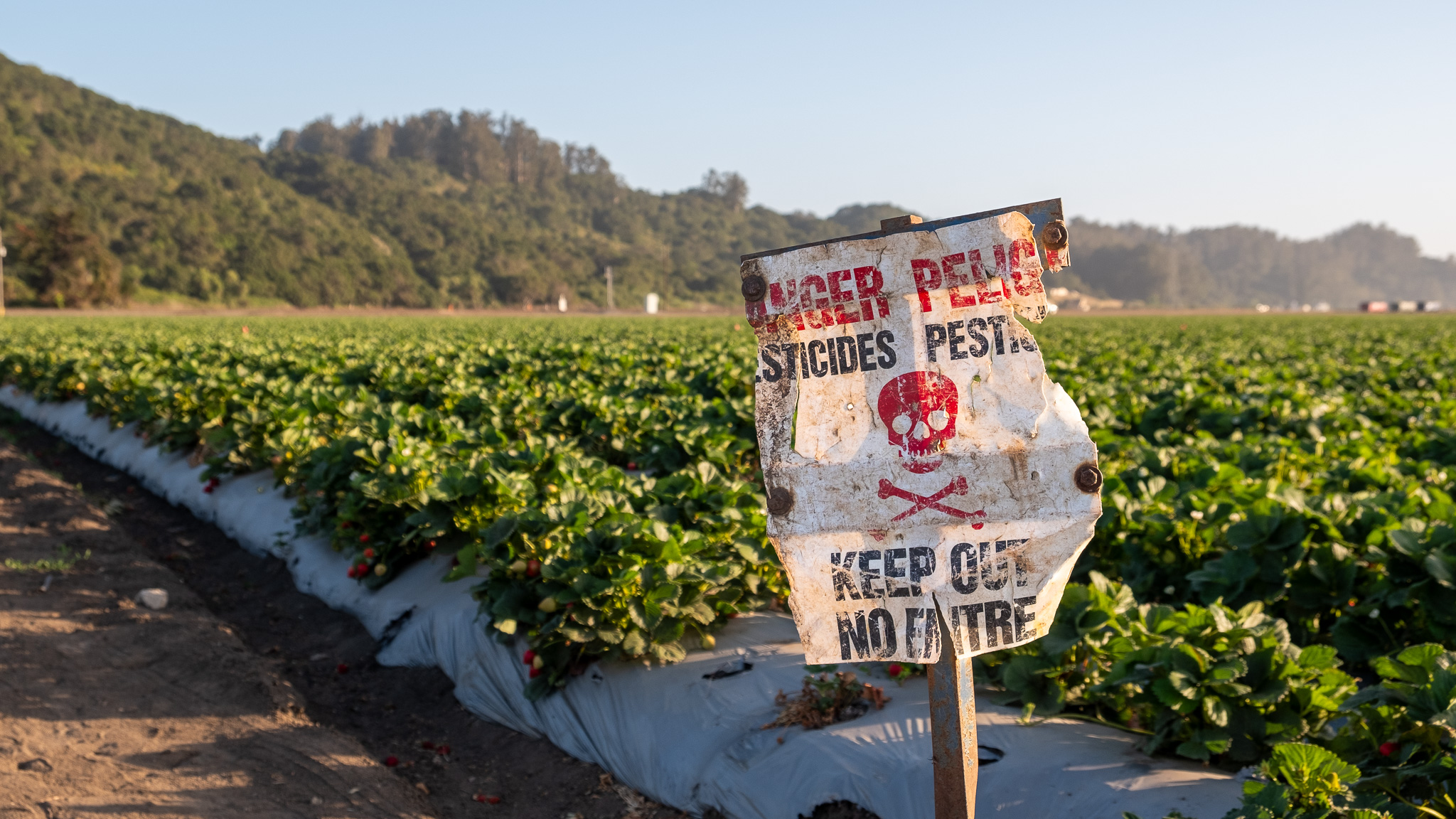
A sign warns to keep out of a strawberry field recently treated with pesticides on San Juan Road near Pajaro on June 13. (Nik Altenberg — Santa Cruz Local)
Pesticide activists have said state regulators should further evaluate the potential health impacts of exposure to many different pesticides, sometimes called a pesticide “cocktail.”
“The ‘cocktail’ is something that I feel like is definitely underplayed by DPR, and is something that, people in our community who come and talk about their pesticide exposures and the harms that they believe are associated with it, it’s the cocktail that they’re talking about. It’s not the individual pesticides,” said Kathleen Kilpatrick, a retired school nurse at Pajaro Valley Unified School District and member of Safe Ag Safe Schools.
Some activists have said state regulators should heed the precautionary principle.
“The precautionary principle just says that if we don’t know the sure effects of something — you don’t use it until you know,” said Katie Bolin, a Santa Cruz County public health nurse. Bolin spoke at a January hearing on proposed regulations for 1,3-D, or 1,3-dichloropropene, a pesticide used in California and banned in more than 30 countries.
1,3-D is from a different class of pesticides: organochlorines, which have been linked with cancer. The U.S. Environmental Protection Agency considers 1,3-D a “probable human carcinogen.” It’s a widely used soil fumigant for strawberries, and according to SprayDays, dozens of applications of the chemical were scheduled in Watsonville in the past two weeks.
SprayDays
How to get new pesticide alerts in Santa Cruz County — March 28, 2025
Farmworkers speak out
For 18-year-old Watsonville native Rocio Ortiz, the danger of pesticides hits close to home. She is a daughter of farmworkers.
“I saw how pesticides affected my family. I saw my dad being rushed to the hospital, my little sister born with asthma, my mom having a miscarriage,” Ortiz said. Ortiz said her father was a pesticide applicator for several years, and had persistent headaches, dizziness and vomiting. One day the symptoms were so severe he went to the hospital, Ortiz said, but doctors couldn’t identify an illness.
Ortiz said in 2022 she was working in the fields with her sister when suddenly a strong, sulfuric smell “like sewage water” enveloped them. Then she saw a green tractor spraying pesticides nearby.
“Everybody just kept working normally. I mean, they would make comments about the smell, but then the mayordomo [foreman] would just tell us ‘Oh yeah they’re just spraying pesticides, but it’s OK, we could continue working,’” Ortiz said.
Francisca López said incidents like that are not uncommon. A farmworker in Watsonville, she aspires to work as a doula to help other Mixteco-speaking farmworkers access maternal health care. She said a lot of women work until their last trimester, potentially putting the pregnancy at risk.
“The pesticide applicator, they work close by. There are some who aren’t as far away as they should be,” López said in Spanish. “Since pregnant women are sometimes close by, that seems dangerous to me for the baby’s health. For example, my sister’s experience — she worked until she was eight months pregnant. Her son is currently very stunted, and even his way of speaking is difficult. He talks like a baby, but he’s already 8 years old. I feel like it’s one of the effects of the pesticides.”
“Everyone deserves to be safe at work.”
—Santa Cruz County Agricultural Commissioner Dave Sanford
One woman, who requested anonymity for fear of retaliation from her employer, told Santa Cruz Local through a Mixteco interpreter that sometimes pesticides have been sprayed very near to where she and others were working. The spray drifted over, she said, hurting her head and burning her eyes, but the supervisor told the workers they are just sensitive.
When asked if she knew how to report a violation, she said other than telling the supervisor or foreman, she didn’t know of any way to report it.
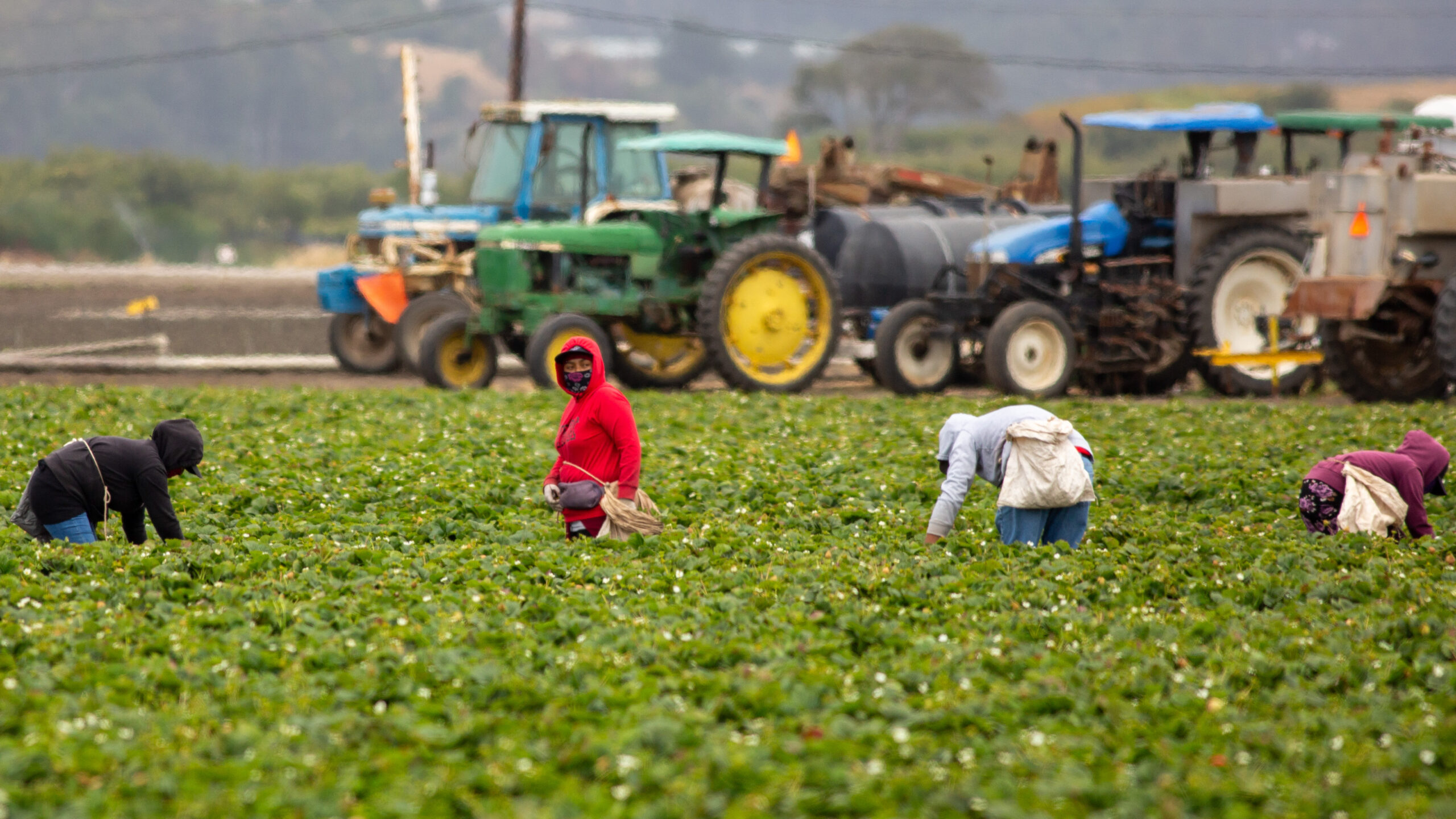
Farmworkers harvest berries off West Beach Street near Watsonville on Thursday. (Amaya Edwards — Santa Cruz Local)
Regulations call for a minimum 100-foot buffer between pesticide applications and workers, and must take into account weather conditions like wind to avoid exposure from pesticides drifting.
Sanford, the county agricultural commissioner, said the department takes such violations seriously, and he wants farmworkers to report incidents. Sanford said of the reports his office gets, it’s usually from clinics or hospitals that have treated someone for pesticide exposure, or from a grower or supervisor.
“We get calls from individual field workers too, but that’s less common,” Sanford said, stressing that he wants people to report any possible pesticide exposure. “Please contact us. You could do it anonymously on the phone, or you can come to us and talk to us and not give a name.”
Santa Cruz County Agricultural Commissioner
- (831) 763-8080
- 500 Westridge Drive, Watsonville
Monterey County Agricultural Commissioner
- Office: (831) 759-7325
- 24 hour hotline: (831) 809-2394
- 1428 Abbott St., Salinas
People can call and leave a voice message in any language, he said, and they will find a way to translate it. “Everyone deserves to be safe at work,” he said.
A safety net with holes
State disability payments are a potential lifeline for pregnant farmworkers to protect themselves and their babies. But the system isn’t working for everyone.
This year, the payments increased to cover up to 90% of wages for low-income workers but some pregnant farmworkers choose to continue working to not miss a paycheck.
Gabriel-Cox, the doctor at Salud Para La Gente, said she discusses pesticide exposure with clients at their first prenatal visit.
“The majority of folks that we see in the clinic stop working in the first trimester,” she said. “There are some people who may not qualify for disability if they’ve arrived recently, and they haven’t had the opportunity to pay into the system so they won’t qualify for disability, or for other economic reasons, they wish to continue working.”
She said farmworkers can seek help to apply for the benefits at the Watsonville Law Center.
If an application goes smoothly, most people get benefits after about six weeks, said Sergio Guzman, a community worker with California Rural Legal Assistance. It offers free assistance for low-income farmworkers if an application is delayed, denied or appealed.
“Unfortunately, they needed the money yesterday,” Guzman said. “Farmworkers live check by check.”
Sometimes applications are appealed because farmworkers didn’t submit the paperwork properly, Guzman said, and they will receive a letter about a hearing with an administrative judge.
“Sometimes they’re afraid to hear that,” Guzman said. “That’s when we explain the process of the hearing. Most of the hearings are by phone and the judge will ask simple questions.”
Watsonville Law Center
- 315 Main St. #207, Watsonville.
- (831) 722-2845
California Rural Legal Assistance
- 21 Carr St., Watsonville.
- (831) 724-2253
Guzman said language access is one of the biggest barriers he sees to resolving issues with farmworkers’ applications. The Employment Development Department offers free interpretive services by appointment for Indigenous languages like Mixteco, Triqui and Zapotec, which many local farmworkers speak.
But Guzman said people have trouble getting someone on the phone who they can communicate with, and the closest office that deals with disability claims is in San José.
“I think having a regional office — that would be very helpful to have bilingual or another language assistance,” Gomez said.
Another barrier, Guzman said, is a lack of awareness on the part of doctors. Some of his clients’ doctors have said they have to keep working until 36 weeks. Farmworkers can qualify for disability as early as the first positive pregnancy test, in part because of the risks of pesticide exposure.
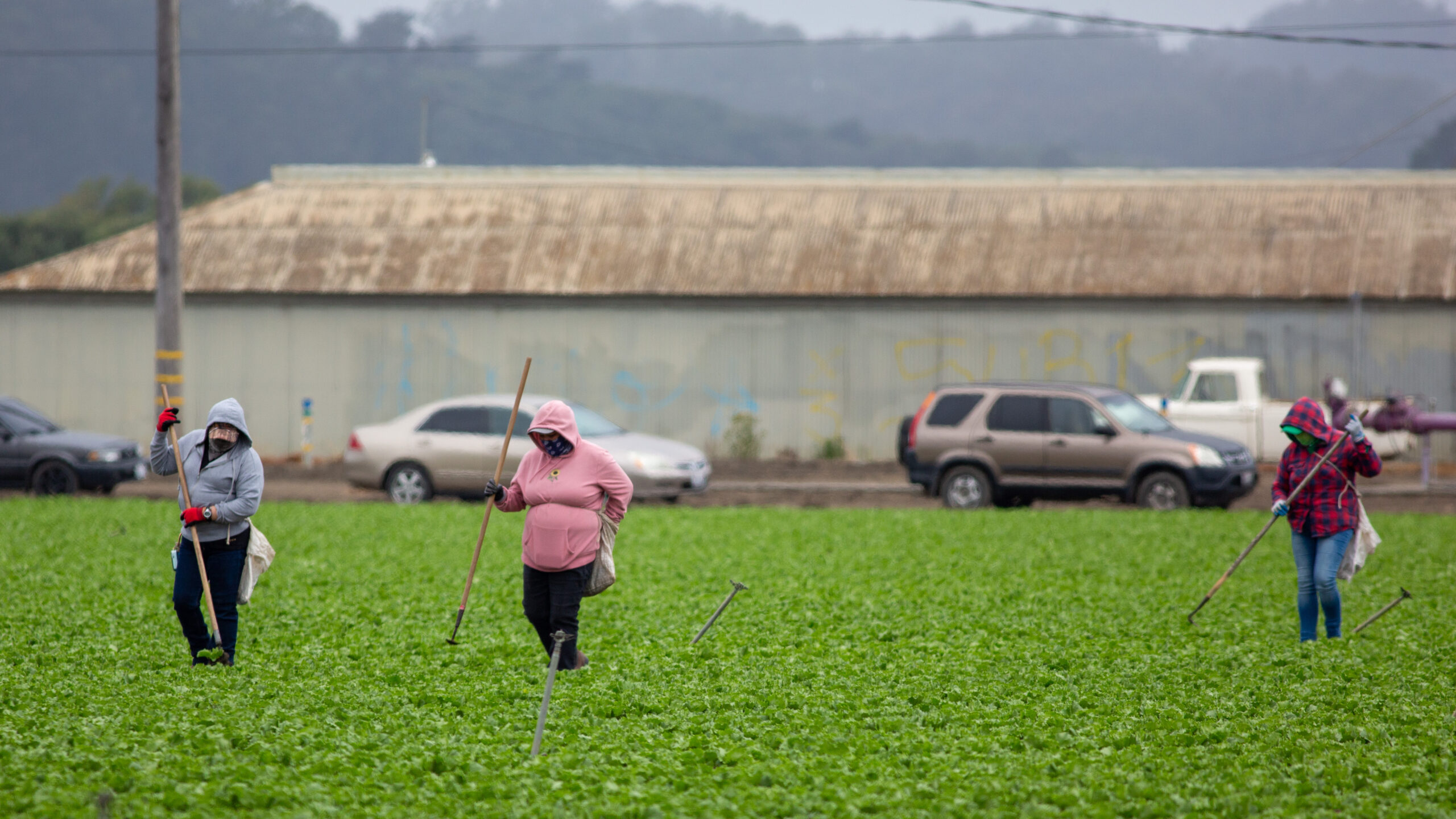
Farmworkers labor in a farm near Holohan Road near Watsonville, on Thursday. (Amaya Edwards — Santa Cruz Local)
For many farmworkers and residents in the Pajaro Valley, the idea that pesticides are harming children is taken as fact.
“A million pounds of toxic pesticides are dumped in the Watsonville area every year, and you can see it in the children. They have all kinds of anomalies — brain cancer, bone cancer, ADHD, autism, learning disabilities,” said Ann Lopez, director of Watsonville-based Center for Farmworker Families.
She called the health harms environmental racism. “People don’t really care, as long as the food keeps coming in.”
Gabriel-Cox, the doctor, is also a board member for the Center for Farmworker Families. She said she has observed a lot more cancer in children and young adults in the Watsonville area than in the Santa Cruz area.
“Everyone thinks, including the farmworkers, ‘It has to be the pesticides.’ And so my question is always, why is the onus on the community to prove that their cancer was related to pesticides?” she asked. “Why isn’t it the agribusiness’ responsibility to prove that it doesn’t cause cancer?”
Solorio, the Watsonville farmworker with four children, said she hopes more growers will transition to organic and forgo the use of pesticides.
“The children that are growing, they are the future,” Solorio said. “They should grow up in a healthy place.”
Are you an employee or owner of a local farm or pesticide business? We want to speak with you. Email [email protected]. To share sensitive information, use HushLine, email [email protected], or reach Nik with username nika.831 on the secure messaging app Signal.
Read more
- New pesticide alerts draw praise, criticism in Santa Cruz County — March 28, 2025
- Pesticides use near schools detailed in Santa Cruz County — April 26, 2024
Santa Cruz Local is funded by members, major donors, sponsors and grants for the general support of our newsroom. Our news judgments are made independently and not on the basis of donor support. Learn more about Santa Cruz Local and how it is funded.

Nik Altenberg is a bilingual reporter and assistant editor at Santa Cruz Local. Nik Altenberg es reportera bilingüe y editora asistente para Santa Cruz Local.