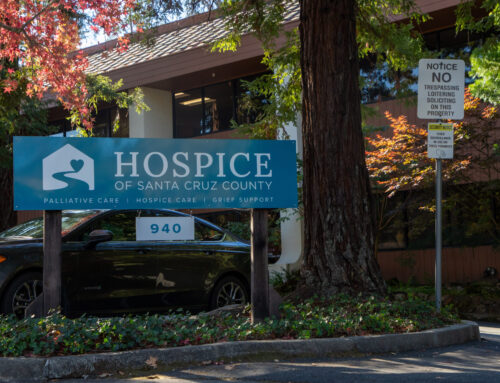

The Santa Cruz County Board of Supervisors on Jan. 27 addressed immigration, veterans services and road conditions. (Stephen Baxter — Santa Cruz Local)
SANTA CRUZ >> The Santa Cruz County Board of Supervisors met Tuesday with a packed agenda, discussing the Veterans Services Office, the county’s preparedness for federal immigration enforcement and the quality of county roads.
Relocating the Veterans Services Office
The supervisors weighed in on a proposal to move the Veterans Services Office from the Human Services Department to the County Executive Office. While they didn’t officially approve a restructuring, they asked County Executive Officer Nicole Coburn to discuss options with the veterans’ office and come back by May with a recommendation.
The move was first proposed and supported by a coalition of veterans who alleged that ineffective management has hamstrung the office and led to longer wait times, insufficient outreach and a lower quality of service for the county’s estimated 7,500 veterans.
Dave Ramos, managing director of the Santa Cruz County Veterans Memorial Building, and Dean Kaufman, former director of the county’s Veterans Service Office, presented the proposed restructuring.
“To be a true leader, you have to meet folks where they are and try to understand their side,” Kaufman said. “The line staff in the Veterans Services Office have not been heard, and the veterans service officer has not had the opportunity to just go out there and serve veterans to date.”
Coburn said they’re looking for third party mediators to help navigate the disagreements between the office and upper management. She added that her office is significantly smaller than the Human Services Department and does not currently have enough staff to take on veterans services.
She requested more time to explore options for how to reorganize the office within the county’s structure and research how the move may impact the budget. While Coburn asked for several months to evaluate the proposal, supervisors were anxious to move forward with a solution.
“The current structure has not been working,” Supervisor Justin Cummings said. “The veterans have been waiting for almost over a year for us to do something on this.”
Preparing for federal immigration enforcement
Local fears around federal immigration enforcement are on the rise, especially following the deaths of Renee Good and Alex Pretti this month in Minneapolis. The board on Tuesday created an ad hoc subcommittee with Supervisors Felipe Hernandez and Monica Martinez, to coordinate the county’s response and protect residents if federal immigration agents increase local activity.
“Right now, preparedness is where we put our values into action,” Martinez said. “The subcommittee’s role is to strengthen coordination inside county government and make sure that we are not reacting in a moment of crisis without a plan.”
U.S. Immigration and Customs Enforcement, or ICE, notified law enforcement in Santa Cruz County of local activity 25 times throughout most of 2025. Agents have been spotted in Santa Cruz, Watsonville, Live Oak and Seascape.
The SHIELD subcommittee — “Safeguard Health, Inclusion, Essential Services, and Local Defense” — will collaborate with local organizations that serve immigrants, such as the Community Action Board of Santa Cruz County and Your Allied Rapid Response for Santa Cruz County.
Those in support of the committee emphasized it needs to produce tangible, urgent actions.
“Process without concrete actions will not protect our communities from these harms. If SHIELD is to be meaningful, it must move quickly from structure to substance,” said Paulina Moreno, director of policy and partnerships for the Community Action Board of Santa Cruz County.
The subcommittee is expected to report back to the board with near-term actions and a possible workplan by March 10.
Crumbling county roads
Supervisors received an update on the quality of the county’s 583 miles of roads. Road quality is rated on a scale of 100 that considers cracks, warping, breakage and other factors, with 100 being a newly paved road.
Santa Cruz County’s roads scored 57 in 2025 — a nine point jump from when the study was last conducted in 2018. But representatives from the county’s Public Works Department said this was due to a change in how the pavement condition was being measured rather than actual improvements.
The county invests about $8.5 million into repaving and patching projects each year. County staff estimate that about $29.5 million is needed to maintain the current quality and that without more investment, overall road quality will continue to deteriorate.
With a tight county budget, supervisors were hesitant to pledge more money to roads. They unanimously approved a request for Coburn to identify potential ways to raise money for road maintenance, and present recommendations at the June budget hearings.
Supervisor Manu Koenig stressed the importance of road repairs and proposed setting aside 10% of the county’s general fund toward maintaining the pavement condition, but that proposal died.
“A prayer is not a plan,” Koenig said. “This is not a problem that will go away.”
Ranking climate resilience projects
To track and measure the county’s work toward its climate goals, county staff unveiled the Climate Resilience Project Inventory. The inventory compiles nearly 100 projects across various departments and creates a clear throughline for how these projects tackle various climate action goals.
It also proposes a criteria to determine project priority, ranking projects based on eight factors: equity, greenhouse gas reduction, feasibility of implementation, funding leverage, project benefits, maintenance and durability, strategic alignment and county authority. Co-benefits are projects that are good for addressing climate change and other things like public health or the economy.
How these criteria are weighted is subject to change, with supervisors making some suggestions at the meeting. The preliminary weighting ranked the county’s vehicle miles traveled mitigation program highest, followed by the California Air Resources Board municipal fleet electrification and workforce accelerator program and a wildfire risk reduction project funded by the Building Resilient Infrastructure and Communities grant.
Supervisors had a few adjustments and questions on how the rankings would work alongside residents’ prioritizations, but were overall supportive of the inventory. Staff plan to come back with an update on the county’s Climate Action and Adaptation Plan, using the inventory, in early 2027.
Questions or comments? Email [email protected]. Santa Cruz Local is supported by members, major donors, sponsors and grants for the general support of our newsroom. Our news judgments are made independently and not on the basis of donor support. Learn more about Santa Cruz Local and how we are funded.

B. Sakura Cannestra is a politics and governance journalist based in San Jose. She previously reported for San José Spotlight and POLITICO California. She graduated from UC Berkeley in 2023 with a Master's of Journalism, where she also got her start as an undergraduate in 2016 covering the university and city of Berkeley for the Daily Californian.