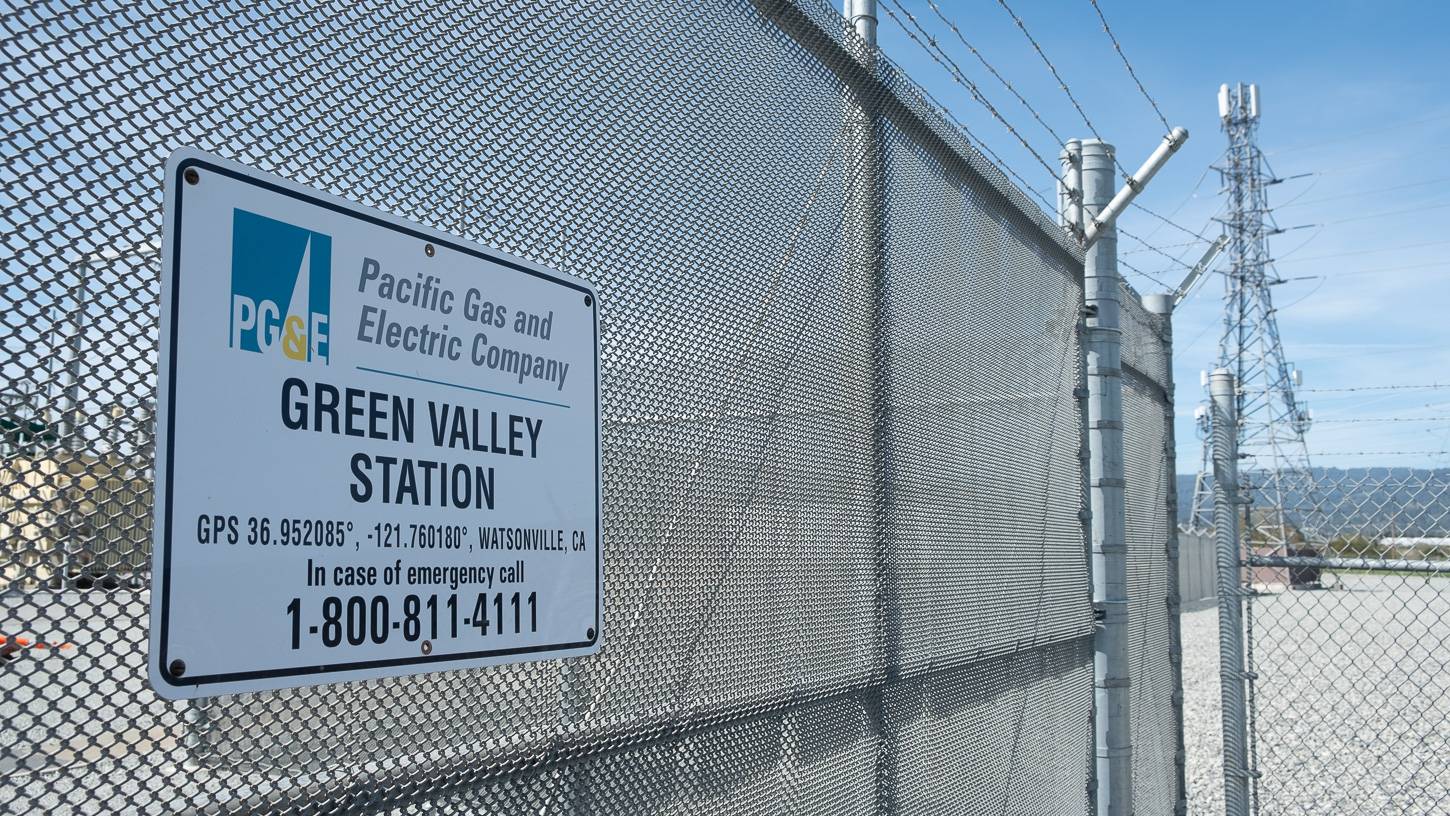
A proposal next to a Pacific Gas and Electric Co. substation near Watsonville for a lithium battery facility could be approved without local input. (Nik Altenberg — Santa Cruz Local file)
SCOTTS VALLEY >> The Santa Cruz County Board of Supervisors gave a thumbs up to revised draft rules for battery energy storage facilities at its Tuesday meeting amid resident dissent.
Now the draft ordinance needs environmental review and approvals from the county Agricultural Policy Advisory Commission and Planning Commission. County staff said they aim to bring the ordinance back to the board for final approval by November.
County leaders began drafting rules to guide the development of battery energy storage systems, or BESS, after New Leaf Energy Inc. submitted plans for a 200 megawatt project in December 2024.
While the Lowell, Mass.-based company is currently seeking approval from the county under these yet to be finalized rules, it could instead apply for permits from the California Energy Commission.
Supervisors are developing the ordinance in part as a bid to maintain local control over the project’s approval.
“If we had the opportunity to eliminate all risk by not approving a project, or making it impossible, I would seriously consider that option — but we don’t,” said Supervisor Manu Koenig.
At a November supervisors meeting, a New Leaf Energy representative said they’re willing to wait for the county’s rulemaking process to continue, but may pivot to seek state approval if the county’s progress on the ordinance slows.
New Leaf Energy Project Developer Max Christian said in an email on Tuesday that the company will review the changes to the draft rules to see if the project “remains viable within the provisions of the ordinance.”
The proposal at 90 Minto Road near Watsonville — dubbed the Seahawk Energy Storage project — initially drew little attention. But after a fire the following month at a battery facility in Moss Landing triggered evacuations and sent a plume of hazardous smoke into the air, the project has received heightened scrutiny from residents concerned about the safety of such facilities.
Santa Cruz County residents were among the thousands impacted, with some reporting symptoms potentially related to the smoke.
Concerned residents speak out
A group of residents who oppose the project, called Ban Lithium BESS Santa Cruz, were among those at Tuesday’s meeting speaking out against the proposal and the draft ordinance.
Shirley Flores Munoz, who grew up in Watsonville, said she and other residents have organized community meetings attended by hundreds of residents who oppose the project.
“Minto Road is very different from Moss Landing, but we have the evidence of Moss Landing, and worse, we’re going to have human damage if something happens there,” Munoz said at the meeting. The Minto Road site is much closer to many more homes than the Moss Landing facility.
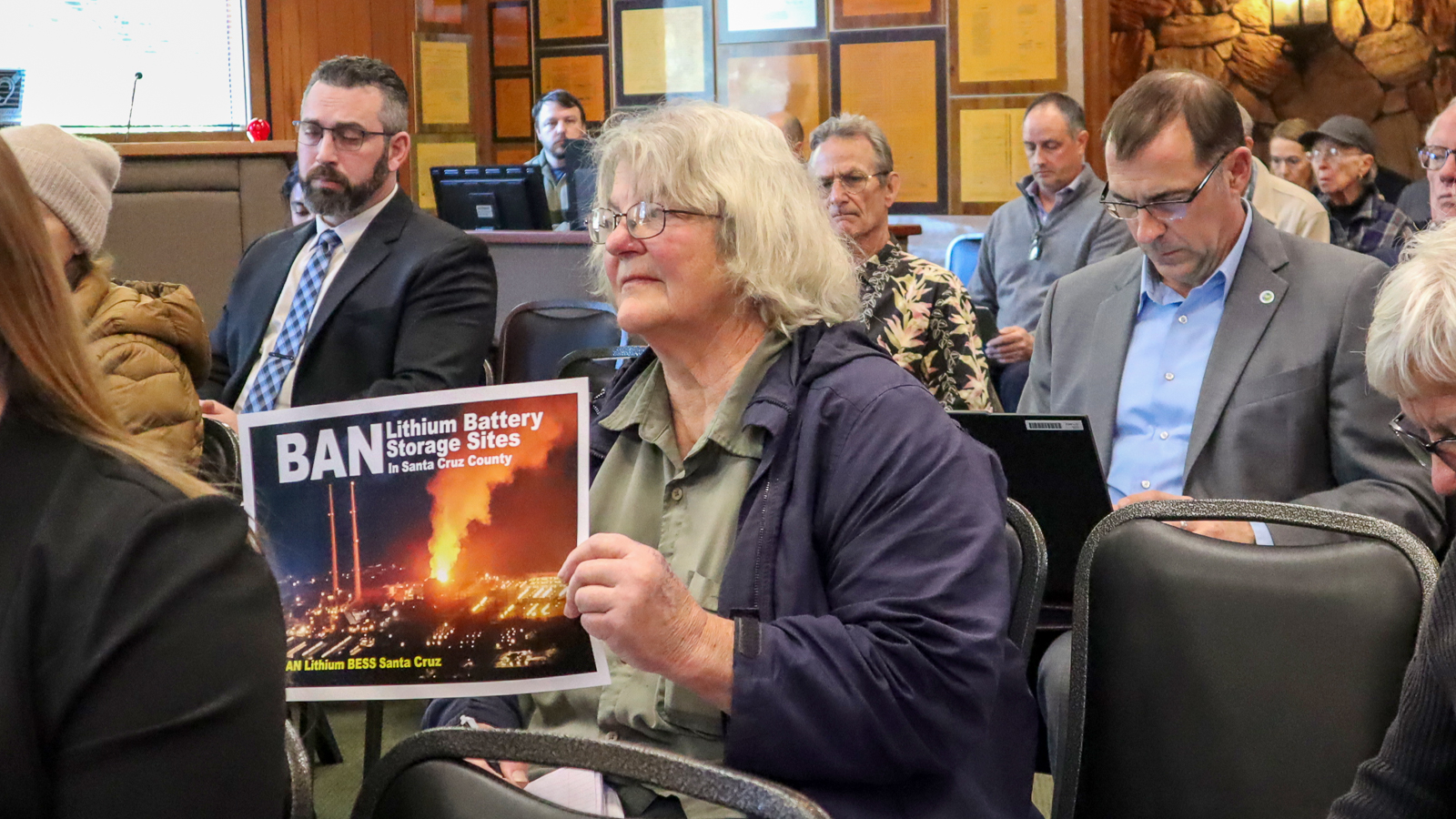
County resident Becky Steinbruner holds a sign reading ‘Ban Lithium Battery Storage Sites in Santa Cruz County.’ Companies could seek state approval for battery storage facilities regardless of local rules. (B. Sakura Cannestra — Santa Cruz Local)
Becky Steinbruner, an opponent of the project, said that it would violate a county law meant to preserve agricultural land. The project would develop about 14 acres of a 37-acre apple orchard. However, county counsel Jason Heath said at the meeting that state law allowing energy storage facilities would supersede local ordinances.
Several people spoke in support of the facility for its importance to storing clean energy for the Central Coast region. Christian, the New Leaf project developer, also tried to quell safety concerns by emphasizing increased protections in newer battery storage technologies.
“As proposed and with the most recent revisions, the draft ordinance exceeds industry standards and it poses stringent protections for both public safety and the environment,” he said at the meeting.
While the draft ordinance was unanimously approved, some supervisors said they’re still wary of the proposed facility. Supervisor Justin Cummings proposed several additions to the ordinance, including:
- To require that any agricultural land set aside by developments be viable and accessible.
- That any ownership change of a battery energy storage facility be approved by the county and the new owner assumes responsibilities of project approval requirements, including decommissioning plans.
- That county staff look for ways to increase the amount of agricultural land protected to offset the loss in agricultural land from the project’s development.
“It’s a pretty challenging decision for us to make and a pretty challenging topic for us to work on, especially given the fact that this is another instance where a lot of local control has been removed by the state,” Cummings said at the meeting, likely referring to state laws that remove local jurisdictions’ power to change or deny some housing projects.
There will be more public hearings and opportunities for public comment about the draft ordinance at the two commission meetings.
Agricultural Policy Advisory Commission meetings are scheduled every other month and agendas are posted on the commission website. Planning Commission meetings are scheduled twice a month.
Questions or comments? Email [email protected]. Santa Cruz Local is supported by members, major donors, sponsors and grants for the general support of our newsroom. Our news judgments are made independently and not on the basis of donor support. Learn more about Santa Cruz Local and how we are funded.

B. Sakura Cannestra is a politics and governance journalist based in San Jose. She previously reported for San José Spotlight and POLITICO California. She graduated from UC Berkeley in 2023 with a Master's of Journalism, where she also got her start as an undergraduate in 2016 covering the university and city of Berkeley for the Daily Californian.