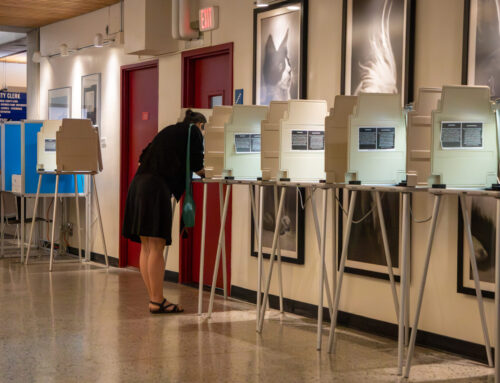
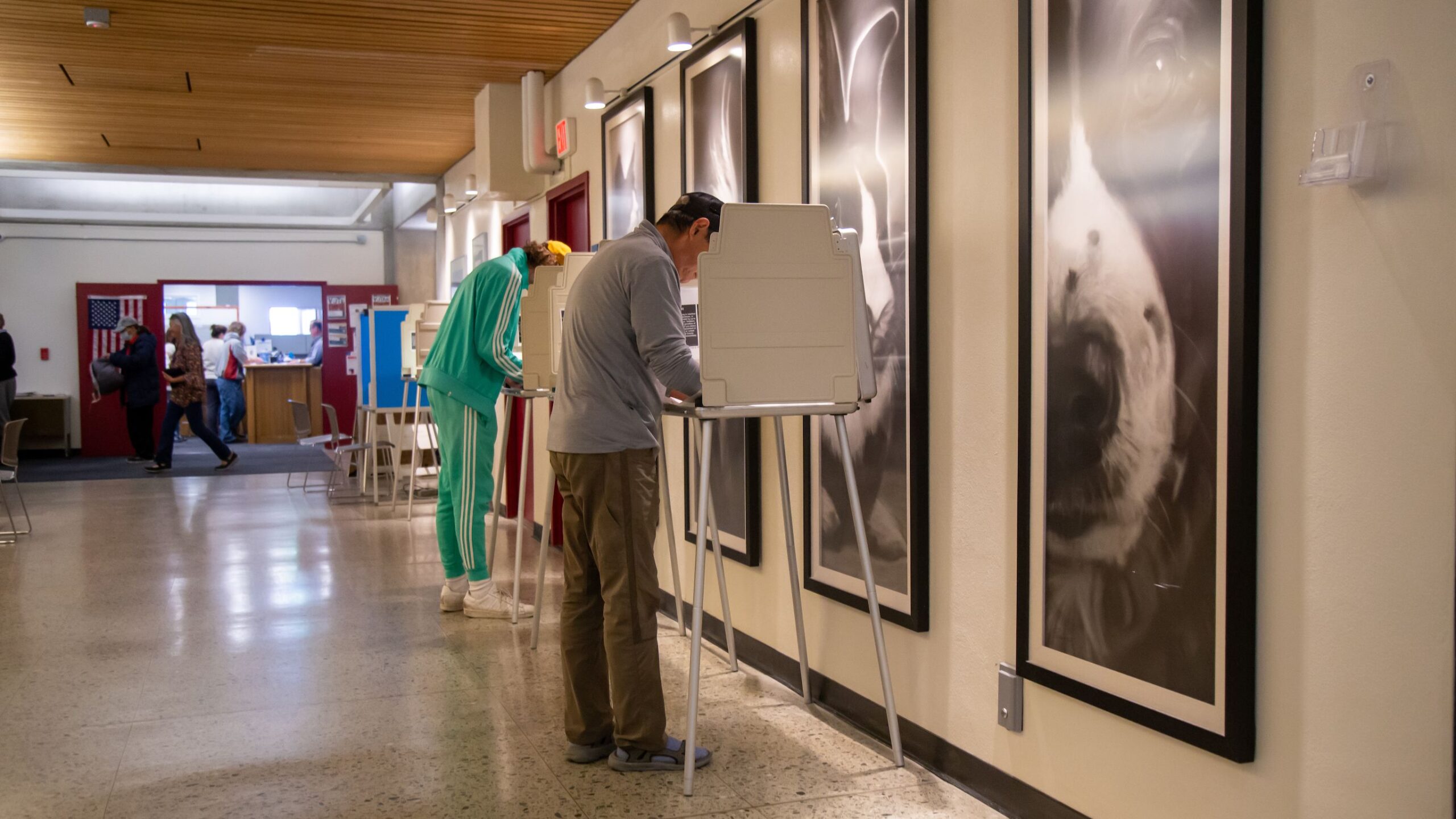
A voter fills out a ballot at the County Building on Ocean Street in Santa Cruz on Nov. 4, 2024. (Allison Garcia — Santa Cruz Local file)
SANTA CRUZ >> On Nov. 4, voters in the City of Santa Cruz will consider Measure C, a property transfer tax and parcel tax to fund affordable housing development and homelessness services. Santa Cruz Local evaluated campaign claims from those advocating for and against the measure.
The following claims were found on the Yes on Measure C website, No on Measure C website, campaign mailers and the Measure C ballot text.
Opponents of Measure C authored an alternative tax initiative, Measure B, but have not yet led an active campaign for that measure.
Read Santa Cruz Local’s Election Guide
Jump to:
- Will Measure C put downward pressure on housing values?
- Will Measure C drive up the cost of housing and push new buyers out of the market?
- Was Measure C drafted by city leaders, contrary to its claims to be a citizen-led measure?
- Did city officials use taxpayer dollars to run polls, develop messaging and coordinate with a political advocacy group?
- Is Measure C open to a lawsuit?
- Would Measure C impose a new parcel tax on nearly every property owner in Santa Cruz, without a senior exemption?
- Would Measure C provide nearly $100 million in funding?
- Santa Cruz Local’s election guide for measures B and C
Will Measure C put downward pressure on housing values?
There is some evidence that higher property transfer taxes can lower property values.
However, most of the peer-reviewed research on this question focuses on Germany, where property transfer taxes in different regions range from 3.5% to 6%. Those rates are much higher than those proposed by Measure C, which is a graduated tax from 0.5% to 2%, and does not apply to properties sold for less than $1.8 million.
There is little peer-reviewed academic research about the effect of transfer taxes on property values in the U.S. A 2017 paper from the University of Michigan found that in Washington D.C., a graduated tax similar to the structure of Measure C caused home prices near the cutoff to drop. For example, a property worth $510,000 that faces a higher tax rate at $500,000 may instead sell for $499,999.
Will Measure C drive up the cost of housing and push new buyers out of the market?
Sellers could increase prices to cover the property transfer tax. However, the tax would apply only to properties worth more than $1.8 million — well beyond the median home price in Santa Cruz, according to online real estate company Zillow.
Was Measure C drafted by city leaders, contrary to its claims to be a citizen-led measure?
The idea for a tax to fund affordable housing began in the city council, but the council did not decide the structure of the tax, the size of the tax, or what specifically it would fund.
The city council began discussions about a tax to raise money for affordable housing in 2023.
Mayor Fred Keeley, who has advocated for the measure and is one of the biggest campaign donors, originally intended for the city council to place a bond measure for affordable housing on the ballot. But he and the rest of the council voted in May 2023 to instead let community groups draft and campaign for the tax.
Housing Santa Cruz County, a coalition of local nonprofits and other housing advocates, unveiled the proposal in January. The campaign collected enough signatures to place it on the Nov. 4 ballot as a citizen initiative. Citizen initiatives need a simple majority, or 50%, to be adopted. A measure placed on the ballot by local government would need two-thirds, or more than 66%, to win.
Did city officials use taxpayer dollars to run polls, develop messaging and coordinate with a political advocacy group?
City officials used public money to run polls on a potential tax measure for affordable housing.
In May 2023, the council approved spending $35,000 on polling, with the intention of allowing community groups, with public participation, to draft and campaign for the tax.
The polling commissioned by the Santa Cruz City Council tested support for multiple “community priorities,” including housing for “nurses, teachers and other essential workers,” for “service workers and other front-line workers” and for veterans, according to a June 2023 council report. The polls found broad public support for a parcel tax and a bond, but did not poll support for a property transfer tax.
It’s debatable whether the polls shaped the messaging of the campaign, or merely indicated the public appetite for a tax. The results were given to Housing Santa Cruz County.
The group invited Keeley, the mayor, to facilitate a series of community meetings over the next two years to work out the structure of the proposed tax. Those meetings included advocates, nonprofits, developers and the Santa Cruz Association of Realtors.
The city council did not draft Measure C or collect signatures. Keeley said he has fundraised for the measure, and contributed $56,000 towards the campaign.
Is Measure C vulnerable to a lawsuit?
The “No on C” campaign – largely sponsored by the Santa Cruz County Association of Realtors – argues that Measure C should be subject to the more than 66% approval required of taxes placed on the ballot by city council, instead of the simple majority required of citizen initiatives.
When the city council commissioned the polls in 2023 and voted to pass off the process to community groups, City Attorney Tony Condotti said the city was on firm legal footing to do so.
“There is nothing in the law that says a city council cannot prepare a measure that a community group can then circulate via petition,” he said in the May 2023 city council meeting. “It is a novel approach, but from a legal perspective, it appears to be doable.”
California does not have explicit laws around local governments “handing off” ballot measures to community groups to gather signatures. According to a judge’s opinion in a 2009 lawsuit against the City of Salinas, local governments cannot use public money to produce campaign materials for a citizen initiative, but can produce informational materials.
A lawsuit around the Santa Cruz City Council’s involvement could argue that the polling shaped the messaging and campaign materials for the measure, and did not merely gauge public interest for a tax.
On Oct. 7, Condotti sent city council members a memo that cited case law, including a recent decision in a lawsuit against the city of San Diego, as evidence that the city would prevail in a lawsuit challenging Measure C. In that lawsuit, a judge ruled that an elected official’s involvement in crafting or promoting a citizen ballot measure does not disqualify it from being a citizen’s initiative.
Even if city leaders have followed the law in this case, they could still face a suit if the measure is adopted. The city is already involved in a lawsuit with the American Beverage Association over a soda tax approved by voters in November 2024.
As in that race, the question of whether the tax could face a legal challenge would likely depend on whether the groups funding the opposition campaign decide to sue. A lawsuit is “an option we are keeping on the table,” said Victor Gomez, Government Affairs Director for the Santa Cruz County Association of Realtors.
Would Measure C impose a new parcel tax on nearly every property owner in Santa Cruz, without a senior exemption?
Seniors aged 65 and older who earn up to 80% of the area median income ($74,360 for a single person in 2025) are exempt from the proposed $96 parcel tax. So are other homeowning households earning up to 60% of the area median income. Schools, churches and 100% below-market-rate housing developments are also exempt.
In the city’s impartial financial analysis of Measure C, Cabell, the city finance director, used census data to estimate that about 7% of the approximately 16,800 parcels in the city of Santa Cruz would be exempt from the parcel tax. The estimate isn’t exact, she said, because the city doesn’t have demographic data on property owners specifically.
Would Measure C provide nearly $100 million in funding?
The ballot question for Measure C says it will raise $4.5 million annually, which amounts to $90 million over its 20-year lifespan. But an analysis from Santa Cruz finance director Elizabeth Cabell found otherwise.
Cabell’s analysis estimates Measure C would raise $2.5 million annually, or about $50 million over 20 years. Her estimate takes into account homeowners and property transactions potentially exempt from the tax.
It is a conservative estimate, she wrote in an Oct. 3 email, based on demographic data on age and income. The exact income from Measure C can’t be known until after the tax is active, and would vary year-to-year according to the number of property sales.
Read Santa Cruz Local’s Election Guide
Questions or comments? Email [email protected]. Santa Cruz Local is supported by members, major donors, sponsors and grants for the general support of our newsroom. Our news judgments are made independently and not on the basis of donor support. Learn more about Santa Cruz Local and how we are funded.

Jesse Kathan is a staff reporter for Santa Cruz Local. They hold a master's degree in science communications from UC Santa Cruz.