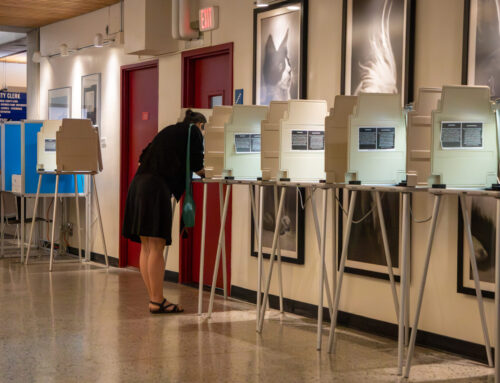

Manny Nevarez, chair of the Santa Cruz County Latino Affairs Commission, poses for a portrait on Thursday, Sept. 18, 2025. He asked that his face not be shown out of safety concerns. (Amaya Edwards — Santa Cruz Local/CatchLight Local)
SANTA CRUZ >> Watsonville, the City of Santa Cruz and Santa Cruz County all have pledged support of immigrant residents.
But for some advocates, current policies don’t go far enough. Members of the Santa Cruz County Immigration Coalition, a collective of nonprofits and other groups, are asking leaders for three additional policies they say would strengthen the cities’ commitments to immigrant rights.
The three laws, each based on legislation adopted or proposed elsewhere in the country, would ban masks for law enforcement, prohibit investment in detention centers and restrict the collection of sensitive data that could be used for immigration enforcement.
Manny Nevarez, chair of the Santa Cruz County Latino Affairs Commission and member of the immigration coalition, is leading the effort to advance the policies by lobbying members of the Santa Cruz County Board of Supervisors and the Santa Cruz and Watsonville city councils.
Nevarez and E, an advocate with San José-based nonprofit Human Agenda, met with Santa Cruz Mayor Fred Keeley on Sept. 10 for the first of what they expect will be months of meetings to work out the details of the proposed policies and determine which Keeley would support. E requested to be identified by his first initial only because of his immigration status.
Local lawmakers have a responsibility to use what power they have to protect immigrants, said E.
“The city cannot act on federal policies,” he said, “but what we can do is act locally and push for ordinances that protect all citizens, regardless of documentation.”
Ban on face masks for law enforcement
California lawmakers passed two bills on Sept. 11 that would prohibit law enforcement from wearing masks and order law enforcement officers to identify themselves. The bills await Gov. Gavin Newsom’s approval.
Both laws have some exceptions, including for undercover or tactical operations, and both apply to local, state and federal law enforcement. But it remains unclear whether federal agencies would be legally bound by California law.
In July, Newsom told The Tennessee Holler he was still determining whether the mask ban is constitutional, but said “it appears that we don’t have the legal authority for federal agents.” Erwin Chemerinsky, dean of the UC Berkeley School of Law, wrote in a Sacramento Bee opinion article that the mask law could extend to federal officers.
Local governments in California have considered similar rules. TheLos Angeles County Board of Supervisors in July ordered county attorneys to draft a law to ban masks for law enforcement officers. The proposed law has not yet returned to the board for a vote.
City council members for Downey, in Los Angeles County, considered a mask ban for law enforcement but decided in July not to vote on it over concerns it would be unenforceable for federal agents.
Get immigration legal help
- Experts recommend to only work with a qualified nonprofit organization or a private attorney recommended by a nonprofit. See a list of nonprofits and recommended private attorneys from Santa Cruz County.
- Notarios, or notaries, are not legally able to handle immigration cases.
- Read more at Santa Cruz Local’s immigration resource page.
Data sharing
Local advocates have sought to end city contracts for license plate cameras in Santa Cruz, Watsonville and Capitola. The cameras are leased from the Georgia-based surveillance company Flock Safety, which has faced backlash amid reports that its data has been illegally used by federal agencies.
Santa Cruz Police Chief Bernie Escalante and Watsonville Interim Police Chief David Rodriguez have advocated for the contracts, and said the camera data has helped solve serious crimes.
A proposed ordinance would ban contracts with Flock and any company that collects sensitive information without residents’ consent. Contractors and city departments would be required to submit annual reports on their data sharing policies.
The local rules could be modeled off a law approved July 7 in Huntington Park, in south Los Angeles County.
“I would argue that if you are knowingly contracting with an agency or with a company like Flock, which is actively violating sanctuary policies, then that means, by extension, the city is violating their own sanctuary policy,” Nevarez said in the meeting with Keeley.
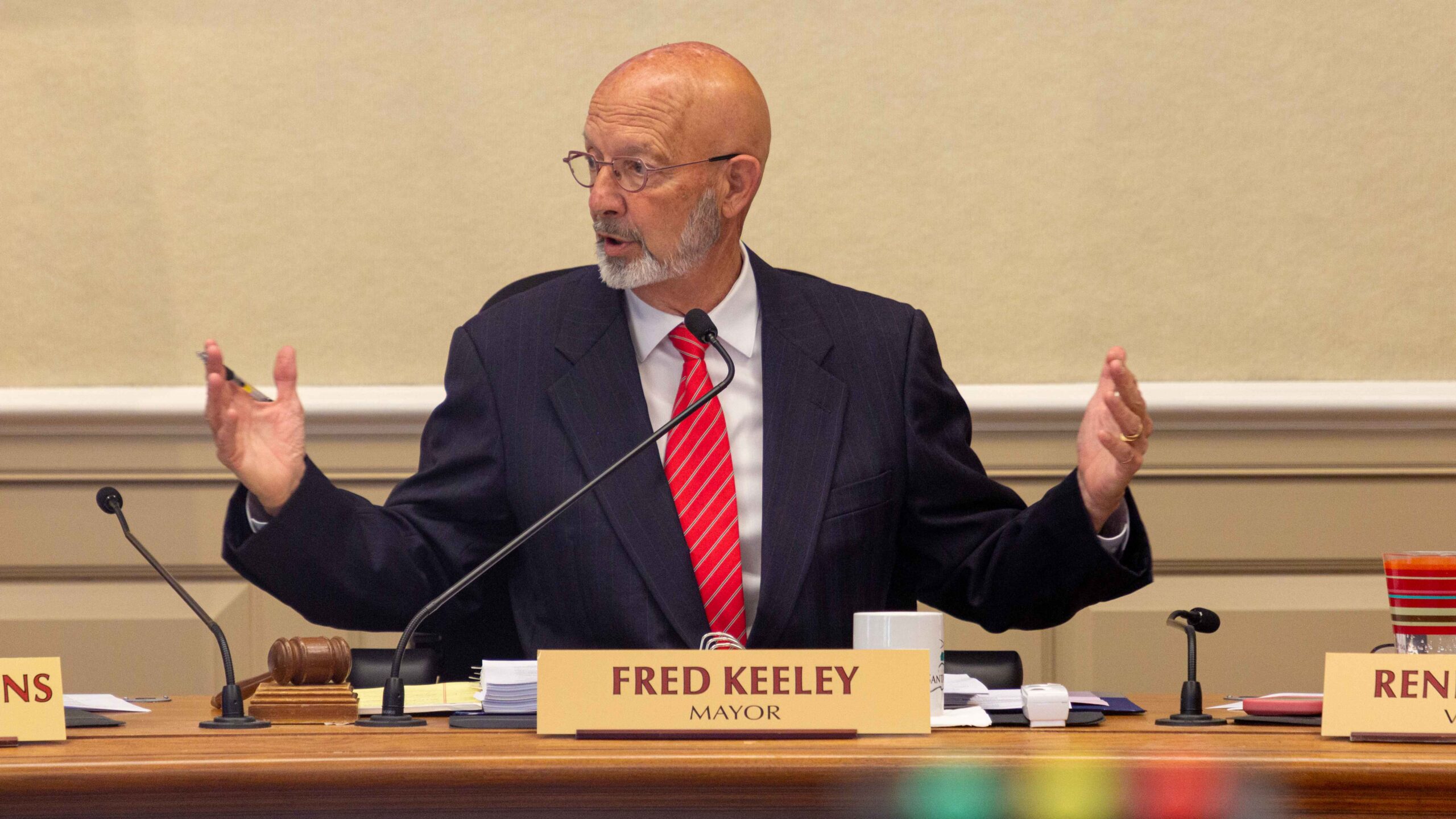
Santa Cruz Mayor Fred Keeley met with advocates on Sept. 10 for the first of many meetings to discuss new policies related to immigration. (Marcello Hutchinson-Trujillo — Santa Cruz Local)
Divestment
On Aug. 5, the Medford City Council in Medford, Mass. approved a sweeping law that in part aims to withdraw city investments in companies involved in federal immigration enforcement, such as those that run immigration detention centers or charter deportation flights.
Nevarez and other members of the immigration coalition want to bring a similar law to Santa Cruz. Like the Medford law, their proposal would also limit investments in companies that extract fossil fuels or manufacture weapons.
To oversee city investments and ensure they meet the proposed standards, Nevarez proposed that Santa Cruz create a treasury oversight commission similar to one for Santa Cruz County.
The City of Santa Cruz’s existing investment policy stipulates that it is the city’s “objective to disallow investments in companies whose industry is classified as energy services, oil and gas producers, and refiners and pipelines” and that when possible, the city invests in renewable energy “and other socially responsible investments.”
Investment policies in Watsonville, Santa Cruz County, Capitola and Scotts Valley do not advise against investments in fossil fuel production or other industries.
Next steps
Nevarez plans to work with Keeley and other local elected officials over the coming months to fine-tune the three proposed laws and hopefully bring them to a vote at Watsonville and Santa Cruz city councils and the Santa Cruz County Board of Supervisors.
Keeley, at the conclusion of the Sept. 10 meeting, said he was open to examining the model laws and would consider if versions of them could be useful for Santa Cruz. But he cautioned that shaping the proposed laws could be a lengthy process as he consults other groups, including the Santa Cruz Police Department.
When writing laws, Keeley said, “make sure you get it right, rather than you get it fast.”
Following the meeting, Nevarez said he appreciated Keeley’s openness to the ideas, but “it did feel like we were being slapped with bureaucracy.” He added, “I understand we have to slow down to get it right, but the urgency for this issue is very high.”
Santa Cruz Local will continue to follow this story.
Support Santa Cruz County asylum-seekers
- The Welcoming Network is looking for volunteers to accompany asylum-seekers to appointments, help distribute food and otherwise support asylum-seekers. They are also looking for people to host asylum-seekers in their home, or offer a home for free or below-market rent.
- The Community Foundation of Santa Cruz County has a fund that collects donations to distribute to nonprofits working with immigrants, including the Community Action Board, Catholic Charities, and Community Bridges. The welcoming network also accepts donations.
Questions or comments? Email [email protected]. Santa Cruz Local is supported by members, major donors, sponsors and grants for the general support of our newsroom. Our news judgments are made independently and not on the basis of donor support. Learn more about Santa Cruz Local and how we are funded.

Jesse Kathan is a staff reporter for Santa Cruz Local. They hold a master's degree in science communications from UC Santa Cruz.