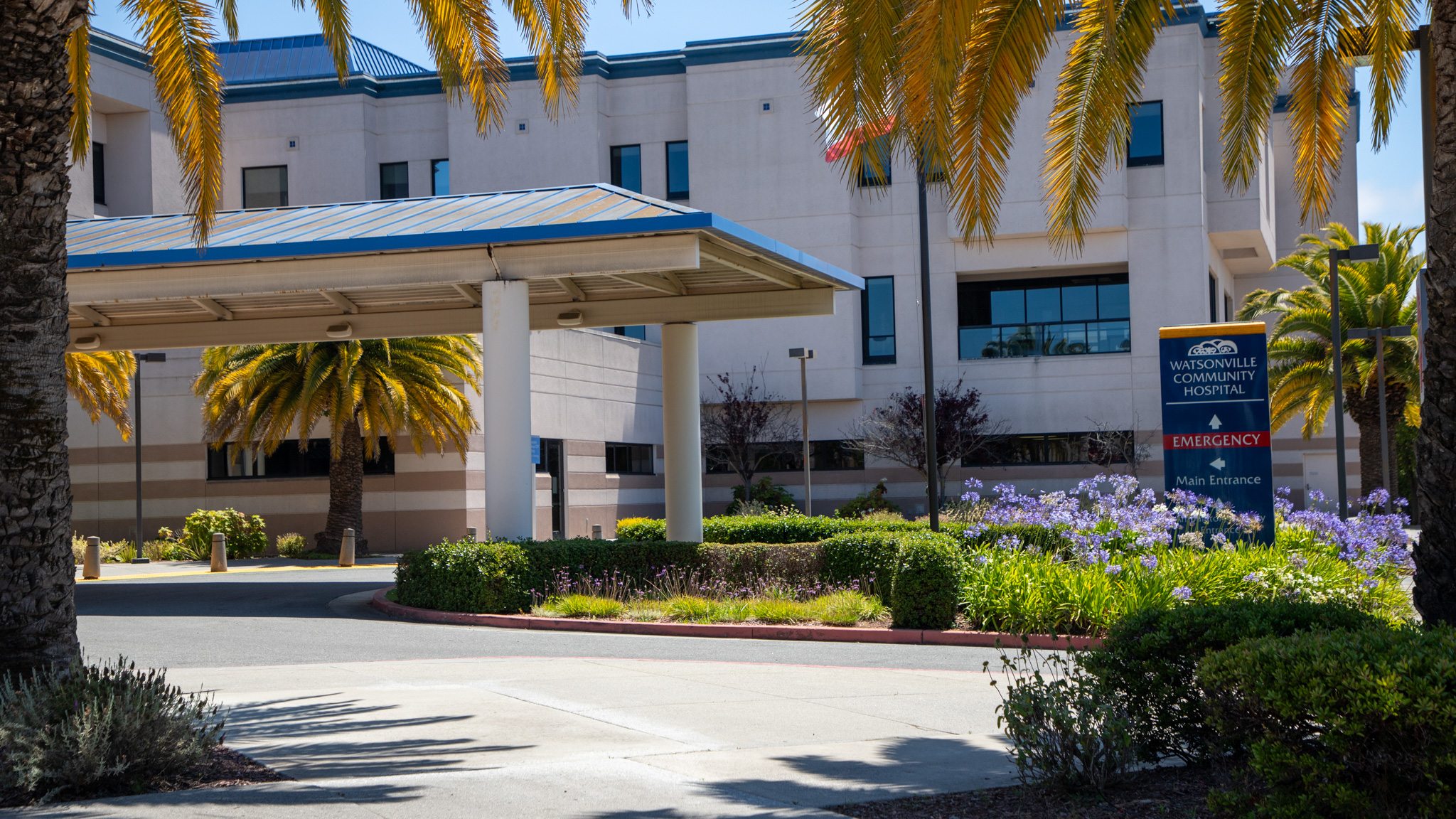
Federal Medicaid cuts could hamper Watsonville Community Hospital’s ability to break even and serve more residents in Santa Cruz and Monterey counties. (Amaya Edwards — Santa Cruz Local)
WATSONVILLE >> Three years after the Pajaro Valley Health Care District saved Watsonville Community Hospital from closure, the hospital’s finances have been on an upward track. But recent federal cuts to Medicaid could upend that progress and leave thousands of Pajaro Valley residents without health insurance.
“We’re already running on pretty razor-thin margins, and we’re not alone in the state,” Watsonville Community Hospital CEO Stephen Gray said in an interview. He said the hospital is working on models to determine how much money they could lose with changes in Medicaid eligibility that start in 2026.
The One Big Beautiful Bill Act, signed into law July 4, cuts hundreds of billions of dollars for Medicaid health insurance over the next decade. Thousands of Santa Cruz County residents could be kicked off Medi-Cal, California’s version of Medicaid, and leave Watsonville hospital with bills when uninsured patients receive emergency care.
Medicaid provides health insurance for residents with the lowest incomes.
“It’s pretty frustrating,” Gray said. “When you think you’re making some progress, and then there’s some significant headwinds that are making that progress harder, or at least more unsure or uncertain.”
About 85% of Watsonville Community Hospital’s patients have government-sponsored health insurance, and the hospital gets about half of its patient income from Medi-Cal. Already, government reimbursements for Medi-Cal services do not cover the costs of medical care, Gray said.
Watsonville resident Mario Villalobos has been accompanying his wife Marisela to Watsonville Community Hospital for two months to treat her eye condition. He said Friday that he would have few other options for specialty care if the hospital closed.
“It helps all the time, and it’s very important for us,” he said in Spanish. “I hope that it does not close,” he said of the hospital.
If uninsured people don’t seek medical care, the hospital makes less money. When uninsured people seek care, it’s often in the emergency department, where “we are either going to ask them to pay out of pocket or not be able to recover those costs,” said Tony Nuñez, chair of the Pajaro Valley Health Care District board of directors.
Watsonville hospital’s emergency department is visited about 35,000 times annually. If it closed, Dominican Hospital in Live Oak and Natividad Hospital in Salinas could not accommodate the added demand, said Pajaro Valley Health Care District chair Tony Nuñez.
“We have to make this work,” Nuñez said.
Another problem is that Watsonville Community Hospital was left out of a rural health care fund that was meant to cushion the blow from Medicaid cuts in the federal megabill.
The hospital serves a largely rural population, including the agricultural areas of south Santa Cruz County and the Pajaro Valley. Like many hospitals in rural communities, it has more patients on Medi-Cal and Medicaid.
In 2023, 47% of Watsonville hospital’s payments for patient care came from Medi-Cal, compared with the state average of 32%.
But legally, the hospital isn’t considered a rural hospital and won’t be eligible for the rural health care fund. “We get the worst of both worlds,” said Nuñez.
From bankruptcy to public ownership
So far, the hospital is doing well financially, said UC Berkeley health economist William Dow, transforming tens of millions of dollars of deficits under the previous owner to just shy of break-even last year.
“That’s definitely in the sustainable range, and the trajectory is good,” Dow said. “But the real concern is, what happens if a substantial portion of their patient population loses their insurance and then their uncompensated care costs go up substantially?”
The hospital has brought in $7 million less than projected in the budget as of May, mostly because of fewer hospital admissions and procedures than anticipated, hospital Chief Financial Officer Julie Peterson said at a June 25 meeting of the Watsonville Community Hospital Board of Directors.
In 2021, the 106-bed hospital fell into bankruptcy under a private owner. In 2022, a new public agency, Pajaro Valley Health Care District, was created to fundraise and keep the hospital from closing. Health care districts are a form of local government that operate independently of city or county governments.
With money from Santa Cruz and Monterey counties, the state, the City of Watsonville and private donors, the health care district bought the hospital operations to run as a nonprofit. In March 2024, voters in the hospital district approved a property tax to pay for $116 million in bonds. The district used the money to buy the hospital land and helped save millions of dollars in rent and insurance.
Momentum toward solvency stalled in October 2024 when a cyberattack locked the hospital out of receiving insurance payments for three months. The next month, Donald Trump was elected president and the hospital administration braced for promised federal cuts to health care.
Fragile progress
Nuñez, the Pajaro Valley Health Care District chair, said he “remains bullish” on the hospital’s future.
Next week, doctors are scheduled to perform the hospital’s first heart catheterization, a specialized procedure that could draw more patients with private insurance. Hospital leaders have purchased state-of-the-art MRI and CT machines to do the same.
The hospital is also looking into new relationships with private insurers, nearby hospitals and the Santa Cruz County and Monterey County governments, Nuñez said.
Though the state of California is unlikely to backfill federal cuts to Medi-Cal, Dow said, county governments could contribute their own money towards health care for residents who don’t qualify for health insurance.
Since 2018, Santa Cruz County has offered MediCruz, a managed health care plan to pay for specialized care for people who cannot otherwise get health insurance. Patients are referred by clinic staff.
The service currently has 15 enrollees. In a response to a question about the potential for expanding the MediCruz program, Health Services Agency Interim Director Jennifer Herrera wrote that staff are “in the early stages of assessing the MediCruz program and are engaging community partners to identify opportunities.”
Thousands in Santa Cruz County could lose health insurance
Medi-Cal cuts are expected to hit people without legal immigration status first, and eventually affect a broad swath of Santa Cruz County residents.
Before the federal cuts were adopted, California announced that starting in January 2026, the state would not accept new Medi-Cal applications for undocumented adults older than 19. The state, not the federal government, pays for Medi-Cal for unauthorized immigrants.
The threat of future health care cuts comes as many immigrants in Santa Cruz County are already avoiding medical care because of a nationwide increase in immigration arrests and deportations.
Judith, a Watsonville resident, said she relies on Watsonville Community Hospital because she doesn’t have a car. She doesn’t have legal immigration status, and worries about losing Medi-Cal. But many members of her family have already effectively lost access to medical care because they worry about immigration enforcement, she said.
“They’re not coming to the hospital, even if they have pain,” she said in Spanish. “There’s a lot of fear.”
As of April, about 7,800 people the state considers to have “unsatisfactory immigration status” are on Medi-Cal in Santa Cruz County, said Adam Spickler, senior analyst for the county’s Human Services Department.
That includes some legal residents, such as asylum-seekers and people with temporary legal residence, who now receive federal-funded Medicaid. Starting in October 2026, those legal residents will be eligible only for emergency health coverage.
The federal cuts could also remove health care from a broad swath of other Santa Cruz County residents.
Beginning Dec. 31, 2026, many Medi-Cal recipients must prove they work, go to school or volunteer at least 80 hours a month. People with informal employment, like day laborers, may have trouble proving that they meet that requirement, said Dow, the health economist.
The cuts are set to roll out over the next four years, he said, and some of them could be reversed by a future Congress.
Santa Cruz County staff are working on estimates for how many people may lose their health insurance with the approved changes, said Spickler.
“I think about the people that are going to be negatively impacted by this, and I think that’s my biggest concern right now,” said Nuñez. “This didn’t have to happen.”
Read more
- How pesticides endanger pregnant farmworkers in Pajaro Valley — July 8, 2025
- Adopted Watsonville budget to finish Ramsay Park upgrades – June 27, 2025
- Watsonville hospital moves closer to acquisition – July 20, 2022
Questions or comments? Email [email protected]. Santa Cruz Local is supported by members, major donors, sponsors and grants for the general support of our newsroom. Our news judgments are made independently and not on the basis of donor support. Learn more about Santa Cruz Local and how we are funded.

Jesse Kathan is a staff reporter for Santa Cruz Local. They hold a master's degree in science communications from UC Santa Cruz.