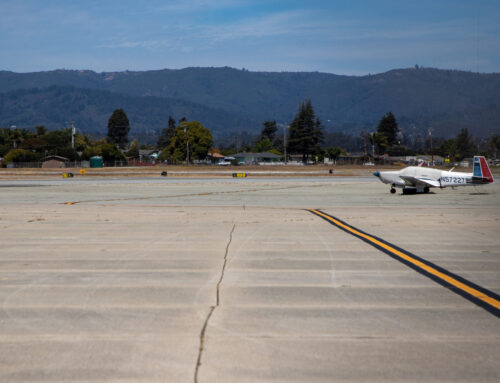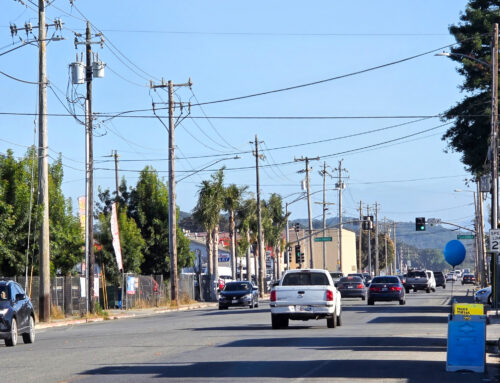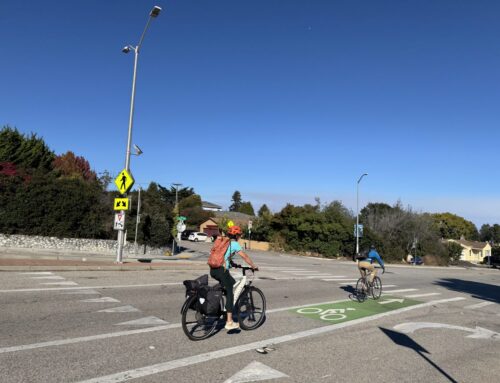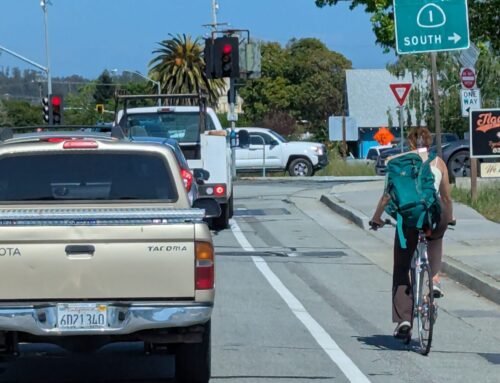

Segment 7 of the rail trail preserves the tracks and runs from Depot Park to Westside Santa Cruz. The final part of the segment finished construction in 2025. (Nik Altenberg — Santa Cruz Local file)
SANTA CRUZ >> A year ago, an effort to build a stretch of the Coastal Rail Trail from Seabright to Aptos was at a crisis point. Millions of dollars over budget, staff suggested saving money by building the trail on the tracks, instead of beside it. The idea was fiercely opposed by advocates of passenger rail, who wanted the tracks to stay in place. The deadlock threatened to severely delay the project and risk state grant money.
Last December, Santa Cruz Mayor Fred Keeley and Santa Cruz County Supervisor Manu Koenig united to advance a “peace plan” for a trail atop the tracks through mid-county. But it sidestepped the politically untenable process of railbanking, a federal process normally used to build a trail on an unused rail line.
Nearly a year later, the peace plan is in limbo. Federal regulators have indefinitely postponed a decision on a request to reclassify the tracks as an inactive rail line — the first step towards carrying out the compromise. Local rail advocates are asking regulators to deny the reclassification on the grounds that it could lead to a permanent end to rail service along the corridor.
The federal case has become the latest battleground for a long-running conflict over the future of the rail corridor, and the latest obstacle in a years-long effort to start building the mid-county portion of the trail, between Seabright and Aptos. County staff have said the delay could again endanger the state grant money, putting the entire project at risk.
‘Peace plan’
Initial designs in 2022 for segments of the rail trail between Santa Cruz and Aptos included two possibilities: an “interim” trail in place of existing tracks — to be replaced if plans for passenger rail service came to fruition in the future — and an “ultimate” trail beside the tracks that would allow both a train and a trail.
In 2023, the Santa Cruz City Council, in charge of Segments 8 and 9 from the Westside to Live Oak, voted to pursue the ultimate trail. In 2024, the Santa Cruz County Board of Supervisors, in charge of Segments 10 and 11 from Live Oak to Aptos, voted the same. The estimated cost for both projects was $43 million over budget, so supervisors ordered a cost-saving redesign.
But by 2025, costs for the project had ballooned further, and the commission risked losing $68 million in state grants if the project was delayed again. Commissioners voted to fill a $72 million shortfall by carrying out the peace plan and pursuing the less-costly interim trail.
Crucially, the so-called “peace plan” put forward by Keeley and Koenig did not include railbanking, a federal process that would allow removal of the train tracks. Rail advocates have strongly opposed railbanking on the grounds that it would harm efforts to build passenger rail on the line.
The polarizing debate has really not moved forward an actual, real, truthful conversation.
—Mikey Cohen, board president of Bike Santa Cruz County
In early 2026, commission staff said they could build the interim trail without railbanking. This week, Executive Director Sarah Christensen said that the plan is to reclassify the rail line as discontinued, and build the trail on the railway without railbanking.
Discontinuance
Most of the rail has not seen traffic in years, but it is still federally classified as part of an active freight line. The first step in allowing the interim trail requires changing that.
On June 15, the freight carrier, St. Paul & Pacific Railroad Company, filed with the Surface Transportation Board to issue a discontinuance for most of the Santa Cruz Branch Rail Line. Once the line is discontinued, an entity affiliated with the transportation commission could take over from St. Paul & Pacific as the rail carrier, Christensen said.
(Chicago, Rock Island & Pacific Railroad, LLC, filed to replace St. Paul & Pacific as the carrier for a 2.5-mile portion of the line near Watsonville that is actively used for freight.)
Multiple people wrote to the Surface Transportation Board opposing the discontinuance, including former heads of the Regional Transportation Commission Linda Wilshusen and George Dondero.
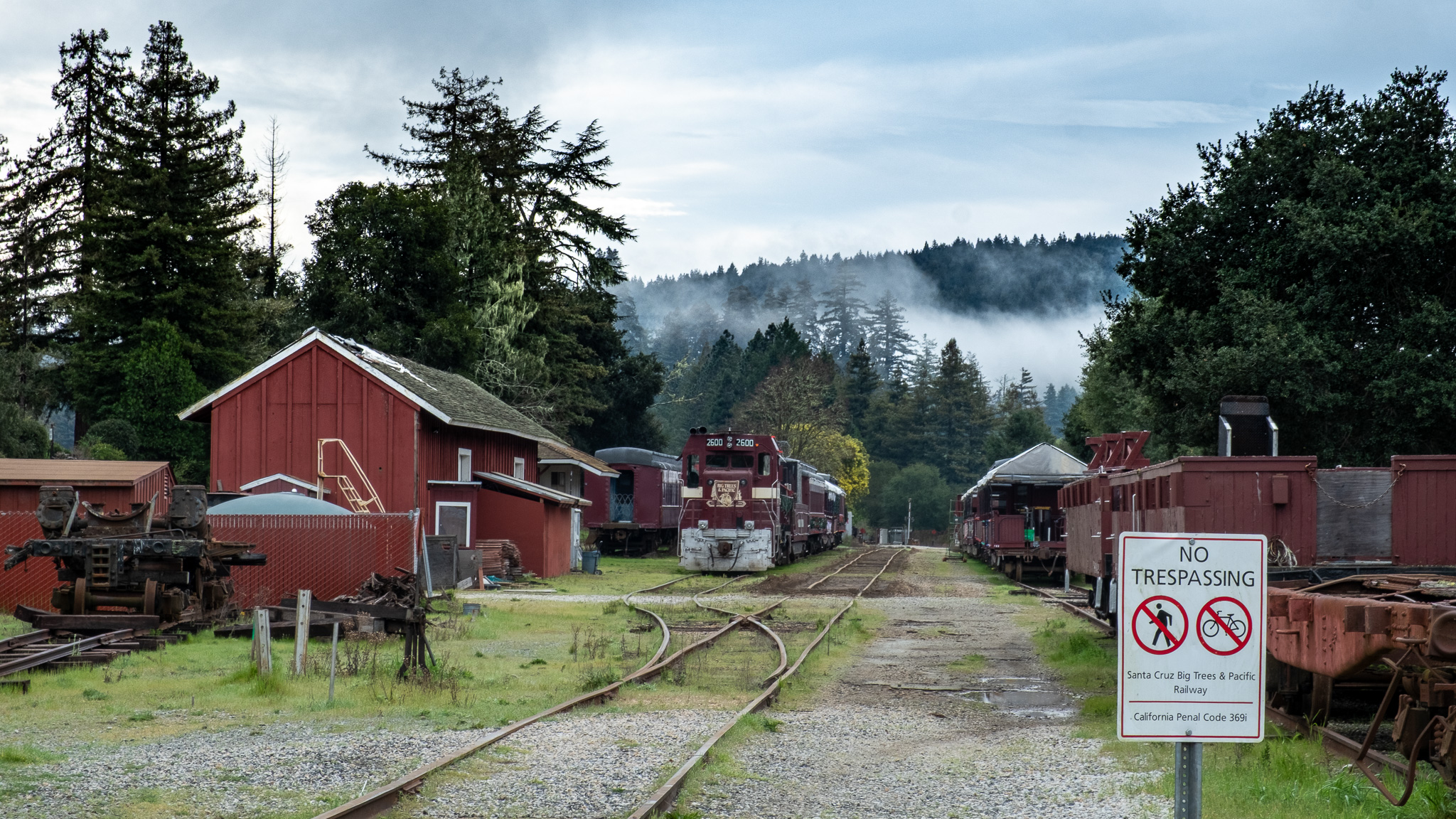
Roaring Camp Railroads, based in Felton, operates a rail line that connects to the Santa Cruz Branch Rail Line in Santa Cruz. (Nik Altenberg — Santa Cruz Local file)
Local pro-rail groups Equity Transit and Friends of the Rail and Trail, or FORT, also opposed the filing. The discontinuance “is an effort to cast aside the will of county residents” for a trail alongside rail, FORT wrote in a Nov. 13 statement to Santa Cruz Local. The group has urged the commission to design a trail that keeps the tracks in place, or to solve the budget shortfall by building a shorter or narrower trail next to the tracks.
Several opponents of the move, along with the railway’s lawyers, wrote that discontinuance alone cannot allow the interim trail as originally designed, with the tracks removed. But Christensen, the commission director, maintains that it can. But, she said, it’s possible that the new trail will be able to keep the tracks in place.
The legal process that would normally be used to create an interim trail is railbanking, a federal process for allowing a trail on an unused rail line while preserving rail easements for future use. The procedure allows the rail carrier to stop service, and a separate entity to steward the corridor as a trail. Railbanked lines can be later reactivated as railroads.
But locally, railbanking has become a political minefield. It is heavily opposed by Roaring Camp Railroads, which operates a rail line between Felton and Santa Cruz and intends to stay connected to the state rail network. Lawyers for Roaring Camp wrote to the Surface Transportation Board that while they do not oppose the requested discontinuance, they fear it is part of a larger plan to abandon the line.
Fred Forstall, a former Surface and Transportation Board analyst, wrote that the filing is “wholly inappropriate” because the rail line has not been properly maintained, and the move would cut off the Felton line. “In the cold, hard light of day the situation more closely resembles an unauthorized abandonment,” he wrote to the Surface Transportation Board on June 25.
Christensen said that the commission is confident that building the interim trail on the discontinued line is legal. The commission is not pursuing railbanking, she added.
The Surface and Transportation Board declined to comment on the ongoing case.
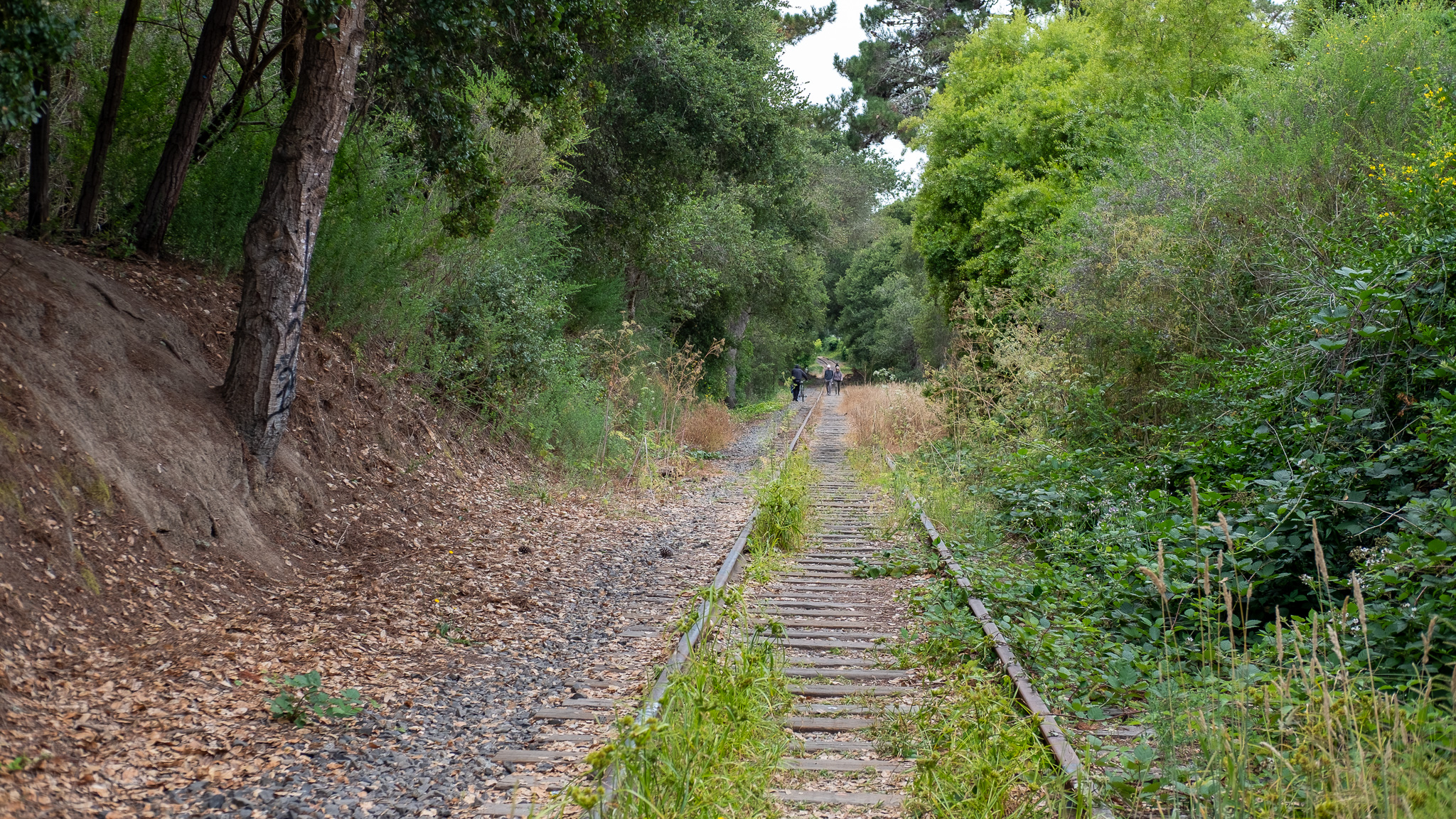
The rail corridor runs by Schwan Lagoon in Live Oak. It is planned as Segment 9. (Nik Altenberg — Santa Cruz Local file)
For cyclist advocate Mikey Cohen, board president of nonprofit Bike Santa Cruz County, the fight over the federal filing reflects deep local divisions over the future of the rail corridor.
This week, Bike Santa Cruz County released a 23-page report on the mid-county rail trail based on public documents and interviews with staff. It concludes that the interim trail is the only way to complete the project as planning for passenger rail continues. Cohen said he hopes that people from all sides of the debate can find common ground.
Ceasing all work towards passenger rail is “not a working solution, because it seems like you have a majority of people that do support moving forward with a train,” he said. At the same time, “train advocates are kind of making it sound like [passenger rail] is just around the corner,” and “that if you remove the tracks, that the train will never come.”
He added, “the polarizing debate has really not moved forward an actual, real, truthful conversation on what’s actually going on, which is why we wrote this report.”
Path forward
Engineers are still designing the interim trail, including the version that would keep the tracks in place. But it’s unlikely that such a “hybrid” trail would be feasible, said county planner Rob Tidmore — it would be more expensive and would make meeting safety requirements more difficult.
The designs should be done in a year, and the project could be ready for construction in 2028, he said.
That would miss a deadline set by the California Transportation Commission, which awarded the grant money, to be ready for construction by June. Christensen said that the regional transportation commission is planning to ask the state commission for an extension.
Christensen and Tidmore said that a trail on top of the tracks does not mean an end to the passenger rail process, and that rail construction is at least 20 years away. “The interim trail has funding now,” Tidmore said. “It has funding that’s very much at risk if we don’t build the trail now.”
In 2024, the transportation commission estimated that rail construction could start by 2032. But the estimated timelines have changed following the release of the conceptual report for rail service released in 2025, Tidmore said. The report estimated a $4.3 billion price tag to build the rail corridor.
“It’s just a very, very long-term project, much more so than if it were like a $500 million project,” he said.
Meanwhile, the process of raising money for the environmental review of passenger rail has been slow-going, Christensen said. This year, the commission has been unsuccessful in at least five grant applications for the project, she said.
Beyond the question of railbanking, and the plans for passenger rail, the most immediate challenge for the rail trail is the uncertain timeline of a ruling from the Surface Transportation Board. There is no deadline for the board to make a decision.
Questions or comments? Email [email protected]. Santa Cruz Local is supported by members, major donors, sponsors and grants for the general support of our newsroom. Our news judgments are made independently and not on the basis of donor support. Learn more about Santa Cruz Local and how we are funded.

Jesse Kathan is a staff reporter for Santa Cruz Local. They hold a master's degree in science communications from UC Santa Cruz.