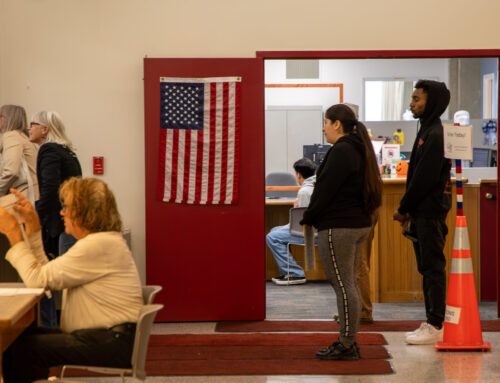
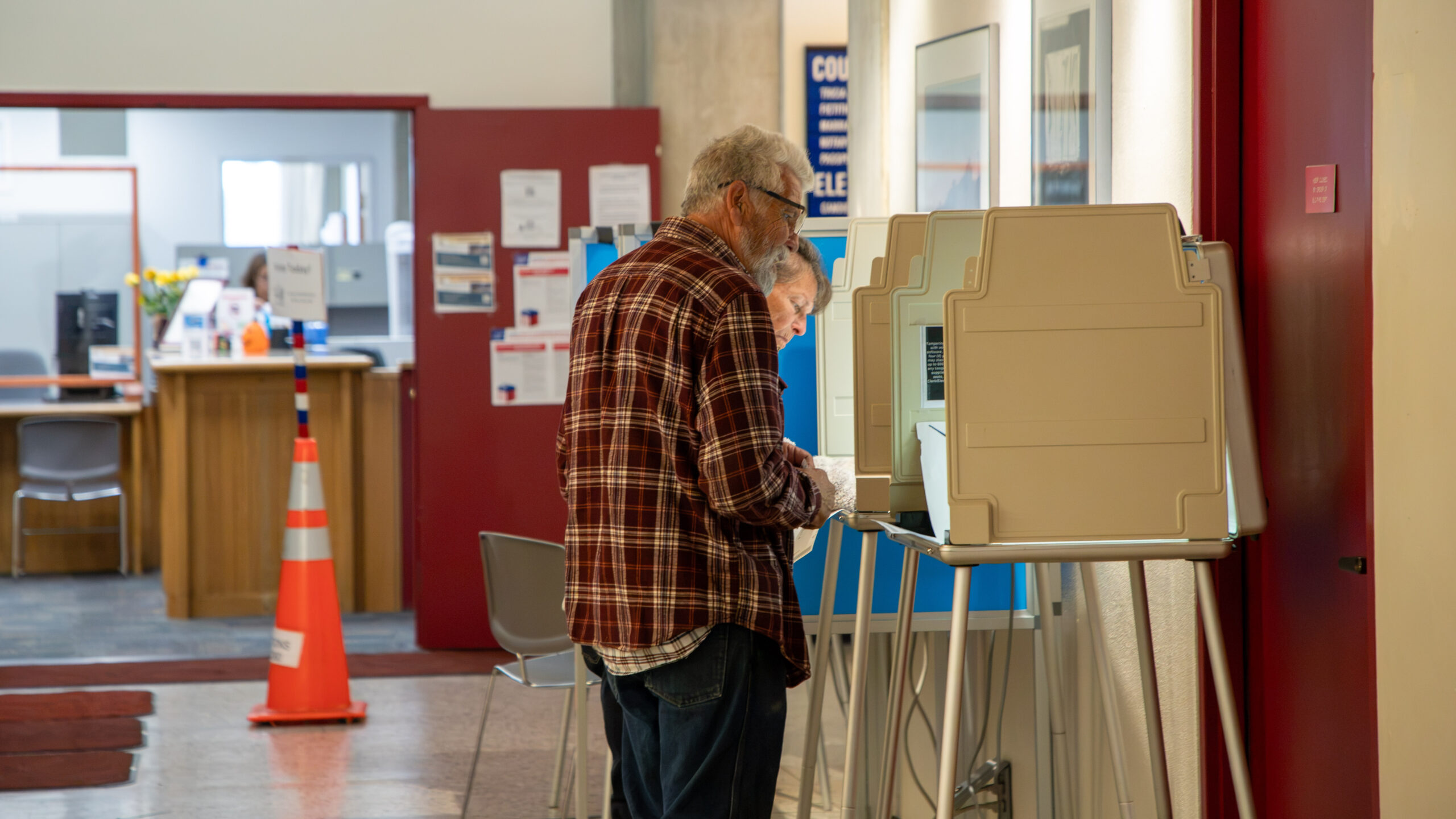
Santa Cruz County residents wait to cast their ballots on Nov. 2. Polls across the county will be open 7 a.m. to 8 p.m. on Election Day, Tuesday, Nov. 3. (Amaya Edwards — Santa Cruz Local/Report for America)
Where to vote
- Looking for an in-person polling place to cast your ballot? Check out Santa Cruz Local’s Election Guide of polling places throughout Santa Cruz County
- Most locations open 9 a.m. to 5 p.m. Nov. 2, and all locations open from 7 a.m. to 8 p.m. on Tuesday, Nov. 3.
SANTA CRUZ COUNTY >> For last-minute voters, Santa Cruz Local’s Election Guide can help you make an informed vote, find a nearby polling place or a ballot drop box and answer your questions about how to register to vote. Whether you are unsure about a candidate’s position, what the impacts of Measure E could be, or how to vote if you’re unhoused, our guide has you covered.
Don’t have much time? Keep reading for a brief overview of the races taking place in Santa Cruz County.
Santa Cruz Mayor
What it is: Along with city council members, the mayor casts a vote to guide city spending, homelessness and housing policies, and many other issues. The mayor works with city staff to determine if and when the council addresses certain issues. The seat can also serve as a “bully pulpit” for leaders to advocate for policies to county or state officials.
Who’s running: There are two candidates in a run-off this election:
- Ami Chen Mills, UC Santa Cruz educator and resilience coach.
- Ryan Coonerty, educator at the Leon Panetta Institute and UC Santa Cruz and CEO of the nonprofit Leadership Santa Cruz County.
What they think: Read the full guide for more details on candidates’ positions on housing, homelessness, civic engagement and other topics.
| Quick comparison | Ami Chen Mills | Ryan Coonerty |
|---|---|---|
| Large housing developments |
|
|
| Renters |
|
|
| Civic engagement |
|
|
| Flock Safety automated license plate readers | No. | Maybe, under a different presidential administration. |
| Taxes |
|
Instead of creating new taxes, raise tax revenue by supporting a new Downtown hotel and filling vacant storefronts. |
| Homelessness |
|
|
Capitola City Council
What it is: The Capitola City Council is a five-member, at-large elected body that serves four-year terms, creates city laws, sets the city’s budget and oversees city functions for four years.
Who’s running: Five candidates are vying for three seats this election:
- Joe Clarke, incumbent city council member and retired sheriff’s sergeant.
- Cami Corvin, paralegal and owner of Corvin’s Legal Services.
- Tory Del Favero, human resource specialist.
- TJ Welch, retired fire battalion chief.
- Peter Wilk, retired engineering manager.
Quick comparison on one major issue: What are your priorities for the rail trail project through Capitola?
- Clarke believes that because the train would be too expensive to build, the pedestrian and bicycle trail is a good idea and should move forward. “I think we’re getting to a point where we’re all going to come together and hopefully use the trestle and have that beautiful trail all the way to Aptos, and then hopefully eventually to Watsonville.”
- Corvin stated that she supports the building of the trail. “That trail will offer a safe, affordable mode of transportation for folks that are going to be taking their bikes, their e-bikes, and walking their dog, but that’s what we need to do.”
- Del Favero believes that the City Council shouldn’t do anything until the report on the trestle is back to review. “We really need that report on the trestle, and that will help us inform our direction and decisions. Because if the trestle is viable and there’s a way to repair the trestle and retrofit the trestle in a way that could serve walkers and bikers, like we’re hoping then it will be brilliant. If that data comes in differently, then we’re going to have to think differently about the rail trail through Capitola.”
- Welch believes that because residents voted on Measure L, the City Council should abide by those votes and take them into consideration moving forward. Welch also expressed excitement over the potential bicycle trail. “To have that open to the public is going to be, I think, probably the shining star of the whole trail.”
- Wilk believes that the rail trail should be built for both pedestrians and bicycles, and would have to find a way to accommodate e-bikes. “What could happen quickly is we can get the trail going, remove the rails, do what we have to do. The trestle can handle the bike traffic. Then people won’t worry about bicyclists in the village.”
What they think: Read the full guide for more details on candidates’ positions, such as the rail trail, housing mandates and pedestrian safety.
Scotts Valley City Council
What it is: The Scotts Valley City Council is a five-member, at-large elected body that serves four-year terms, creates city laws, sets the city’s budget and oversees city functions.
Who’s running: Three candidates are vying for two seats on Nov. 3:
- Greg Wimp, incumbent city council member and Togo’s sandwich shop owner.
- Danny Reber, executive director of Valley Churches United.
- Michael Zeller, director of programming and project delivery at the Transportation Agency for Monterey County.
Quick comparison on one major issue: What will you do to help advance the Town Center, and what will you prioritize in your conversations with developers?
- Wimp said, “People have been trying to get it done for the past 30 years or so. But we’re finally at a point where we’re farther along than we ever have been as far as getting all the pieces together with the developers, and definitely work with them to put money into the community.” He added, “We’ve done that with some other developments around town, we’re put money for our infrastructure and parks and and our services, and so definitely would want to see that get done, especially for this large project, but even our smaller projects. There have been some local developers that have done some projects recently on Scotts Valley Drive, and they have contributed to local organizations because they were a local developer, such as Apple Homes, which we’d like to see more of that, not just contributing to like the infrastructure and parks, but for those community groups in town.”
- Reber said the project has been a long time coming, and was delayed by the 2008 financial crisis, the rise of online shopping, and other factors. “A lot of the heavy lifting has already been done on the biggest obstacles that were holding it up. So there’s been a lot of meetings already with getting community engagement and community input, and working with the developer,” Reber said. “There’s a balance of making it work for the developer. Having a housing component in there, but then also making the retail component work, but then making it also feel like a Town Center where it actually does feel like a community gathering place.
- Zeller said, “The city has prepared a specific plan for its ideal vision for what the Town Center would look like. The developer can present a different proposal as well, but we would like to try to get those things as aligned as possible.” In particular, Zeller said, he wants to see open spaces and commercial space. “If we have new people moving in, we need to give them places to shop, places to go to restaurants, you know, places to help spend their money to boost the local economy. So making sure that all of those things are incorporated are really important.”
What they think: Read the full guide for more details on candidates’ positions, such as the Town Center development, housing affordability and road safety.
Watsonville City Council
What it is: The Watsonville City Council is a seven-member, district-based elected body that creates city laws, sets the city’s budget and oversees city functions including Watsonville police, fire and parks. Watsonville City Council members serve four-year terms.
Who’s running: Watsonville City Council Districts 3, 4, 5 and 7 are up for election. In Districts 3 and 4, incumbent council members are running unopposed. Districts 5 and 7 each have two candidates:
- Casey Clark, incumbent city council member and state licensed administrator for adult residential facilities, is running in District 5.
- Angel Zuniga, agricultural logistics manager at Americold Logistics., is running in District 5.
- Ed Acosta, an agriculture manager and former Watsonville planning commissioner, is running in District 7.
- Nancy Bilicich, a PVUSD administrator and former Watsonville City Council member, is running in District 7.
| District 5 comparisons: Yes/No | Casey Clark | Angel Zuniga |
|---|---|---|
| Would you support a rent control ordinance? | Would consider it. | Yes. |
| Do you support the city’s camping ban? | Yes. | Yes. |
| Do you support the city’s oversized vehicle ordinance? | Yes. | No. |
| ¿Hablas español? | Muy poquito. | Sí. |
| Do you support continuing the city’s contracts with Flock Safety? | Undecided. | Yes. |
| District 7 quick comparison | Ed Acosta | Nancy Bilicich |
|---|---|---|
| Small businesses |
|
|
| Encouraging new businesses downtown |
|
|
| Road safety |
|
|
| Traffic |
|
|
| Keeping residents in town |
|
|
| Youth |
|
|
What they think: Read the full guide for more details on candidates’ positions, such as road safety, economic activity and housing affordability.
PVUSD Board of Trustees
What it is: The PVUSD board of trustees consists of seven members elected by trustee area to four-year terms. The board provides leadership and oversight of the district’s schools and adopts the district’s annual budget.
Who’s running: Trustee Areas 1, 4, 5 and 7 are up for grabs this election:
Area 1: In Trustee Area 1, Andrew Goldenkranz, Meilin Obinata and Robin Sukow are competing to replace Joy Flynn, who was appointed in January 2025 and is not running for reelection.
Area 4: In Trustee Area 4, incumbent Daniel Dodge Jr. faces a challenger in Eriberto Estrada.
Area 5: In Trustee Area 5, three candidates filed to run for the seat held by Olivia Flores, who is not seeking reelection. All three candidates, Alicia Jimenez, Jennifer Schacher and Curt Wilcox, will appear on the ballot. Schacher withdrew from the race in August, endorsing Jimenez. Wilcox was arrested in September and is facing felony charges related to his campaign filings.
Area 7: In Trustee Area 7, incumbent Misty Navarro faces a challenger in Mads Realmuto.
What they think: Read the full guide for more details on candidates’ positions, such as student mental health, fostering a collaborative board and teacher support.
Felton Fire Protection District
What it is: The Felton Fire Protection District includes 30 volunteer firefighters alongside full-time emergency medical technicians, captains and a fire chief. It provides emergency response to 6,000 permanent residents and up to 15,000 summer visitors in the Santa Cruz Mountains. It includes a five-member board of directors that oversees the district’s governance and budget.
Who’s running: Three candidates are vying for two director positions this election:
- Craig Winter, incumbent Felton Fire board member since 2025.
- Jim Anderson, Felton Fire board member since 1999.
- Norm Crandall, Felton Fire board member since 2021.
Quick comparison on one major issue: How will you ensure Felton Fire is financially sustainable?
- Winter says he intends to: Stick to the financial plan laid out in planning documents for the Prop 218 assessment, and “to track that budget very closely,” work with a citizens oversight group for the Prop 218 money and, “look for other ways to be frugal,” like applying for grants and buying used fire engines.
- Anderson said he takes issue with “speculation that we’ve had financial issues for years” among some members of the community. With the income from the new assessment, “there’s a lot of stuff that we have to manage and make sure we conform to,” he said. The district has contracted with SCI Consulting Group to comply with some of those requirements, he said. “We’ll hopefully over time take that on as we get more familiar with the process.”
- Crandall said he plans to: Pick a chief that will stick to the long-term plan laid out in plans for the 218 income, the hiring is set to be made before the end of his current term. “I don’t yet have my long-term chief in hand, so that we can’t have that direct and frank discussion, but that’s going to be certainly part of the qualifying portions of the interview,” he said. Review the district’s annual budget, work with the citizens group overseeing Prop 218 assessment spending and complete the leasing of a cell phone tire atop the station, which “allows us to save up for things like vehicle acquisition without having to borrow money,” he said.
What they think: Read the full guide for more details on candidates’ positions, such as financial stability, operational concerns and community involvement.
Scotts Valley Water District
What it is: The Scotts Valley Water District manages, treats and delivers drinking water and recycled water to about 10,700 people across a 6 square mile service area that includes most of the City of Scotts Valley and adjacent unincorporated areas.
Who’s running: Four candidates are vying for three seats on the Scotts Valley Water District’s board of directors this election:
- Ruth Stiles, incumbent board member and arborist consultant.
- Brody Knutson, water operations manager for Scotts Valley Water District.
- Bill Jager, retired business executive.
- Brian Youmans, administrative professional.
What they think: Read the full guide for more details on candidates’ positions, such as how they’ll ensure the district has enough water supply and their ideas for how they will improve the district.
Soquel Union Elementary School District Board of Trustees
What it is: The Soquel Union Elementary School District serves approximately 1,700 students in the communities of Capitola, Soquel and Santa Cruz. The school district is governed by a five-member board and works in conjunction with the superintendent. Trustee Area 4 includes part of Capitola, near New Brighton Middle School and eastern areas of the school district.
Who’s running: Two candidates are vying for the Area 4 seat on the Soquel Union Elementary School District Board of Trustees:
- Ariel Gray, incumbent.
- Andrea Locke, first-time candidate.
What they think: Read the full guide for more details on candidates’ positions, such as boosting district enrollment and teacher turnover.
San Lorenzo Valley Unified School District Board of Trustees
What it is: San Lorenzo Valley Unified School District serves the towns of Felton, Ben Lomond, Brookdale and Boulder Creek. There are 1,937 students enrolled for the current school year in the district’s four schools. The district also has an independent charter school with more than 300 students.
Who’s running: Two candidates are vying for the Area 4 seat on the San Lorenzo Valley Unified School District Board of Trustees this election:
- Gayle Levine, incumbent.
- Ashleigh Hopkins, first-time candidate.
What they think: Read the full guide for more details on candidates’ positions, such as retaining teachers and student enrollment.
Cabrillo Community College District Governing Board of Trustees, Area 6
What it is: The Cabrillo Community College Governing Board gives the superintendent authority to oversee the college. The board directly impacts students by shaping college policies, budgets and leadership. The board includes representatives from seven areas of Santa Cruz County and a student trustee who represents the student body. Cabrillo serves more than 17,000 students each year at its Aptos and Watsonville campuses.
Who’s running: Three candidates are vying for one seat on the Cabrillo Community College District Governing Board of Trustees, Area 6 this election:
- Karen Cogswell, first-time candidate.
- Milissa Ales-Barnicoat, first-time candidate.
- Benjamin Finke, first-time candidate.
What they think: Read the full guide for more details on candidates’ positions, such as the board’s budget, faculty support and community involvement.
Measure E
Measure E is a proposed temporary half-cent sales tax hike to address the effects of federal changes to welfare programs, which are expected to remove many people from health care plans and food assistance. The money is intended to go towards the county’s increasing costs and community partners, like hospitals. A “yes” vote is for the sales tax hike. A “no” vote is against the sales tax hike. The measure needs more than 50% of the vote to win. Read more about Measure E in our full guide.
Measure G
Scotts Valley voters will consider Measure G, a proposed hotel tax increase. It is an increase to Scotts Valley’s hotel tax to raise money for city services and needs more than 50% of the vote to win. Read more about Measure G in our full guide.
Measure D
Measure D would strengthen local laws limiting facilities that support offshore oil drilling and deep-sea mining. Read more about Measure D in our full guide.
Questions or comments? Email [email protected]. Santa Cruz Local is supported by members, major donors, sponsors and grants for the general support of our newsroom. Our news judgments are made independently and not on the basis of donor support. Learn more about Santa Cruz Local and how we are funded.

As government accountability reporter, Erika Zaro brings in-depth, enterprise reporting on local institutions that affect residents’ everyday lives. Her stories examine major government decisions, track the promises of elected officials and investigate wrongdoing.