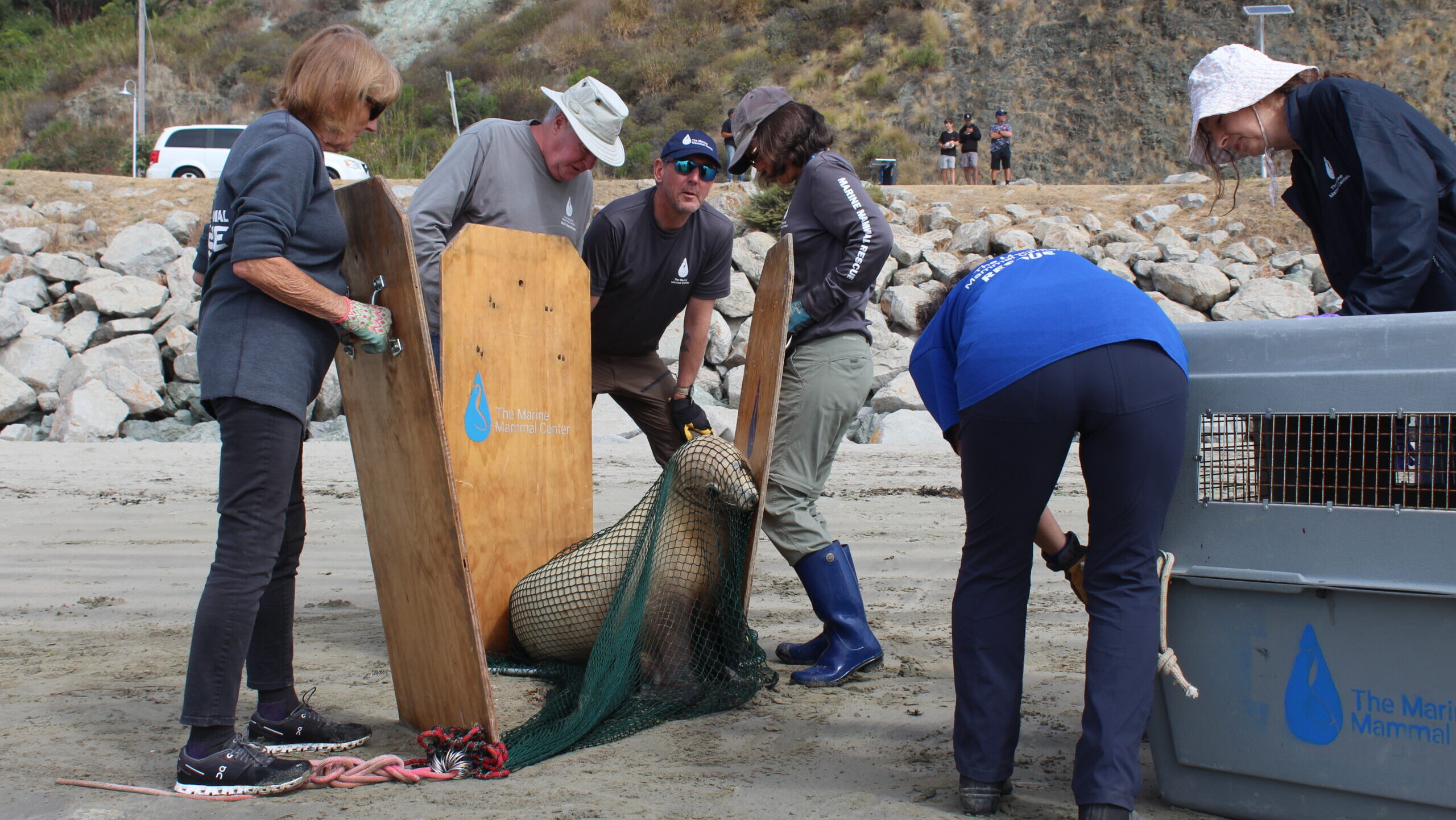
Marine Mammal Center team rescues a California sea lion on Avila Beach. (Giancarlo Rulli — Marine Mammal Center)
Story at a glance
- Monterey Bay was the epicenter of an outbreak that hit sea mammals hard, but scientists say it’s hard to know what caused it to be so severe.
- The Marine Mammal Center has documented 317 cases of domoic acid poisoning this year, the largest outbreak in its 51-year history.
- The biotoxin comes from blooms of algae and can poison marine animals like sea lions, whales, and birds.
- Responders said blooms that typically follow a fairly regular seasonal pattern are beginning to flare up at unexpected times of the year and last longer than usual.
- Experts say that the toxin is a risk mostly for wildlife and recreational shellfish harvesters, but commercial seafood remains safe.
SANTA CRUZ >> The daily cacophony along the Santa Cruz coast reveals the waters are home to cacophony of natural voices — sea lions bark at Steamer Lane, coastal birds pierce the air with screeches and onlookers gasp and point as whales spout in distant seas.
But another, lesser-known marine resident has quietly been wreaking havoc in recent months — an algae that produces a deadly chemical called domoic acid, a biotoxin that can make marine animals seize and die. This year’s outbreak has been tied to the deaths of at least two humpback whales and a record-setting year for sea lion strandings.
Responders at the Sausalito-based nonprofit Marine Mammal Center said this year is already the worst in 51 years with more than triple the usual number of reported sea lions in need of help. For three months this summer the center’s teams were responding to more than a dozen reports of sick sea lions per day across the 600 miles between Mendocino and San Luis Obispo. Santa Cruz and Monterey counties emerged as the epicenter of this year’s outbreak, which began in July and reached its peak in late August.
The monthslong outbreak appears to now be receding, but responders say what used to be a seasonal problem lasting a few weeks is now being observed throughout the year. They say even chronic low levels of exposure can worsen problems like malnutrition and ship collisions, as disoriented animals struggle to feed and avoid vessels.
An unseasonally long bloom
Responders at the Sausalito center are tracking blooms like these, which are beginning to occur outside of regular, seasonal spikes and stick around longer. Scientists also warn the bloom could move north, threatening the state of marine life up the coastline.
“We’re seeing flare ups year round. We’re seeing flare ups in the winter and the spring. That makes things that much more difficult to plan for,” said Giancarlo Rulli, the Marine Mammal Center’s associate director of public relations. “This disease is insidious. It’s unpredictable.”
In a typical year, his team rescues 75 to 90 animals for domoic acid poisoning, which they treat with fluids, clean fish, and anti-seizure medication to help flush out the toxin. This year, they documented 317.
“It was at a point where we just were not able each day to get to every single one,” Rulli said. “We’d have to pick it back up the next morning.” He added that while the acid can be flushed from an animal’s system, permanent brain and heart damage can’t be treated.
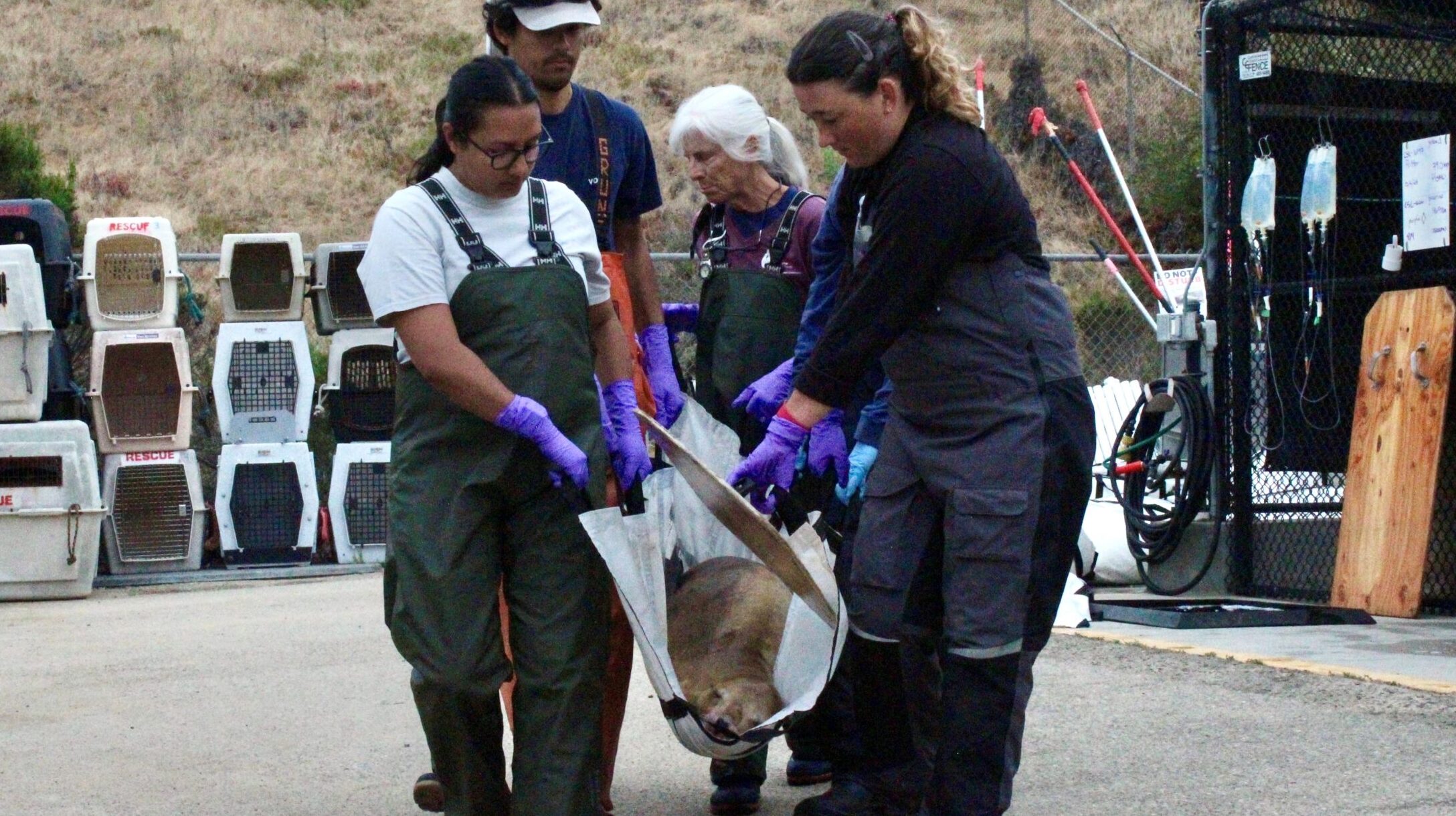
Transporting a California sea lion with domoic acid poisoning in San Luis Obispo County. (Giancarlo Rulli — Marine Mammal Center)
Locally, UC Santa Cruz’s Marine Mammal Stranding Network saw a similar surge in affected animals. Between June and September, it responded to 75 strandings, nearly as many as it handled in all of 2025.
Robin Dunkin, faculty director of the stranding network, said that most years the blooms are short lived, with a seasonal spike that drops within weeks. “This year, it’s been prolonged. It just kept going all summer,” she said.
In addition to sea lion strandings, two humpback whales found beached earlier this summer were confirmed to have domoic acid in their tissues. “One of them had very high levels that is very much a smoking gun for domoic acid toxicity,” Dunkin said.
The Marine Mammal Center and stranding network also responded to the recent death of a fin whale at Cowells. The whale was severely emaciated and exhibited signs of long-term illness, but Rulli said it’s too early to determine a cause of death and that subsequent testing is needed to see if domoic acid played a role.
Effects on marine life and people
Domoic acid is produced by microscopic algae called Pseudo-nitzschia. From there, it moves up the food chain: local shellfish, sardines and anchovies take up the toxin when they ingest algae. When sea lions, whales and birds eat those fish, the toxin can accumulate in their tissue at dangerous levels. Poisoned mammals become disoriented and erratic, and can experience seizures, and long term exposure can result in permanent brain and heart issues.
“It’s really a problem for the wildlife because of course they can’t read the signs,” said Raphael Kudela, a professor at UCSC’s Institute of Marine Sciences. “They have to eat the shellfish, or the anchovies or what have you, even if it’s toxic.”
Some have speculated that domoic acid was behind the sea lion attack in Capitola, though responders emphasized that there’s no way to confirm it and that approaching wild animals always poses a risk.
Kudela said that beyond the reported strandings, “there’s probably many more cases where it’s just interfering with their ability to survive in the ocean,” he said.
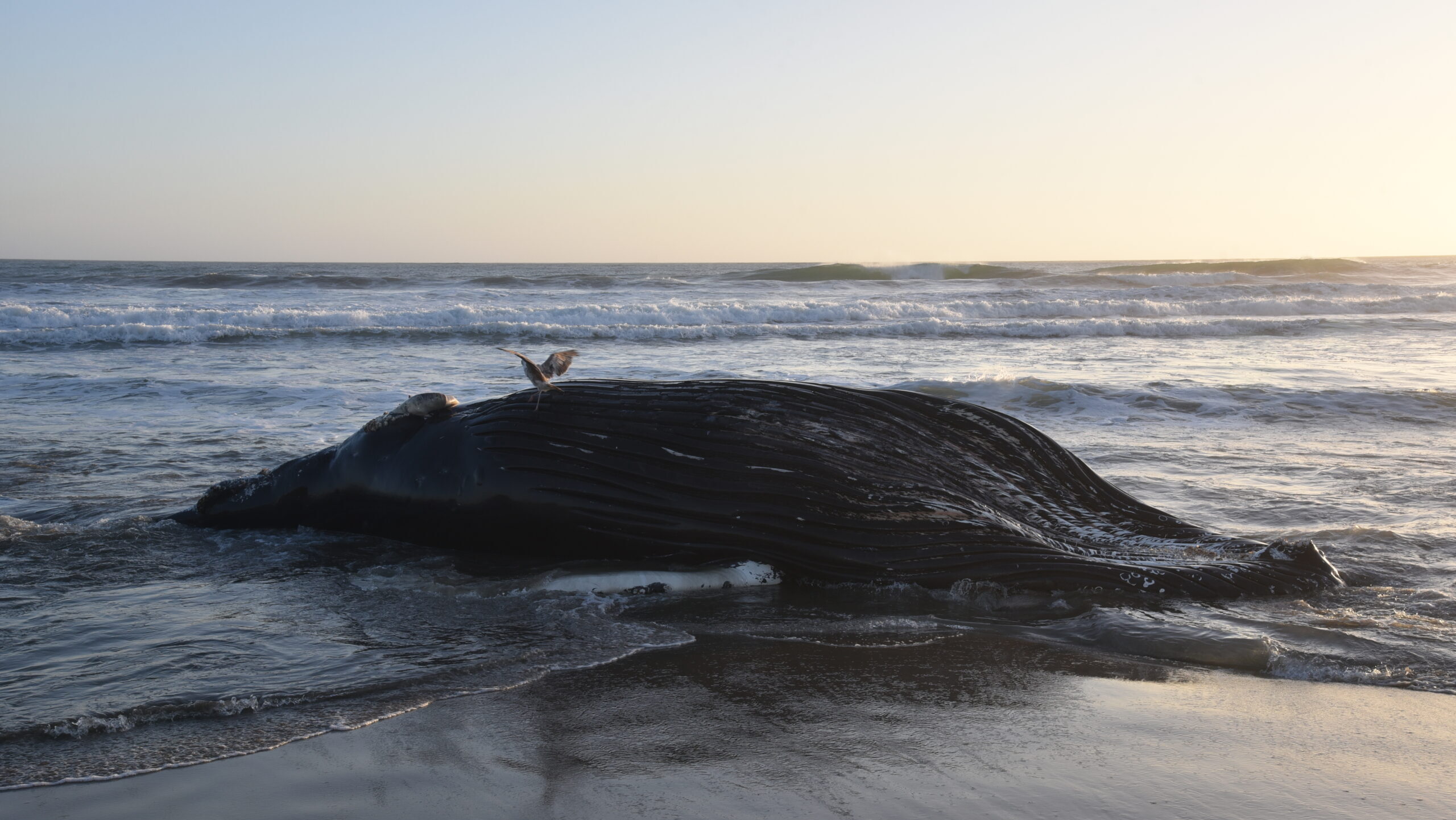
A juvenile humpback whale found deceased near Watsonville on June 5. (Marine Mammal Stranding Network — UC Santa Cruz)
In humans, the effects are known as amnesic shellfish poisoning and usually happens when people eat mussels and oysters with high levels of domoic acid. Poisoning can cause headaches, confusion and seizures.
Kudela noted that the risk to humans is generally much lower because of state seafood testing. “If you’re eating commercial fish or shellfish, it’s perfectly safe,” he said.
Clarissa Anderson, a biological oceanographer at Scripps Institution of Oceanography, said the biggest risk to humans lies with recreational harvesting of mussels and oysters. The state’s recreational mussel quarantine runs from May to October, “but we do see some blooms in the winter,” she said.
Challenges tracking domoic acid
Anderson and Kudela stressed that there’s no single trigger for domoic acid outbreaks, which makes it hard to explain what set off this one. “We’ve never been good at predicting them,” Anderson said.
Current models can track a bloom a few days ahead once it begins, but forecasting a good or bad season months out is a much bigger challenge as each event is unique.
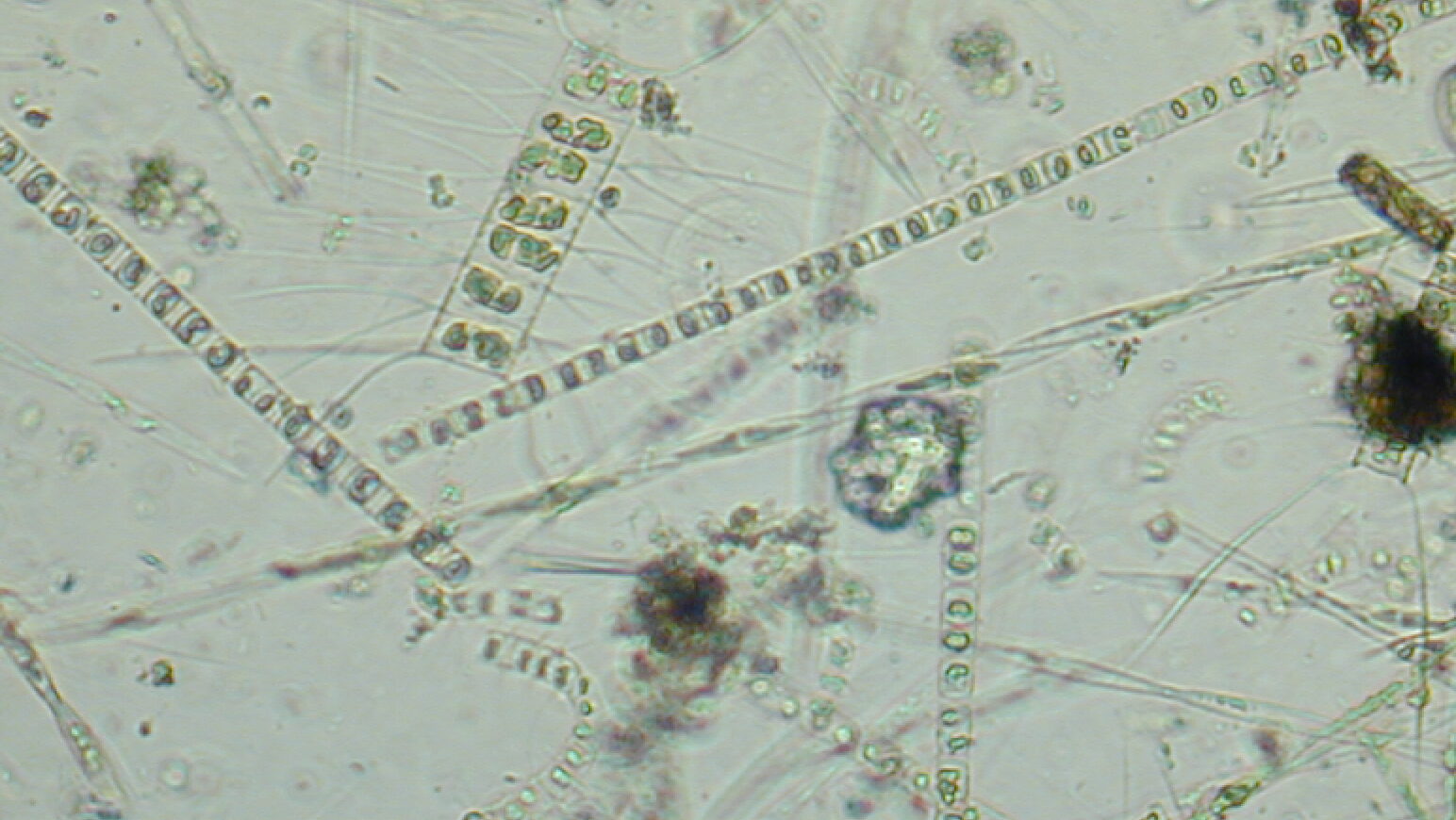
A microscopic view of algal bloom. (Marine Mammal Center)
“There’s a dozen things that could cause domoic acid to be produced,” Kudela said, explaining that factors like sunlight, water temperature and nutrient levels can all play a role in harmful blooms, and that it can be difficult to decipher the exact cause. “Is it cold water or is it warm water? It turns out it’s both,” Kudela said.
Beyond that, Anderson noted that a bloom alone doesn’t mean mass poisoning. It also takes the animals’ prey being in the right place to take up the acid and then be eaten.
“It can be a mixed bag. We’ve had weird domoic acid events where only birds got sick, because maybe all the anchovies were at the surface.” Anderson explained that in other instances, deeper blooms and clusters of fish could target sea lions, which forage deeper than birds.
Looking ahead
Kudela confirmed what Rulli’s teams at the Marine Mammal Center have seen on the ground: outbreaks that used to follow a set rhythm — from March to June and again from August to November — are starting to occur at odd times throughout the year.
“It’s really changing its pattern, which makes it difficult to predict what’s going on. That’s primarily probably due to a combination of sort of interannual variability and climate change,” Kudela said. “It’s just the ocean is not the way it used to be.”
As far as El Niño’s possible effects on this, Kudela said it tends to suppress domoic acid in Southern California but makes blooms more likely from Santa Cruz northward, and that another intense bloom could emerge in early December. Anderson, the oceanographer, noted that as a warm Kelvin wave moves up the coast, any blooms are likely to be patchy, appearing in isolated bays rather than along the whole coastline.
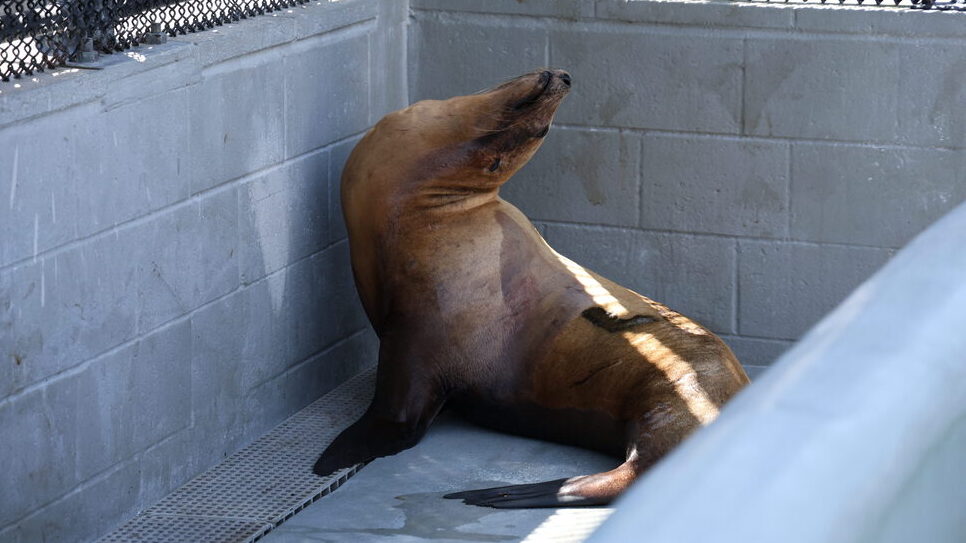
A California sea lion in treatment for domoic acid poisoning. (Jillian Pastick — Marine Mammal Center)
New tools developed by Kudela’s team could give responders more anticipation before blooms hit sea mammals. The detection methods use chemical “alarm cues” released by copepods, tiny crustaceans that eat the toxic algae, and can forecast toxic blooms up to seven weeks ahead.
In the meantime, Rulli urged locals to stay alert and inform response teams of sick or distressed marine mammals. He advised locals to stay at least 150 feet away, keep pets leashed and call the Marine Mammal Center’s hotline at 415-289-SEAL (7325).
He emphasized that sea lions are a “sentinel species” for ocean health. “Their health is our health,” he said. “When they’re coming ashore sick, it should be a real flag for all of us.”
Questions or comments? Email [email protected]. Santa Cruz Local is supported by members, major donors, sponsors and grants for the general support of our newsroom. Our news judgments are made independently and not on the basis of donor support. Learn more about Santa Cruz Local and how we are funded.

Alonso Daboub joins Santa Cruz Local as a California Local News Fellow. He earned a master’s degree in Science Communication at UC Santa Cruz.