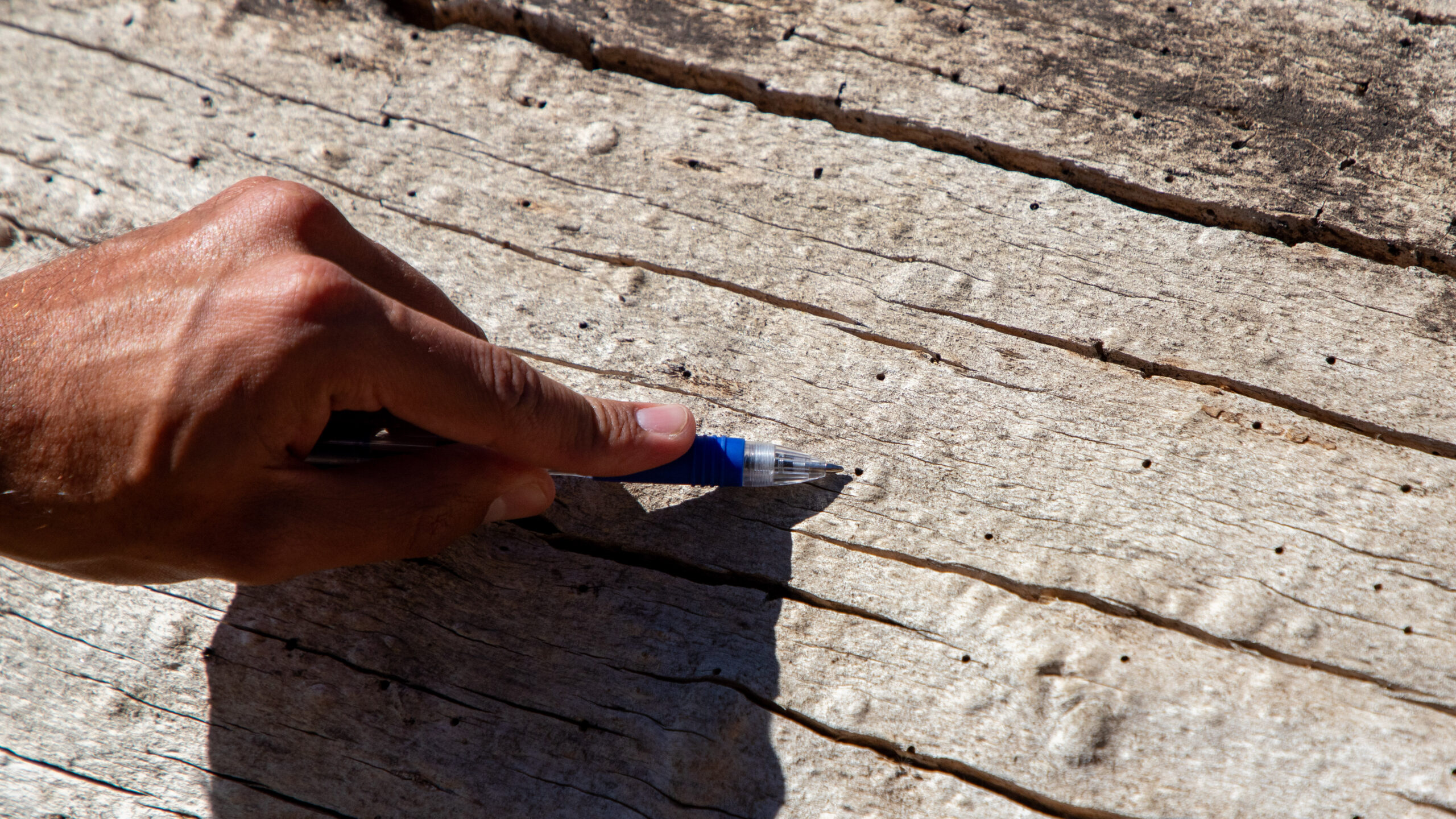
Blake Shaw points out an invasive beetle’s bore hole. (Amaya Edwards — Santa Cruz Local/CatchLight Local)
Help report suspected infestations
- To report suspected damage from invasive shothole borers, property owners should call the Santa Cruz County Agricultural Commissioner’s Office at (831) 763-8080
- Resources on the monitoring, detection, and management of the pests are available at ISHB.org, or by contacting your local Cooperative Extension Forest Advisor.
FELTON >> Zayante trail starts off like most in Henry Cowell. On a recent afternoon, chirping birds fluttered about a box elder tree’s branches, the leaves providing the birds and the hikers refuge from the sun. But just a few meters down from the trailhead, something changes. The treecover disappears abruptly, and the sun beats down.
Blake Shaw, a forest health surveillance coordinator with Santa Cruz County Agricultural Commissioner’s Office, said the lack of canopy is a symptom of an ongoing infestation of invasive pests. The culprit is a beetle species called the Greater shothole borer. It’s no bigger than the tip of a pen, but it can wreak havoc on native tree species like the box elder.
“This is kind of the future,” Shaw said, gesturing toward the fallen corpse of a box elder tree on the trail. “These are the oldest infestations, and as you can see, they’re all dying.”
Since its discovery in 2024, the county has been monitoring an ongoing infestation of the invasive species, which is likely new to California. The beetle is attacking native tree species important for ecosystems near rivers, and with every fallen tree, the risk of fire and damage increases for communities in the Santa Cruz Mountains, where the problem started and is spreading outward.
The county’s Agricultural Commissioner is collaborating with University of California scientists to better understand the infestation and its leading edge — the advancing border of the beetle’s territory. The team hopes to manage the local infestation by focusing efforts on community engagement and proper disposal of infested trees.
The beetle was first identified two years ago, when an arborist hiking near Zayante Creek noticed trees filled with tiny holes. But Brian Woodward, a regional forest advisor with the University of California, said the beetles have likely been here longer. “We caught this a little late in Santa Cruz, it’s likely been in this area for a number of years.”
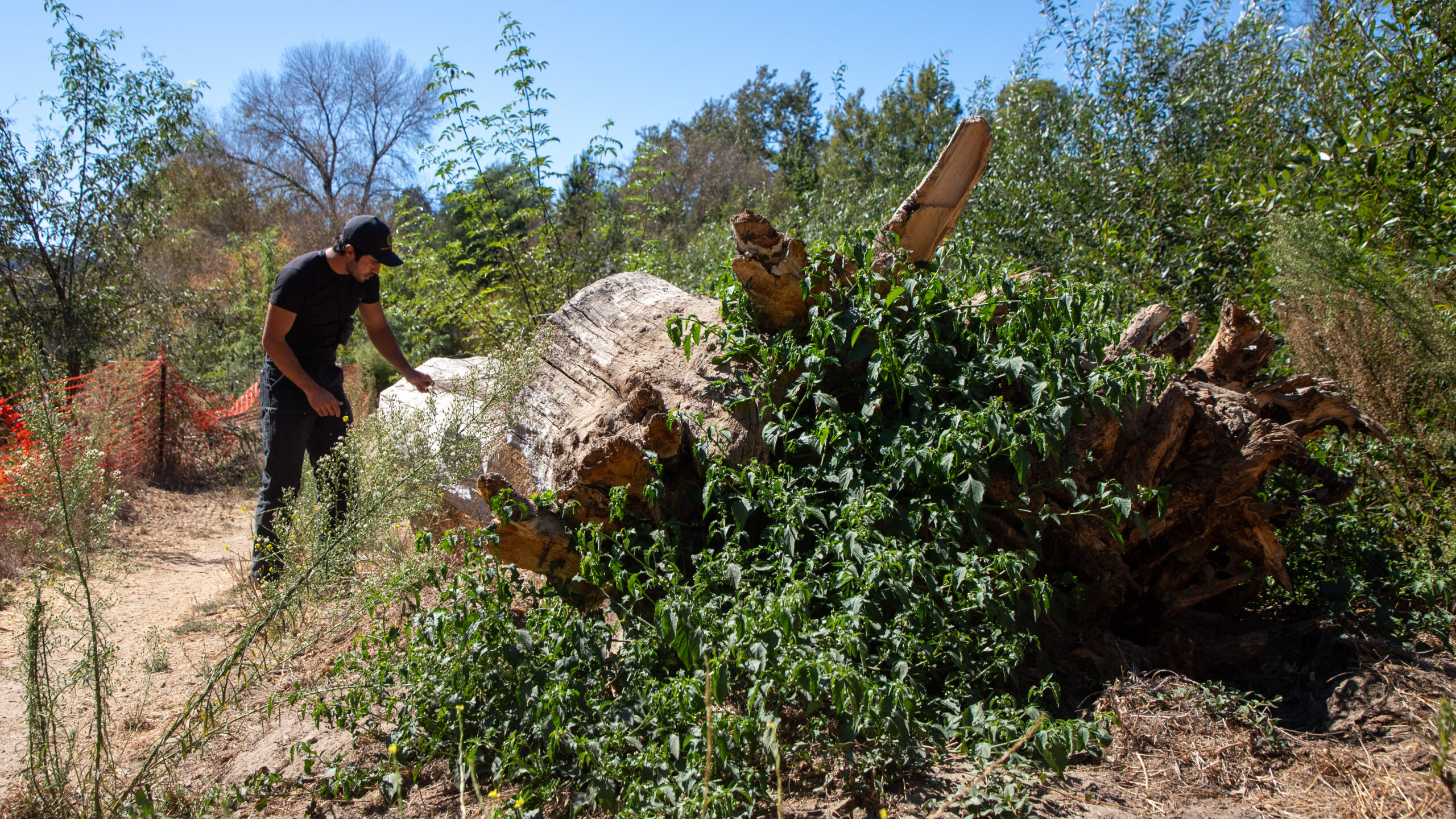
Blake Shaw, a forest health surveillance coordinator with the County of Santa Cruz, examines a dead box elder tree in Henry Cowell. (Amaya Edwards — Santa Cruz Local/CatchLight Local)
Southern California has seen its own infestation of invasive shothole borer beetles, where two species of the beetle have collectively killed hundreds of thousands of trees. But Santa Cruz’s shothole borer is a species completely new to California, distinct from ones identified in Southern California and San Jose. The Greater shothole borer also boasts a slightly larger size than the other two species, reaching roughly the size of a grain of rice.
“Because this is a brand new species of pests, we really don’t actually know what tree species are most susceptible in our communities,” Woodward said. The most impacted trees so far have been box elders, which provide shade for fish along rivers.
Scientists believe the beetles, originally from Southeast Asia, were introduced to California with shipping materials. Shannon Lynch, an assistant professor of forest pathology UC Davis, said that while native beetles go after stressed and dying trees, the invasive shothole borers are more problematic.
“This class of ambrosia beetle actually tends to attack apparently healthy trees,” she said.
The beetles bore holes into the bark where they grow their main food source, a fungus called Fusarium. Once beetles emerge from the holes, they don’t go far, often drilling holes into the same tree, reproducing incestuously with siblings and spreading Fusarium further throughout it. As Lynch explained, the fungus acts as a pathogen, causing an immune response that eventually kills the tree.
The UC scientists explained that this quick propagation within the same tree can create “amplifier trees” that drive the infestation. “One tree can have 10,000, 20,000 holes supporting many hundreds of thousands of beetles,” Woodward said
Santa Cruz County Agricultural Commissioner David Sanford said that managing the issue is paramount for protecting native tree species and preventing costs related to dead trees — things like damage to homes and powerlines from falling limbs and increased fire risk.
“What we’re dealing with is a pest that’s not your typical pest that we deal with in the ag world,” he said. He also explained that because the beetles don’t go after agricultural plants or timber, less assistance comes from the state’s Department of Food and Agriculture for dealing with the infestation.
His team is working with a “small amount” of grant money from the Invasive Species Council of California, which has granted funds to counties dealing with invasive pests. “Really, it’s strictly like a surveillance and monitoring kind of grant. It’s not a lot of money to do management and mitigation work,” he said.
His team is also looking for grants through Cal Fire and state parks for actual mitigation efforts, which involve taking down amplifier trees and disposing of them properly by burning or shredding them. Both methods, Sanford underscored, are costly.
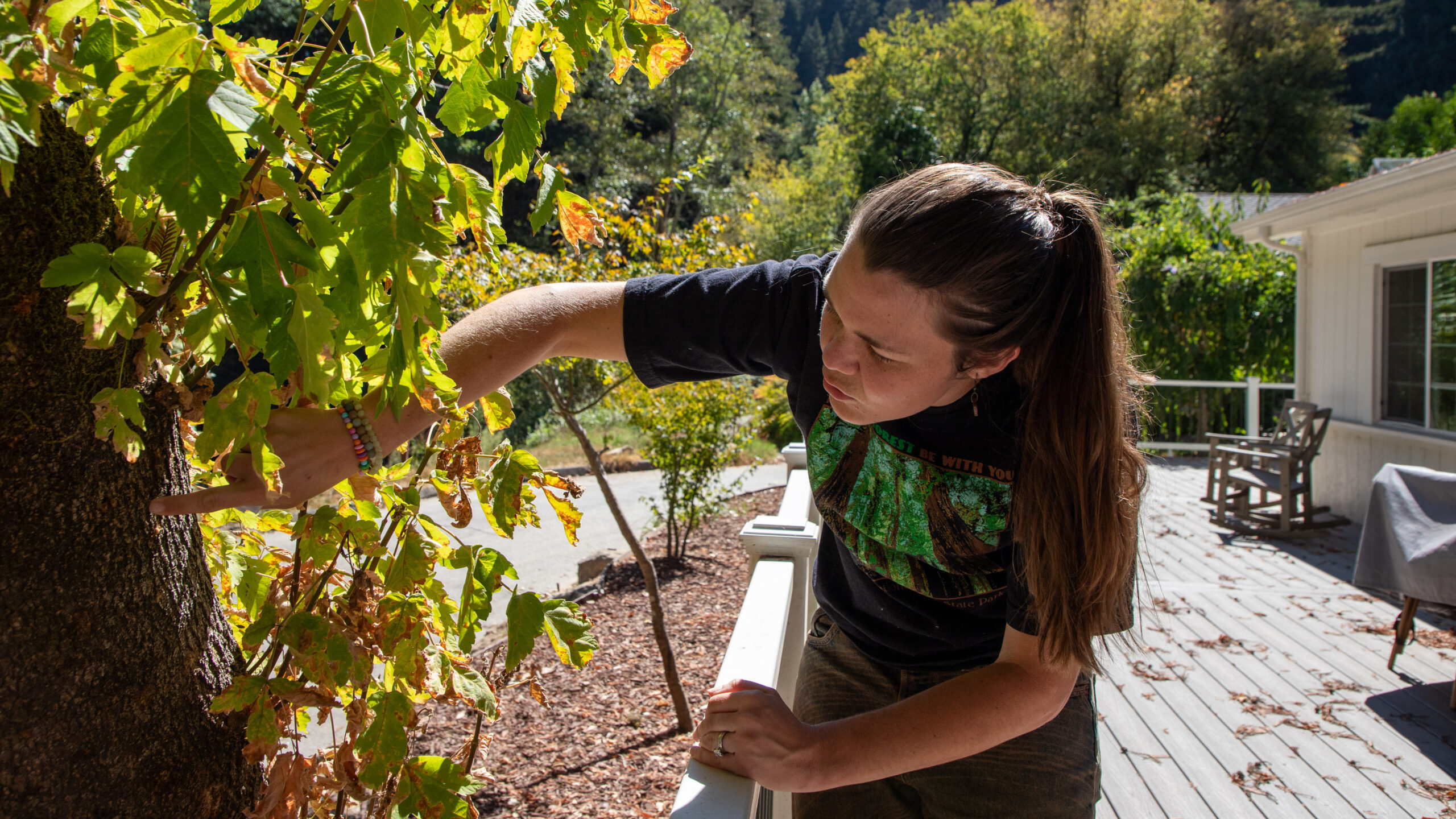
Kristy Swor points out a new infestation in a tree in Paradise Park. (Amaya Edwards — Santa Cruz Local/CatchLight Local)
In places like Paradise Park along the San Lorenzo River, residents like Kristy Swor have had to come together with their communities to pay for the removal of infested trees.
“The problem with at least our community is we don’t have a budget to deal with this,” Swor said as she pointed out a nearby tree that recently became infested.
In the meantime, Sanford and Shaw are focusing on educating residents about how to identify infested trees. “Outreach is one of the most important aspects when dealing with an invasive pest,” said Shaw. “We need that momentum and that word of mouth and everything to kind of create action.”
The team held meetings last week to inform community members about the issue and encourage them to report infested trees to the county. They recommend residents to use an online ISHB Detection Assessment to see if their trees are suffering from the pest, and recommend calling the county directly to report infested trees at (831) 763-8080.
Signs of an infestation may include “small, round entry holes, wet staining, gumming, boring dust or sugary buildup on trees,” according to a county press release.
For her part, Lynch explained that while there’s no eradicating the beetle from California, aggressive monitoring and management can make a difference. “This is something to take seriously, and being proactive is the best way to take it seriously, but it can be managed,” she said.
Questions or comments? Email [email protected]. Santa Cruz Local is supported by members, major donors, sponsors and grants for the general support of our newsroom. Our news judgments are made independently and not on the basis of donor support. Learn more about Santa Cruz Local and how we are funded.

Alonso Daboub joins Santa Cruz Local as a California Local News Fellow. He earned a master’s degree in Science Communication at UC Santa Cruz.