

The Palomar Inn was built in 1929. (Amaya Edwards — Santa Cruz Local/CatchLight Local)
SANTA CRUZ >> Palomar Inn tenants that were facing rent hikes on June 1 will now get at least a 90-day reprieve after a Santa Cruz Local story revealed the notices of rent increase were improperly delivered to tenants.
When reached by phone Friday morning, Palomar Inn property manager Geno Lira hung up without comment. A city spokesperson then emailed Santa Cruz Local to say a new 90-day notice would be issued to tenants properly. By the afternoon, notices were posted in the building that said the rent hikes would not go into effect June 1 and tenants would receive another rent increase notice with an effective date of Sept. 1.
Under California law, tenants facing a rent hike of more than 10% are due 90 days’ notice, and notices must be mailed or handed to tenants in person. Palomar property managers first taped the notices to residents’ doors on March 3, and initially gave only 60 days’ notice, Santa Cruz Local reported earlier this month. In a call with a reporter, Lira confirmed that the notices had not been delivered properly.
Members of the tenant association requested new 90-day notices in a May 19 email shared with Santa Cruz Local. In a May 20 response from Lira, he wrote that tenants who face financial hardship should apply for funding from local nonprofit Community Action Board’s rent assistance program.
“Should the current increases be delayed due to technical requirements on the notices, there will be a financial impact on the building,” Lira wrote.
Many of the units are for very low income tenants and are roughly $750 a month. Those units are facing rent hikes to $1,000. Market rate units in the building are at roughly $1,800 a month. Even the rent hikes that remain below market rate threaten to displace many vulnerable tenants who are unable to work.
The Palomar is a residential hotel largely home to seniors, disabled people and formerly homeless people, many of whom live on a fixed income.
Santa Cruz Local spoke with nearly a dozen tenants of Palomar Inn facing rent increases of 20% to 35%, and many who said they will be unable to pay the difference. Most tenants spoke on condition of anonymity, for fear of retaliation from property managers.

Palomar tenants David Rankin, 79, speaks about his living situation in an interview in Santa Cruz Coffee Roasting on April 29. (Nik Altenberg — Santa Cruz Local)
One tenant, who got in touch with Santa Cruz Local this week, said they never received the initial rent increase notice that most tenants received March 3. The tenant said they saw the notices taped to other residents’ doors, but there was no notice on their own door — but when they inquired about the rent hike with property managers they received confirmation their unit was facing a rent increase.
This tenant, and many others, described habitability concerns — in particular a severe cockroach infestation.
“I’ve been renting all my life, and there’s cockroaches everywhere, but I’ve never, ever seen more cockroaches in one place than in this place. I mean, in broad daylight, just crawling up and down the walls, all over everything,” the tenant said. “The walls are still standing up merely because of the cockroaches that are within it.”
City leaders struck a deal with Palomar property owner Evelyn Baumelgruen earlier this year to reduce the rent hikes — when an affordable housing agreement expired in January, it allowed Baumelgruen to raise rents without limit. Under the new city agreement, she received a three-year low interest loan of $1 million in exchange for limiting the rent increases.
The agreement also requires that the Palomar be kept “in good condition, order and repair.” Palomar property managers have the building treated for cockroaches once a month, but some tenants said the treatments don’t do much to help.
The Palomar is primarily single room occupancy units, less than 200 square feet and without a kitchen. Some tenants are also prohibited from using appliances that draw too much power like toaster ovens, because the electrical panels can’t handle the load.
Santa Cruz City Councilmember Scott Newsome, whose district includes downtown, did not respond to multiple requests for comment. Newsome, who is running for reelection in the June 2 primary, has touted the city’s deal with the Palomar as a success in his campaign.
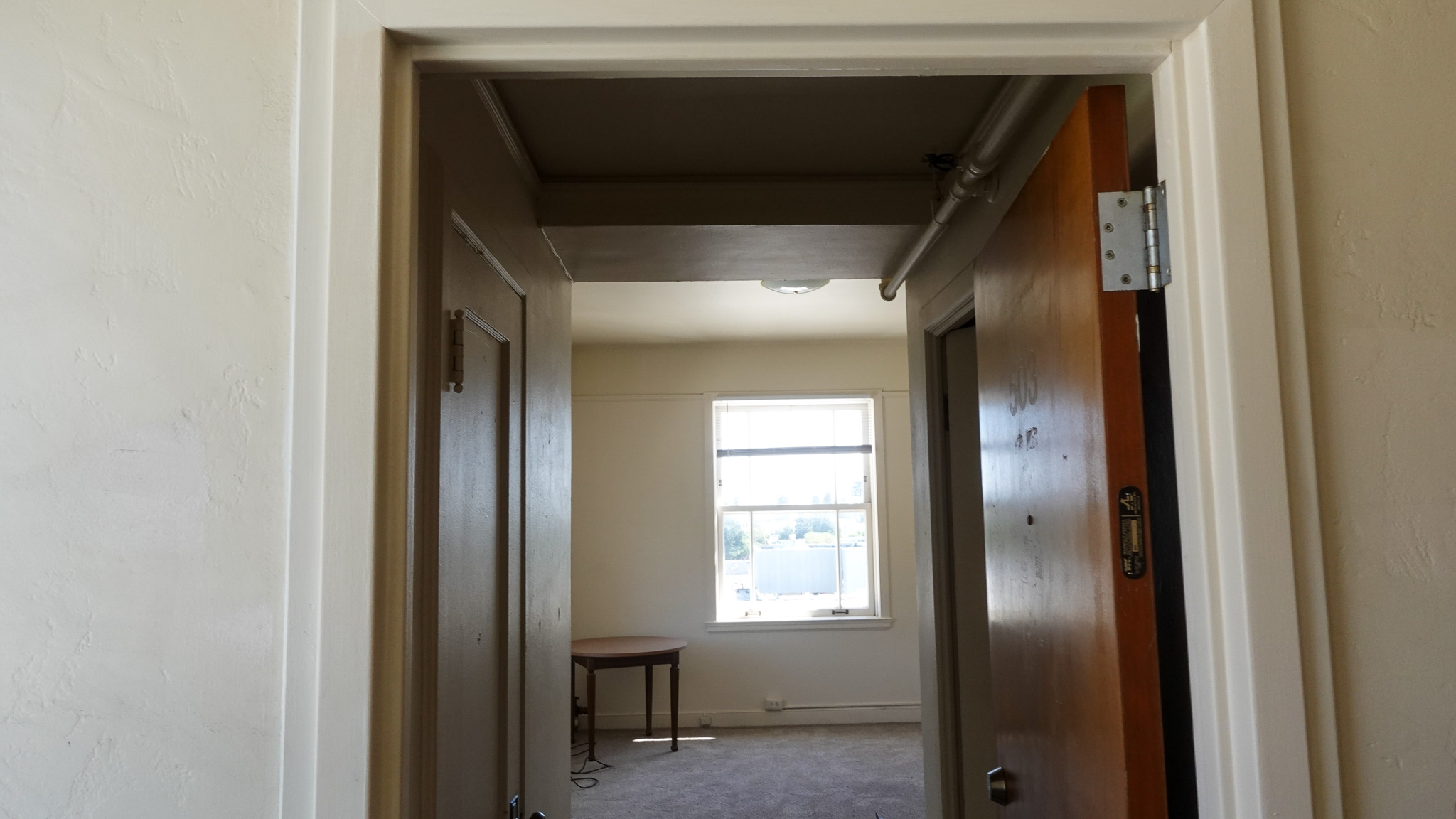
Homes at the Palomar Inn are a single room with a bathroom. (Nik Altenberg — Santa Cruz Local file)
A similar scenario unfolded with the St. George Apartments, also a low-income residential hotel on Pacific Avenue, when its affordable housing agreement expired and some tenants faced rent hikes of double or more in 2024. The city then created an ordinance to shield tenants of St. George from the rent hikes — the law would have applied to Palomar and any buildings where an affordable rent agreement is expiring.
But the St. George landlord, an LLC affiliated with San José-based developer Swenson Builders, sued the city. In a settlement agreement, the city won a limit on rent hikes for St. George in exchange for walking back protections for Palomar tenants.
Deputy City Manager Bonnie Lipscomb said the city would like to buy the Palomar Inn to maintain its affordability in perpetuity, but Baumelgruen isn’t interested in selling. During the three-year loan, Baumelgruen and the city plan to work on a long-term solution to keep the rents below market rate.
Joseph Tobener, a San Francisco-based tenant rights attorney, said in addition to Santa Cruz’s actions to protect St. George tenants, there is precedent throughout California for city councils to adopt laws to protect tenants in this situation.
“There have been some cities that have passed emergency ordinances, when specific landlords have gotten greedy with rent increases,” Tobener said in a phone interview May 12. Given the context of the St. George settlement, Tobener said Santa Cruz City Council could do something similar with Palomar.
“They would do it the same exact way as they did it before, and then agree to, you know, a 9% cap rather than litigating,” Tobener said.
In an interview last month, Palomar tenant David Rankin, 79, said he’s scraping by financially. He used to live in his van and relies on veteran benefits to cover his cost of living. When asked how he makes ends meet with about $450 left each month after rent, he said “I’m not.”
He faces a rent hike of about $100 a month.
Questions or comments? Email [email protected]. Santa Cruz Local is supported by members, major donors, sponsors and grants for the general support of our newsroom. Our news judgments are made independently and not on the basis of donor support. Learn more about Santa Cruz Local and how we are funded.

Nik Altenberg is a bilingual reporter and assistant editor at Santa Cruz Local. Nik Altenberg es reportera bilingüe y editora asistente para Santa Cruz Local.