

A Flock security camera on the corner of Green Valley Road in Watsonville on Sept. 9. (Amaya Edwards — Santa Cruz Local/CatchLight Local file)
SANTA CRUZ >> About a month after the last license plate camera was taken down in the City of Santa Cruz, advocates that successfully lobbied for the end of the surveillance technology are now looking to other cities in Santa Cruz County — but efforts are slow going.
Residents, educators and anti-surveillance activists have called on Watsonville and Capitola city leaders to end their contracts with Flock Safety, a Georgia-based surveillance company that provides the automated license plate readers and software to law enforcement. Scotts Valley and the County of Santa Cruz do not have contracts for license plate cameras.
Local group Get The Flock Out was critical in orchestrating conversations with Santa Cruz City Councilmembers that eventually led to them cancelling their Flock contract in January. This came after reports found the city’s data was accessed by outside agencies on behalf of federal immigration agents, including U.S. Immigration and Customs Enforcement, or ICE. As of March 9, all eight cameras in Santa Cruz are gone.
The group’s ongoing goal is to educate residents on surveillance concerns and get the cameras removed in Capitola and Watsonville. In the months since, GTFO members have been trying to meet with leaders in neighboring cities to discuss the controversies surrounding Flock, but with little success.
Earlier this month, Capitola’s contract for 10 license plate cameras was renewed for two years without city council approval. Because the contract included no financial changes, a city council vote wasn’t required, said Capitola Police Chief Sarah Ryan.
“I get it, the police is focused, they’re very laser focused,” said Ami Chen Mills, co-founder of the grassroots advocacy group Get The Flock Out. “But they’re not used to protecting a community from the government.” Chen Mills is also a candidate for Santa Cruz Mayor.
In an attempt to rally more support and spread awareness, the group is hosting an upcoming “Freedom School” seminar alongside the advocacy group Pajaro Valley for Ethnic Studies and Justice on Monday. Location information is provided after registering.
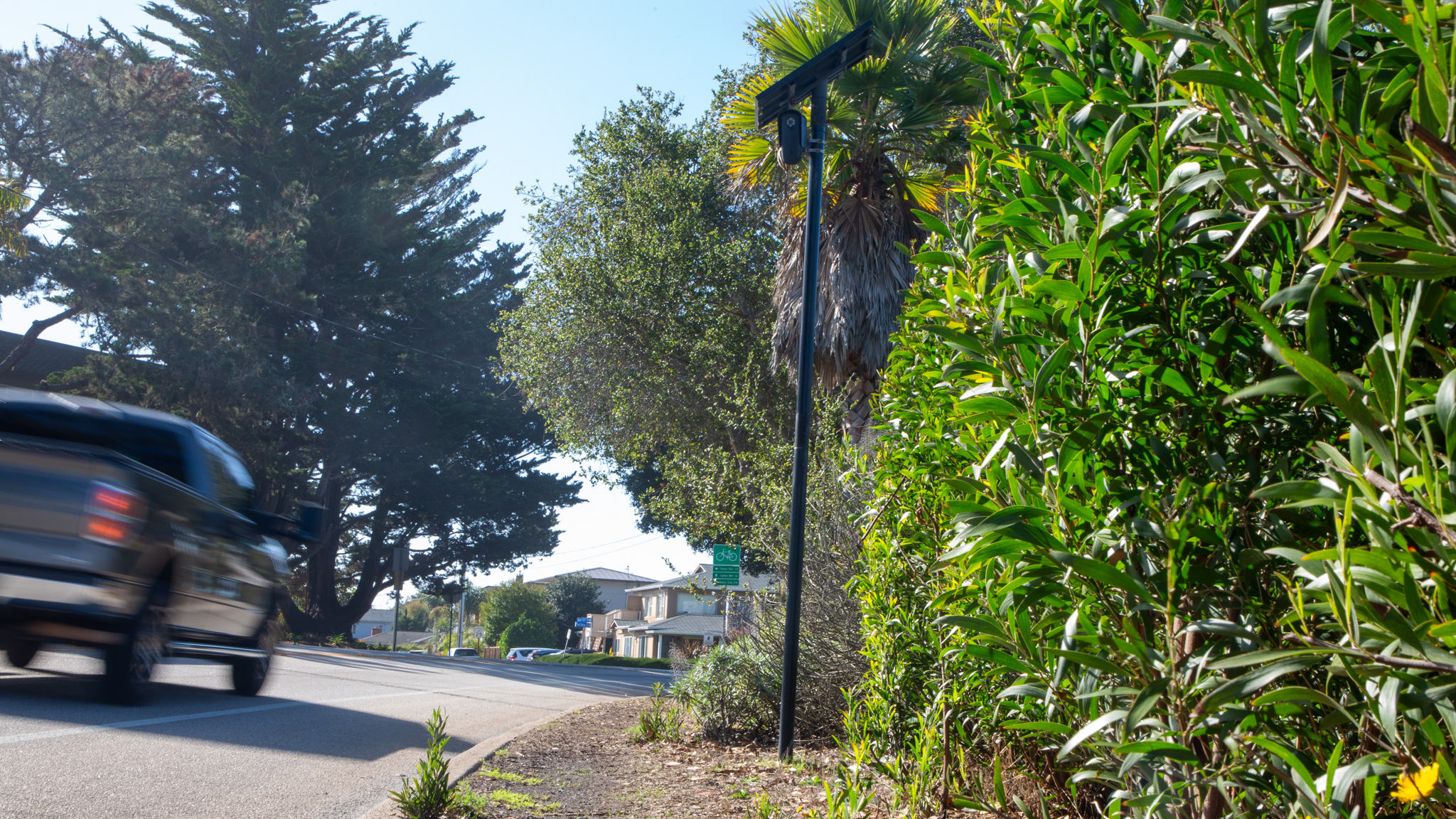
A truck drives past a Flock license plate reader camera on Cliff Drive in Capitola on Nov. 6. (Amaya Edwards — Santa Cruz Local/CatchLight Local)
Managing the public’s safety
The technology is used by law enforcement to locate cars by their license plate. The cameras are posted on streets, often targeting major thoroughfares, and detect and record the license plates of every car that drives by, storing that information in a searchable database.
Ryan said automated license plate readers are an important modern tool for officers, and they have helped Capitola police track vehicles in more than 48 cases. In 2024, they used it to track a suspected murderer to Berkeley and find the victim’s body.
As technology advances, Ryan said people’s expectations of privacy also change, citing how police can track people by their cellphones just as they can using license plate cameras. Ryan has met with representatives from the local American Civil Liberties Union chapter and Get The Flock Out, and said she hopes to keep in communication about evolving data privacy worries.
Ryan said Capitola has added more safeguards to the city’s contract with Flock, like requiring other jurisdictions to gain permission before accessing their data and monthly audits of the license plate data.
“Things have evolved over time and that’s how rules of engagement get rewritten and reassimilated, because of this evolution of time and the tech that’s available to us,” Ryan said.
Scotts Valley resident Julia Monahan, an organizer with Get The Flock Out, said it’s “shocking” that Capitola’s contract was automatically renewed without public discussion, given the increased advocacy to cancel them. The coalition only learned about the renewal a week before it happened, she said.
“(Some members) of the campaign are definitely not anti-police, we support law enforcement and public safety,” said Monahan, though she clarified there are many different views on law enforcement within the GTFO coalition. “We just have an interest in protecting the actual safety of everyone, which includes our right to privacy.”
Watsonville city spokesperson Michelle Pulido wrote in an email on April 9 that the city is aware of the data privacy concerns, but that Flock cameras have “proven to be effective” in helping Watsonville police locate stolen vehicles and track down suspects.
The Watsonville City Council voted 5-2 in September to renew the city’s contract with Flock for two years and increased the number of cameras to 37 from 20. Of the city’s 37 contracted cameras, only 30 have been installed so far. Councilmember Vanessa Quiroz-Carter declined to comment. All other council members did not respond to requests for comment.
Pulido said Watsonville police follow state laws and have local guidelines on Flock camera data usage that prevent data sharing with federal agencies.
“Our priority is to enhance public safety while respecting individual rights, maintaining transparency, and continuing to build trust with the community we serve,” Pulido said.
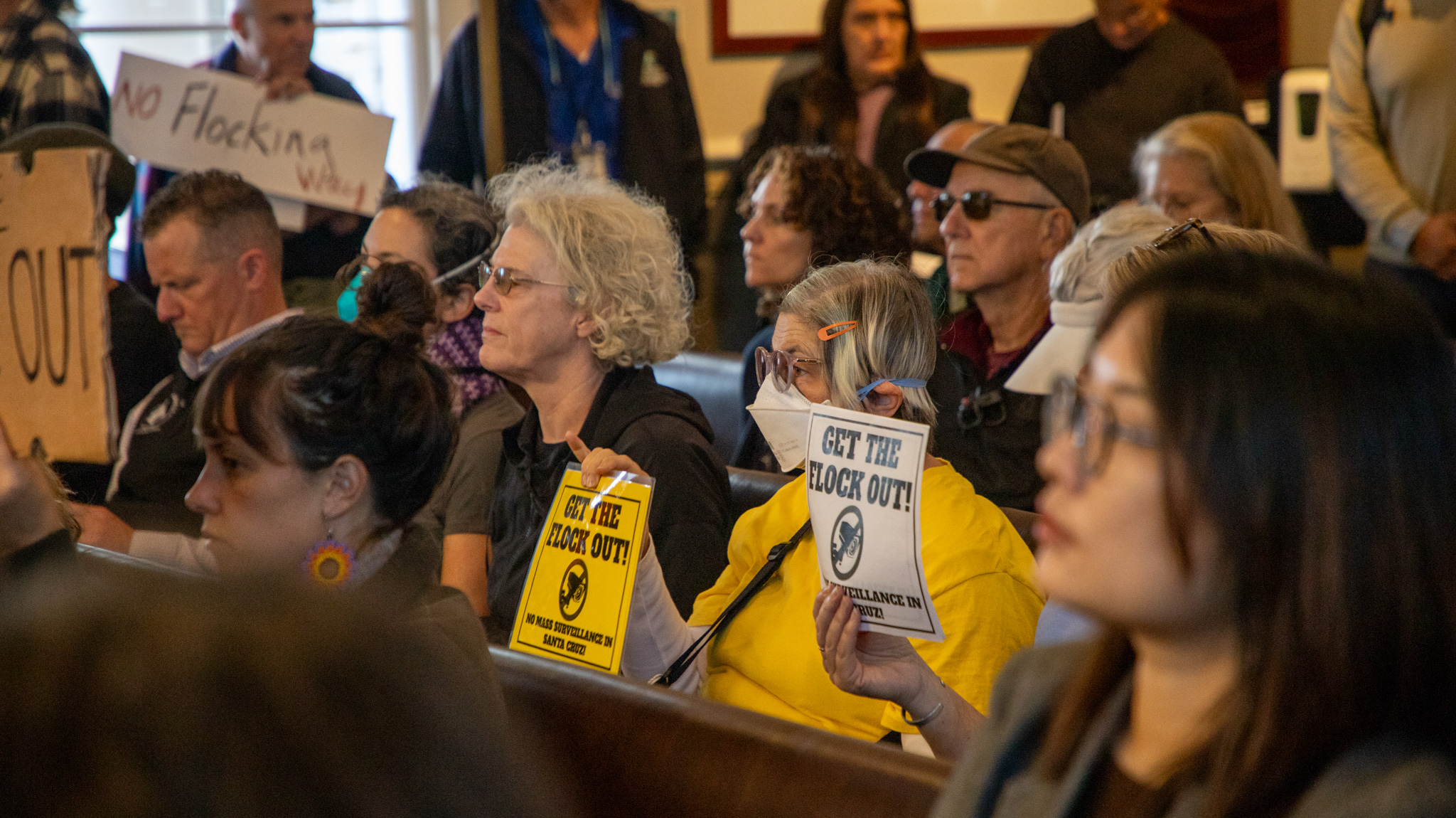
People hold signs against Flock surveillance cameras during public comment at a Santa Cruz City Council meeting at City Hall on Nov. 18. (Amaya Edwards — Santa Cruz Local/CatchLight Local)
Watsonville resident and Get The Flock Out member Lourdes Barraza said she and her husband Gabriel have been meeting with Watsonville City Council members and speaking with neighbors about the technology. Chen Mills and Louredes Barraza said the group has been building momentum and has partnered with local immigrant rights organizations like Your Allied Rapid Response.
Gabriel Barraza said they’ve been expanding their outreach as more people learn about Flock and the data privacy worries, growing the Watsonville organizing team to six.
“People are receptive because people care about privacy,” Lourdes Barraza said.
Lourdes Barraza said they’ve spoken with Councilmembers Maria Orozco and Quiroz-Carter, the two who voted against renewing the contract, as well as Councilmember Eduardo Montesino, who she said was surprised to learn that the data can be misused.
Others, like Councilmember Jimmy Dutra, declined to speak with them and cited the city’s 2020 Measure Y as proof of the community’s support for Flock cameras as a public safety tool.
Measure Y was a sales tax extension to fund public safety, including police and fire, and was approved by 78% of the vote. It had no specific provision related to surveillance technology.
Chen Mills said these types of cameras infringe on people’s personal privacy and have been used to track protestors and transgender people, which is why GTFO is keen on getting the 47 cameras removed in Watsonville and Capitola as soon as possible.
“You’re introducing a type of surveillance technology that then you have to somehow monitor and control for misuse,” she said. “Whether it’s misuse by police, or by criminal actors, foreign governments, our own government.”
Editor’s note: this story has been updated — Julia Monahan lives in Scotts Valley.
Questions or comments? Email [email protected]. Santa Cruz Local is supported by members, major donors, sponsors and grants for the general support of our newsroom. Our news judgments are made independently and not on the basis of donor support. Learn more about Santa Cruz Local and how we are funded.

B. Sakura Cannestra is a politics and governance journalist based in San Jose. She previously reported for San José Spotlight and POLITICO California. She graduated from UC Berkeley in 2023 with a Master's of Journalism, where she also got her start as an undergraduate in 2016 covering the university and city of Berkeley for the Daily Californian.