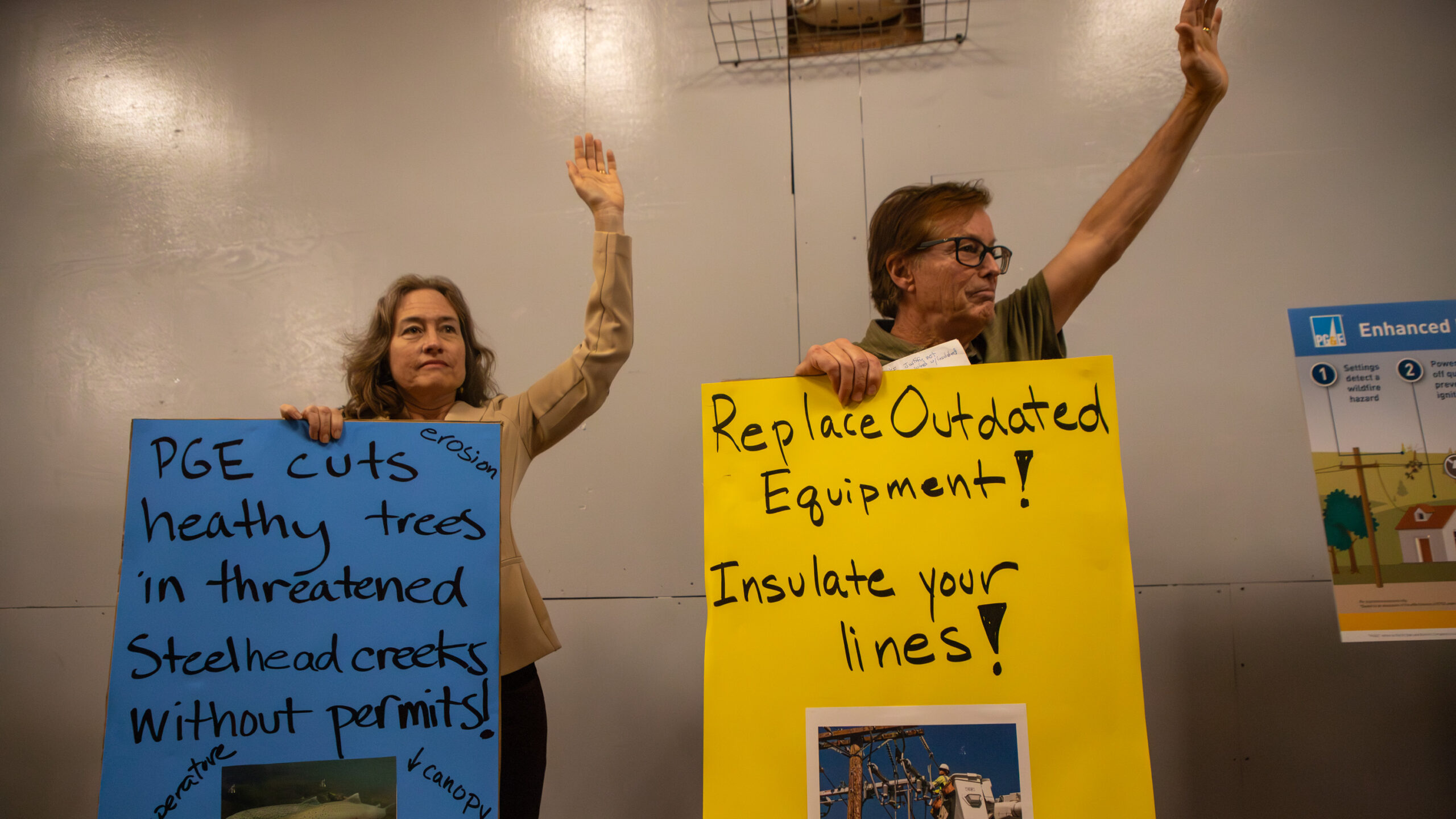
Lompico residents Tamara Stolzenthaler, left, and Tim Tonsing were among dozens at a community meeting with Pacific Gas & Electric Co. at the Boulder Creek Recreation Hall on March 2. Many expressed concerns about excessive tree cutting. (Amaya Edwards — Santa Cruz Local/CatchLight Local)
BOULDER CREEK >> Cathy Hoeft stood on her patio on a cloudy day in late January – she was anxious. The ground outside was still slick with moisture from the New Years Eve rain storm that soaked all of the Bay Area for days. Outside, she watched a crew of workers as they cut down trees on the slope across the creek from her Lompico home. With every felled tree, Hoeft couldn’t help but ruminate about what might happen to the land and, subsequently, her home.
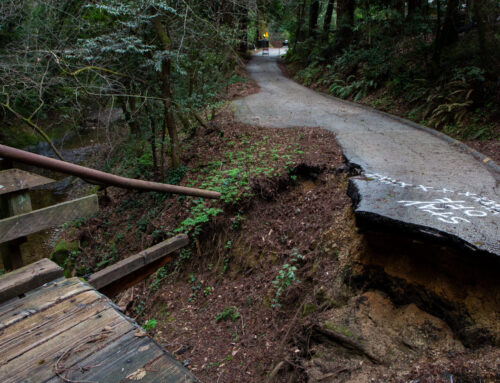
The trees’ roots hold the mountainside together, she said, and in heavy rain, the steep slope has been known to give way to landslides, destabilizing the ground beside her and her two neighbors’ homes. Over the years, landslides have pushed the creek closer to the dirt road that connects the three houses. As the creek moves, it erodes the road, threatening to leave all three stranded.
Hoeft is one of many San Lorenzo Valley residents growing frustrated with Pacific Gas & Electric Co.’s vegetation management program, which aims to reduce wildfire risks by trimming or removing trees near power lines. In addition to concerns about erosion and environmental damage, residents described redwood trees felled by mistake, a lack of notice from PG&E prior to cutting trees on private property and challenges holding the company accountable for property damage.
“They do their inspections and say ‘OK we’re done here,’ but then a year or two years from now, we have a hard winter, and the damage that they’ve done is left for those of us who are still here,” Hoeft said.
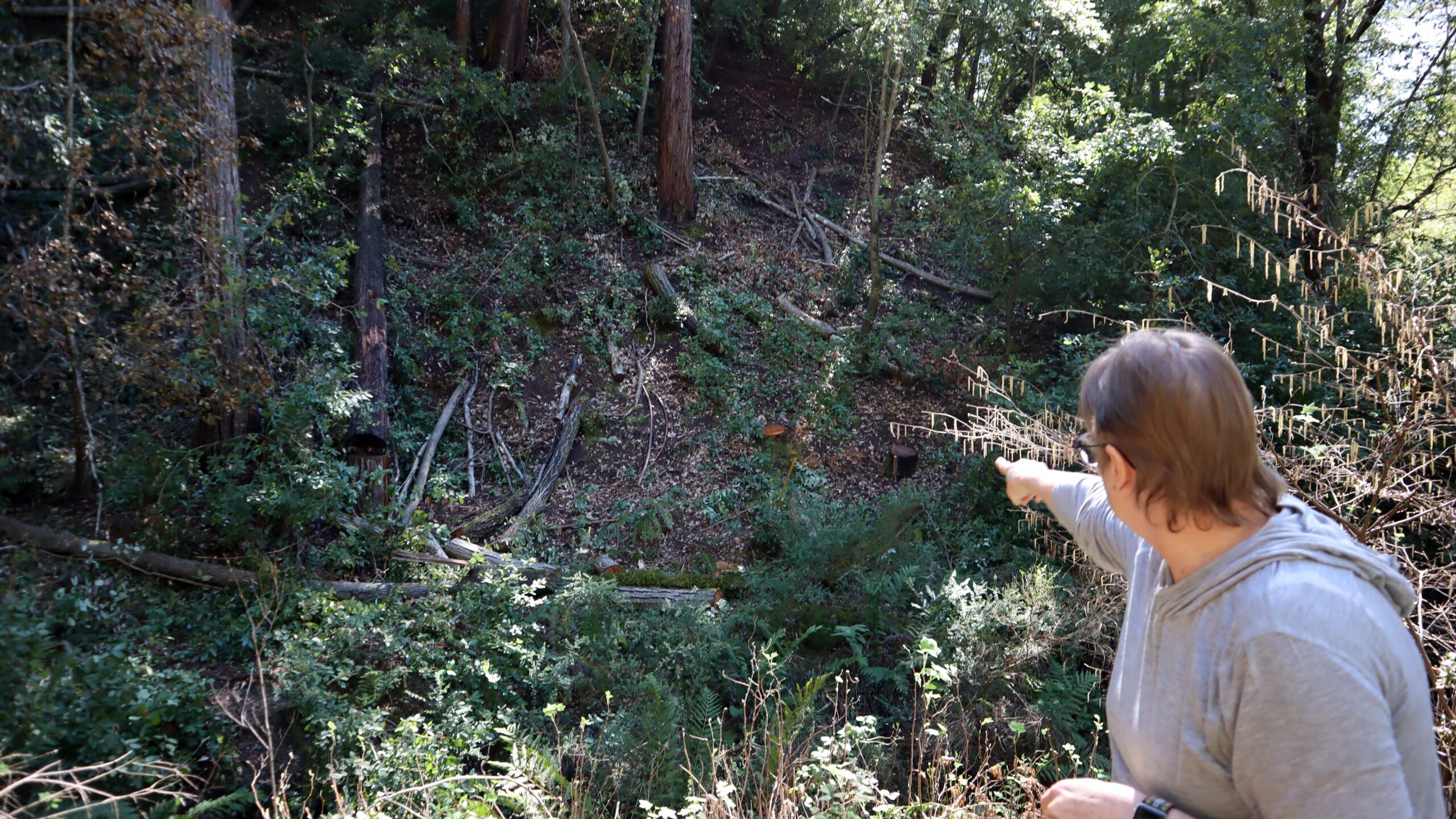
Lompico resident Cathy Hoeft watched as PG&E’s contracted workers cut trees on a slope near her home in January, leaving her worried about potential landslides. (B. Sakura Cannestra — Santa Cruz Local)
Last week, a community meeting with representatives of PG&E was dominated by discussion on wildfire management and tree work.
“Our community is still trying to figure out the balance between living in the forest and living in a world where fire season is potentially all year long,” said Santa Cruz County Supervisor Monica Martinez, who hosted the forum. “Some people are uncomfortable with most tree removal efforts. However, fuel breaks and clear evacuation routes aren’t going to be possible without some amount of compromise.”
PG&E ramped up its vegetation management program in 2019 following the devastating Camp Fire in Butte County, which was ignited by a downed power line. The California Public Utilities Commission lists most of the San Lorenzo Valley as a Tier 3 “Extreme” fire threat region.
Jeremy Howard, PG&E’s regional senior manager covering the Central Coast region, said at the meeting that last year the company inspected about 2,500 miles of power lines in Santa Cruz County and trimmed or cut more than 67,000 trees every year.
Ben Lomond resident Kristen Sandel said she wasn’t notified when PG&E came to remove 15 trees from her property, including six redwood trees that she was later told were erroneously cut down.
“One of the things that troubles me is that, as rate payers, I feel like we’re all in a sense paying PG&E to come and do this to our trees without permission and with very little recourse,” Sandel said.
State laws mandate that though the property owner’s consent isn’t required, PG&E must notify residents of planned tree work.
Sandel, who co-chairs the Valley Women’s Club of San Lorenzo Valley’s environmental committee, said she’s hesitant to file a claim with PG&E about the erroneously cut trees, because she’s heard from multiple people whose claims have been denied.
Some of these concerns were raised at the March 2 community meeting, including questions about ensuring communication with residents.
“When we prune 67,000 trees here in Santa Cruz County, we’re bound to make a mistake, we’re not perfect,” Howard said at the community meeting. “But we have a standard, and we want to adhere to that standard.”
Hoeft, the Lompico resident, said crews left several logs on the slope near her home and she’s worried about them rolling into the creek and disrupting steelhead trout.
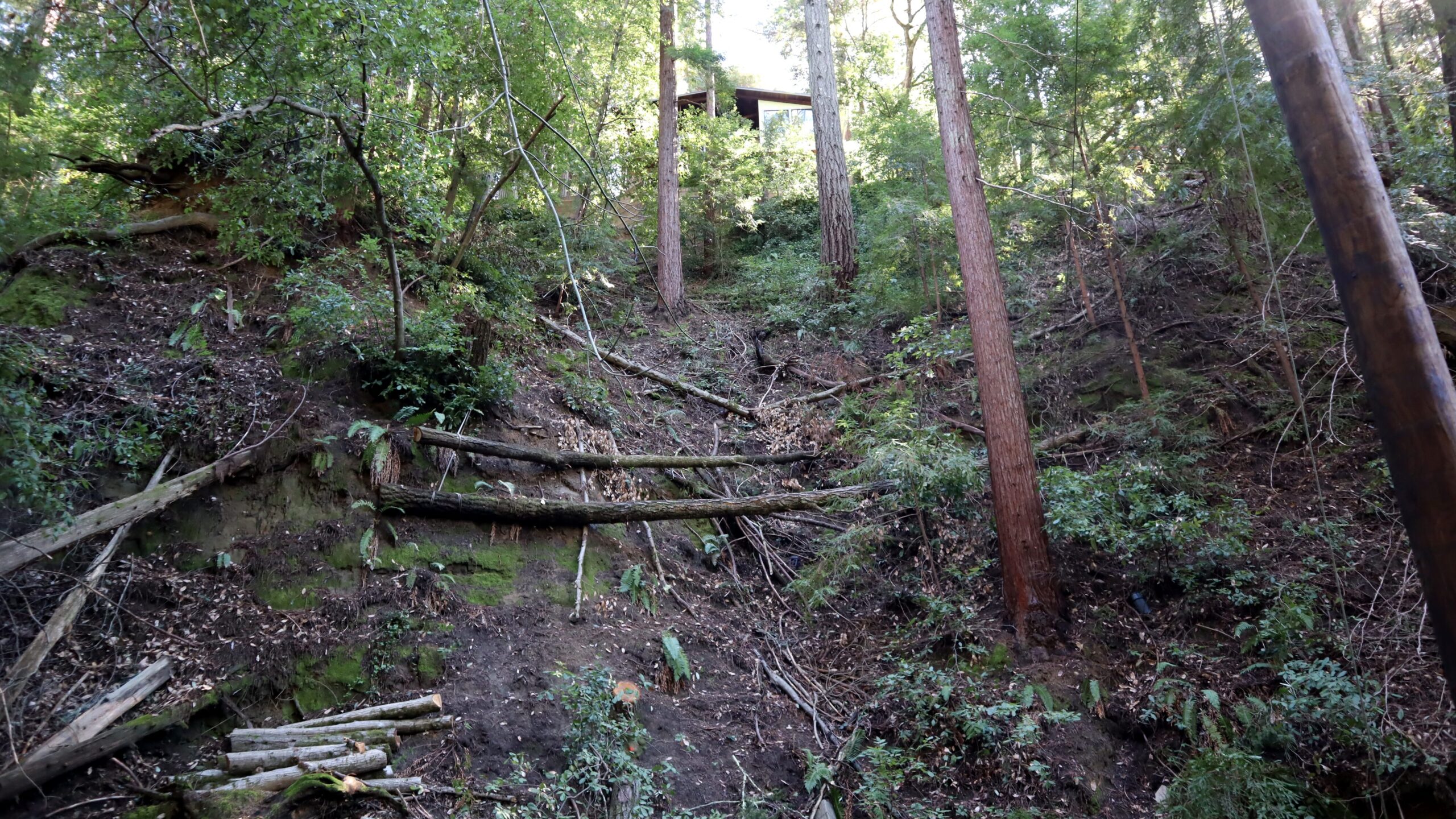
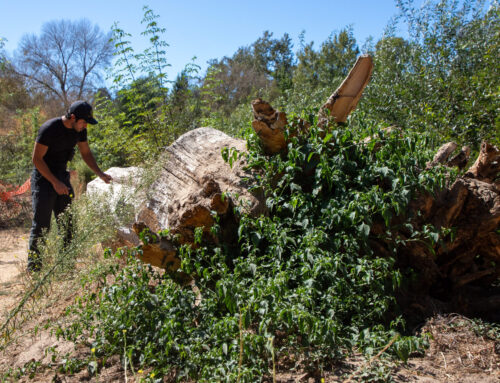
After cutting them, PG&E leaves behind logs that have a diameter of 4 inches or more, claiming it’s valuable timber for the residents. But some residents worry the logs will disrupt local ecosystems and a fire hazard.(B. Sakura Cannestra — Santa Cruz Local)
PG&E spokesperson Stephanie Magallon said the utility contracts certified arborists and that every project is reviewed by biological, cultural and environmental specialists. She said the specialists have not reported any evidence of erosion or impacts to nearby creeks.
Magallon encouraged residents to reach out to the utility’s vegetation customer engagement team with questions and concerns. Property owners can also submit property damage claims online.
Vegetation management isn’t PG&E’s only wildfire management strategy. Magallon said the utility has moved more than 1,210 miles of powerlines underground and is on track to more than double that by the end of 2027. She said there are plans to underground 1 mile of powerlines in Davenport and additional projects are being evaluated in the Santa Cruz Mountains, but the utility weighs various environmental factors with undergrounding, such as terrain and weather patterns.
The company rebuilt more than 20 miles of hardened powerlines in the area burned by the 2020 CZU Lightning Complex Fire, and added 20 miles of hardened lines in Boulder Creek, Brookdale, Rio Del Mar and other neighborhoods throughout the county.
Lompico resident Tim Tonsing said he wants to see system improvements in his neighborhood soon, rather than more tree work.
He said the area’s infrastructure is aging, and pointed out a power pole at Carrol Avenue and Lake Boulevard that’s been marked for replacement since April 2020.
Tonsing said system hardening like covering conductor lines could be a good option for the area.
Tonsing also said he doesn’t think PG&E’s vegetation management plan will limit wildfire risks without other system work. He’s had multiple fire scares in his over 40 years of living in Lompico and Felton, when PG&E’s bare powerlines have snapped in heavy winds.
“Copper wires are what start fires, not trees,” Tonsing said. “They try to make it seem like the trees are dangerous, and I always tell them I’ve never seen a tree playing with matches yet.”
Questions or comments? Email [email protected]. Santa Cruz Local is supported by members, major donors, sponsors and grants for the general support of our newsroom. Our news judgments are made independently and not on the basis of donor support. Learn more about Santa Cruz Local and how we are funded.

B. Sakura Cannestra is a politics and governance journalist based in San Jose. She previously reported for San José Spotlight and POLITICO California. She graduated from UC Berkeley in 2023 with a Master's of Journalism, where she also got her start as an undergraduate in 2016 covering the university and city of Berkeley for the Daily Californian.