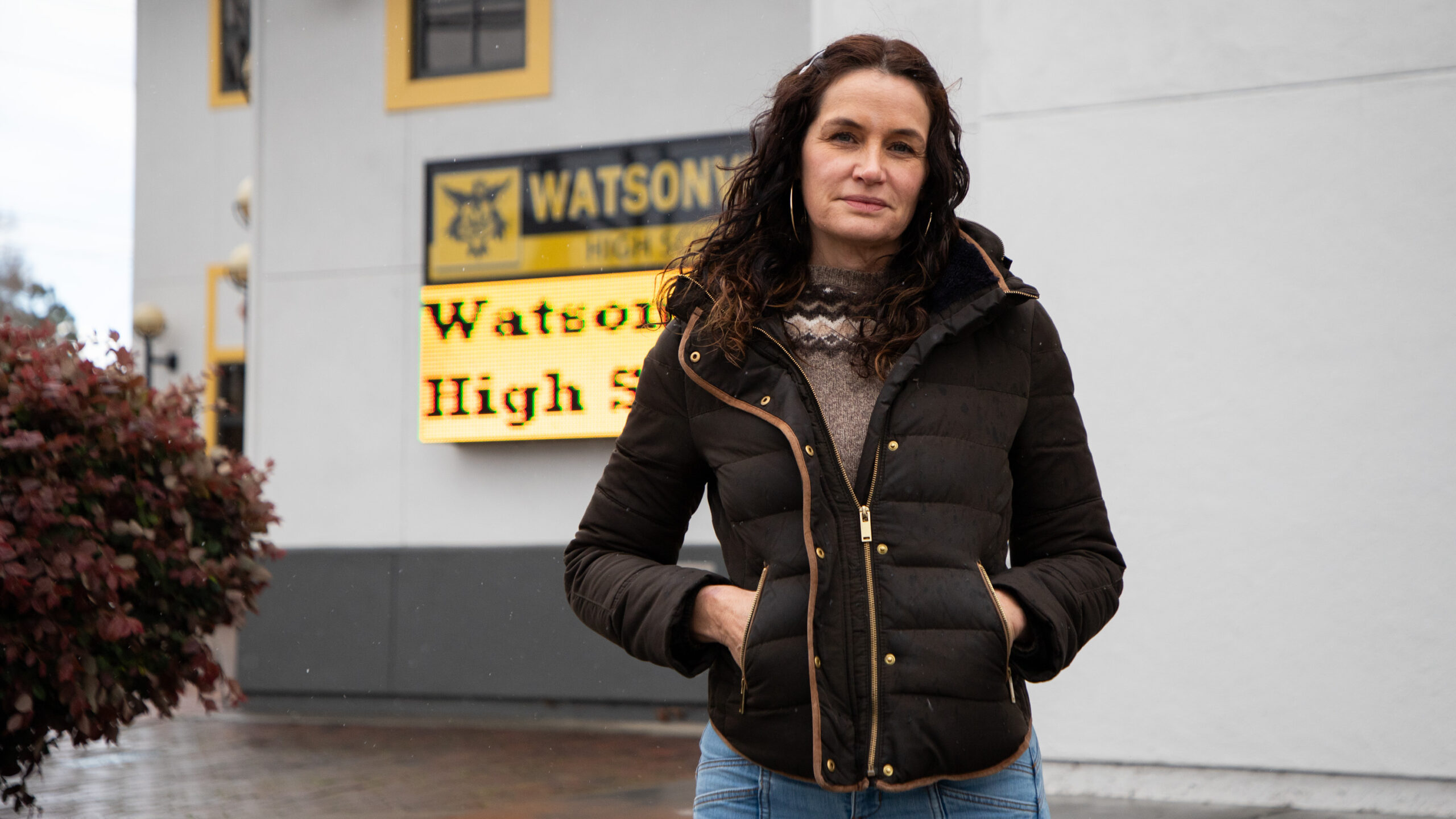
Aine Kahn poses for a portrait on Feb. 19 in front of Watsonville High, where she works as a mental health clinician serving students with disabilities. Kahn resigned after the district approved layoffs to every mental health clinician and her last day is Feb. 27. (Amaya Edwards — Santa Cruz Local/CatchLight Local)
Pajaro Valley Unified School District meeting
- 6 p.m. Wednesday, Feb. 25 at 275 Main St. fourth floor, Watsonville.
- The meeting will be streamed on YouTube.
WATSONVILLE >> Months ahead of the anticipated layoffs of dozens of mental health staff in Pajaro Valley Unified School District, the fallout from the cuts is already being felt by students.
The PVUSD board of trustees voted to eliminate nearly 160 positions in December, including dozens of teachers, 15 counselors, 33 behavior technicians, and all 13 mental health clinicians in the district.
Three mental health clinicians have already found jobs elsewhere, leaving the district scrambling to find care for students as remaining clinicians take on burdensome caseloads to fill the gap. Speaking publicly for the first time, the clinicians told Santa Cruz Local that the highest-needs students may suffer the most.
“It’s been awful,” said Aine Kahn, a mental health clinician who treats kids with special needs and has worked in the district for nine years. “Some of them are taking it OK and understanding, and for some of them, it’s really destabilizing,” adding that it can be especially challenging for students with autism.
Kahn said she took another job because as a single parent, she needs a guaranteed income beyond the end of the school year. Her last day is Feb. 27. While it’s possible the board will rescind some of the layoffs — the district has until May 15 to decide — Kahn said she can’t take that chance.
Clinicians differ from counselors because they are licensed therapists and treat students with the highest needs, like students with disabilities or those with depression, anxiety or trauma. The district said it plans to outsource the services, but Kahn said the loss of every district-employed clinician will be devastating.
Alejandro Chavez, a district spokesman, said the cuts are needed for financial sustainability.
“Our absolute priority during this transition is ensuring that care for our students remains seamless and uninterrupted,” Chavez wrote in an email Friday.
For students, the clinicians are “a group of caring adults that they see from year to year to year, that watch them make progress,” Kahn said. “Those are the intangibles of therapy that make it successful,” she said, adding that it’s something outside agencies often don’t provide.
The cuts to mental health services come after three students died by suicide in the past year and recent violence has rocked Watsonville High School. The board approved the cuts after partially rejecting a proposal for layoffs a year ago. The district is grappling with money problems in part due to declining enrollment and the exhaustion of one-time pandemic funding.
Chavez said clinicians were hired during the pandemic and largely funded by the federal relief package, and the district can’t afford them moving forward. But several of the clinicians pre-date the pandemic.
“As student needs evolve and enrollment shifts, we are returning to our sustainable pre-pandemic structure,” wrote Chavez. Chavez did not immediately respond to a follow up email seeking clarification.
Several mental health clinicians said that throughout the past months as cuts were discussed, they felt that the district was not considering all possible solutions. One example offered was for the district administration to sell its office spaces at 294 Green Valley Road, which costs more than $1 million annually, but administrators said it would be a multiyear process and haven’t pursued it.
“We are modernizing our services and right-sizing our footprint at the same time to ensure we provide the academic consistency and staffing stability our students and educators deserve. We will continue to evaluate our service model regularly,” wrote Chavez.
Jessica Zovar, a mental health clinician who worked her last day in the district on Jan. 30, said district administrators don’t have a background in mental health and don’t necessarily understand students’ needs. “I don’t think the right people are in the room when those conversations are being had,” she said.
Will some students be left behind?
Michelle Abodeely is another mental health clinician who left the district after eight years. She worked her last day on Friday. She treated middle schoolers in general education and special education, and worries about the impacts of leaving.
“These are really our most fragile students,” she said.
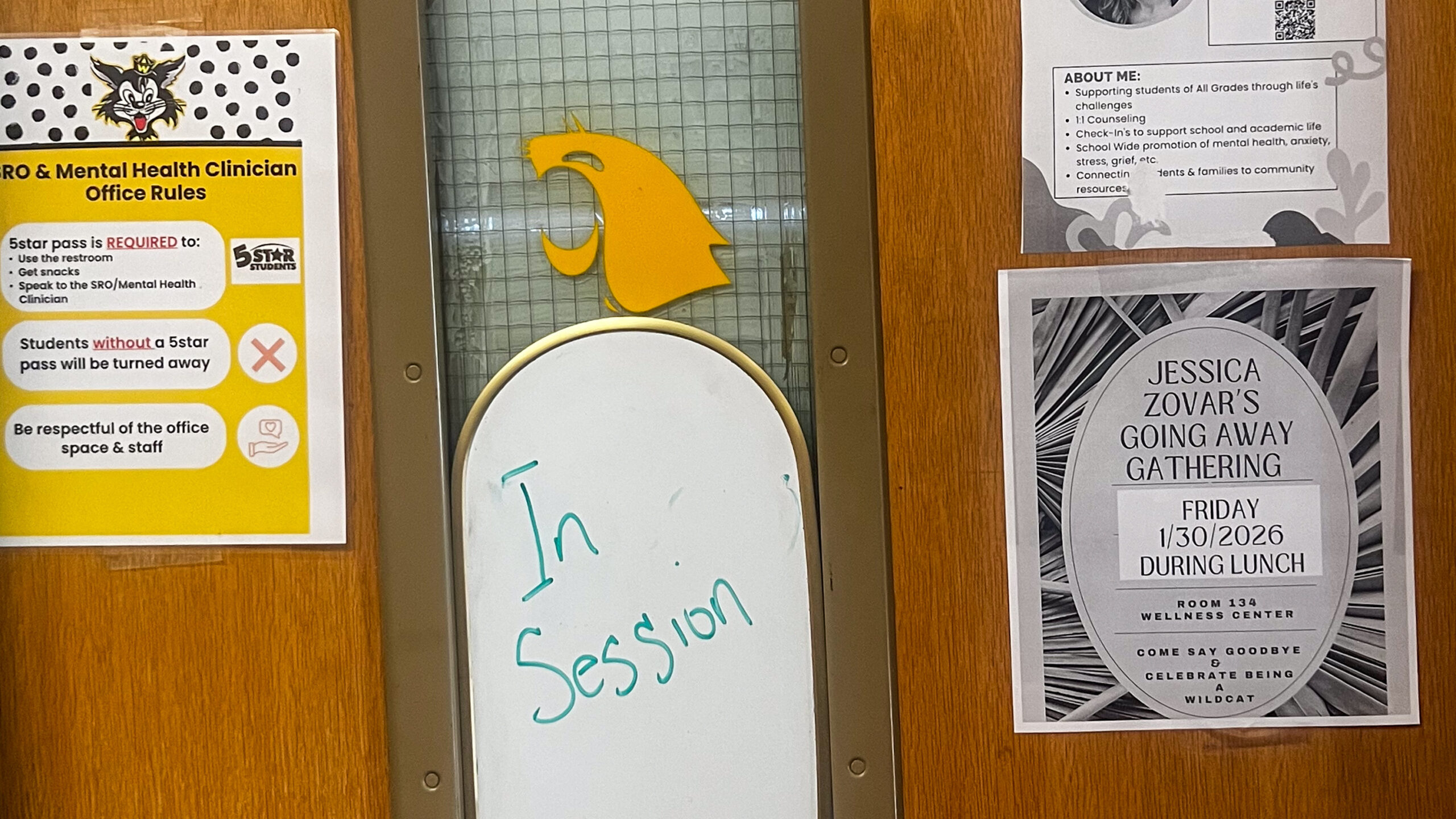
A flier on Jessica Zovar’s former office door at Watsonville High School advertises a going away gathering for students on her last day of work. (Amaya Edwards — Santa Cruz Local/CatchLight Local)
The district is legally required to provide mental health services to students in special education if their individualized education plan (IEP) indicates that therapy is necessary.
Abodeely said Thursday it was a very hard decision to leave the district and that some of her general education students didn’t yet have a new clinician assigned to them. It’s unclear if they will get one.
“For the special ed kids, it’s cut and dry, it’s a legal service,” Abodeely said. “But my gen ed (general education) kids, that’s a lot more challenging to refer them out or to get them services to come into the school.”
Chavez, the spokesman, said the district will provide all legally required support and is relying on counselors and partner organizations “to provide immediate coverage when necessary.” He added that, “From my understanding in speaking with staff, all students will continue to have coverage.”
A home away from home
Zovar, who worked in the district for two years, said it was hard to leave the district. In an interview shortly before her last day, she described the difficult goodbyes with her students.
“Seeing the kids, saying goodbye, having them tell me, ‘who am I going to talk to? What am I going to do? Who am I going to talk to now? Nobody’s coming? Who’s going to be here?’” Zovar said. “The only ones that suffer are the kids, and it is a feeling of abandonment and disenfranchisement for them.”
The work the clinicians do goes beyond the sessions with students. They also provide counseling and training to parents when it’s indicated in the student’s education plan. They may provide informal mental health support to teachers and staff, though it’s not part of the job description. They collaborate with teachers and school leaders to provide the most support they can for students in need.
“We need to rethink that schools are actually second homes. Schools are where we catch kids. Schools are where we give supports outside of the family system,” Zovar said.
Each clinician said they wished the district could find a way around the cuts so the students can have a stable, reliable, safe presence of an adult they can confide in and trust will be there year after year. That trust, if broken, may not be easily rebuilt.
“Subjecting them to many changes all at once in key support relationships with adults they already trust can have a devastating impact on their ability and desire to trust going forward. They’re likely to shut down and turn away from therapists if there have been too many,” said Kahn.
While at least three clinicians have already found other jobs, others, who spoke on the condition of anonymity, hold on to hope that the district will reverse some of the layoffs while they still can.
What do you think?
Questions or comments? Email [email protected]. Santa Cruz Local is supported by members, major donors, sponsors and grants for the general support of our newsroom. Our news judgments are made independently and not on the basis of donor support. Learn more about Santa Cruz Local and how we are funded.
Nik Altenberg is a bilingual reporter and assistant editor at Santa Cruz Local. Nik Altenberg es reportera bilingüe y editora asistente para Santa Cruz Local.

Amaya Edwards is Santa Cruz Local's Photo and Social Media Journalist. She is a Catchlight Local Fellow.